
July 10, 2026
Mexico's Silver Exploration Sector Reaches an Inflection Point
Precious metals exploration in Mexico has long operated within a paradox: the country sits atop some of the world's most prolific silver geology, yet regulatory friction, land access complexity, and cyclical capital flight have repeatedly interrupted the translation of geological promise into drill-bit activity. That dynamic is beginning to shift in 2026, with a combination of elevated metal prices, improving permitting conditions, and a new generation of technically sophisticated exploration campaigns converging at once.
Few developments illustrate this convergence more precisely than the environmental clearance issued by Mexico's federal environmental authority, SEMARNAT, authorising Sierra Madre Gold and Silver to commence drilling in the East District of its La Guitarra silver-gold complex in Estado de México. The Sierra Madre Guitarra Complex drilling permit represents more than a single project milestone; it reflects a broader recalibration of exploration capital deployment across Mexico's most productive silver-bearing terranes.
When big ASX news breaks, our subscribers know first
Understanding the La Guitarra Complex and Why the East District Commands Attention
The La Guitarra complex sits within Estado de México, a jurisdiction with a long and documented history of precious metals production. The broader complex includes an operating mine with a 500 tonnes per day processing facility, which represents a critical strategic asset. The existence of permitted, functioning infrastructure at an adjacent mine meaningfully reduces the capital required to convert exploration discoveries into production-ready material, a distinction that separates this program from purely greenfield campaigns.
The East District as a Distinct Geological Frontier
Within the broader complex, the East District functions as a structurally separate and underexplored domain. It encompasses a series of epithermal vein systems, a geological setting characterised by precious metal mineralisation deposited from hydrothermal fluids at relatively shallow crustal depths. These systems are the same geological architecture responsible for many of Mexico's most historically significant silver deposits.
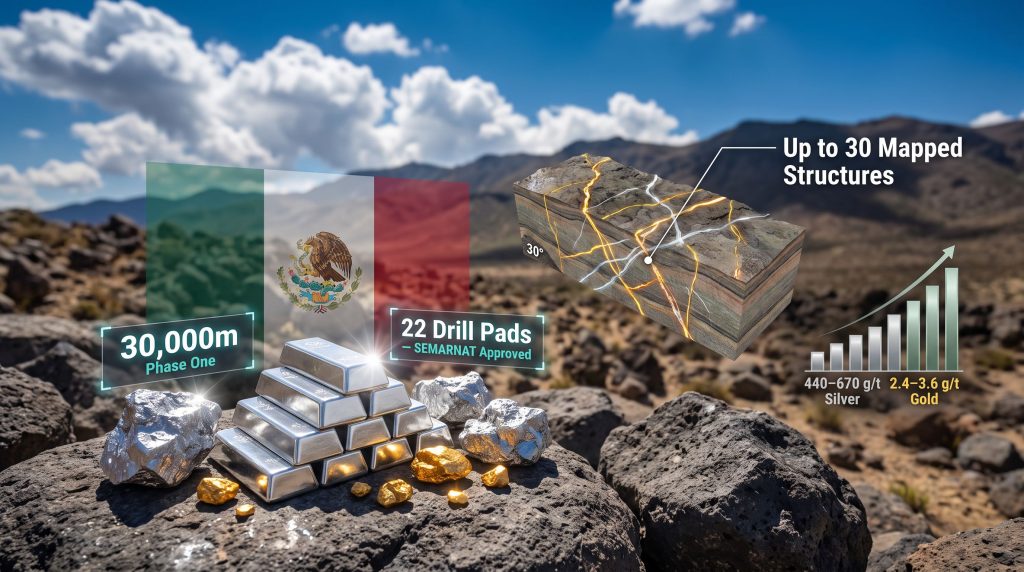
The critical factor that elevates the East District's status is the volume of mapped but undrilled structural inventory. Sierra Madre's geological team has identified up to 30 distinct vein systems across the area, a figure that dwarfs the five systems covered in the foundational resource study conducted in 2023. This gap between what has been mapped and what has been systematically tested with drilling represents the core exploration thesis.
The SEMARNAT Drilling Permit: Scope, Structure, and What It Actually Authorises
The Sierra Madre Guitarra Complex drilling permit as issued by SEMARNAT covers 22 drill pads, each of which is capable of hosting multiple individual drill holes. This design architecture is significant from an efficiency standpoint: by permitting multi-hole pads rather than single-collar sites, the program can gather far greater geological data density per permitted location. Each pad essentially functions as a data hub, generating intersecting lines of geological information that feed the three-dimensional structural model underpinning the entire campaign.
Key Permit Metrics at a Glance
Parameter Detail Permitting Authority SEMARNAT (Mexico's Federal Environmental Agency) Permitted Drill Pads 22 Phase One Drilling Target 30,000 metres Vein Systems Targeted Up to 30 mapped structures First Phase Hole Length 1,000m to 1,500m (sub-horizontal) Initial Drill Area Tlacotal area (surface ownership held) Estimated Mobilisation Within 60 days of contractor selection Additional Pre-Existing Permits Inca and La Palma veins (north of Guitarra Mine)
The 60-Day Contractor Window and H2 2026 Execution
Sierra Madre has indicated it is actively reviewing bids from drilling contractors, with mobilisation targeted within 60 days of contract award. Given that this process was underway at the time of the permit announcement in mid-2026, first-phase drilling activity is realistically positioned for the second half of 2026. This timeline carries operational importance: H2 2026 drill results would feed directly into any updated resource modelling undertaken ahead of a potential 2027 estimation update, compressing the exploration-to-resource timeline considerably.
How Geologists Quantified the East District's Exploration Potential
The 2023 NI 43-101 technical report assigned the East District a conceptual exploration potential that, while not a formal mineral resource estimate, provides a quantitative framework for understanding the scale of geological opportunity being tested.
East District Conceptual Resource Parameters (2023 NI 43-101)
Metric Low Estimate High Estimate Tonnage 0.77 Mt 1.54 Mt Gold Grade 2.4 g/t 3.6 g/t Silver Grade 440 g/t 670 g/t Vein Systems Covered 5 systems 5 systems Combined Strike Length 7.7 km 7.7 km These figures are conceptual in nature and do not constitute a mineral resource estimate under NI 43-101 standards. Investors should not rely on these numbers as a representation of defined resources.
What makes these numbers particularly instructive is what they do not include. The 7.7 kilometres of combined strike covered only five vein systems. Sierra Madre's subsequent surface and underground mapping has revealed many additional structures across a considerably wider footprint. In practical geological terms, this means the 2023 conceptual estimate effectively captured a fraction of the total prospective mineralised corridor.
Grade Context: Why 440 to 670 g/t Silver Matters
For investors less familiar with precious metals geology, it is worth contextualising these silver grades. The global average silver grade for producing mines is typically well below 200 g/t. A conceptual estimate ranging from 440 to 670 g/t silver places the East District's potential squarely in the high-grade category, where the economics of extraction are significantly more favourable even at lower metal prices. Furthermore, understanding silver supply deficits and the structural demand pressures behind them adds important context to why high-grade assets like this attract disproportionate investor attention. At current silver price levels, which entered 2026 near multi-year highs, the economic leverage of high-grade silver mineralisation is amplified further.
Vein System Targeting: The Logic Behind the First Drill Holes
The initial phase of the East District program will collar the first seven holes from the Tlacotal area, where Sierra Madre holds direct surface ownership. This eliminates one of the most common operational obstacles in Mexican exploration: landowner access negotiations, which can delay programs by months or years.
Magdalena and Los Locos: Priority Targets With a Production Pedigree
The Magdalena and Los Locos vein systems have been identified as primary targets for the first seven holes. Both carry the geological credibility of past production, meaning historical extraction records and existing workings can be integrated into drill targeting. This is a fundamentally different risk profile from targeting an untested structure with no production history.
The methodology selected for these initial holes is sub-horizontal drilling, with individual hole lengths ranging from 1,000 to 1,500 metres. This orientation is specifically suited to the geometry of steeply dipping epithermal veins, allowing a single drill hole to intersect multiple vein structures at depth rather than cutting across them at inefficient angles. In practical terms, each hole has the potential to generate multiple mineralised intersections, multiplying the geological return per metre drilled.
The Rincon Mine Area and Parallel Permit Pathways
Beyond Tlacotal, Sierra Madre is engaged in surface access negotiations near the historic Rincon mine area, which would support a separate SEMARNAT application covering nine additional drill holes. Meanwhile, pre-existing permits for the Inca and La Palma veins, located north of the main Guitarra mine, allow parallel drilling activity to proceed independently of the East District program. This multi-front approach means geological data generation is not limited to a single permitting pathway.
Three-Dimensional Modelling: How Archival Intelligence Reduces Exploration Risk
One of the less publicised but strategically significant aspects of the Guitarra East District program is the depth of pre-drilling geological preparation undertaken by the exploration team. Sierra Madre's technical group constructed a three-dimensional structural model by integrating three independent data streams:
- Surface mapping across the East District's vein corridor
- Underground mapping within accessible historic workings
- Archival records including old maps, cross-sections, and geological reports from previous operators
This approach, sometimes described as forensic geology within the industry, is particularly valuable in historic Mexican mining districts where decades of undocumented or poorly documented extraction can obscure the true structural picture. By recovering and digitising archival material, the team effectively compressed what might otherwise have been a multi-year target generation program into a single pre-drilling phase. In addition, 3D geological modelling of this kind has become an industry benchmark for reducing targeting uncertainty before a single metre is drilled.
Greg Liller, Sierra Madre's Chief Operating Officer, has publicly described the team's preparation as exceptionally thorough, noting that the integration of historic data with modern mapping formed the structural backbone of the targeting strategy. He has also stated that the decision to acquire the La Guitarra complex was fundamentally driven by the conviction that the East District represents one of Mexico's most compelling exploration opportunities. (Source: Sierra Madre Gold and Silver, July 2026)
The use of sub-horizontal, long-hole drilling to intersect multiple vein structures per hole is a technically sophisticated choice that reflects a deep understanding of the deposit's geometry. Many junior explorers default to vertical holes, which can miss steeply dipping veins entirely.
The next major ASX story will hit our subscribers first
The Mina de Agua Resource: Established Foundation Beneath the Exploration Upside
While the East District exploration program captures the attention of those focused on discovery potential, the La Guitarra complex already carries an established resource base at Mina de Agua, providing a tangible foundation beneath the exploration narrative.
Mina de Agua Resource Summary (NI 43-101)
Category Tonnage Silver Grade Indicated 761,000 t 159 g/t Ag Inferred 545,000 t 178 g/t Ag
The Mina de Agua resource demonstrates that the Guitarra complex's mineralising system is capable of generating economically meaningful silver concentrations. The inferred resource's 178 g/t silver grade marginally exceeds the indicated category, which is geologically unusual and suggests the deeper or peripheral portions of the system may host more intensely mineralised material than the central, better-characterised zones. This is speculative at this stage but aligns with patterns observed in other epithermal systems where grade increases with proximity to the original hydrothermal fluid conduits.
Mexico's Permitting Environment: Sector-Wide Shifts in 2025 and 2026
The Guitarra East District permit does not exist in isolation. SEMARNAT has issued multi-year drilling authorisations to several precious metals explorers in the 2025 to 2026 period, including GR Silver operating in Sinaloa and Silver Storm in Durango. This pattern suggests a structural shift in permitting throughput rather than a project-specific development.
Economy Minister Marcelo Ebrard has publicly committed to accelerating the permit approval process and restarting large-scale exploration activity to meet rising global demand for critical minerals. Mexico's mining sector operates within a broader federal policy framework that increasingly recognises silver and gold as economically strategic, though it is important to note that this policy direction represents a general regulatory posture rather than project-specific government support for any individual company.
Industry advocates have estimated that a comprehensive critical minerals framework could attract up to US$43 billion in investment into Mexico's mining sector by 2030, contingent on resolving approximately 160 projects currently stalled under provisions of the 2023 Mining Law.
The 2023 Mining Law introduced permitting requirements that created a significant backlog across the junior exploration sector. The law's intent was to increase community consultation and environmental oversight, but its implementation created procedural uncertainty that effectively froze capital deployment for many operators. The current permitting momentum suggests regulatory interpretation is evolving, though the underlying legal framework remains in place.
How Elevated Metal Prices Reshape Exploration Economics in 2026
Mexico's position as the world's largest silver producer means that precious metals price cycles have an outsized effect on exploration capital allocation within its borders. Gold and silver both entered 2026 near multi-year price highs, a condition that dramatically improves the project-level economics for high-grade silver and gold exploration assets. Indeed, gold and silver supply constraints are increasingly influencing where capital flows within the global exploration sector.
The relationship between price and exploration activity is not linear. At high-grade projects like the Guitarra East District, where conceptual estimates suggest silver grades three to four times the global producing average, price leverage is disproportionately powerful. A 20% increase in silver prices translates into a proportionally larger improvement in projected economics than it would at a low-grade, bulk-tonnage operation. This is why the combination of high-grade geology and a favourable price environment represents such a compelling intersection for exploration capital.
Furthermore, silver's dual role as both a monetary asset and an industrial input — particularly in photovoltaics and electronics — continues to support structural demand growth beyond what traditional safe-haven price models would predict.
Comparative Landscape: Where Does the Guitarra East District Sit Among Active Programs?
| Explorer | State | Permit Status | Program Scale | Primary Metal |
|---|---|---|---|---|
| Sierra Madre Gold and Silver | Estado de México | SEMARNAT Approved (2026) | 30,000m Phase One | Silver-Gold |
| GR Silver | Sinaloa | Multi-Year Permit Issued | Active | Silver |
| Silver Storm | Durango | Multi-Year Permit Issued | Active | Silver |
| Guanajuato Silver | Guanajuato | Active | 75,000m (2026 Record Program) | Silver |
Comparative data compiled from publicly available regulatory and company disclosures.
Positioned against this peer group, the Guitarra East District program's 30,000 metre Phase One is a substantial initial commitment, particularly given that the program is described as fully funded. The structural complexity of targeting up to 30 vein systems across a large footprint also distinguishes the Guitarra program from more geographically concentrated campaigns.
Why Tlacotal's Surface Ownership Changes the Execution Risk Profile
A frequently underappreciated dimension of mineral exploration in Mexico is the complexity of surface rights negotiations. Mining concessions grant the right to explore and extract minerals but do not automatically convey the right to physically access and disturb surface land, which may be held by ejidos (communal land groups), private landowners, or other parties. Negotiating surface use agreements can extend timelines by months or years and introduce political and social risk that is difficult to quantify in advance.
Sierra Madre's ownership of surface rights at the Tlacotal area fundamentally removes this variable from Phase One execution. The company also holds a land use authorisation for Tlacotal, which provides an additional regulatory layer of support for future development scenarios beyond the current exploration phase.
Frequently Asked Questions: Sierra Madre Guitarra Complex Drilling Permit
What is the Sierra Madre Guitarra Complex drilling permit?
It is an environmental clearance issued by SEMARNAT authorising Sierra Madre Gold and Silver to conduct exploration drilling across 22 drill pads in the East District of the La Guitarra silver-gold complex in Estado de México.
How many metres will be drilled in Phase One?
The first phase targets 30,000 metres of drilling across the permitted pad network.
Which vein systems are the primary targets initially?
The Magdalena and Los Locos vein systems will be tested by the first seven holes collared from the Tlacotal area, both of which have historic production records.
When is drilling expected to begin?
Sierra Madre is reviewing contractor bids and has indicated mobilisation will occur within 60 days of contract award, placing drilling commencement in H2 2026.
What is the conceptual exploration potential of the East District?
A 2023 NI 43-101 report assigned the East District a conceptual potential of 0.77 to 1.54 million tonnes grading 2.4 to 3.6 g/t gold and 440 to 670 g/t silver across five vein systems. These figures are conceptual and do not constitute a formal mineral resource.
How does existing infrastructure support the program?
The La Guitarra mine operates a 500 tpd processing facility adjacent to the East District, reducing the capital required to convert future discoveries into production-ready material.
What role does SEMARNAT play?
SEMARNAT is Mexico's federal environmental authority responsible for issuing environmental impact authorisations, including drilling permits, for mining exploration and development activities.
How many drill pads are covered under the new permit?
The permit covers 22 drill pads, each capable of hosting multiple individual holes, significantly multiplying the geological data generated per permitted site.
What the Guitarra East District Permit Signals for Mexico's Exploration Cycle
The convergence of three distinct forces at the Guitarra East District represents the kind of alignment that defines the most productive phases of any exploration cycle: regulatory access has been secured, geological preparation is advanced, and metal prices are supportive. Each of these conditions is necessary but not sufficient on its own. Together, they create the conditions under which exploration capital can be deployed with a meaningful probability of generating discovery-grade results.
The broader signal for Mexico's mining sector is equally instructive. Permit momentum across multiple operators and jurisdictions within Mexico suggests that the regulatory bottleneck created by the 2023 Mining Law is being navigated, at least incrementally, by operators willing to invest in the environmental and social preparation required to satisfy SEMARNAT's assessment criteria. As more permits are issued and exploration capital flows into the country, the sector's capacity to contribute to global silver supply will gradually recover.
For the Guitarra East District specifically, the combination of historic production data, modern three-dimensional structural modelling, drill-ready targets, and existing processing infrastructure represents a lower-risk exploration profile than most greenfield programs of comparable scale. Consequently, interpreting drill results from this program will carry heightened significance for the broader sector, given the geological pedigree behind each targeted intercept. That does not eliminate exploration risk, which remains inherent to any pre-resource program. However, it does suggest that the program's geological foundation is among the most thoroughly prepared in Mexico's current exploration cycle.
This article contains forward-looking statements and references to conceptual exploration estimates that do not constitute defined mineral resources under NI 43-101 or any equivalent reporting standard. Investors should conduct independent due diligence and consult qualified financial and technical advisors before making investment decisions based on exploration-stage information.
Want to Track the Next Major Silver Discovery the Moment It Hits the ASX?
Discovery Alert's proprietary Discovery IQ model scans ASX announcements in real time, instantly identifying high-potential mineral discoveries — including significant silver and gold opportunities — and delivering actionable alerts before the broader market reacts. Explore how historic discoveries have generated substantial returns on Discovery Alert's dedicated discoveries page, then begin your 14-day free trial to position yourself ahead of the next major find.