August 7, 2026
What's Driving India's Unprecedented Silver Market Transformation?
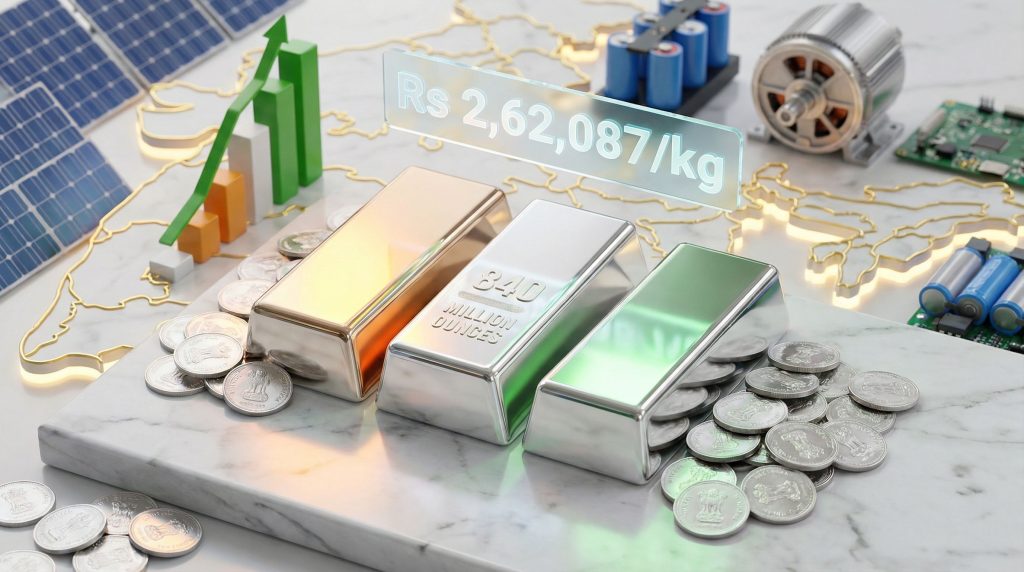
Silver demand in India has reached extraordinary levels, with the Mumbai Commodity Exchange (MCX) reflecting prices of ₹2,62,087 per kilogram as of January 2026, representing a remarkable 15% year-to-date appreciation following an exceptional 192% annual gain. This price trajectory demonstrates the fundamental restructuring occurring within India's precious metals consumption ecosystem.
Furthermore, the transformation extends beyond simple price appreciation. India now commands approximately 25% of global silver consumption, importing roughly 6,000 metric tons annually valued at $9.2 billion, marking a 44% year-over-year increase in import values. This consumption pattern reflects a unique convergence of industrial modernisation, investment psychology, and macroeconomic positioning.
According to Naveen Mathur, Director of Commodities and Currencies at Anand Rathi, the phenomenon represents a distinct psychological pattern where Indian retail investors exhibit sustained purchasing behaviour despite significant price appreciation. This behavioural characteristic, which Mathur describes as driven by fear of missing out, contrasts sharply with typical investment demand elasticity observed in developed markets where rising prices generally deter new market entrants.
However, the rupee's depreciation trajectory, averaging 3.5-4% annually against the USD during 2020-2025, has amplified the appeal of dollar-correlated assets among Indian households. Combined with India's nominal GDP growth of 9.7% annually and urban household income growth of 11-13% in major metropolitan areas, these macroeconomic conditions create sustained purchasing power directed toward precious metals accumulation.
Key Market Dynamics:
- MCX silver maintains 95%+ correlation with global spot prices while commanding local premiums
- Cumulative bar and coin demand has reached 840 million ounces (26,100 tons)
- Sustained demand persistence from ₹80,000/kg to ₹2.5 lakh/kg price levels
- Import dependency creating complete reliance on international supply chains
When big ASX news breaks, our subscribers know first
The Industrial Revolution Behind India's Silver Surge
Green Energy Infrastructure: The Hidden Silver Consumer
India's commitment to achieving 500 GW of renewable energy capacity by 2030 has created an unprecedented industrial silver consumption channel that operates independently of traditional jewellery and investment demand. The nation's annual solar capacity additions of 35 GW require approximately 700-900 metric tons of silver annually, based on the standard 20 grams of silver paste required per photovoltaic panel.
In addition, solar photovoltaic manufacturing demands silver-based paste due to its exceptional electrical conductivity properties (63 × 10⁶ S/m) and ability to maintain stability across 25+ year operational lifespans while withstanding extreme temperature cycling. India's cumulative solar capacity reached approximately 70 GW by the end of 2024, positioning the country as the fourth-largest globally in renewable energy capacity according to the Ministry of New and Renewable Energy.
The Production-Linked Incentive (PLI) scheme for solar photovoltaic manufacturing has accelerated domestic production capabilities, reducing import reliance while simultaneously increasing localised silver demand. This policy framework has enabled Indian manufacturers to capture value-added production stages previously dominated by international suppliers, contributing significantly to the silver market squeeze impact on global markets.
Solar Industry Silver Requirements:
- Traditional PERC cells: 20-25 grams per panel
- Heterojunction (HJT) technology: 15-18 grams per panel
- Emerging perovskite-silicon tandem cells: 12-15 grams per panel
- Bifacial panel variants: Additional silver paste requirements
Electronics and Electric Vehicle Manufacturing
India's electric vehicle sector represents another significant industrial silver consumption driver, with EVs requiring 67-79% more silver content compared to internal combustion engines. This increased demand stems from sophisticated battery management systems, power distribution architecture, and regenerative braking controls that rely heavily on silver-based electrical contacts and components.
According to the Society of Indian Automobile Manufacturers (SIAM), EV sales in India reached approximately 1.5 million units in 2024, with projected compound annual growth rates of 18-22% through 2030. The government's target of 30% EV penetration by 2030 suggests sustained industrial silver applications from this sector alone.
EV Silver Content Distribution:
- Battery Management Systems: Thermal management and safety monitoring electronics
- Power conversion stages: DC-DC converters and onboard charging systems
- High-voltage contactors: 0.5-1.5 grams of silver contacts per vehicle
- Printed circuit boards: 3-5 grams of silver content
- Conductive adhesives and specialised coatings: 2-3 grams
- Power semiconductor applications: 1-2 grams
Consequently, the electronics manufacturing boom, supported by government incentive schemes, has created additional silver-intensive production channels. Companies like Tata Motors, Hero Electric, and emerging manufacturers are expanding domestic production capabilities, creating localised silver demand in India that doesn't appear in traditional import statistics but represents genuine consumption growth.
Investment Behaviour Analysis: Understanding the "Buying the Rip" Phenomenon
Retail Investment Psychology in Emerging Markets
Indian retail investors have demonstrated extraordinary behavioural characteristics that contradict traditional investment psychology principles. Despite silver prices appreciating from ₹80,000 per kilogram to ₹2.5 lakh per kilogram (approximately 250% appreciation), demand has remained consistently robust rather than experiencing the price-elastic decline typically observed in developed markets.
This phenomenon reflects a fundamental difference in investment approach where Indian households view silver accumulation as wealth preservation rather than speculative trading. The sustained purchasing behaviour during price appreciation periods suggests that Indian investors perceive rising silver prices as confirmation of the metal's protective value rather than a signal to reduce position sizes.
For instance, the silver supply and demand dynamics show how India's consumption patterns differ from traditional investment markets, demonstrating unique consumer behaviour patterns.
Investment Demand Characteristics:
- Cumulative bar and coin demand: 840 million ounces across the appreciation cycle
- Price tolerance: Sustained purchasing despite 192% annual gains
- Market entry persistence: New investors continue entering at elevated price levels
- Cultural integration: Silver purchases aligned with traditional wealth storage practices
Wealth Preservation Strategies
India's macroeconomic environment provides rational justification for precious metals allocation beyond speculative considerations. With average inflation rates of 5.1% annually from 2010-2024 according to Reserve Bank of India documentation, Indian households face genuine purchasing power erosion risks that precious metals can potentially mitigate.
Limited domestic investment alternatives contribute to precious metals demand channels. Fixed deposit returns of 6.5-7.5% annually, government bond yields of 6.2-7.1%, and equity market volatility of 18-22% on a 12-month rolling basis create conditions where precious metals offer distinctive portfolio characteristics as part of comprehensive asset allocation strategies.
According to RBI household saving patterns studies, precious metals constitute 11-15% of total household financial assets among middle-income households, increasing from 7-9% in 2015. This allocation shift reflects both rising disposable incomes and evolving investment sophistication among India's expanding middle class, projected to reach 260 million people by 2030.
Wealth Preservation Factors:
- Currency depreciation hedge against USD-denominated purchasing power
- Direct commodity price correlation providing inflation protection
- Physical possession reducing counterparty risks
- Liquid resale markets with minimal bid-ask spreads
- Government acceptance in traditional jewellery and ceremonial applications
Supply Chain Vulnerabilities and Import Dependencies
Geographic Concentration Risks
India's complete dependence on silver imports creates significant strategic vulnerabilities that distinguish its market from nations with domestic mining operations. Unlike gold, where India operates several commercial mines, silver production remains negligible at less than 100 metric tons annually, primarily as a byproduct of copper and zinc operations.
The 6,000-metric-ton annual import requirement represents approximately 193 million troy ounces, sourced primarily from Peru (28% of imports), Poland (18%), and Mexico (15%), with the remainder distributed across China, Canada, and Australia according to the Indian Bureau of Mines documentation.
Furthermore, this geographic concentration creates multiple risk vectors for silver demand in India. Any production disruptions, labour disputes, or export policy changes in major producing nations directly impact Indian supply availability and pricing. The absence of strategic stockpiling capabilities further amplifies these vulnerabilities.
Supply Chain Risk Factors:
- Single-point-of-failure risks from major producing nations
- Transportation and logistics dependencies across multiple international routes
- Currency exchange rate exposures affecting import costs
- Working capital requirements for extended delivery timelines
- Quality assurance and certification processes for international sourcing
Geopolitical Supply Constraints
Recent supply chain disruptions have demonstrated the practical implications of India's import dependency. Peru's labour strikes in key mining regions during 2023 reduced export availability, while Russian supply disruptions due to geopolitical tensions affected European and Asian trade flows. Myanmar's political instability created cascade effects across broader metal trading networks.
These constraints have forced Indian importers to implement risk management strategies including premium pricing, forward contracting, and sourcing diversification. During periods of supply constraints in Q4 2024 and Q1 2026, Indian importers have reportedly paid London spot price plus 2.5-4.5% premiums for guaranteed delivery from Peru and Poland sources.
Additionally, the impact of tariffs impacting silver prices has added another layer of complexity to import cost calculations.
Global Silver Production Distribution (2024):
| Country | Production (Metric Tons) | Global Share |
|---|---|---|
| Peru | 3,600 | 30% |
| China | 3,500 | 29% |
| Russia | 1,500 | 12% |
| Australia | 1,400 | 11% |
| Mexico | 800 | 7% |
| Other | 1,200 | 11% |
The Ministry of Mines has engaged in commodity diplomacy with major producers to secure supply chains, while foreign direct investment restrictions on precious metals aim to maintain supply security. These policy responses reflect government recognition of strategic vulnerabilities created by complete import dependency.
Price Discovery Mechanisms in the Indian Silver Market
The Mumbai Commodity Exchange (MCX) serves as India's primary silver price discovery mechanism, maintaining strong correlation with global spot prices while reflecting local supply-demand imbalances. The MCX silver contract demonstrates 95%+ correlation with international pricing while commanding premiums that reflect domestic market conditions.
Local price dynamics incorporate both global spot price movements and India-specific factors including import duties, transportation costs, and regional demand variations. The current ₹2,62,087 per kilogram pricing reflects global silver appreciation amplified by rupee depreciation effects and local premium adjustments.
Price Discovery Components:
- Global spot price transmission through LBMA and Shanghai exchanges
- Currency exchange rate impacts from USD/INR fluctuations
- Local supply-demand imbalances affecting premium structures
- Import duty and taxation effects on final consumer pricing
- Regional distribution costs and dealer margin requirements
However, currency impact analysis reveals that rupee depreciation substantially amplifies silver price movements for Indian consumers. The 3.5-4% annual depreciation trend creates additional volatility in rupee-denominated pricing while affecting demand elasticity calculations.
Mathur's projection that silver could potentially reach $100 per ounce in 2026 suggests continued appreciation potential, though he recommends staged investment approaches rather than concentrated purchasing to manage volatility risks. This guidance reflects the practical challenges of navigating highly volatile precious metals markets while maintaining long-term accumulation strategies.
Structural Market Implications for Global Silver
Supply Deficit Acceleration
India's consumption patterns are contributing to a fifth consecutive year of global silver supply deficits, with projected shortfalls of 95 million ounces annually. This structural imbalance reflects the convergence of industrial demand growth, investment accumulation, and supply constraints across major producing regions.
The sustained deficit conditions create upward pressure on global pricing while depleting silver inventories from major storage facilities including LBMA and Shanghai exchange warehouses. India's 25% share of global consumption means that continued demand growth significantly impacts global supply-demand equilibrium.
Market Structure Changes:
- Inventory drawdown from major global storage facilities
- Forward price curve adjustments reflecting supply scarcity
- Premium structure evolution across different geographic markets
- Industrial user hedging behaviour modifications
Global Competitive Dynamics
India's dominant position as a silver consumer provides significant influence over global pricing and supply allocation, potentially affecting other major consuming nations' access to material. This market power creates strategic considerations for global supply chain management and international trade relationships.
Moreover, insights from the latest mining innovation expo insights suggest that technological advances in extraction and processing may help address some supply constraints, though implementation timelines remain extended.
The industrial silver consumption growth from India's renewable energy and electronics manufacturing expansion represents a structural demand shift that operates independently of price-sensitive investment demand. This creates a floor level of consumption that persists regardless of precious metals investment cycles.
The next major ASX story will hit our subscribers first
Future Demand Trajectory Analysis
Urbanisation and Middle-Class Expansion
India's ongoing urbanisation, with 600 million people expected to live in cities by 2031, will likely sustain silver demand in India through both industrial applications and wealth accumulation behaviours. Urban households demonstrate higher precious metals allocation rates compared to rural populations, suggesting continued demand growth as urbanisation accelerates.
The expanding middle class, projected to reach 260 million people by 2030, represents a substantial demographic driver for precious metals demand. Rising disposable incomes, combined with limited domestic investment alternatives and cultural affinity for precious metals, create sustained purchasing power directed toward silver accumulation.
Urbanisation Impact Factors:
- Higher income levels supporting discretionary precious metals purchases
- Improved access to financial markets and investment products
- Cultural integration of precious metals in urban wedding and ceremonial practices
- Electronic payment systems enabling easier precious metals transactions
Technology Adoption Curves
India's 5G infrastructure deployment, smart city initiatives, and digital payment system expansion all require silver-intensive electronic components, suggesting sustained industrial demand growth independent of investment cycles. These technological adoption curves operate on multi-year implementation timelines, providing predictable silver consumption channels.
Consequently, the electronic manufacturing boom, supported by Production-Linked Incentive schemes, has created additional silver-intensive production channels. Government policies promoting domestic electronics manufacturing reduce import dependencies while increasing localised silver consumption that supports long-term demand stability.
Risk Assessment and Market Volatility Factors
Price Volatility Management
Extreme price volatility poses significant risks for both industrial users and retail investors, potentially requiring development of more sophisticated hedging mechanisms and financial products. The 192% annual price appreciation, while beneficial for existing holders, creates cost management challenges for industrial consumers requiring predictable input pricing.
Industrial silver consumers, particularly in solar manufacturing and electronics production, may need to implement forward purchasing strategies, supplier agreements, or alternative material research to manage input cost volatility. These adaptations could affect long-term demand patterns if successful substitution technologies emerge.
According to recent reports, India's silver demand surge continues to shape global market dynamics despite price volatility concerns.
Volatility Management Strategies:
- Forward contracting for industrial consumers
- Dollar-cost averaging for retail investors
- Diversified supplier relationships for importers
- Government policy coordination for strategic supply security
Regulatory Environment Evolution
Government policies regarding precious metals imports, taxation structures, and investment regulations significantly impact demand patterns and market structure. The Goods and Services Tax framework for precious metals affects consumer pricing decisions, while import duty adjustments can influence demand elasticity.
Recent policy discussions regarding strategic stockpiling and commodity diplomacy suggest government recognition of precious metals' strategic importance. Future regulatory developments could include supply security measures, taxation adjustments, or investment framework modifications that affect market dynamics.
Disclaimer: This analysis contains forward-looking projections and market assessments based on current economic conditions and policy frameworks. Precious metals markets are subject to significant volatility and regulatory changes that may affect future performance. Investors should consider their risk tolerance and investment objectives before making precious metals allocations. Currency exchange rate fluctuations and geopolitical developments may substantially impact market conditions and investment returns.
Looking to Capitalise on Global Precious Metals Market Movements?
Discovery Alert's proprietary Discovery IQ model delivers real-time alerts on significant ASX mineral discoveries, including those from precious metals exploration companies that could benefit from global demand surges like India's silver consumption boom. With immediate notifications on actionable trading and investment opportunities, subscribers stay ahead of market movements in the metals sector, gaining access to potential opportunities before broader market recognition occurs.