June 13, 2026
The modern financial ecosystem increasingly demands sophisticated instruments that bridge traditional commodities with contemporary trading mechanisms. Understanding the intricate architecture of derivative contracts becomes essential as investors navigate between physical asset ownership and financial market participation. Silver futures contracts represent a convergence point where industrial metal consumption, monetary hedging strategies, and speculative trading intersect within highly regulated exchange environments.
These standardised agreements enable market participants to establish price discovery mechanisms for future delivery dates while managing exposure through leverage and margin systems. The evolution of contract specifications reflects changing market demands, from institutional-scale transactions to retail-accessible micro-contracts that democratise precious metals trading.
Understanding Silver Futures Contract Architecture
Silver futures contracts operate through precisely defined specifications that determine trading parameters, settlement procedures, and delivery obligations. The fundamental architecture revolves around standardised contract units, tick sizes, and exchange-specific mechanics that facilitate transparent price discovery across global markets.
Contract Specifications and Trading Units
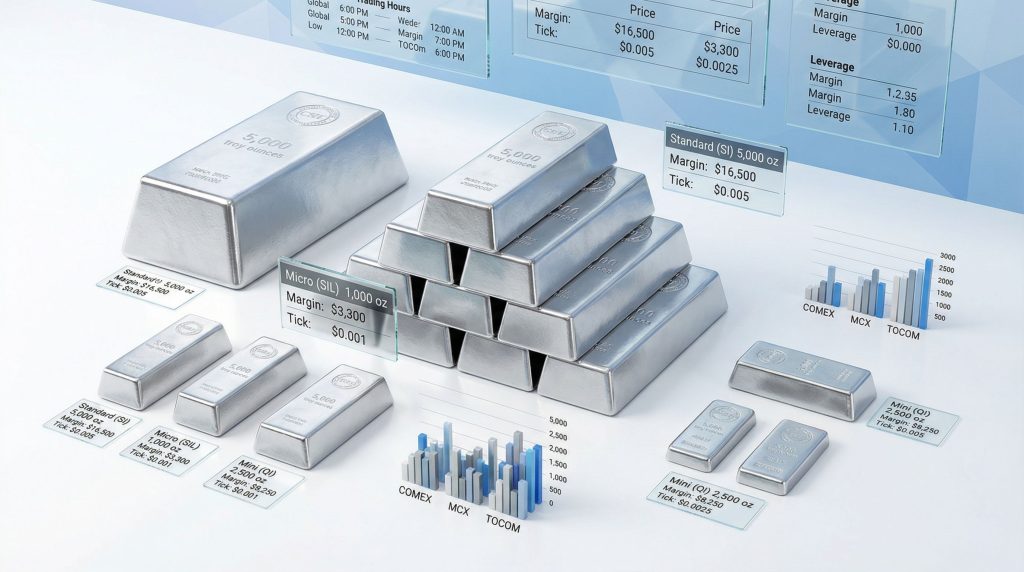
The standard silver futures contract encompasses 5,000 troy ounces of silver, with each troy ounce equivalent to 31.1 grams. This substantial contract size reflects institutional trading requirements and provides significant market exposure through a single transaction. The tick size operates at $0.005 per troy ounce, translating to a tick value of $25.00 per contract movement.
Recent market evolution introduced the 100-ounce silver futures contract (SIC), launched on January 13, 2026, featuring a tick size of $0.01 per troy ounce. This smaller contract addresses accessibility concerns for retail participants while maintaining the essential characteristics of futures trading mechanics.
Settlement mechanisms differentiate between physical delivery and cash settlement structures. The standard SI contract requires physical metal delivery upon expiration, involving warehouse receipt systems and approved storage facilities. Conversely, the 100-ounce SIC contract utilises cash settlement, eliminating delivery logistics while providing equivalent price exposure.
Exchange Infrastructure and Global Trading Venues
COMEX, operating under CME Group's umbrella, maintains dominant market share in silver futures contracts trading volume. However, global participation occurs across multiple regulated exchanges, each contributing to international price discovery mechanisms:
- Multi Commodity Exchange of India (MCX) – Serving Asian market participants during regional trading hours
- Tokyo Commodity Exchange (TOCOM) – Facilitating Japanese institutional and retail access
- Dubai Gold & Commodities Exchange (DGCX) – Bridging Middle Eastern and European time zones
- Indian National Commodity & Derivatives Exchange (NCDEX) – Supporting Indian agricultural and metals trading
Electronic trading platforms enable 24-hour daily access, Monday through Friday, allowing price movements while traditional equity markets remain closed. This continuous trading schedule accommodates global participation and responds to international economic developments across different time zones.
When big ASX news breaks, our subscribers know first
How Do Silver Futures Contract Sizes Impact Trading Strategy?
Contract size selection fundamentally influences capital requirements, risk exposure, and strategic flexibility within precious metals portfolios. Understanding the relationship between contract specifications and trading objectives becomes crucial for optimising position management and risk control.
Standard vs. Micro vs. Mini Contract Analysis
| Contract Type | Size (Troy Oz) | Tick Value | Settlement Type | Capital Requirement* | Leverage Ratio* |
|---|---|---|---|---|---|
| Standard (SI) | 5,000 | $25.00 | Physical delivery | High | Substantial |
| Mini (QI) | 2,500 | $31.25 | Physical delivery | Moderate | Moderate |
| Micro (SIL) | 1,000 | $5.00 | Physical delivery | Lower | Controlled |
| 100oz (SIC) | 100 | $1.00 | Cash settlement | ~$1,400 margin** | 5.7:1** |
*Specific margin requirements vary based on exchange volatility assessments and current market conditions
**Based on $80/troy ounce silver pricing example provided by CME Group
The 100-ounce contract example illustrates leverage mechanics: a trader controlling an $8,000 position (100 ounces × $80) with a $1,400 margin deposit achieves approximately 5.7 times leverage. This relationship scales proportionally across larger contract sizes, though specific margin requirements fluctuate based on market volatility assessments.
Capital Efficiency and Risk Management Considerations
Position sizing strategies must account for tick value variations and their impact on profit-and-loss calculations. Higher tick values generate larger monetary swings per price movement, requiring careful consideration of account size and risk tolerance.
Risk amplification through leverage means that a 5% adverse price movement in silver can potentially result in losses exceeding 25% of the initial margin deposit. This mathematical relationship emphasises the importance of stop-loss orders and position sizing relative to total account equity.
Furthermore, liquidity considerations vary across contract types, with trading volume and market participation changing regularly. Standard contracts typically maintain deeper liquidity pools, while smaller contracts may experience wider bid-ask spreads during off-peak trading hours.
What Drives Silver Futures Pricing Mechanisms?
Silver futures contracts pricing reflects the convergence of industrial demand fundamentals, investment sentiment, and macroeconomic forces that operate across multiple time horizons. Understanding these pricing drivers enables more informed trading decisions and risk assessment.
Industrial Demand vs. Investment Demand Dynamics
Understanding silver's dual nature as both an industrial commodity and precious metal creates complex pricing dynamics that differentiate it from pure investment assets. Industrial applications consume significant quantities across multiple sectors:
- Electronics manufacturing – Circuit boards, semiconductors, and electrical components
- Solar panel production – Photovoltaic cell conductivity requirements
- Medical devices – Antimicrobial properties in healthcare applications
- Battery technology – Emerging energy storage systems
- Manufacturing processes – Specialised industrial applications
Industrial demand provides a baseline consumption floor that supports price stability during economic downturns. This consistent demand pattern contrasts with investment-driven purchases that respond to macroeconomic uncertainty, inflation expectations, and currency debasement concerns.
Investment demand operates through multiple channels including safe-haven purchases during financial stress, portfolio diversification strategies, and speculative positioning based on technical analysis patterns. The combination creates pricing mechanisms that respond to both fundamental supply-demand balances and sentiment-driven flows.
Correlation Analysis with Other Precious Metals
Silver demonstrates complex correlation patterns with gold that vary across different market conditions and time periods. The gold-silver ratio analysis historically fluctuates between wide ranges, creating arbitrage opportunities for sophisticated traders who monitor relative value relationships.
During periods of financial stress, silver often exhibits higher volatility than gold while maintaining positive correlation. This relationship reflects silver's smaller market size and dual industrial-monetary characteristics that amplify price movements in both directions.
Cross-commodity arbitrage opportunities emerge when pricing relationships deviate from historical norms, though execution requires careful consideration of contract specifications, delivery dates, and margin requirements across different exchanges.
Silver Futures Trading Hours and Market Sessions
The 24/5 trading schedule enables continuous price discovery and risk management across global time zones. Understanding session characteristics and volatility patterns helps optimise entry and exit timing while managing overnight exposure risks.
24/5 Trading Schedule Breakdown
Silver futures contracts operate with minimal interruption from Monday morning through Friday evening, providing access during periods when traditional equity markets remain closed. This extended schedule accommodates:
- Asian session participation through TOCOM and MCX during regional business hours
- European morning activity preceding London precious metals fix timing
- North American COMEX primary trading during overlapping institutional hours
- After-hours electronic trading for risk management and position adjustments
Price movements frequently occur outside traditional US market hours as international developments influence precious metals sentiment. Economic data releases, geopolitical events, and central bank announcements can trigger significant volatility during extended trading periods.
Volatility Patterns Across Trading Sessions
Historical analysis reveals distinct volatility characteristics across different global sessions. Asian trading hours often experience lower volume but can produce substantial price gaps when regional economic data conflicts with Western market expectations.
European sessions typically demonstrate increased activity around London precious metals fix timing, while North American hours concentrate the highest volume and liquidity during institutional participation periods. Additionally, CME Group's silver futures market data provides comprehensive insights into trading patterns and volume distributions.
Weekend gap risk represents an additional consideration, as markets remain closed from Friday evening through Monday morning, potentially creating significant price discontinuities when trading resumes.
What Are the Key Risks in Silver Futures Trading?
Silver futures contracts involve multiple risk categories that require comprehensive understanding and active management. Leverage amplification, delivery obligations, and market volatility create potential scenarios that can exceed initial investment amounts.
Leverage-Related Risk Amplification
The fundamental risk characteristic of futures trading stems from leverage mechanisms that amplify both potential gains and losses. Margin requirements represent only a fraction of total contract value, meaning adverse price movements can quickly erode account equity.
Critical Risk Warning: Silver futures involve substantial leverage that can amplify both gains and losses. A 5% adverse price movement in a standard contract can result in losses exceeding 25% of the initial margin deposit.
Forced liquidation scenarios occur when account equity falls below maintenance margin requirements, triggering automatic position closure regardless of subsequent market recovery potential. This mechanism protects brokers and clearinghouses but can result in realised losses at unfavourable price levels.
Portfolio correlation risks increase during market stress periods when asset correlations converge toward unity, reducing diversification benefits precisely when protection becomes most valuable.
Physical Delivery Obligations and Procedures
Standard silver futures contracts retain physical delivery obligations that activate unless positions close before first notice day. Delivery procedures involve:
- Warehouse receipt systems specifying approved storage facilities
- Quality specifications meeting exchange-approved standards
- Delivery notice procedures with specific timing requirements
- Financial settlement for the full contract value upon delivery
Many retail-oriented brokerage platforms, including Charles Schwab and Forex LLC, prohibit physical delivery to individual accounts, forcing cash settlement or position closure before expiration. This restriction eliminates delivery logistics but may force unwanted position adjustments at disadvantageous timing.
How Do Professional Traders Approach Silver Futures?
Professional trading approaches encompass hedging strategies for commercial participants and speculative techniques for investment-oriented traders. Understanding institutional methodologies provides insights into market dynamics and price formation processes.
Hedging Strategies for Mining Companies
Mining companies utilise silver futures contracts to establish forward pricing for production output, reducing revenue volatility and enabling more predictable cash flow planning. Production hedging typically involves:
- Forward sales contracts establishing predetermined prices for future production
- Options combinations providing downside protection while maintaining upside participation
- Seasonal hedging patterns aligning with production cycles and capital expenditure requirements
These hedging activities contribute significant volume to futures markets while providing price stability for commercial operations. Understanding commercial participant behaviour helps identify support and resistance levels based on hedging flow patterns.
Speculative Trading Approaches
Technical analysis applications in silver markets focus on price pattern recognition, momentum indicators, and volume analysis specific to precious metals characteristics. Common approaches include:
- Trend-following systems utilising moving average crossovers and breakout strategies
- Mean reversion techniques exploiting short-term price dislocations
- Spread trading between different contract months or related commodities
Fundamental analysis incorporates industrial demand forecasting, monetary policy assessment, and supply chain disruption analysis. This multi-factor approach attempts to identify medium-term price trends based on underlying economic drivers. Moreover, understanding silver squeeze dynamics provides additional insights into potential market disruptions.
The next major ASX story will hit our subscribers first
Silver Futures vs. Physical Silver Investment Comparison
Investment decision-making requires comprehensive comparison of futures contracts against physical silver ownership, considering factors such as liquidity, storage requirements, tax implications, and counterparty risks.
Liquidity and Transaction Cost Analysis
Futures contracts provide superior liquidity during normal market conditions, with tight bid-ask spreads and immediate execution capabilities. Electronic trading platforms enable position adjustments without physical handling or storage considerations.
Physical silver involves purchase premiums above spot prices, storage and insurance costs, and potential selling discounts that reduce net investment returns. However, physical ownership eliminates counterparty risks and provides tangible asset possession.
Portfolio Allocation Considerations
| Factor | Silver Futures | Physical Silver |
|---|---|---|
| Liquidity | Excellent | Good |
| Storage Required | None | Yes |
| Leverage Available | High | None |
| Counterparty Risk | Exchange clearing | None |
| Tax Treatment | Section 1256 (60/40) | Collectibles rate (28%) |
| Holding Period | Contract expiration limits | Indefinite |
| Insurance Needs | None | Required for storage |
Tax implications significantly impact net returns, with futures contracts receiving favourable Section 1256 treatment (60% long-term, 40% short-term capital gains rates) compared to physical silver's 28% collectibles tax rate.
Regulatory Framework and Market Oversight
Silver futures markets operate under comprehensive regulatory oversight designed to ensure fair trading practices, prevent market manipulation, and maintain financial system stability. Understanding regulatory structures helps traders navigate compliance requirements and market limitations.
CFTC Position Limits and Reporting Requirements
The Commodity Futures Trading Commission (CFTC) establishes position limits for speculative traders while providing exemptions for legitimate hedging activities. Large trader reporting requirements create transparency through Commitment of Traders (COT) reports that reveal institutional positioning patterns.
Speculative position limits prevent excessive concentration in individual accounts while hedging exemptions allow commercial participants unlimited position sizes when demonstrating legitimate business purposes. Furthermore, a silver market squeeze could potentially test these regulatory frameworks.
International Regulatory Variations
Cross-border trading involves multiple regulatory jurisdictions with varying margin requirements, position reporting thresholds, and settlement procedures. International participants must navigate:
- Margin harmonisation across different exchanges and clearinghouses
- Settlement currency considerations for non-USD participants
- Tax treaty implications for international trading entities
Technology and Execution Platforms for Silver Futures
Modern futures trading relies heavily on electronic platforms that provide direct market access, real-time price discovery, and sophisticated order management capabilities. Technology infrastructure directly impacts execution quality and trading efficiency.
Electronic Trading System Requirements
Direct market access (DMA) platforms enable institutional-quality execution with minimal latency between order submission and exchange matching. Essential features include:
- Real-time market data with minimal delay for price discovery
- Advanced order types including stop-losses, bracket orders, and algorithmic strategies
- Mobile trading capabilities for position monitoring and emergency management
- Integration capabilities with portfolio management and risk control systems
Retail-oriented platforms typically provide simplified interfaces with basic order types, though they may impose restrictions on physical delivery and advanced trading strategies. Traders seeking more sophisticated approaches can reference our ETCs investment guide for alternative precious metals exposure.
Data Feed Integration and Analysis Tools
Successful futures trading requires comprehensive data analysis capabilities including:
- Historical price databases for backtesting trading strategies and pattern recognition
- Volume and open interest data for liquidity assessment and sentiment analysis
- Economic calendar integration for fundamental analysis and event-driven trading
- Cross-market correlation analysis for spread trading and arbitrage identification
Additionally, monitoring live silver futures quotes provides essential real-time market information for active traders.
Future Outlook for Silver Futures Markets
Market structure evolution continues adapting to changing participant needs, technological advances, and regulatory developments. Understanding emerging trends helps position for long-term market changes and opportunity identification.
Market Structure Evolution Trends
Micro-contract adoption demonstrates increasing retail participation as smaller position sizes reduce capital barriers while maintaining leverage characteristics. This democratisation trend may increase overall market volume while potentially adding volatility during retail-driven sentiment shifts.
Environmental, Social, and Governance (ESG) considerations increasingly influence silver demand patterns as renewable energy adoption accelerates. Solar panel manufacturing and battery technology development create new industrial demand sources that may reshape traditional supply-demand dynamics.
Technological Disruption Factors
Blockchain-based settlement systems may eventually reduce counterparty risks while maintaining exchange-traded standardisation benefits. Artificial intelligence applications in price discovery and risk management could improve market efficiency while creating new competitive advantages for technology-enabled participants.
Central bank digital currencies (CBDCs) represent potential disruption to precious metals monetary demand, though industrial consumption patterns likely remain independent of digital currency developments. Consequently, renewable energy sector projections suggest sustained silver demand growth, particularly in photovoltaic applications where silver's conductivity properties remain difficult to substitute cost-effectively.
Investment Disclaimer: Silver futures contracts involve substantial risk and are not suitable for all investors. Leverage can amplify both gains and losses, and trading decisions should be based on individual financial circumstances and risk tolerance. Past performance does not guarantee future results. Consider consulting with qualified financial advisors before engaging in futures trading activities.
Ready to capitalise on the next major silver discovery?
Discovery Alert instantly alerts investors to significant ASX mineral discoveries using its proprietary Discovery IQ model, turning complex mineral data into actionable insights. Understand why historic discoveries can generate substantial returns by visiting Discovery Alert's dedicated discoveries page, showcasing exceptional outcomes from major finds.