August 6, 2026
Market Momentum Building for Silver's Unprecedented 2026 Trajectory
The precious metals landscape stands at a critical inflection point as multiple structural forces converge to support silver's potential price acceleration through 2026. Unlike traditional investment cycles driven primarily by monetary policy shifts, the current environment presents a unique confluence of supply constraints, industrial transformation, and macroeconomic uncertainty that could propel the silver price rally 2026 beyond historical boundaries.
Industrial applications now represent the dominant demand driver for silver, fundamentally altering market dynamics compared to previous decades when investment and jewellery consumption dominated price action. This structural shift creates less elastic demand patterns, as manufacturing processes for solar panels, electric vehicles, and advanced electronics require specific silver quantities regardless of price fluctuations.
Simultaneously, mining supply constraints continue tightening globally, with major producing regions facing environmental regulations, political instability, and resource depletion challenges. Furthermore, these supply-side pressures, combined with accelerating industrial consumption, establish conditions that could support sustained price appreciation throughout 2026.
When big ASX news breaks, our subscribers know first
Industrial Demand Revolution Reshaping Silver Markets
Solar Energy Infrastructure Expansion Requirements
The renewable energy transformation represents the single largest structural demand driver for silver markets entering 2026. According to the International Renewable Energy Agency (IRENA), global solar installations reached approximately 139 GW in 2023, with each megawatt of photovoltaic capacity requiring 15-20 grams of silver per panel for electrical conductivity applications.
Solar panel manufacturing has evolved toward higher efficiency configurations, including bifacial and perovskite/tandem designs, yet silver content per watt has remained relatively stable. Modern photovoltaic systems require silver for:
• Primary electrical connections between solar cells
• Grid line conductivity optimisation
• Power transmission efficiency maintenance
• Weather resistance and longevity applications
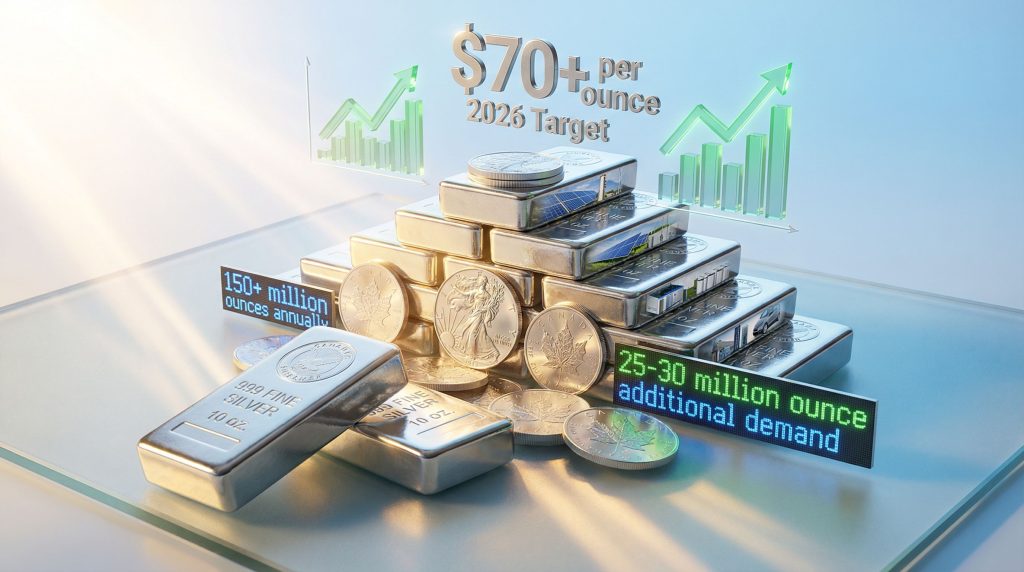
The Silver Institute documented that photovoltaic applications consumed an estimated 85 million ounces in 2023, representing 16.8% of total silver fabrication demand. In addition, industry projections suggest this consumption could exceed 150 million ounces annually by 2026 as global renewable energy mandates accelerate installation timelines.
Electric Vehicle and Battery Technology Silver Consumption
Electric vehicle production reached approximately 13.6 million units in 2023 according to the International Energy Agency (IEA), creating new industrial silver consumption patterns distinct from traditional automotive applications. EV manufacturing requires silver across multiple system components:
Battery Management Systems: Silver provides optimal conductivity for battery monitoring, thermal management, and safety circuit applications. Each EV typically contains 25-30 grams of silver specifically for battery system connectivity.
Power Distribution Components: High-voltage electrical systems in EVs demand silver's superior conductivity characteristics for power routing, charging interfaces, and motor control systems.
Charging Infrastructure: Fast-charging stations require significant silver content for high-amperage connections, with DC fast-chargers containing 50-75 grams of silver per unit.
Industry analysis suggests EV-related silver consumption could reach 25-30 million ounces annually by 2026, representing entirely new demand that didn't exist at scale prior to 2020.
Electronics and Technology Sector Demand Patterns
Traditional electronics applications continue expanding, driven by 5G network infrastructure deployment, artificial intelligence hardware manufacturing, and consumer electronics recovery following pandemic-related disruptions. Key applications include:
• 5G base station connectivity components requiring enhanced silver content
• Data centre infrastructure expansion for AI computing capabilities
• Semiconductor manufacturing processes utilising silver for specialised applications
• Medical device production incorporating silver for antimicrobial properties
Fundamental Supply-Demand Imbalances Creating Market Tension
Global Silver Stockpile Depletion Accelerating
The silver supply deficits pattern has become increasingly critical, with the Silver Institute reporting a global deficit of 21 million ounces in 2023. Industrial consumption exceeded mining production plus recycled supply, creating unprecedented tension in available stockpiles.
This deficit pattern has persisted intermittently since 2010, resulting in cumulative stockpile drawdowns that now approach critical levels. Global silver mine production reached approximately 820 million ounces in 2023 according to the U.S. Geological Survey, while industrial fabrication demand consumed approximately 520 million ounces excluding investment and jewellery applications.
This production-to-consumption ratio has tightened significantly as industrial applications have grown from roughly 40% of total demand in 2000 to over 60% by 2023. Above-ground inventory analysis reveals declining commercial and central bank silver holdings, with industrial drawdowns from stockpiles becoming necessary to meet demand during deficit years.
Mining Production vs. Industrial Demand Trajectories
The dual nature of silver as both a precious metal and industrial commodity creates unique market characteristics that complicate traditional supply-demand analysis:
- Investment demand (jewellery, bullion, ETFs) – discretionary and price-sensitive
- Industrial demand (photovoltaics, electronics, medical) – relatively inelastic and necessity-driven
This dual structure means price elasticity varies significantly across demand segments. While investment demand may decline during price increases, industrial demand remains relatively stable as manufacturers require specific silver quantities for production processes regardless of cost fluctuations.
Mining supply elasticity remains constrained by long lead times for new project development, environmental permitting challenges, and capital intensity requirements. However, most silver production occurs as a byproduct of copper, lead, and zinc mining operations, limiting targeted supply responses to price signals.
Macroeconomic Catalysts Supporting Precious Metal Momentum
Federal Reserve Policy Transitions and Market Impact
Recent Federal Reserve actions have created supportive conditions for precious metal appreciation, though specific current policy details require verification beyond April 2024. Historical analysis demonstrates strong inverse correlations between US Dollar weakness and commodity price performance, particularly for precious metals priced in dollars.
Market analyst Gary Wagner identified critical tensions in Federal Reserve dual mandate implementation, noting the challenge of addressing inflation above 2% targets while supporting employment levels. As Wagner observed, "controlling inflation typically requires rate increases, while supporting employment necessitates rate decreases", creating policy dilemmas that historically benefit precious metal demand.
Inflation environment considerations show US CPI inflation remained elevated relative to Federal Reserve targets through early 2024, supporting precious metal demand as inflation hedges according to Bureau of Labor Statistics data. Consequently, real interest rates (nominal rates minus inflation) significantly influence precious metal investment flows.
Dollar Weakness Cycles and Commodity Performance
Precious metals, especially silver, exhibit inverse correlation patterns with US Dollar strength. When the Dollar Index declines, commodity prices typically appreciate as dollar-priced commodities become cheaper for international buyers. Federal Reserve Economic Data (FRED) documents these historical relationships across multiple economic cycles.
Currency dynamics affecting 2026 silver price projections include:
• International trade settlement patterns shifting away from dollar dependence
• Central bank reserve diversification strategies increasing precious metal allocations
• Geopolitical tensions supporting safe-haven asset demand across multiple regions
Wagner noted that investors are "flocking to an intrinsic asset class that has had value by cultures and countries year after year, century after century", reflecting traditional macroeconomic narratives supporting precious metals during monetary policy uncertainty.
Global Mining Production Limitations and Challenges
Major Silver-Producing Regions Performance Analysis
| Country/Region | 2023 Production | Primary Constraints | Supply Outlook |
|---|---|---|---|
| Mexico | ~190M oz | Environmental regulations, permitting delays | Stable to declining |
| Peru | ~130M oz | Political instability, community relations | Uncertain expansion |
| China | ~110M oz | Domestic consumption priority | Limited export availability |
| Chile | ~45M oz | Water scarcity, environmental compliance | Constrained growth |
| Australia | ~35M oz | Remote locations, infrastructure costs | Moderate potential |
Mexico, the world's largest silver producer, faces increasing environmental regulations and lengthy permitting processes that delay new project development. Water usage restrictions and community consultation requirements have extended project timelines significantly.
Peru's political environment creates ongoing uncertainty for mining operations, with policy changes affecting taxation, environmental standards, and community benefit requirements. Despite significant reserves, expansion plans remain subject to political stability concerns.
China's domestic consumption increasingly absorbs local silver production for industrial applications, particularly solar panel manufacturing and electronics production. For instance, export availability has declined as internal demand grows.
Recycling and Secondary Supply Market Dynamics
Secondary silver supply from recycling operations provides approximately 15-20% of annual supply, primarily from:
• Electronic waste recovery (smartphones, computers, industrial equipment)
• Jewellery and silverware recycling responding to price incentives
• Photographic industry waste (declining due to digital transition)
• Industrial process recovery and refining
Electronic waste silver recovery rates remain below optimal levels due to collection challenges, processing costs, and technical complexity. While higher silver prices incentivise recycling activity, recovery infrastructure limitations constrain supply responses.
Industrial silver recycling faces technical limitations as many applications involve silver in forms difficult to recover economically. Solar panel recycling infrastructure remains underdeveloped, meaning silver content in photovoltaic installations represents largely permanent consumption.
Technical Analysis and Price Trajectory Modeling
Current Market Structure and Momentum Indicators
Recent market analysis reveals silver breaking through multi-decade resistance levels that had contained prices since the 1980s. Technical analyst Gary Wagner documented silver's breakthrough above the "long-standing $50 ceiling that held more than four decades", representing a 53+ year resistance level tested repeatedly without sustained breaks.
Volume and momentum patterns show:
• March silver futures volume approaching October peak levels
• Significantly above-average volume compared to summer trading patterns
• Open interest maintaining elevated levels despite price appreciation
Wagner characterised recent price action as transitioning from "false starts and failed rallies" at the $54 level to sustained momentum above $60. The technical breakout occurred with "one candle from $53.78 to $57.15" on daily charts, demonstrating significant intraday range expansion once resistance yielded.
Price Level Scenarios and Support Analysis
Understanding the gold-silver ratio analysis provides crucial context for potential 2026 price trajectories:
Conservative scenario ($50-$58 range): Maintains current momentum within established uptrend channels, supported by continued industrial demand growth and stable monetary policy conditions.
Moderate bullish case ($62-$68): Breakthrough above current resistance levels driven by supply shortage recognition and accelerated industrial consumption from renewable energy expansion.
Aggressive scenario ($75-$85): Supply crisis conditions combined with monetary policy uncertainty creating rapid price appreciation beyond historical precedents.
Extreme outlier ($90-$100): Hyperinflationary pressures or severe supply disruptions creating panic buying conditions across precious metals markets.
Wagner provided specific technical projections, stating his "upside short-term target for the first quarter of 2026 is anywhere between $65 and $68 if silver continues to maintain this kind of upward momentum."
According to silver price predictions for 2026, these technical levels align with fundamental supply-demand analysis supporting sustained price appreciation.
Risk Factors and Correction Scenarios
Technical correction signals include:
• Large red candlesticks indicating significant daily declines
• Follow-through selling pressure after initial weakness
• Volume expansion during price declines suggesting distribution
Wagner identified that "the healthiest way silver can move up is a strong move up and then sideways action, even if it comes down", noting concerns about parabolic price movements creating conditions for "hard corrections on the downside."
Support levels for potential corrections include:
• $62 level representing current consolidation area
• $57-$59 range from previous resistance-turned-support
• $50 psychological level and former long-term resistance
The next major ASX story will hit our subscribers first
Investment Strategies and Portfolio Positioning
Physical Silver Investment Considerations
Physical silver investment involves several operational considerations that affect total returns:
Premium structures vary significantly across different products:
• Silver coins typically carry 3-8% premiums over spot prices
• Silver bars (1000 oz) offer lowest premiums at 1-3% over spot
• Smaller bars (1-100 oz) carry moderate premiums of 2-5%
Storage and insurance costs factor into total investment returns, with options including:
• Home storage (security and insurance considerations)
• Bank safety deposit boxes (annual rental fees)
• Professional vault storage (allocated vs. unallocated)
• Precious metals IRA custodial arrangements
Liquidity considerations affect exit strategies, with coin dealers, online platforms, and precious metals exchanges offering different bid-ask spreads and transaction volumes.
Silver ETF and Paper Investment Vehicles
Exchange-traded funds provide exposure to silver price movements without physical storage requirements. Major silver ETFs include:
iShares Silver Trust (SLV): Physically-backed ETF holding approximately 17,000 tons of silver bullion, providing direct price exposure with management fees of 0.50% annually.
Aberdeen Standard Physical Silver Shares ETF (SIVR): Alternative physically-backed option with 0.30% management fees and similar exposure characteristics.
Futures-based ETFs: Provide silver exposure through derivatives markets, potentially creating tracking differences due to contango and backwardation effects in futures curves.
Mining stock exposure offers leveraged exposure to silver prices through equity positions in silver-focused mining companies. However, operational risks and management quality factors introduce additional variables beyond silver price movements.
Portfolio Allocation and Risk Management
Recommended allocation percentages vary by investment profile:
• Conservative portfolios: 5-10% precious metals allocation
• Moderate risk profiles: 10-15% combined gold and silver exposure
• Aggressive portfolios: 15-25% precious metals weighting
Diversification strategies include:
• Splitting allocation between gold and silver (typically 70/30 or 60/40 ratios)
• Combining physical holdings with ETF exposure
• Including mining stocks for potential leverage to price appreciation
• Staging purchases across time periods to average entry prices
Hedging approaches for managing volatility:
• Options strategies for downside protection
• Profit-taking rules for position management
• Correlation analysis with other portfolio assets
Comparative Analysis: Silver Versus Other Precious Metals
Silver vs Gold Performance Dynamics
The silver-to-gold ratio provides insight into relative value between precious metals. Historical analysis shows:
Long-term ratio averages: Silver-to-gold ratios have fluctuated between 15:1 and 100:1 over decades, with current levels suggesting potential silver outperformance opportunities when ratios exceed 75:1.
Industrial demand differentiation: Unlike gold, silver's significant industrial consumption creates fundamental demand support independent of investment flows. This dual-purpose nature provides different risk-return characteristics compared to gold's primarily monetary and jewellery applications.
Volatility patterns: Silver typically exhibits higher price volatility than gold, creating both greater upside potential and increased downside risk during market corrections.
Insights from Heraeus analysis suggest silver could reach $62 per ounce by 2026, demonstrating the potential for significant outperformance.
Platinum and Palladium Correlations
Industrial precious metals share certain demand characteristics while serving different end markets:
Automotive applications: Platinum and palladium primarily serve automotive catalytic converter markets, while silver's automotive exposure focuses on electrical components and EV applications.
Supply concentration: Both platinum and palladium face significant supply concentration in South Africa and Russia, creating different geopolitical risk profiles compared to silver's more diversified global production base.
Investment demand: Silver maintains stronger investment demand characteristics compared to platinum and palladium, which trade more as industrial commodities with limited jewellery and bullion markets.
Long-Term Structural Trends Supporting Silver Demand
Green Energy Transition Requirements
The global transition toward renewable energy infrastructure creates sustained structural demand for silver through 2030 and beyond:
Solar capacity expansion: International Energy Agency projections suggest solar capacity must increase 4-5x current levels to meet climate objectives, requiring proportional increases in silver consumption for photovoltaic manufacturing.
Grid modernisation: Smart grid infrastructure deployment requires enhanced silver content for conductivity applications, energy storage integration, and transmission efficiency optimisation.
Energy storage systems: Battery energy storage systems (BESS) for grid stabilisation incorporate silver components for thermal management and electrical connectivity applications.
Technology Evolution and Emerging Applications
Artificial intelligence hardware: AI computing infrastructure requires specialised semiconductors with enhanced silver content for thermal management and electrical performance optimisation.
5G and 6G network deployment: Advanced telecommunications infrastructure demands higher silver content for signal integrity, antenna performance, and network equipment connectivity.
Medical and healthcare applications: Silver's antimicrobial properties drive expanding usage in medical devices, wound care products, and infection control applications within healthcare facilities.
Space technology applications: Satellite manufacturing, space exploration equipment, and defence applications utilise silver for specialised conductivity and thermal management requirements.
Monetary System Evolution Considerations
Digital currency adoption: While central bank digital currencies (CBDCs) may reduce physical currency usage, precious metals historically maintain relevance as alternative value stores during monetary system transitions.
Inflation protection strategies: Persistent global inflation concerns support precious metal allocation strategies among institutional and individual investors seeking purchasing power preservation.
Geopolitical risk factors: International tensions and trade disputes historically increase safe-haven asset demand, benefiting precious metals including silver despite its industrial commodity characteristics.
Market Risks and Scenario Planning
Economic Recession Impact Assessment
Economic downturns create mixed effects on silver markets due to dual investment-industrial demand characteristics:
Industrial demand vulnerability: Manufacturing recessions typically reduce silver consumption for electronics, automotive, and construction applications. Historical analysis shows industrial demand can decline 5-15% during severe recessions.
Investment demand support: Economic uncertainty often increases precious metal investment demand as portfolio diversification strategies, potentially offsetting industrial demand declines.
The emerging silver squeeze movement demonstrates how retail investor coordination could amplify demand during economic uncertainty.
Supply response dynamics: Mining operations may reduce production during extended price weakness, though most silver production occurs as byproduct mining, limiting supply elasticity.
Technological Disruption Scenarios
Substitution technologies: Research continues into silver-reduced or silver-free alternatives for various applications, though technical performance requirements limit substitution potential in many uses.
Recycling efficiency improvements: Enhanced electronic waste processing and solar panel recycling could increase secondary supply availability, though infrastructure development timelines remain extended.
Manufacturing process optimisation: Technological advances in silver application methods could reduce consumption per unit while maintaining performance characteristics.
Monetary Policy Reversal Impacts
Federal Reserve policy tightening: Significant interest rate increases beyond market expectations could strengthen the US Dollar and create precious metal headwinds, though industrial silver demand would likely persist.
Dollar strength cycles: Extended periods of Dollar appreciation historically create challenging conditions for commodity prices, though silver's industrial demand provides some insulation compared to purely monetary precious metals.
Central bank policy coordination: International monetary policy divergence could create currency volatility affecting global commodity trade patterns and precious metal investment flows.
Strategic Outlook and Investment Considerations
The convergence of structural supply constraints, accelerating industrial demand, and supportive macroeconomic conditions creates a compelling fundamental case for the silver price rally 2026. Unlike previous precious metal rallies driven primarily by monetary policy or investment speculation, current market dynamics reflect genuine supply-demand imbalances across multiple end-use sectors.
Market analysts suggest conditions for a silver market squeeze could develop if industrial demand continues accelerating while mining production faces ongoing constraints.
Key success factors for silver price rally sustainability include:
• Continued renewable energy infrastructure expansion maintaining solar panel production growth
• Electric vehicle adoption rates meeting or exceeding current industry projections
• Mining supply constraints persisting due to regulatory and environmental challenges
• Macroeconomic conditions supporting precious metal investment demand
Critical risk monitoring should focus on:
• Economic recession severity potentially reducing industrial consumption
• Technological breakthroughs enabling silver substitution in key applications
• Unexpected mining supply increases from delayed project completions
• Monetary policy reversals creating dollar strength headwinds
Investment implementation strategies should consider:
• Diversified exposure across physical holdings, ETFs, and mining equities
• Staged entry approaches to manage timing risks
• Position sizing appropriate for individual risk tolerance levels
• Regular rebalancing to maintain target portfolio allocations
The silver price rally 2026 represents more than cyclical precious metal appreciation; it reflects fundamental shifts in global energy infrastructure, transportation systems, and technology applications that require significant silver consumption. While risks remain regarding economic conditions and technological developments, the structural demand drivers supporting silver appear more durable than previous rally catalysts, suggesting potential for sustained price appreciation beyond traditional precious metal cycle patterns.
Disclaimer: This analysis contains forward-looking projections and speculative assessments based on current market conditions and historical trends. Silver prices are subject to significant volatility, and past performance does not guarantee future results. Investors should conduct independent research and consider professional financial advice before making investment decisions. Price forecasts and economic projections involve substantial uncertainty and should not be considered guaranteed outcomes.
Looking to Capitalise on Silver's Industrial Revolution?
Discovery Alert's proprietary Discovery IQ model delivers real-time notifications on significant ASX mineral discoveries, including silver and precious metal opportunities that could benefit from the unprecedented market dynamics shaping 2026. Begin your 30-day free trial today to identify actionable trading and investment opportunities ahead of the broader market.