July 31, 2026
The convergence of monetary instability, supply constraints, and industrial acceleration has created an unprecedented environment for precious metals. While traditional investment models typically focus on linear growth patterns, the current silver market exhibits characteristics of a system approaching a critical threshold. Understanding why triple-digit silver prices prediction scenarios have gained credibility requires examining the structural forces reshaping global commodity markets and monetary systems.
The Structural Evolution of Silver Market Fundamentals
Modern silver markets have undergone a profound transformation that challenges conventional pricing frameworks. Unlike historical periods where silver primarily functioned as either an industrial commodity or monetary asset, current conditions present simultaneous demand acceleration across multiple sectors. This dual-functionality creates pricing dynamics that traditional econometric models struggle to capture accurately.
The industrial foundation supporting silver demand has expanded beyond traditional applications into critical technology sectors. Solar photovoltaic installations now consume approximately 110-130 million ounces annually, according to U.S. Geological Survey data, while emerging technologies including 5G infrastructure, electric vehicle systems, and advanced battery storage create additional industrial demand floors. Electric vehicles typically contain 50-100 grams of silver per unit, and with global EV production projected to reach 40+ million units by 2030, this represents significant incremental demand growth.
Furthermore, the silver supply deficits have intensified as industrial applications expand faster than mining production can accommodate. This structural imbalance creates sustained upward pressure on pricing mechanisms that traditional forecasting models often underestimate.
Industrial Demand as a Price Foundation
The renewable energy transition has fundamentally altered silver's demand profile. Each megawatt of solar capacity requires approximately 20-30 grams of silver for electrical connectivity and conductivity applications. With global solar installations reaching 1,224 GW cumulative capacity by 2023, up from 773 GW in 2020, the mathematics of industrial consumption suggest sustained upward pressure on price equilibrium levels.
Silver Industrial Demand Breakdown:
| Application Category | Annual Consumption | Trend Direction |
|---|---|---|
| Electrical/Electronics | ~26% of total demand | Growing |
| Photovoltaic Systems | ~22% of total demand | Rapidly expanding |
| Industrial Machinery | ~12% of total demand | Stable |
| Automotive Applications | ~8% of total demand | Growing (EV adoption) |
| Medical/Healthcare | ~3% of total demand | Growing |
Unlike previous industrial cycles, current silver applications in renewable energy and electric vehicles exhibit low price elasticity. Solar panel manufacturers cannot easily substitute alternative materials without significant performance degradation, creating what economists term "inelastic demand" at the margin. This structural shift means that price increases may not substantially reduce consumption in critical applications, potentially amplifying price volatility during supply constraints.
Consequently, the silver squeeze dynamics have become increasingly complex as industrial users compete with investment demand for limited supply availability.
When big ASX news breaks, our subscribers know first
Institutional Forecasting Limitations and Market Disconnects
Traditional financial institutions have consistently underestimated silver's price potential through 2025-2026, with most major banks projecting peak prices between $42-$65 per ounce. These conservative estimates reflect fundamental limitations in conventional forecasting methodologies that struggle to account for nonlinear market dynamics and regime changes.
Major Bank Silver Price Projections (Pre-2026):
| Institution | Initial Target | Revised Target | Actual January 2026 |
|---|---|---|---|
| UBS | $42-$47 | $55 mid-2026 | $100+ |
| Bank of America | $56.25 average | $65 peak | $100+ |
| Citigroup | $42 | Not revised | $100+ |
The systematic underestimation by institutional forecasters highlights a critical analytical gap. Most econometric models assume stable monetary conditions and linear demand relationships, failing to capture the exponential dynamics that occur when multiple demand drivers converge simultaneously. When silver crossed $100 per ounce in January 2026, it demonstrated forecast errors ranging from 35% to 58% within a six-month timeframe.
However, independent analysts have been more aggressive in their assessments, with some forecasting triple-digit territory based on technical analysis and supply-demand fundamentals rather than traditional banking models.
The Dual-Nature Modelling Challenge
Silver's unique position as both an industrial commodity and monetary asset creates exceptional forecasting complexity. During normal market conditions, silver trades approximately 90% as an industrial commodity, with pricing tied to manufacturing demand and economic growth cycles. However, during monetary instability periods, this relationship can invert dramatically, with monetary demand dominating price discovery.
Traditional models fail to account for this regime-switching behaviour. Linear regression frameworks assume independent variables act additively, but simultaneous monetary debasement fears and industrial demand acceleration create exponential rather than linear price effects. This mathematical limitation explains why conventional forecasts became obsolete so rapidly during 2025.
In addition, the global silver squeeze effect compounds these modelling challenges by introducing feedback loops that amplify price movements beyond linear expectations.
Alternative Analysis Frameworks and Technical Perspectives
Beyond institutional forecasting, technical analysts and independent commodity researchers have identified long-term patterns suggesting significant price appreciation potential. The identification of a multi-decade cup-and-handle formation in silver's price structure provided technical justification for extreme upside scenarios well before institutional analysts recognised the trend.
Historical Volatility and Bull Market Performance
Silver's historical performance during precious metals bull markets demonstrates consistently higher volatility than gold, with a beta coefficient typically ranging from 1.8 to 2.2 compared to gold's market movements. This relationship suggests that during sustained precious metals rallies, silver tends to outperform gold by factors of 2-5x.
Precious Metals Bull Market Comparison:
| Period | Silver Performance | Gold Performance | Silver/Gold Outperformance |
|---|---|---|---|
| 2008-2011 | +403% | +168% | 2.4x |
| 2020-2021 | +127% | +25% | 5.1x |
| 2025 | +146% | +64% | 2.3x |
This outperformance pattern reflects silver's smaller market size and higher industrial demand sensitivity. When precious metals enter bull market phases, silver's limited supply and diverse demand sources create amplified price movements compared to gold's primarily monetary demand structure.
For instance, the gold-silver ratio insights demonstrate how historical ratios can provide valuable timing indicators for precious metals allocation strategies.
Supply Deficit Mathematics and Resource Constraints
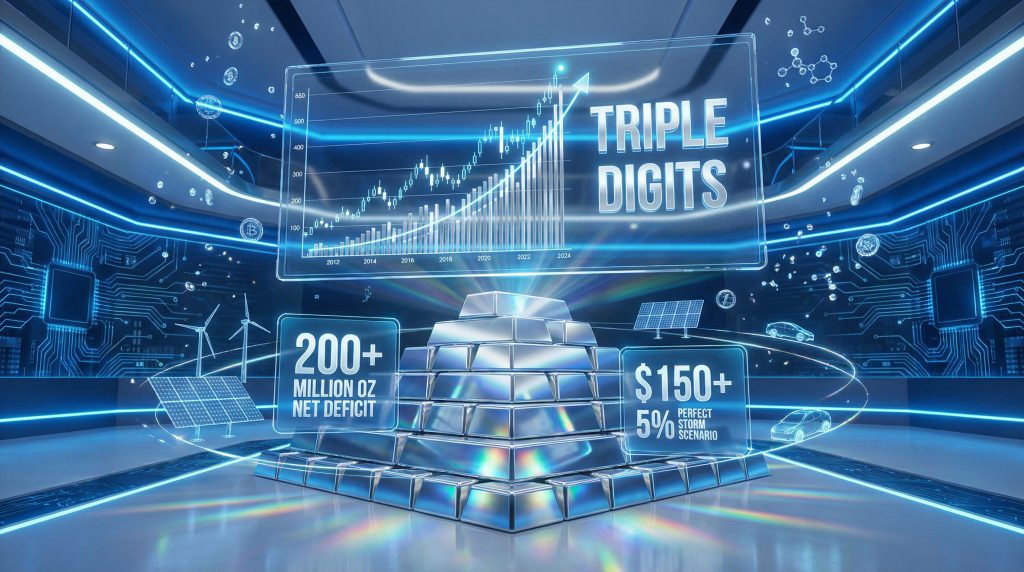
Global silver production has faced increasing challenges from declining ore grades, environmental regulations, and mining cost inflation. According to industry data, annual silver supply deficits have exceeded 200 million ounces in recent years, creating cumulative inventory drawdowns that support higher equilibrium prices.
Silver Supply-Demand Balance:
- Annual Mine Production: ~840 million ounces
- Recycling Supply: ~180 million ounces
- Total Annual Supply: ~1,020 million ounces
- Industrial Demand: ~520 million ounces
- Investment Demand: ~240 million ounces (highly variable)
- Jewellery/Silverware: ~200 million ounces
- Net Annual Deficit: 200+ million ounces
Unlike demand, which can increase rapidly through policy changes or technological adoption, supply responses in mining typically require 3-7 years to implement. This supply inelasticity creates potential for sustained price pressure when demand acceleration occurs faster than new production capacity can be developed.
Market Conditions Supporting Extreme Price Scenarios
Several macroeconomic and structural factors have aligned to create an environment conducive to extreme silver price appreciation. These conditions extend beyond traditional supply-demand fundamentals to include monetary policy consequences, geopolitical risk premiums, and demographic investment trends.
Currency Debasement and Monetary Policy Impact
Central bank balance sheet expansion has accelerated globally since 2020, with major economies increasing money supplies by 20-40% within a three-year period. Historical precedent suggests that rapid monetary expansion often leads to precious metals appreciation as investors seek alternatives to depreciating fiat currencies. Silver's industrial applications provide additional fundamental support during inflationary periods, as replacement costs for critical infrastructure components increase proportionally.
Moreover, tariff impacts on silver have created additional pricing pressures as international trade policies affect global supply chains and manufacturing costs.
Geopolitical Risk and Safe-Haven Demand
International tensions and trade disputes create additional demand for tangible assets with universal recognition and portability. Silver's smaller market size compared to gold means that relatively modest capital flows from geopolitical risk hedging can create disproportionate price impacts. During the 2025 precious metals rally, silver's 146% annual return reflected both industrial demand growth and crisis-driven investment flows.
Retail Investment Phenomenon and Market Dynamics
Social media-driven investment coordination has demonstrated the ability to move commodity markets dramatically, particularly in smaller, less liquid markets like silver. The relatively modest size of the global silver market, with annual production valued at approximately $25-30 billion, makes it susceptible to significant price movements when retail investor interest concentrates around precious metals themes.
Probability Analysis and Risk Assessment Framework
Rather than focusing on specific price targets, sophisticated investors analyse probability distributions across multiple outcome scenarios. This approach recognises that while extreme outcomes may represent low-probability events, their potential portfolio impact justifies careful position sizing and risk management considerations.
Triple-Digit Silver Scenario Probability Matrix:
| Price Range | Estimated Probability | Required Catalysts |
|---|---|---|
| $50-$75 | 60% | Moderate industrial growth, stable monetary policy |
| $75-$100 | 25% | Supply disruption + moderate inflation |
| $100-$150 | 10% | Currency instability + industrial surge |
| $150+ | 5% | Perfect storm: monetary crisis + supply shock |
This framework acknowledges that January 2026's $100+ silver prices represented a materialisation of what many analysts considered a low-probability, high-impact scenario just months earlier. The rapid transition from "extreme" to "actual" pricing demonstrates the importance of scenario planning in volatile commodity markets.
Risk Factors and Downside Considerations
Despite supportive fundamental conditions, several factors could constrain silver's price appreciation or trigger significant corrections. Understanding these risks provides essential context for investment decision-making and portfolio allocation strategies.
Technology Substitution Threats
Advances in materials science could potentially reduce silver's industrial necessity over time. Research into graphene, carbon nanotube conductors, and alternative photovoltaic technologies represents ongoing substitution risks. However, the timeline for large-scale commercial deployment typically extends 5-10 years, providing a substantial lead time for market adjustment.
Economic Recession Impact Scenarios
Severe global recession could simultaneously reduce industrial demand whilst forcing leveraged investors to liquidate precious metals positions for liquidity needs. This dual pressure created significant precious metals corrections during the 2008 financial crisis, despite eventual monetary policy responses that ultimately supported higher prices.
Central Bank Policy Reversals
Successful inflation control or unexpected monetary tightening could reduce the currency debasement fears that drive precious metals demand. However, the structural challenges facing global fiscal positions suggest that sustained monetary tightening may prove difficult to maintain without triggering debt servicing crises.
The next major ASX story will hit our subscribers first
Investment Strategy Considerations and Portfolio Integration
The emergence of triple-digit silver prices prediction scenarios requires careful consideration of portfolio allocation strategies and implementation approaches. Professional portfolio managers typically recommend precious metals allocations ranging from 5-15% of total assets, with specific allocation decisions depending on individual risk tolerance and macroeconomic outlook.
Physical Versus Paper Silver Considerations
Extreme price scenarios often coincide with financial market stress that can impact paper silver instruments through counterparty risk, settlement delays, or liquidity constraints. Physical silver ownership eliminates these counterparty risks but introduces storage, insurance, and liquidity considerations that investors must evaluate within their specific circumstances.
Dollar-Cost Averaging and Timing Strategies
Given silver's demonstrated volatility, systematic accumulation strategies often prove more effective than attempting to time optimal entry points. Dollar-cost averaging approaches reduce the impact of short-term price fluctuations whilst allowing investors to build positions gradually during various market conditions.
Strategic Allocation Approaches:
- Conservative Allocation: 5-7% precious metals (3-4% gold, 2-3% silver)
- Moderate Allocation: 8-12% precious metals (5-7% gold, 3-5% silver)
- Aggressive Allocation: 13-20% precious metals (7-10% gold, 6-10% silver)
External Catalysts and Acceleration Factors
Several external developments could accelerate silver's price appreciation beyond current fundamental projections. Understanding these potential catalysts helps investors recognise inflection points that might trigger rapid price adjustments.
Green Energy Policy Implementation
Government mandates for renewable energy adoption could dramatically increase silver demand beyond current projections. Solar installation requirements, electric vehicle subsidies, and grid modernisation initiatives all carry significant silver content implications. The Infrastructure Investment and Jobs Act and Inflation Reduction Act in the United States alone allocate hundreds of billions toward renewable energy deployment, much of which requires substantial silver content.
Furthermore, industry analysts suggest that silver's future potential in renewable energy applications may be significantly underestimated by current market pricing mechanisms.
Mining Industry Structural Challenges
Environmental regulations, labour disputes, and declining ore grades continue pressuring global silver production. Major silver-producing regions including Mexico, Peru, and Bolivia face ongoing operational challenges that constrain supply responses. Unlike demand increases, which can materialise rapidly through policy implementation, supply additions typically require multi-year development timelines.
Financial System Stress Indicators
Banking sector instability, sovereign debt concerns, or currency crises could trigger flight-to-safety demand that overwhelms silver's relatively small market capitalisation. Historical precedent during the 1970s inflation crisis and 2008 financial crisis suggests precious metals often become preferred portfolio insurance during systemic financial stress periods.
Technological Applications and Future Demand Drivers
Emerging technologies continue expanding silver's industrial applications beyond traditional uses, creating additional demand growth potential that many conventional forecasts may underestimate.
Advanced Manufacturing and Nanotechnology
Silver nanoparticles find increasing applications in medical devices, water purification systems, and antimicrobial coatings. The global silver nanoparticle market represents a small but rapidly growing segment with specialised applications that command premium pricing and exhibit low substitution potential.
Energy Storage and Battery Technology
Grid-scale energy storage deployment requires significant silver content for electrical connectivity and thermal management systems. As renewable energy penetration increases, the requirement for battery storage systems grows proportionally, creating derivative silver demand from solar and wind installation programmes.
Emerging Silver Applications:
- Quantum Computing Components: Ultra-pure silver for quantum processor cooling
- 5G Infrastructure: Silver-based connections for high-frequency applications
- Advanced Medical Devices: Silver antimicrobial properties in implants and surgical instruments
- Aerospace Technology: Silver components for satellite and spacecraft applications
Global Economic Context and Monetary Implications
The broader macroeconomic environment supporting triple-digit silver prices prediction scenarios extends beyond commodity-specific factors to encompass fundamental shifts in global monetary systems and economic structures.
Sovereign Debt Dynamics and Currency Competition
Global sovereign debt levels have reached unprecedented peacetime levels, constraining conventional monetary policy tools and increasing reliance on financial repression strategies. These conditions historically support precious metals prices as real interest rates remain negative and currency debasement accelerates.
Demographic Investment Trends and Wealth Transfer
The largest intergenerational wealth transfer in history is currently underway, with younger generations demonstrating different investment preferences and higher comfort levels with alternative assets. This demographic shift may support sustained precious metals demand as traditional investment paradigms evolve.
Long-Term Outlook and Strategic Considerations
The convergence of industrial demand growth, supply constraints, and monetary policy conditions has created a unique environment for silver price appreciation that extends beyond typical commodity cycles. While triple-digit silver prices prediction may appear extreme relative to historical norms, the fundamental drivers supporting such scenarios reflect structural rather than cyclical changes in global economic conditions.
Successful precious metals investors typically focus on understanding the underlying trends driving supply and demand dynamics rather than attempting to predict specific price levels. This approach allows portfolio positioning that can benefit from significant price appreciation whilst managing downside risks through appropriate diversification and position sizing.
The key insight from silver's recent price trajectory is that low-probability, high-impact events do materialise in financial markets, often more rapidly than conventional models suggest. Investors who recognise the structural forces supporting extreme scenarios whilst maintaining disciplined risk management frameworks are better positioned to navigate both the opportunities and risks inherent in volatile commodity markets.
Rather than betting everything on any single price prediction, the optimal approach involves building positions based on fundamental analysis whilst acknowledging the uncertainty inherent in all market forecasts. The emergence of triple-digit silver prices serves as a compelling case study in how structural market changes can invalidate conventional wisdom and reward investors who recognise paradigm shifts before they become consensus views.
Ready to Position Yourself for the Next Major Metal Discovery?
Discovery Alert's proprietary Discovery IQ model delivers real-time alerts on significant ASX mineral discoveries, instantly empowering subscribers to identify actionable opportunities ahead of the broader market. Begin your 14-day free trial today and secure your market-leading advantage whilst positioning yourself to capitalise on historic discovery returns.