
June 24, 2026
The Scarcity Architecture of Silver: Why Fewer Than 15 Companies Control a Critical Gateway
The global silver market operates under a structural paradox that most investors never fully appreciate. Despite silver's growing importance across energy, defence, and advanced manufacturing, the overwhelming majority of the world's silver supply is produced almost accidentally, as a residual output of mines primarily targeting copper, lead, and zinc. This byproduct dependency means that silver supply cannot meaningfully respond to its own price signals. When silver demand accelerates, the mines responsible for roughly 70% of global silver output simply continue doing what they were already doing, extracting base metals with silver as an afterthought.
Furthermore, silver supply deficits have persisted across multiple years, compounding the structural imbalance that byproduct dependency creates. This inelasticity creates a compounding effect in tight markets. It also creates a valuation premium for the rare operators that actually mine silver as their primary product. Understanding where Americas Gold & Silver (TSX: USA | NYSE American: USAS) fits within this architecture, and why the Americas Gold & Silver US silver producer strategic premium thesis is gaining institutional traction, requires starting with the supply side of the equation rather than the company itself.
When big ASX news breaks, our subscribers know first
Why Primary Silver Producers Are Rarer Than Most Investors Realise
Revenue Composition as the True Classification Criterion
The term "primary silver producer" is used far more loosely than its economic implications would suggest. Many companies carry the classification while deriving less than half of their revenue from silver sales. The more meaningful threshold is revenue concentration, and by that standard, the investable universe shrinks dramatically.
Globally, only 11 to 13 publicly traded companies qualify as genuinely investable primary silver producers at institutional scale. The majority of the sector's participants either generate silver as a byproduct or are too small, illiquid, or jurisdictionally challenged to attract institutional capital. Americas Gold & Silver's 75% to 80% silver revenue concentration places it unambiguously within the genuine primary producer category, distinguishing it from peers that nominally carry the label but are, in practice, base metals operators with silver credits.
This scarcity matters for capital flows. When institutional investors seek leveraged silver exposure, they must compete for positions in a very small number of qualifying assets. That structural condition alone underpins a persistent premium relative to companies where silver exposure is diluted by other commodity streams.
Six Years of Structural Deficits: The Demand Forces Reshaping Silver's Supply Equation
Industrial Applications Driving Demand Beyond Traditional Uses
Silver markets have now recorded six consecutive years of structural deficits, with annual shortfalls estimated between 150 million and 200 million ounces. In addition, silver's industrial role continues to broaden into sectors that were negligible demand sources just a decade ago. Three demand vectors are primarily responsible for sustaining this imbalance:
-
Solar photovoltaic manufacturing consumes silver in the conductive paste used within each panel's cell architecture. As global solar installation capacity expands in response to energy security priorities, silver demand from this sector grows in direct proportion.
-
Artificial intelligence infrastructure requires silver-intensive components in the high-performance computing hardware that populates data centres. As the compute buildout accelerates globally, this demand category is compounding rather than plateauing.
-
Solid-state battery technology represents the most speculative but potentially most transformative demand driver. Toyota's planned electric vehicle rollout using solid-state batteries is reported to require approximately one kilogram of silver per battery unit, a figure that, if realised at scale, would represent a step-change in automotive silver consumption with no historical precedent.
| Demand Driver | Silver Intensity | Growth Trajectory |
|---|---|---|
| Solar PV Manufacturing | High per-panel consumption | Expanding with global energy transition |
| AI Data Centre Infrastructure | Moderate per-unit consumption | Accelerating with compute buildout |
| Solid-State EV Batteries | Up to ~1 kg per battery unit | Pre-commercial; potentially transformative |
| Traditional Industrial Uses | Broad-based | Stable to moderate growth |
The Critical Minerals Classification and Its Institutional Implications
Recognising silver as a critical mineral has introduced a second layer of institutional interest that operates independently of precious metals sentiment. Investors who would not traditionally allocate to silver as a store of value or inflation hedge are now evaluating primary silver producers through a supply security lens, a categorically different framework that historically attracts longer-duration capital.
The distinction is important. Precious metals capital tends to be tactical and sentiment-driven. Critical minerals capital tends to be structural and policy-anchored. The convergence of both capital types toward the same small pool of primary silver producers creates a demand dynamic for equity positions that the supply of investable companies cannot easily accommodate.
"The scarcity of genuine primary silver producers, combined with accelerating industrial demand and a tightening supply outlook, creates a structural condition where a limited number of operations may attract disproportionate institutional capital flows as the silver market continues to tighten."
Idaho's Silver Valley: The Most Concentrated Strategic Mining District in North America
130 Years of Continuous Production and What It Means for New Operators
Idaho's Silver Valley has produced silver continuously for over 130 years, a track record that translates into tangible operational advantages: established infrastructure corridors, a trained and experienced workforce with generational knowledge of the district's geology, regulatory frameworks shaped by decades of productive engagement between operators and authorities, and processing capacity built over multiple mining cycles.
The district currently hosts an unusual concentration of significant silver operations. Hecla Mining's Lucky Friday mine, Bunker Hill's development activities, and Sunshine Silver all operate within the same corridor. Consequently, infrastructure sharing, workforce mobility, and technical knowledge transfer are natural features of doing business rather than exceptional arrangements.
The Geological Case: Grade as a Competitive Moat
The Galena Complex within the Silver Valley is not merely a productive silver mine. It hosts over 200 million ounces of silver at approximately 500 grams per tonne, making it the second-highest grade silver mine globally. Grade is the single most important determinant of unit economics in underground precious metals mining. High-grade deposits enable lower operating costs per ounce, absorb more infrastructure investment per tonne of ore, and remain economically viable across a wider range of silver price scenarios than lower-grade operations.
The Crescent Silver Mine, acquired in December 2025 and located approximately nine miles from Galena, holds the world's third-highest grade silver resource. The acquisition of a globally ranked high-grade asset within the same operational district as an existing globally ranked high-grade producer reflects a deliberate district consolidation strategy with clear synergy logic. For broader context on how these assets compare globally, a review of the largest silver mines underscores just how exceptional this grade profile is.
Why District Consolidation Historically Precedes Acquisition Activity
In mining, the concentration of high-quality assets within a single geographic corridor tends to attract corporate attention for predictable reasons. Shared processing infrastructure reduces per-tonne milling costs. Combined resource bases support longer-term mine planning and capital allocation. District operators develop a geological understanding of their terrain that exploration companies cannot replicate quickly.
The Silver Valley's emerging concentration of high-grade silver assets across multiple operators creates a natural M&A logic. District consolidation events in comparable mining jurisdictions have historically been followed by valuation re-ratings as the combined strategic value of a district becomes legible to acquirers in ways that individual assets do not always communicate.
From Cut-and-Fill to Long-Hole Stoping: The Technical Transformation at Galena
Understanding Why Mining Method Transitions Are Productivity Step-Changes
Underground silver mining methods are not interchangeable. The choice between underhand cut-and-fill and long-hole stoping is not simply an operational preference. It determines how much ore can be moved per shift, how many personnel are required per tonne of production, and how quickly stope cycles can be completed.
Underhand cut-and-fill is the more conservative method. Miners excavate ore in small, controlled slices, backfilling each cut before proceeding. It offers excellent dilution control and is well-suited to weak or complex ground conditions, but it is inherently slow. Remote mucking under this method produces approximately 50 tonnes per shift.
Long-hole stoping drills and blasts larger volumes of ore simultaneously from pre-prepared drill rings, then recovers the broken material in bulk. The same remote mucking operations that move 50 tonnes per shift under cut-and-fill can move approximately 200 tonnes per shift under long-hole stoping, a 300% productivity improvement that is not theoretical at Galena. It has been demonstrated across 10 panels mined at the 49-360 stope, with dilution and planned mining widths tracking in line with cut-and-fill benchmarks.
"Technical context: The ability to maintain dilution control during a long-hole stoping transition is a critical variable that many underground mines struggle with. Galena's 10-panel track record suggests the geological and structural conditions of the ore body are amenable to the method at current production widths, though sustaining this performance as the program scales across additional stopes will be the key operational test."
The Paste Backfill System: Enabling Higher-Frequency Stope Cycling
Long-hole stoping creates large voids when ore is extracted. Without a reliable backfill system, the rate at which adjacent stopes can be accessed is constrained by ground stability concerns. The paste backfill plant under construction at Galena addresses this directly. The system mixes a cement-based paste on surface and delivers it into mined-out voids, where it solidifies into a stable mass capable of supporting adjacent mining operations.
This infrastructure is what enables the company's target of a 70% long-hole stoping mix across Galena's production portfolio. Without paste backfill, the proportion of production achievable through the more productive method is capped by the available sequence of unsupported panels. With paste backfill commissioned, stope cycling frequency increases substantially, and the 1,000 tonne-per-day longer-term throughput target becomes operationally achievable rather than aspirational.
Throughput Trajectory: The Numbers Behind the Ramp
The Galena throughput progression tells a clear story about the execution trajectory:
-
Entry rate under current management: approximately 270 tonnes per day
-
Current operating rate: 410 tonnes per day
-
Year-end 2026 target: 650 tonnes per day
-
Longer-term target: exceeding 1,000 tonnes per day
Three additional long-hole stopes are currently in development for Q2 and Q3 2026 mining, providing the sequential stope pipeline that sustains throughput during the ramp period. The hoisting infrastructure upgrades to the Number Three shaft, including a new hoist motor, braking system, and communications systems, removed the mechanical bottleneck that previously capped production rates regardless of mining method efficiency.
Q1 2026 Operating Results: What the Numbers Confirm About Execution Quality
Production and Cost Data Benchmarked Against Prior Periods
The Q1 2026 results provide the first substantive data set against which the operational transformation thesis can be evaluated. The headline figures are unambiguous in their direction:
| Metric | Q1 2025 | Q1 2026 | Change |
|---|---|---|---|
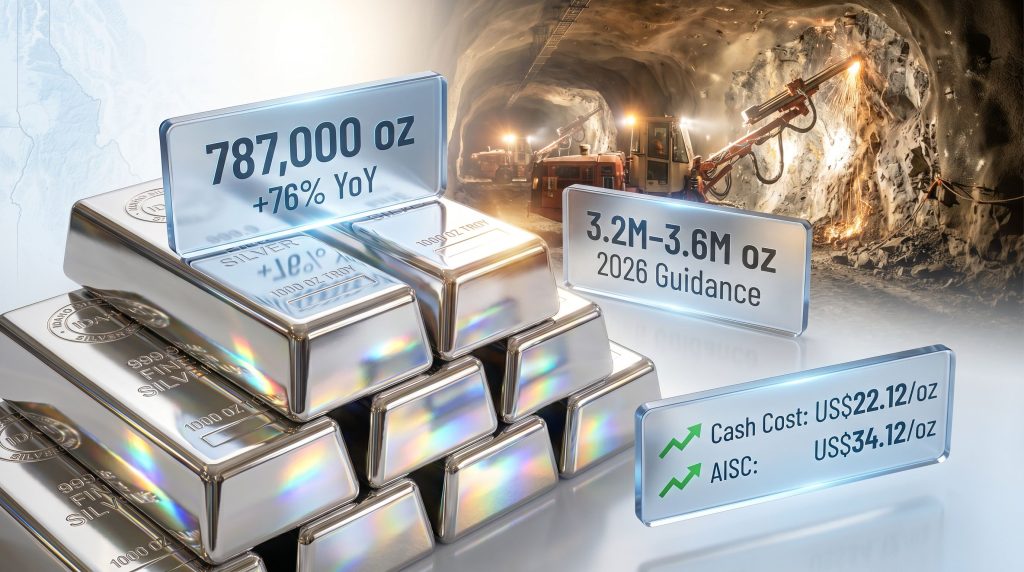
| Consolidated Silver Production | ~446,000 oz | ~787,000 oz | +76% |
| Galena Silver Production | ~315,000 oz | ~425,000 oz | +35% |
| Galena Cash Cost per Oz Sold | US$28.19 | US$22.12 | -21.5% |
| Consolidated AISC per Oz | Not provided | US$34.12 | Within guidance |
| Consolidated Silver Sales | Not provided | 830,000 oz | Record quarter |
The 21.5% reduction in Galena's cash cost per ounce, from US$28.19 to US$22.12, is the most operationally significant figure in the dataset. Cost reductions of this magnitude in underground mining are rarely achieved through price management or supply chain optimisation alone. They require genuine productivity improvements at the mine face, which is precisely what the long-hole stoping transition delivers when it is functioning within design parameters.
Full-year 2026 production guidance of 3.2 million to 3.6 million ounces represents approximately 30% growth over 2025 output levels, with AISC guidance maintained at US$30 to US$35 per ounce sold. The Q1 AISC of US$34.12 sits within the upper portion of this range, which is consistent with the cost profile expected during a ramp-up phase before the full productivity benefits of higher throughput rates are realised. The company's Q3 2025 results demonstrated similar positive momentum, reinforcing the case for sustained operational improvement heading into 2026.
The next major ASX story will hit our subscribers first
The 0.6x NAV Discount: Anatomy of an Execution Gap
Quantifying the Distance Between Current Multiples and Acquisition Precedent
Two recent acquisitions of primary silver producers have established a concrete benchmark for what the M&A market is willing to pay for assets of this type. Both Gatos Silver and Silverest were acquired at approximately 2 times net asset value, reflecting the scarcity premium that genuine primary producers command when strategic buyers compete for a limited number of qualifying targets.
Americas Gold & Silver currently trades at approximately 0.6 times NAV based on consensus analyst estimates, which exclude projects under evaluation beyond the 5-million-ounce annual production target. The gap between 0.6x and 2.0x is not noise. It is a quantifiable expression of the market's current scepticism about whether the operational improvements being reported will be sustained across multiple quarters at increasing scale.
This execution discount is a well-understood phenomenon in the mining investment cycle. Projects transitioning from turnaround phase to established operator status typically trade at compressed multiples until a track record of consistent delivery makes the transformation legible to a broader investor base.
"Valuation framework: In the mining sector, the gap between current trading multiples and acquisition precedent multiples typically reflects accumulated execution risk. As that risk is progressively retired through consistent operational delivery, the discount compresses. The pace and extent of that compression depends on both company-specific performance and broader commodity market sentiment. This analysis is not a guarantee of future price performance and should not be construed as investment advice."
Management Track Record as a Credibility Signal
The current management team's prior operational history provides a reference point for evaluating the probability of sustained execution. At their previous operation, the team delivered guidance in 19 out of 20 consecutive quarters, a track record that is notably difficult to achieve in underground precious metals mining, where geological variability, equipment reliability, and ground conditions routinely disrupt production forecasts.
A single quarter of strong results can be dismissed as timing or inventory management. Nineteen out of twenty quarters cannot. It is this prior record, rather than Q1 2026 alone, that forms the foundation of the re-rating argument for longer-duration investors.
Americas Gold & Silver's Antimony Joint Venture: Adding a Critical Minerals Dimension
The Strategic Logic of a Mine-to-Product Antimony Supply Chain
In February 2026, Americas Gold & Silver signed a joint venture agreement with United States Antimony to construct and operate an antimony processing facility within Idaho's Silver Valley. The company holds a 51% controlling interest in the venture, with the objective of creating a vertically integrated, domestic antimony supply chain from mine extraction through to finished product delivery.
The commercial rationale begins with Galena's own ore chemistry. High-grade silver veins in the Silver Valley carry copper and antimony as natural byproducts. Historically, these byproducts were either sold at minimal value or not monetised at all. Under a new agreement with Teck Resources, Americas began monetising copper and antimony production from Galena for the first time in Q1 2026, providing an immediate revenue contribution while the processing facility is developed.
What makes the antimony story strategically distinct is the supply geography. Galena currently operates as the only active antimony-producing mine in the United States. The broader context of antimony supply risks at a global level makes this domestic production capability particularly significant. Antimony's applications span defence-relevant uses, flame retardants, and semiconductor manufacturing, sectors where US supply security concerns are acute. The combination of domestic production capability and a vertically integrated processing ambition within a single jurisdictional boundary is a positioning that very few mining companies globally can replicate.
Investors should note that the antimony processing facility is in development rather than operational, and timelines for commissioning carry the typical execution risks associated with construction and permitting in the mining sector.
Balance Sheet and Capital Allocation: Funding Growth Without Dilution
The Financial Architecture Supporting the Expansion Program
A growth strategy is only as credible as the balance sheet supporting it. Americas Gold & Silver reported cash and cash equivalents of US$122.4 million and working capital of US$66.8 million as of March 31, 2026. Total capital expenditure for 2026 is targeted at US$90 million to US$120 million, including US$30 million to US$40 million directed toward the Crescent Mine.
The significance of this financial position is that the paste backfill plant construction, fibre optic installation, mill upgrades, and Crescent development can all proceed simultaneously without requiring additional equity issuance or new debt facilities. For investors sensitive to dilution risk, this self-funding capability removes one of the most common sources of value leakage in mining growth stories.
The 2026 exploration budget of US$15 million to US$20 million supports a 64,000-metre drilling campaign with the potential to extend Galena's mine life and expand the resource base beyond the 5-million-ounce annual production target. Supporting this program is a recently confirmed 19% year-over-year increase in Measured and Indicated Mineral Resources at Galena, alongside a 21% improvement in Measured and Indicated grades, reported on March 30, 2026. When both resource volume and grade improve simultaneously, it is a strong signal that the deposit's geological understanding is maturing in the right direction.
Institutional Capital Flows: Why Daily Volume Jumped from $500K to $75 Million
Reading the Liquidity Signal
Trading liquidity is not merely a convenience metric for active traders. It is a diagnostic indicator of the investor profile a company is attracting. Americas Gold & Silver's daily trading volume expanded from a range of US$400,000 to US$500,000 under prior management to a current range of US$70 million to US$75 million. That is not a marginal improvement. It represents a fundamental shift in the type of capital engaging with the stock.
The profile of new entrants appears to be generalist investors seeking leveraged precious metals exposure without the geological uncertainty of exploration-stage companies or the commodity diversification of major miners where silver is a secondary consideration. These investors specifically value US jurisdiction for reasons that go beyond operational familiarity:
-
Lower perceived political and regulatory risk relative to Latin American or African mining jurisdictions.
-
Alignment with domestic critical minerals policy frameworks that create a policy-informed rationale for holding US-based silver assets.
-
Proximity to institutional counterparties familiar with the Silver Valley's operational track record through established operators like Hecla Mining.
The Three-Layer Investment Architecture
The institutional thesis for the Americas Gold & Silver US silver producer strategic premium appears to rest on three distinct but reinforcing value layers:
-
Silver price leverage from primary producer status, which amplifies exposure to silver price movements relative to diversified miners where silver is incidental.
-
Critical minerals optionality from antimony production and processing capability on US soil, which introduces a second, policy-informed valuation layer independent of silver prices.
-
Multiple re-rating potential from the gap between the current 0.6x NAV trading multiple and the 2.0x NAV precedent established by recent primary silver producer acquisitions.
Key Milestones That Will Determine Whether the Strategic Premium Is Justified
Near-Term Execution Checkpoints
The investment thesis is execution-dependent, and the following milestones represent the critical validation points for the near-term period:
-
650 tonne-per-day exit rate at Galena by year-end 2026 is the primary operational test. Achieving this target would confirm that the long-hole stoping transition and hoisting upgrades are delivering as planned.
-
Quarterly production consistency within the 3.2 to 3.6 million ounce guidance range across all four quarters of 2026 will be the signal that shifts institutional perception from turnaround to established operator.
-
Antimony processing facility construction progress will determine whether byproduct revenue diversification is on track for the timeline communicated to investors.
Medium-Term Strategic Indicators
Beyond 2026, the following developments will shape whether the Americas Gold & Silver US silver producer strategic premium expands, stabilises, or reverses:
-
Paste backfill plant commissioning in 2027 and its role in unlocking the targeted 70% long-hole stoping production mix.
-
Results from the 64,000-metre drilling campaign and subsequent resource updates that could expand the production scalability pathway beyond 5 million ounces annually.
-
Evidence of additional Silver Valley consolidation activity, which would validate the district concentration thesis and potentially accelerate acquisition interest from larger operators.
-
Broader US critical minerals policy developments that may clarify whether domestic silver purchasing programmes or stockpile initiatives create incremental structural demand.
This article is for informational purposes only and does not constitute investment advice. Mining investments carry material risks including operational variability, commodity price exposure, and geological uncertainty. Investors should conduct independent due diligence before making any investment decisions.
Want to Know When the Next Major Silver Discovery Hits the ASX?
Discovery Alert's proprietary Discovery IQ model delivers real-time alerts the moment significant mineral discoveries — including silver — are announced on the ASX, turning complex data across 30-plus commodities into clear, actionable insights for investors at every level. Explore historic discovery returns on Discovery Alert's dedicated discoveries page and start your 14-day free trial today to position yourself ahead of the broader market.