June 4, 2026
What Are the Primary Bottlenecks Limiting Silver Recycling Capacity?
Modern silver recycling faces unprecedented challenges as global demand for secondary silver sources intensifies while processing infrastructure struggles to keep pace. Understanding these fundamental constraints reveals why recycled silver markets experience persistent supply volatility despite growing material availability from electronic waste and industrial applications. These silver recycling bottlenecks create significant disruptions that affect global supply security and market stability.
Material Collection and Sourcing Challenges
Electronic waste generation continues accelerating worldwide, yet formal recovery systems capture less than 20% of the estimated 62 million metric tons produced annually according to UN Global E-waste Monitor data. This collection inefficiency creates the first major bottleneck in silver recycling bottlenecks, where vast quantities of silver-bearing materials never reach processing facilities.
The declining silver concentrations in modern electronics compound collection challenges significantly. Contemporary smartphones contain approximately 0.034% silver by weight, representing a 40-60% reduction compared to electronics manufactured in previous decades. This concentration decline means recyclers must process substantially larger volumes of material to recover equivalent silver quantities, straining collection networks designed for higher-grade feedstock.
Geographic disparities in collection infrastructure create additional supply chain constraints. Only 57 countries maintain national e-waste legislation, leaving significant regions without formal collection systems. Developing economies particularly struggle with infrastructure gaps, where 80% of e-waste flows through informal channels, resulting in 30-50% silver recovery losses compared to properly managed formal processes.
Consumer behavior patterns further limit material availability for recycling operations. Unlike industrial silver scrap with predictable generation cycles, consumer electronics accumulate in households for extended periods before disposal. This behavioral dynamic creates unpredictable material flows that complicate facility capacity planning and processing schedules.
Japan's manufacturer take-back programs demonstrate optimal collection potential, achieving 98% mobile phone collection rates and recovering approximately 150,000 kg of silver annually from phones alone. However, replicating this success requires substantial coordination between manufacturers, governments, and consumers that remains absent in most global markets.
Processing Infrastructure Limitations
Processing capacity constraints represent the most critical element among silver recycling bottlenecks currently affecting global markets. Recent industry analysis confirms that refineries frequently operate at 78-85% capacity during standard periods, yet experience severe bottlenecks when processing demand peaks, forcing temporary material deferrals or processing suspensions.
Equipment capacity mismatches between collection and processing create persistent supply chain imbalances. Collection volumes in developed regions have expanded 12-15% annually while refinery capacity growth averages only 3-5% annually, creating a widening processing gap that constrains silver recovery regardless of material availability. Furthermore, this silver market squeeze intensifies during periods of high demand.
Sequential processing requirements for complex waste streams extend batch cycle times significantly. Standard silver extraction from simple scrap requires 5-7 days, while complex multi-metal alloys demand 14-21 days of sequential processing involving mechanical shredding, magnetic separation, density separation, leaching, and electrowinning stages.
Aging infrastructure compounds processing limitations across established recycling regions. Approximately 60% of silver recycling refineries in North America and Europe operate equipment over 15 years old, contributing to 8-15% reduced throughput efficiency compared to modern processing technologies.
The processing backlog problem becomes particularly acute during high silver price periods when recycling demand intensifies. Swiss refinery operations exemplify this constraint, processing approximately 400 metric tons of silver-bearing material annually while receiving requests exceeding 520 metric tons during peak demand quarters, creating 4-6 month processing backlogs.
When big ASX news breaks, our subscribers know first
How Do Contamination Issues Impact Silver Recovery Efficiency?
Chemical Contamination Barriers
Material contamination creates substantial processing inefficiencies that directly contribute to silver recycling bottlenecks by extending processing times and reducing recovery yields. Modern electronic waste contains 15-25 different metallic elements per kilogram, with competing base metals like copper, zinc, and nickel reducing silver extraction efficiency by 12-18% without specialized pre-treatment procedures.
Plastic and polymer residues present particularly challenging contamination issues for silver recovery operations. Contemporary circuit boards contain 25-35% by weight of polymeric binders and encapsulation materials that, when incompletely removed, increase processing time by 20-40% and reduce silver purity recovery from potential 99.9% levels to 92-96% in contaminated feedstock.
Hazardous substance complications further extend processing timelines through mandatory safety protocols and additional wastewater treatment requirements. Legacy electronics containing lead, cadmium, and mercury compounds increase processing time by 30-60% due to specialized handling procedures that regulatory compliance demands.
Non-ferrous metal interference creates electrochemical complications during silver recovery processes. When contaminating ions including iron, copper, and zinc enter electrowinning solutions, they create competing electrochemical reactions that reduce silver current efficiency from standard 95%+ levels to 70-85%, requiring extended processing time or increased electrical energy input.
Quality degradation risks from improper contamination management can render entire batches unsuitable for high-purity applications, forcing additional refining steps that add $3-8 per ounce to processing costs while extending batch cycle times substantially.
Technical Purification Challenges
Ultra-thin coating recovery presents significant economic barriers within silver recycling bottlenecks, particularly affecting electronic component processing. Modern electronics employ silver coatings of 0.5-2 microns thickness, where recovery costs approximately $15-25 per ounce compared to $8-12 per ounce from bulk silver sources, creating marginal viability when silver prices fall below $22-24 per ounce.
Multi-metal alloy separation demands specialized processing techniques that substantially increase complexity and cost. Materials containing three or more metallic elements require sequential separation stages with processing costs averaging 40-60% higher than pure silver recovery operations, while yields decline by 8-15% due to unavoidable separation losses.
Electrochemical process limitations constrain recovery efficiency from complex material compositions. Standard nitric acid leaching achieves 88-92% silver recovery from complex alloys, while alternative hydrometallurgical methods achieve 94-98% recovery but require specialized equipment and waste management systems that add significant operational costs.
Processing methodology selection directly impacts both recovery rates and economic viability. Printed circuit board recycling exemplifies these challenges, where silver content averages 0.08-0.15% by weight, requiring sequential milling, flotation, leaching, and electrowinning with total processing costs averaging $18-28 per kilogram of final silver recovered.
Current efficiency rates in electrowinning operations demonstrate technical constraints. Standard electrowinning cells operate at 92-96% current efficiency for silver recovery from clean solutions, yet contaminating ions reduce efficiency to 75-85%, requiring extended processing time or higher electrical energy input to maintain output levels.
Why Do Economic Factors Create Recycling Supply Volatility?
Price-Driven Processing Decisions
Silver price volatility creates significant challenges for recycling operations, with 2024 prices ranging from $19.50 to $33.50 per ounce, representing a 71% variance that directly affects processing profitability thresholds. These fluctuations force refineries to continuously reassess which materials remain economically viable for processing, contributing to supply volatility in recycled silver markets.
Industry standard processing costs averaging $12-18 per ounce for secondary silver recovery establish minimum break-even price thresholds of $20-22 per ounce for marginal materials. When silver prices fall below these levels, refineries defer processing of lower-grade materials and complex waste streams, reducing recycling volumes by 25-40% during low-price periods.
Processing cost calculations versus material recovery value create binary processing decisions that amplify supply volatility. Low-grade silver sources from electronic waste, averaging 50-150 ppm silver concentration, require $15-25 per ounce in processing costs, creating razor-thin margins that disappear entirely during price downturns.
Investment uncertainty stemming from price volatility limits infrastructure expansion decisions. Refinery operators require long-term supply guarantees and stable pricing to justify capital expenditures of $80-150 million per new facility, yet silver price volatility makes these investment decisions increasingly difficult to support. Meanwhile, ongoing silver supply deficits continue to pressurize markets.
Market timing considerations influence material release patterns significantly. During the 2020 COVID-era silver price collapse to $11.50 per ounce, recycling volumes dropped 35-40% as refineries suspended processing of marginal-grade materials, demonstrating how economic factors create supply disruptions independent of physical material availability. However, understanding silver squeeze strategies can help market participants navigate these challenges.
Cash flow dynamics compound processing decisions during volatile periods. Refineries with external capital constraints defer complex, longer-cycle materials that require 14-21 days of processing versus standard 5-7 day processing, as working capital costs at current 4-5% interest rates add $0.40-0.80 per ounce to effective processing costs.
Financial Viability Assessment Framework
Economic viability thresholds create distinct operational zones that determine recycling capacity utilization across different price ranges:
| Price Range (USD/oz) | Recycling Viability | Processing Priority | Capacity Utilization |
|---|---|---|---|
| Below $20 | Marginal | Low-grade materials deferred | 40-50% |
| $20-25 | Moderate | Standard processing maintained | 60-75% |
| $25-30 | Strong | Increased capacity utilization | 80-95% |
| Above $30 | Maximum | All available materials processed | 95-100% |
Processing margins vary dramatically across price tiers, creating operational decisions that directly impact silver recycling bottlenecks. Below $20 per ounce, processing costs exceed revenue by 8-15%, forcing refineries to suspend operations and hold material in inventory awaiting price recovery.
The $20-25 per ounce range compresses processing margins to 2-8% for complex materials, leading refineries to process primarily high-grade, simple materials including coins, bullion bars, and industrial scrap while deferring complex waste streams such as electronic waste, alloys, and contaminated materials.
Strong viability emerges in the $25-30 per ounce range, where processing margins expand to 10-18% for complex materials. This pricing level enables refineries to increase capacity utilization to 80-95% while processing broader feedstock ranges including electronic waste and lower-grade materials, though processing queues typically expand to 4-8 weeks.
Maximum processing occurs above $30 per ounce, where all available materials become economically viable for processing. However, this pricing level often creates capacity constraints as refineries attempt to process accumulated inventory backlogs while handling current material flows.
What Regulatory Constraints Limit Silver Recycling Operations?
Environmental Compliance Requirements
Environmental regulations create substantial operational constraints that contribute to silver recycling bottlenecks through mandatory compliance procedures and treatment requirements. Wastewater treatment standards for silver-bearing effluents require specialized equipment and monitoring systems that add significant operational costs while extending processing timelines.
Chemical usage restrictions affect processing methodologies across multiple jurisdictions, forcing refineries to employ alternative techniques that may reduce efficiency or increase costs. Air quality regulations limit certain refining techniques, particularly pyrometallurgical processes that could achieve higher throughput rates but exceed emission standards.
Hazardous waste classification requirements increase operational costs substantially when processing certain electronic waste streams. Materials containing lead, cadmium, mercury, or other regulated substances require specialized handling, storage, and disposal procedures that extend processing times by 30-60% compared to clean feedstock.
Worker safety regulations mandate specialized training, equipment, and procedures that affect processing capacity. Facilities processing complex waste streams must implement comprehensive safety protocols that may reduce daily throughput to ensure compliance with occupational health standards.
Waste disposal costs for processing residues create additional economic pressures, particularly for low-grade materials where disposal expenses can represent 15-25% of total processing costs. These expenses directly affect the minimum silver price thresholds required for economic viability.
Regional Regulatory Variations
Japan's nitric acid usage restrictions exemplify how regional regulatory differences create processing constraints. These regulations force alternative processing methods that may reduce recovery efficiency or increase processing time compared to standard industry practices, contributing to regional capacity limitations.
European Union WEEE directive compliance requirements affect electronic waste processing through mandatory collection targets, treatment standards, and reporting obligations. While these regulations improve collection rates, they also create administrative burdens and compliance costs that affect processing economics.
North American environmental standards influence facility design requirements, often mandating more extensive pollution control systems and monitoring equipment compared to facilities in regions with less stringent standards. These requirements increase capital costs for new facility development while affecting operating margins for existing operations.
Developing nation informal sector challenges create global supply chain inefficiencies where lack of regulatory oversight reduces recovery rates while potentially creating environmental and social problems. However, overly restrictive regulations without supporting infrastructure can drive operations underground, reducing formal sector recovery rates.
International trade regulations affect recycling material flows between regions with different processing capacities. Tariff structures, import restrictions, and environmental regulations governing international waste shipments can limit the ability to optimize processing across global capacity networks. Additionally, understanding market crash impact helps explain how these regulatory factors intersect with economic cycles.
How Do Infrastructure Deficiencies Constrain Global Silver Recovery?
Geographic Processing Imbalances
Global silver recycling capacity concentrates heavily in developed economies, creating geographic bottlenecks when these facilities reach capacity limits. North American and European refineries process approximately 60-70 million ounces annually but receive material requests exceeding 85-95 million ounces, creating a 20-25 million ounce annual processing gap.
Emerging market infrastructure gaps reduce potential recovery rates substantially despite these regions generating significant quantities of silver-bearing waste. Limited processing infrastructure forces material export to developed economies, adding transportation costs and extending supply chain timelines that reduce overall system efficiency.
Transportation bottlenecks between collection and processing centers create additional constraints, particularly affecting remote or rural collection areas. Limited logistics infrastructure increases material transport costs while extending delivery timelines that can affect processing schedules and capacity utilization.
Regional capacity imbalances become particularly pronounced during peak demand periods when developed economy facilities operate at maximum capacity while potential processing capacity in emerging markets remains underdeveloped due to technology transfer barriers and capital constraints.
Technology transfer barriers limit global best practice adoption, preventing emerging market operations from achieving recovery rates and processing efficiencies comparable to advanced facilities. This technological gap perpetuates capacity imbalances and reduces global recovery potential.
Investment and Capacity Planning Challenges
Long-term supply guarantee requirements for infrastructure investment create planning difficulties in volatile silver markets. Potential investors require assured material flows to justify $80-150 million facility investments, yet collection systems cannot guarantee consistent supply volumes due to consumer behavior variability.
Capital expenditure requirements for new refinery capacity significantly exceed most operators' financial capabilities, limiting capacity expansion despite clear demand for additional processing infrastructure. These high investment thresholds create barriers to entry that perpetuate existing capacity constraints.
Tariff impacts on international recycling trade flows affect capacity planning decisions by creating uncertainty about material sourcing costs and export market access. Trade policy changes can render international recycling operations economically unviable, affecting investment decisions for cross-border processing capacity.
Supply chain disruption vulnerabilities affect operational planning as facilities must maintain buffer capacity for unexpected material flow interruptions. These contingency requirements reduce effective capacity utilization while increasing operational costs through underutilized infrastructure.
Financing challenges for recycling infrastructure investment stem from uncertain returns due to commodity price volatility and regulatory changes. Traditional infrastructure financing models struggle to accommodate the unique risk profiles of precious metals recycling operations.
What Technological Innovations Could Address Current Bottlenecks?
Advanced Processing Technologies
Hydrometallurgical improvements offer significant potential for addressing silver recycling bottlenecks through enhanced complex waste stream handling capabilities. Advanced leaching technologies can achieve 94-98% silver recovery from challenging materials compared to 88-92% from conventional processing, while reducing processing time requirements.
Automated sorting systems provide opportunities to increase material preparation efficiency substantially. Modern optical sorting and AI-powered classification systems can process mixed electronic waste at rates exceeding manual sorting by 300-500%, while improving material quality consistency for downstream processing.
Real-time quality monitoring systems could reduce batch processing delays by enabling continuous process optimization rather than end-of-batch quality assessment. These systems allow immediate processing parameter adjustments that maintain quality standards while maximizing throughput rates.
Modular refining units enable distributed processing capacity that could address geographic imbalances in recycling infrastructure. Smaller, standardized processing modules require $15-25 million capital investment compared to $80-150 million for traditional large-scale refineries, while offering faster deployment timelines.
Energy recovery systems integrated with recycling operations could improve overall process economics by capturing waste heat for facility heating or electrical generation. These systems reduce operating costs while improving environmental compliance through reduced energy consumption.
Digital Supply Chain Solutions
Blockchain tracking systems provide material provenance verification that could improve collection efficiency while reducing contamination issues. Digital tracking enables refineries to identify high-quality material sources and provide collection incentives that increase recovery rates.
AI-powered demand forecasting systems could optimize processing schedules by predicting material flow patterns and price volatility impacts on processing demand. These systems enable capacity planning that reduces processing queues while maximizing facility utilization rates.
IoT monitoring networks improve collection efficiency by providing real-time data on material accumulation rates and quality characteristics. Smart collection systems can optimize pickup schedules while ensuring material quality maintenance throughout the collection process.
Predictive maintenance systems reduce equipment downtime through early failure detection and optimized maintenance scheduling. These systems can improve facility uptime by 8-15% while reducing maintenance costs through prevention of major equipment failures.
Digital marketplace platforms could connect material suppliers directly with processing facilities, reducing collection inefficiencies while providing price transparency that encourages increased participation in recycling programs. These platforms could also provide insights into silver price outlook trends.
The next major ASX story will hit our subscribers first
How Significant Is Silver Recycling in Global Supply Security?
Current Market Contribution Analysis
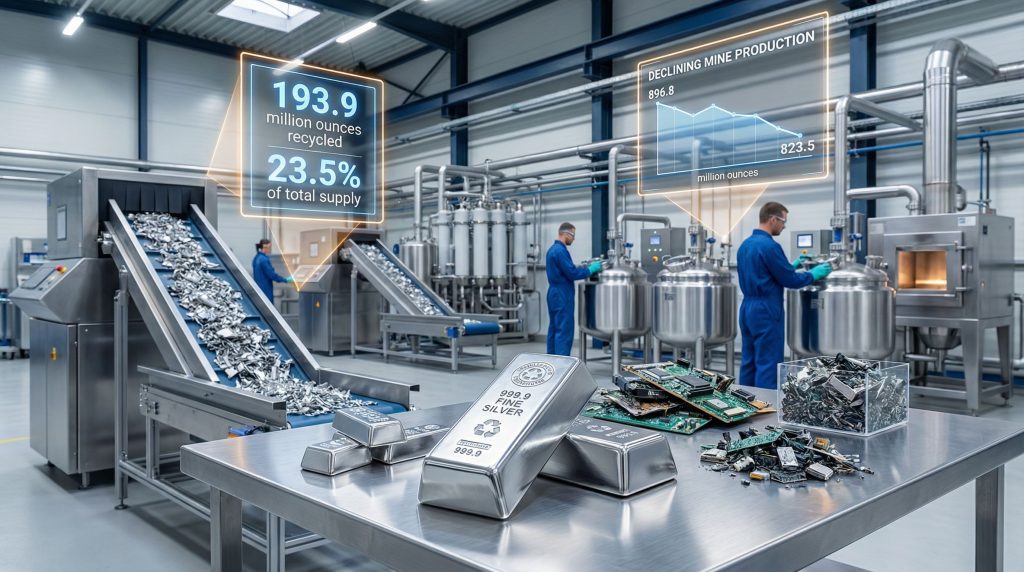
Silver recycling has achieved unprecedented significance in global supply security, reaching 193.9 million ounces in 2024, representing a 12-year high and demonstrating the growing importance of secondary silver sources. This recycled volume constitutes approximately 23.5% of total silver supply, establishing secondary sources as a crucial component of global silver markets.
Mine production declining from 896.8 to 823.5 million ounces between 2015 and 2024 underscores the critical importance of recycling in maintaining supply adequacy. This 73.3 million ounce decline in primary production increases dependency on recycled sources to meet growing industrial and investment demand.
The growing dependency ratio on recycled materials reflects fundamental changes in silver supply dynamics. As high-grade primary deposits become increasingly difficult to develop economically, recycled silver provides supply flexibility that mining operations cannot match due to long development timelines and geological constraints.
Industrial demand growth, particularly from solar panel production and electronics manufacturing, creates sustained demand pressure that mining supply alone cannot satisfy. Recycled silver provides the supply elasticity needed to respond to demand fluctuations without the multi-year development cycles required for new mining capacity.
Investment demand variability creates additional supply pressures during periods of economic uncertainty or currency devaluation. Recycling operations provide supply responsiveness to price signals that mining operations cannot match due to fixed production costs and capacity constraints.
Future Supply Scenario Modelling
Supply deficit projections indicate potentially severe market imbalances if current trends continue without infrastructure improvements. Analysis suggests recycling bottlenecks could create supply deficits exceeding 150 million ounces annually by 2030, representing nearly 20% of projected total demand.
Critical market insight reveals that processing capacity constraints, rather than material availability, represent the primary limitation on recycled silver supply. Without substantial infrastructure investment, these bottlenecks will intensify as electronic waste generation continues growing while mining production remains constrained.
Demand growth scenarios across industrial applications suggest recycled silver requirements could reach 250-300 million ounces annually by 2030, requiring processing capacity expansion of 60-80% compared to current levels. This expansion requirement significantly exceeds historical infrastructure growth rates.
Mining production forecasts indicate continued declining output from existing operations while new project development faces increasingly challenging economic and environmental constraints. This primary supply limitation increases recycled silver's strategic importance for supply security.
Geographic supply concentration risks affect supply security as processing capacity remains concentrated in developed economies despite waste generation occurring globally. Supply chain disruptions affecting major processing regions could create temporary but severe supply shortages.
What Investment Opportunities Exist in Silver Recycling Infrastructure?
High-Priority Development Areas
Urban mining facilities represent significant investment opportunities for concentrated electronic waste processing operations. Metropolitan areas generate 65-70% of electronic waste in developed economies, creating opportunities for dedicated processing facilities that can achieve economies of scale while reducing transportation costs.
Mobile processing units offer investment potential for addressing remote collection optimization challenges. Smaller, transportable processing systems could serve regional markets that cannot support large-scale facilities while providing processing services closer to material sources.
Specialised solar panel recycling presents emerging investment opportunities as first-generation installations approach end-of-life cycles. Current mechanical recycling methods recover only 85-88% of silver from photovoltaic panels, while proposed hydrometallurgical methods could achieve 96-98% recovery rates.
Medical device recovery systems capture high-purity silver sources that command premium pricing due to quality characteristics. Medical silver applications require 99.95%+ purity levels that justify higher processing costs while providing superior profit margins compared to electronic waste processing.
Automotive catalyst recycling infrastructure addresses growing silver content in emission control systems. Modern catalytic converters contain increasing silver loadings that create concentrated recovery opportunities with predictable supply flows from automotive recycling networks.
Strategic Partnership Models
Mining company-recycler alliances ensure integrated supply chains that optimise both primary and secondary production. These partnerships provide recycling operations with financial stability while offering mining companies supply flexibility to meet customer demand during production disruptions.
Technology licensing agreements accelerate best practice adoption across global recycling networks. Established recycling technologies can be licensed to emerging market operators, enabling rapid capacity expansion without requiring complete technology development.
Government-private sector collaborations provide funding mechanisms for infrastructure development that individual operators cannot finance independently. Public sector support reduces capital requirements while ensuring strategic supply security objectives align with private sector efficiency incentives.
Equipment manufacturer partnerships enable technology advancement through collaborative development programs. Processing equipment manufacturers can provide financing arrangements that reduce upfront capital requirements while ensuring access to latest processing technologies.
Collection network integration creates vertical supply chain coordination that improves material quality and supply consistency. Partnerships between collection operators and processing facilities ensure steady material flows while improving overall system efficiency. Additionally, understanding recycled silver applications helps identify high-value opportunities.
How Can Stakeholders Optimise Silver Recovery Efficiency?
Collection Network Enhancement
Incentive program design provides crucial mechanisms for encouraging consumer participation in recycling programs. Successful programs like Japan's manufacturer take-back initiatives demonstrate that structured incentives can achieve 98%+ collection rates when properly implemented with adequate consumer education and convenience factors.
Corporate take-back initiatives for electronics manufacturers create direct responsibility for product lifecycle management while ensuring high-quality material flows to recycling facilities. These programs reduce collection costs while improving material quality consistency through controlled reverse logistics.
Municipal waste stream integration improves collection rates by incorporating electronic waste into existing collection infrastructure. Cities achieving integrated collection report 40-60% higher participation rates compared to separate collection programs, while reducing collection costs through shared logistics.
International cooperation frameworks enable standardised recovery practices that improve global recycling efficiency. Harmonised standards for material classification, processing requirements, and quality specifications reduce trade barriers while enabling capacity optimisation across regions.
Educational campaigns targeting consumers significantly improve participation rates and material quality. Programs emphasising proper device preparation and collection timing can reduce processing costs by 15-25% while increasing recoverable silver content through better material handling.
Operational Excellence Strategies
Continuous flow processing represents a fundamental improvement over traditional batch-based operations. Flow processing reduces silver recycling bottlenecks by eliminating batch cycle delays while enabling higher capacity utilisation through constant material throughput rather than intermittent processing cycles.
Multi-metal recovery optimisation maximises facility utilisation by extracting gold, platinum, palladium, and other valuable metals alongside silver. Integrated precious metals recovery improves processing economics while justifying investment in advanced processing equipment.
Quality assurance protocols maintain recycled material standards that command premium pricing while ensuring customer acceptance. Rigorous quality control enables recycled silver to substitute for primary silver in industrial applications without performance compromises.
Workforce development programs build specialised technical expertise required for complex waste stream processing. Trained technicians improve processing efficiency while reducing safety risks associated with hazardous material handling in recycling operations.
Supply chain visibility systems enable real-time tracking of material flows from collection through final processing. These systems optimise capacity planning while identifying bottlenecks before they affect processing schedules or customer deliveries.
Addressing Silver Recycling's Critical Constraints
Silver recycling bottlenecks represent complex challenges spanning material collection, processing capacity, economic viability, and regulatory compliance. These constraints collectively limit recycled silver supply despite growing material availability from electronic waste and industrial applications, creating market inefficiencies that affect global supply security.
Processing capacity limitations currently represent the most binding constraint, where refineries operate at maximum capacity during peak demand periods while material accumulates in processing queues extending 4-6 months. This infrastructure deficit requires coordinated investment exceeding $2-3 billion globally to achieve adequate processing capacity for projected recycling demands.
Economic volatility creates supply unpredictability as processing decisions depend heavily on silver price levels relative to processing costs. Price-sensitive processing thresholds mean recycled silver supply can vary by 25-40% based solely on spot price movements, independent of material availability or demand requirements.
Technological innovations offer significant potential for addressing current bottlenecks through improved processing efficiency, automated material handling, and digital supply chain optimisation. Advanced hydrometallurgical processes could increase recovery rates to 94-98% while reducing processing time requirements substantially.
The strategic importance of recycled silver continues growing as mining production declines and industrial demand expands. Recycled sources now provide 23.5% of total silver supply, with this percentage likely increasing as electronic waste generation accelerates while new mining development faces increasing constraints.
Organisations capable of addressing infrastructure limitations, processing efficiency challenges, and supply chain coordination problems may find substantial opportunities in an increasingly supply-constrained silver market. Success requires integrated approaches addressing collection, processing, and distribution challenges simultaneously rather than isolated solutions to individual bottlenecks.
Investment opportunities exist across the recycling value chain, from urban mining facilities and mobile processing units to specialised recovery systems for emerging waste streams. Strategic partnerships between mining companies, technology providers, and government agencies offer mechanisms for financing infrastructure development while ensuring operational efficiency.
Resolving silver recycling bottlenecks ultimately depends on coordinated industry action addressing capacity constraints, technological advancement, regulatory harmonisation, and economic incentive alignment. Without these improvements, recycling limitations will increasingly constrain silver supply adequacy as global demand continues expanding across industrial, technological, and investment applications.
Ready to Capitalise on Silver Market Opportunities?
Silver supply constraints and recycling bottlenecks create significant market opportunities for informed investors tracking the precious metals sector. Discovery Alert's proprietary Discovery IQ model delivers real-time notifications on ASX silver discoveries and mining developments, empowering subscribers to identify actionable opportunities before broader markets react. Begin your 30-day free trial with Discovery Alert today to gain a competitive advantage in the evolving silver market.