May 18, 2026
Modern financial markets operate under a complex web of central bank interventions, monetary policy shifts, and technological disruptions that collectively influence asset pricing across multiple sectors. Among precious metals, one commodity stands apart for its extraordinary price volatility and dual-market characteristics that create unique investment dynamics during periods of monetary uncertainty. Understanding silver as the restless metal becomes crucial for investors navigating today's complex financial landscape.
Understanding Silver's Volatile Market Characteristics
The Historical Framework Behind Silver's Restless Nature
Silver has earned its reputation as the "restless metal" through decades of extreme price movements that dwarf those of traditional precious metals. This terminology originates from Roy Jastram's seminal 1982 work Silver: The Restless Metal, which documented silver's tendency toward dramatic price swings compared to gold's more measured appreciation patterns.
Recent market action exemplifies this volatility, with silver surpassing $60 USD per ounce for the first time in history during December 2025, while gold maintained levels above $4,200 USD per ounce. This price surge reflects fundamental market forces rather than speculative excess, distinguishing the current cycle from previous bubble episodes.
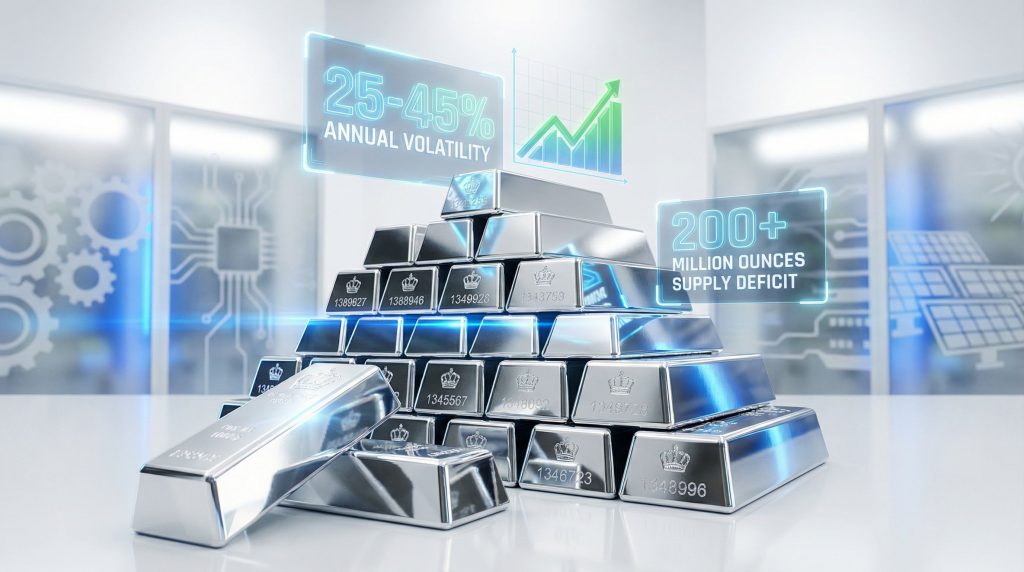
The metal's price behavior exhibits characteristics comparable to highly volatile assets like Bitcoin, with annual volatility ranges often exceeding 25-45% compared to gold's more stable 15-25% range. This extreme sensitivity stems from silver's unique position straddling both monetary and industrial demand sectors.
Physical Properties Driving Industrial Demand
Silver's exceptional conductivity properties create irreplaceable applications across multiple industrial sectors. The metal's electrical conductivity surpasses all other elements, making it essential for high-performance electronics, renewable energy systems, and advanced manufacturing processes where substitution would result in significant efficiency losses.
Solar photovoltaic manufacturing represents a particularly significant demand driver, consuming approximately 15% of annual global silver supply according to industry estimates. This industrial consumption creates supply constraints independent of monetary metal demand, contributing to the complex price dynamics that characterise silver as the restless metal.
Monetary Metal Status During Currency Instability
Silver functions as both an industrial commodity and a monetary hedge, responding to currency debasement concerns while simultaneously reacting to supply-demand imbalances in manufacturing sectors. This dual nature creates price discovery mechanisms that operate across different market cycles and economic conditions.
During periods of central bank monetary expansion, silver attracts investment flows from participants seeking protection against currency dilution. The "debasement trade" phenomenon occurs when investors anticipate that monetary policy expansion will erode purchasing power, making commodity-denominated assets more attractive as wealth preservation vehicles.
When big ASX news breaks, our subscribers know first
Silver's Investment Appeal in Current Market Conditions
Supply-Demand Fundamentals Creating Price Pressure
Current market dynamics reflect a significant supply-demand imbalance that extends beyond traditional monetary considerations. Furthermore, the silver supply deficits continue outpacing mine production increases, creating structural deficits that support price appreciation independent of speculative trading activity.
The supply constraint mechanism operates through multiple channels:
• Mining production bottlenecks limiting new supply additions
• Geographic concentration of major silver deposits creating supply chain vulnerabilities
• Industrial hoarding patterns among technology manufacturers securing future supply
• Recycling limitations preventing secondary supply from meeting demand growth
Unlike purely monetary metals, silver's industrial applications create consistent baseline demand that provides price support during economic downturns while amplifying upward pressure during growth periods.
Technology Sector Expansion Driving Consumption
The global transition toward renewable energy technologies significantly increases silver consumption patterns across multiple applications. Electric vehicle manufacturing, energy storage systems, and advanced semiconductor production all require silver inputs that cannot be economically substituted without performance degradation.
This technological demand trajectory operates independently from precious metals investment flows. Consequently, it creates a fundamental supply constraint that persists regardless of monetary policy changes or investor sentiment shifts toward hard assets.
Portfolio Diversification Through Volatility Management
Silver's extreme price movements create both opportunities and risks for portfolio managers seeking exposure to precious metals sectors. The metal's volatility patterns exhibit low correlation with traditional equity markets during stress periods, providing diversification benefits despite higher individual asset risk.
Volatility Comparison Analysis:
| Asset Class | Annual Volatility Range |
|---|---|
| Bitcoin | 80-120% |
| Silver | 25-45% |
| Gold | 15-25% |
| S&P 500 | 12-20% |
Strategic allocation models typically recommend limiting silver exposure to 5-10% of precious metals holdings due to volatility considerations. In addition, they maintain gold as the primary monetary hedge component.
Central Bank Policy Impact on Precious Metals Markets
Federal Reserve Liquidity Management and Market Stress
Current Federal Reserve liquidity conditions mirror stress patterns observed during previous market disruptions. For instance, overnight repo rates have been trading approximately 60 basis points above the Fed's target rate during year-end 2025 trading. This spread indicates underlying strain in money markets that historically precedes significant monetary policy interventions.
The 2019 repo crisis provides historical context for understanding current dynamics. During September 2019, overnight rates on Treasury-collateralised lending spiked from approximately 2% to 10% within a single trading session, forcing Federal Reserve intervention through liquidity injections totaling $60 billion monthly.
This precedent established the Fed's "fourth mandate" of maintaining smooth market functioning beyond the three statutory mandates. However, current market stress suggests potential for renewed monetary expansion if liquidity conditions deteriorate further.
Political Pressure Influencing Monetary Policy Direction
Political considerations increasingly influence Federal Reserve decision-making processes, with explicit policy preferences communicated through public statements regarding future monetary policy direction. Recent statements suggest rate reduction expectations exceed traditional economic justifications based on employment and inflation metrics.
This political influence creates additional uncertainty around monetary policy implementation, contributing to precious metals demand as investors seek assets independent from policy discretion. Furthermore, a potential silver market squeeze benefits from this environment through both monetary hedge appeal and industrial demand growth during economic expansion periods.
Global Interest Rate Divergence Creating Currency Volatility
International monetary policy divergence, particularly regarding Bank of Japan rate normalisation, creates currency instability that historically benefits precious metals markets. Japanese 10-year yields approaching 2% represent significant increases from previous near-zero levels, potentially triggering capital repatriation flows.
The carry trade unwinding scenario poses systemic risks to leveraged financial positions across multiple markets. Consequently, precious metals serve as traditional safe-haven assets during periods of forced deleveraging and margin calls.
Market Structure and Investment Vehicle Considerations
Physical Silver Storage and Insurance Requirements
Physical silver investment involves storage costs and insurance considerations that differ significantly from paper precious metals instruments. The metal's lower unit value compared to gold requires larger storage volumes for equivalent monetary exposure, creating logistical challenges for individual investors.
Professional storage facilities offer allocated storage options with insurance coverage. However, these services add ongoing costs that reduce net investment returns. Self-storage alternatives require security measures and insurance arrangements that many investors find impractical for significant allocations.
ETF Premium and Discount Dynamics
Exchange-traded funds tracking silver prices experience premium and discount variations during volatile market periods, creating tracking errors that affect investment performance. Physical silver ETFs face redemption pressures during stress periods when investors seek direct metal ownership rather than fund shares.
Leveraged silver ETFs amplify price movements through derivative positions. Consequently, they create additional volatility during market stress while providing tactical trading opportunities for sophisticated investors willing to accept enhanced risk exposure.
Dollar-Cost Averaging Versus Tactical Timing Strategies
Silver's extreme volatility makes timing-based investment strategies particularly challenging. Moreover, sudden price movements create significant opportunity costs for investors attempting market timing approaches. Dollar-cost averaging strategies help smooth purchase price volatility while maintaining consistent market exposure.
Professional traders may employ tactical approaches during obvious supply-demand imbalances. However, these strategies require constant market monitoring and willingness to accept significant drawdown periods during adverse price movements.
Industrial Applications and Supply Chain Vulnerabilities
Technology Manufacturing Dependencies
Silver's unique properties create manufacturing dependencies that cannot be economically substituted across multiple high-growth technology sectors. Advanced semiconductor production, 5G infrastructure development, and electric vehicle manufacturing all require silver inputs where performance degradation from substitutes would compromise product functionality.
The renewable energy transition particularly depends on silver for photovoltaic cell efficiency, with alternative materials providing inferior electrical conductivity that reduces energy conversion rates. This technological lock-in effect ensures consistent industrial demand regardless of economic cycle positioning.
Geographic Concentration and Mining Constraints
Global silver production concentrates in specific geographic regions, creating supply chain vulnerabilities during political instability or trade disputes. Major producing countries face infrastructure limitations that constrain rapid production increases even during elevated price periods.
Mining grade depletion at existing operations requires increasingly complex extraction processes. Furthermore, this raises production costs and limits supply elasticity. New mine development timelines span multiple years, preventing rapid supply responses to price signals.
Secondary Supply and Recycling Limitations
Silver recycling rates remain significantly lower than gold due to the metal's dispersion across numerous small applications rather than concentration in easily recoverable forms. Electronic waste recycling captures only a fraction of silver content due to economic constraints in recovery processes.
Industrial applications often consume silver through processes that make recovery impractical. Consequently, this creates permanent supply reduction that cannot be offset through recycling programmes. This dynamic contrasts with gold's higher recovery rates from jewelry and investment holdings.
Risk Assessment and Volatility Management
Extreme Price Movement Scenarios
Silver's price history includes multiple episodes of 40-50% monthly gains followed by equally dramatic corrections, creating significant wealth transfer between market participants during short timeframes. The 2011 price spike to nearly $50 per ounce followed by subsequent collapse to $14 demonstrates the metal's capacity for extreme movements.
These volatility episodes typically coincide with broader financial stress periods when traditional risk management models fail to predict correlation increases across asset classes. Although silver's industrial demand component provides some downside protection, monetary factors dominate during crisis periods.
Correlation Analysis During Market Stress
Silver exhibits complex correlation patterns with equity markets, bonds, and currencies that shift dramatically during stress periods. Historical analysis shows correlation increases during market panics when liquidity constraints force broad asset sales regardless of fundamental valuations.
Understanding silver vs gold history reveals these performance differentials reflect varying demand patterns, with silver's industrial component providing both upside leverage during growth periods and downside vulnerability during manufacturing contractions.
20-Year Precious Metals Performance Comparison:
| Metal | Total Return |
|---|---|
| Gold | +520% |
| Silver | +380% |
| Palladium | +290% |
| Platinum | +180% |
Portfolio Allocation Guidelines
Risk-adjusted portfolio allocation typically limits silver exposure to complement rather than replace gold holdings. Furthermore, total precious metals allocation ranges from 5-15% of investment portfolios depending on risk tolerance and economic outlook.
Conservative investors may prefer physical silver allocation of 2-5% of total holdings. Alternatively, aggressive portfolios might accept 10-15% allocation through combination of physical metal, mining equities, and ETF instruments to capture upside leverage while managing downside exposure.
The next major ASX story will hit our subscribers first
Future Scenarios and Market Outlook
Green Energy Transition Impact Projections
Global renewable energy installation targets require significant silver consumption increases over the next decade. Solar capacity additions alone potentially consume 20-25% of annual silver production by 2030. Energy storage system deployment adds additional demand pressure through battery technology applications.
Electric vehicle adoption creates secondary silver demand through charging infrastructure, power electronics, and battery management systems that scale with transportation electrification rates. These demand projections assume continued technology deployment without major substitution breakthroughs.
Monetary System Evolution Considerations
Central bank digital currency implementation may affect precious metals demand patterns through changes in physical cash usage and monetary transmission mechanisms. Historical precedent suggests monetary system transitions typically benefit hard asset demand during uncertainty periods.
Currency instability scenarios could dramatically increase silver's monetary demand component. This occurs particularly if inflation expectations exceed central bank policy responses. The metal's accessibility compared to gold makes it attractive for smaller-scale monetary hedge positioning.
Geopolitical Risk and Supply Nationalisation
Trade tensions and resource nationalism trends may fragment global silver supply chains, creating regional price variations and supply security concerns among major consuming nations. Strategic stockpiling policies could remove significant supply from commercial markets.
Supply chain diversification efforts may increase mining investment in politically stable regions. However, development timelines limit near-term supply additions. Alternative supply sources require substantial capital investment and regulatory approvals spanning multiple years.
Current supply deficit estimated at 200+ million ounces annually, driven by industrial demand growth outpacing mine production increases. Solar panel manufacturing alone consumes 15% of global silver supply, creating structural support for price appreciation independent of monetary factors.
Strategic Investment Positioning
Investment Vehicle Selection Considerations
Physical silver ownership provides direct exposure without counterparty risk. Nevertheless, storage and insurance costs reduce net returns compared to paper alternatives. Allocated storage accounts offer professional management while maintaining ownership claims to specific metal holdings.
Silver mining equities provide leveraged exposure to metal prices while adding operational and management risks specific to individual companies. Diversified mining ETFs reduce single-company risk while maintaining sector exposure and dividend potential during profitable periods.
Risk-Adjusted Allocation Strategies
Modern portfolio theory suggests limiting high-volatility assets like silver to tactical allocations that complement rather than dominate precious metals exposure. Strategic core holdings typically emphasise gold's monetary characteristics while using silver for enhanced upside participation.
Tactical positioning may increase silver allocation during obvious supply-demand imbalances or monetary policy shifts. Investors seeking to capitalise on these opportunities should consider silver squeeze strategies that favour industrial commodity exposure over pure monetary hedges. These positions require active monitoring and predetermined exit strategies to manage volatility exposure.
For those interested in relative value opportunities, analysing gold-silver ratio insights can help identify optimal entry points and allocation adjustments. According to The Silver Institute's comprehensive analysis, understanding these historical relationships provides crucial context for modern investment decisions.
Silver as the restless metal reflects fundamental characteristics that create both significant opportunities and substantial risks for investors seeking precious metals exposure. The metal's dual nature as both industrial commodity and monetary asset generates complex market dynamics that require careful analysis and appropriate risk management to navigate successfully. Current market conditions suggest continued volatility ahead as supply-demand imbalances intersect with monetary policy uncertainty to create an environment where silver's restless nature will likely persist.
Looking to Capitalise on Silver's Explosive Market Movements?
Discovery Alert's proprietary Discovery IQ model delivers real-time alerts on significant mineral discoveries across the ASX, helping investors identify actionable opportunities in precious metals and mining companies before broader market recognition. With silver's recent surge past $60 USD per ounce highlighting the sector's potential, begin your 30-day free trial today to gain the market-leading edge needed to navigate these restless metal markets successfully.