
August 11, 2026
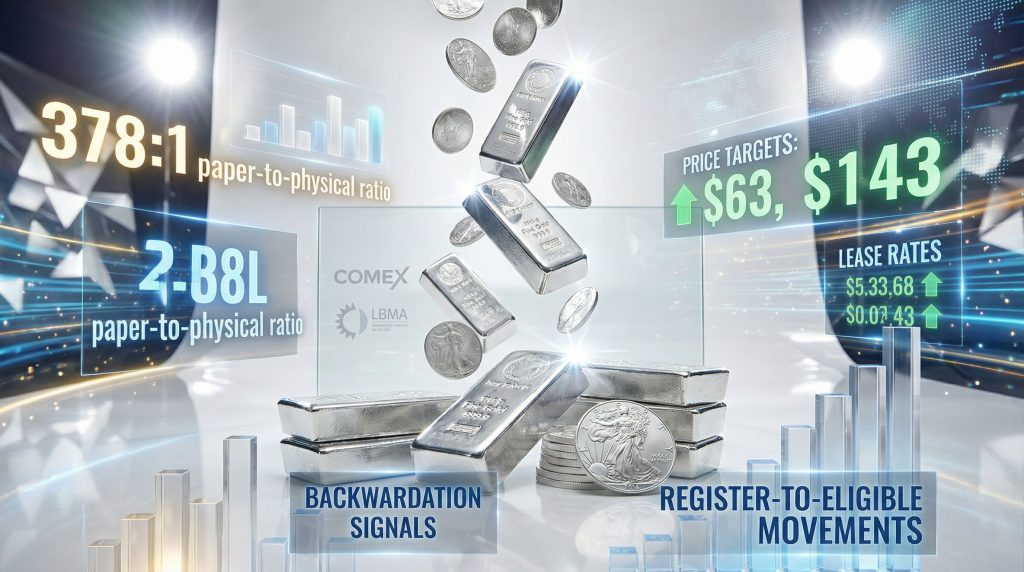
The silver short squeeze debate has dominated precious metals discussions throughout 2024, yet market evidence suggests silver remains in a tightness phase rather than experiencing an active squeeze. Understanding the distinction between market stress and genuine squeeze conditions becomes crucial for investors navigating these volatile waters.
Understanding Silver Market Mechanics Before the Squeeze
The silver market operates within a complex ecosystem where paper contracts vastly outnumber physical metal availability. Current market data suggests paper-to-physical ratios have reached concerning levels, with some estimates indicating over 300 paper claims for every ounce of deliverable silver. This structural imbalance creates inherent volatility when physical delivery becomes demanded rather than deferred.
Physical vs. Paper Silver Dynamics
The foundation of silver market mechanics rests on the relationship between three major exchanges: COMEX in New York, the London Bullion Market Association (LBMA), and the Shanghai Gold Exchange (SGE). Each serves distinct functions in global silver price discovery and physical settlement. COMEX operates as the primary futures market for North American silver contracts, while LBMA facilitates over-the-counter physical transactions internationally.
The SGE has emerged as a significant physical delivery hub, particularly for Asian market participants. Physical silver availability becomes constrained when large holders withdraw metal from "registered" status (available for delivery) to "eligible" status (stored but unavailable for immediate delivery). Consequently, this reclassification can occur during market stress periods, effectively reducing the pool of metal available to fulfil delivery obligations.
Recent market observations indicate substantial movements from registered to eligible categories during periods of price volatility. The paper silver market includes futures contracts, options, and exchange-traded funds that may not hold proportional physical backing. When retail investors purchase silver ETFs like SLV, custodian banks must either allocate existing vault inventory or source additional physical metal.
Market analysts note that custodians previously managed this through internal reallocation. However, current demand levels may have exhausted excess inventory buffers, highlighting the growing silver supply deficits drivers affecting the market.
What Defines a True Short Squeeze vs. Market Tightness
Distinguishing between market tightness and an actual silver short squeeze requires examining specific behavioural indicators. True short squeezes exhibit vertical price movements, forced liquidations, and the inability of short holders to roll positions forward. Current silver market conditions show gradual price increases averaging $2 per week, which market participants characterise as orderly price discovery rather than panic-driven vertical moves.
The 2022 London Metal Exchange nickel crisis provides a modern benchmark for squeeze dynamics. Nickel prices spiked from approximately $8,500 per tonne to over $48,000 in a single session, prompting exchange intervention and liquidation-only trading rules. This event demonstrated how true squeezes develop rapidly and require regulatory intervention to prevent market collapse.
Furthermore, lease rates serve as the most reliable early warning system for potential squeezes. Normal silver lease rates operate around 0.25% annually, while crisis conditions can drive rates above 200%. These rates reflect the cost of borrowing physical metal for delivery purposes.
When lease rates spike dramatically, it signals acute physical scarcity and typically precedes significant price moves. Current market behaviour suggests shorts retain the ability to roll positions forward by paying backwardation premiums. This "extend and pretend" strategy allows shorts to defer delivery obligations monthly while hoping new supply materialises.
When big ASX news breaks, our subscribers know first
Current Silver Market Positioning Analysis
Global silver flows have experienced significant disruption over the past three years, with China emerging as a dominant accumulation force. Intelligence from industry sources indicates Chinese entities have been purchasing silver directly from mining operations, refiners, and concentrate producers before metal reaches exchange delivery systems. This strategy, described as "intercepting at the mint," removes potential supply from Western markets before it becomes available for traditional trading mechanisms.
Supply Chain Bottlenecks Creating Pressure
The repatriation of precious metals to American markets following the 2024 election created temporary supply relief. However, this flow has stabilised as tariff impacts on silver uncertainties diminished. American retail investors have returned to silver markets through ETF purchases, creating renewed demand pressure on custodial systems.
This renewed domestic demand coincides with continued Chinese accumulation, creating a dual-pressure scenario on available supply. Production constraints from mining operations have not kept pace with accelerating demand. Traditional silver supply sources include primary silver mines and silver recovered as a byproduct of base metal mining.
When base metal production declines or mining operations face operational challenges, secondary silver supply decreases proportionally. Current mining industry reports suggest production has not expanded sufficiently to offset increased consumption from both industrial and investment sources. The solar energy sector alone consumes substantial silver quantities for photovoltaic panel production.
As renewable energy adoption accelerates globally, industrial silver demand continues growing. This industrial consumption, combined with investment demand, creates competing pressure on available supply that mining production struggles to fulfil.
Financial Engineering Mechanisms in Play
The "extend and pretend" strategy currently employed by shorts involves systematically rolling delivery obligations into future months. When silver trades in backwardation (spot prices exceeding futures), shorts must pay premiums to defer delivery. For instance, if spot silver trades at $59 while one-year futures trade at $57, a short must pay $2 per ounce to roll the obligation forward.
This backwardation premium represents the market's assessment of physical tightness. Each monthly roll incurs a loss for shorts, but allows them to avoid immediate physical delivery requirements. The strategy succeeds as long as shorts can absorb these monthly premiums while hoping supply conditions improve.
ETF demand creates additional complications for custodial banks. When investors purchase shares in silver ETFs, custodians must back these shares with physical metal. Previously, banks could allocate internal vault inventory to meet new ETF demand. Nevertheless, current conditions suggest custodians have exhausted excess inventory, forcing them to source additional physical metal from increasingly tight markets.
The phenomenon of "double-dipping" occurs when the same physical metal serves multiple purposes simultaneously. Custodians may use vault inventory to back ETF shares while simultaneously lending portions of that metal into the lease market. This leverage multiplies the utilisation of physical inventory, but becomes problematic when lease demand and ETF demand accelerate simultaneously.
Is Silver Currently in a Short Squeeze? Expert Analysis
Market evidence suggests silver remains in a tightness phase rather than experiencing an active silver short squeeze. The absence of distressed exits, forced liquidations, or margin-call driven panic indicates shorts retain viable exit strategies through position rolling. True squeezes eliminate these exits, forcing immediate capitulation or default.
Evidence Against Current Squeeze Status
Price action provides the clearest evidence against current squeeze conditions. Silver's movement from $50 to $54, followed by correction and subsequent recovery, demonstrates orderly price discovery rather than vertical squeeze dynamics. Weekly gains averaging $2 suggest gradual revaluation rather than panic-driven buying.
Comparative analysis with other commodities supports this assessment. Copper experienced 3% single-day moves and 7.5% two-week gains during the same period, representing larger moves in a much larger market. These copper moves received minimal media attention, while silver's more modest gains generated significant coverage, suggesting perception rather than reality drives current silver market discussion.
The successful rolling of short positions monthly indicates shorts maintain access to deferral mechanisms. During true squeezes, these mechanisms fail as counterparties refuse to extend credit or accept rolled positions. The continued availability of rolling options suggests market makers still provide liquidity for position management, according to recent analysis on short squeeze dynamics.
Exchange operations continue normally without emergency interventions. During the 2022 nickel crisis, the London Metal Exchange implemented liquidation-only trading and position limits within hours of price spikes. COMEX has not implemented similar emergency measures for silver, indicating exchange officials view current conditions as manageable.
Warning Signs of Impending Pressure
Several incidents during November 2024 suggested potential coordination amongst large market participants. A reported coolant system failure at COMEX warehouse facilities coincided with significant metal reclassification from registered to eligible status. While exchanges maintain multiple redundancies should prevent such failures, the timing raised questions about coincidental market stress.
Simultaneously, large buy orders appeared on the Shanghai Gold Exchange while COMEX experienced technical difficulties. Industry observers noted the coordination timing, with some suggesting attempts to trigger squeeze conditions through simultaneous pressure across multiple exchanges. While unconfirmed, these incidents demonstrate the interconnected nature of global silver markets, potentially contributing to a broader silver squeeze market transformation.
Register-to-eligible metal movements accelerated during peak volatility periods. When custodial banks move metal from immediately deliverable status to storage-only status, it reduces available supply for contract settlement. Large movements during price peaks suggest defensive positioning by major holders.
The frequency of such "technical difficulties" during market stress periods has increased compared to historical norms. Whether coincidental or coordinated, these incidents indicate system strain during periods of elevated demand and price volatility.
What Would Trigger an Actual Silver Short Squeeze?
Lease rate spikes represent the most reliable leading indicator for potential squeeze development. When borrowing costs for physical silver exceed sustainable levels, shorts face impossible mathematics. Lease rates above 200% annually make rolling strategies economically unviable, forcing either capitulation or default.
Critical Threshold Scenarios
Industrial demand surges could overwhelm available supply faster than investment demand. Large manufacturers requiring immediate physical delivery for production purposes cannot defer like financial speculators. If major industrial consumers simultaneously demand delivery, available inventory could deplete rapidly.
Central bank or sovereign wealth fund accumulation represents another trigger scenario. Unlike retail investors who may accept ETF shares, institutional buyers often require physical delivery and secure storage. Large institutional accumulation programmes could exhaust registered inventory quickly.
Geopolitical events affecting major silver-producing regions could disrupt supply expectations. Approximately 57% of global silver production comes from just seven countries. Political instability or trade restrictions affecting major producers could trigger supply concern buying, as evidenced by professional analysis of squeeze mechanics.
Exchange delivery failures would immediately escalate market stress. If COMEX or LBMA cannot fulfil delivery obligations on expired contracts, it would signal system breakdown and likely trigger vertical price moves as remaining shorts rush to cover positions.
Price Targets and Mathematical Models
Technical analysis suggests measured move targets based on recent breakout patterns. Silver's move from the $44 low to the $53 breakout level creates a $9 range. Adding this range to the breakout point suggests initial targets near $63, assuming sustained momentum above current levels.
Historical precedent from other critical minerals provides framework for potential price appreciation. When lithium and uranium received critical mineral designations, both experienced average gains exceeding 300% within five years. Applying similar mathematics to silver's current base suggests potential targets near $143, representing conservative projections based on established precedents.
However, these projections assume orderly market development without intervention. Vertical price moves typically trigger regulatory or exchange response, potentially limiting upside acceleration. The balance between mathematical targets and intervention thresholds creates uncertainty around ultimate price objectives, influencing silver squeeze price strategies market participants employ.
Potential Market Outcomes and Risk Assessment
Two primary scenarios emerge for silver market development: orderly price appreciation versus vertical squeeze dynamics. Each carries distinct implications for investors, exchanges, and regulatory authorities.
Orderly Rally Scenario (Preferred by Markets)
Gradual price increases of $2-5 monthly allow market participants to adjust positions systematically without triggering emergency interventions. This scenario benefits mining companies through sustainable PE ratio expansion as commodity prices rise predictably. Investors can make calculated decisions without panic-driven volatility.
Regulatory authorities prefer orderly markets that maintain system stability while allowing price discovery. Gradual increases keep precious metals "off the headlines," reducing public attention that might complicate monetary policy communication. Central banks can continue accumulation programmes without appearing to destabilise currency systems.
Mining company valuations benefit most from predictable commodity price trends. Operating leverage amplifies steady price increases into substantial earnings growth. Investors can calculate price-to-earnings ratios confidently when underlying commodity prices follow sustainable trajectories.
This scenario allows shorts to gradually reduce positions or arrange alternative supply sources. Extended timelines provide opportunities for new mining production or recycled supply to enter markets, potentially stabilising supply-demand dynamics without severe disruption.
Vertical Squeeze Scenario (High Risk)
Parabolic price movements trigger exchange intervention mechanisms similar to the 1980 Hunt Brothers precedent. COMEX implemented liquidation-only trading rules that prevented new buying while allowing existing positions to close. Similar interventions would likely occur during vertical silver moves, protecting exchange stability at the expense of speculative positions.
Government intervention becomes probable during severe price dislocations. Silver's designation as a critical mineral empowers regulatory authorities to implement trading restrictions or position limits during national security concerns. Unlike 1980, current critical mineral status provides explicit legal framework for market intervention.
Post-squeeze corrections historically range from 50-70% of parabolic gains. Investors holding positions during vertical moves face substantial reversal risk when interventions occur or natural profit-taking begins. The mathematics of parabolic moves suggest unsustainable acceleration followed by severe retracements.
International coordination amongst exchanges becomes likely during extreme volatility. The interconnected nature of global silver markets means unilateral intervention by one exchange creates arbitrage opportunities. Coordinated response across COMEX, LBMA, and SGE would be necessary to effectively manage severe price dislocations, demonstrating the silver market squeeze impact on global finance.
Investment Strategy Implications
Understanding potential scenarios allows investors to develop appropriate positioning strategies. The choice between physical silver, ETF shares, and mining stocks carries different risk-reward profiles depending on how events unfold.
Positioning for Different Scenarios
Physical silver ownership provides direct exposure to metal price appreciation but lacks liquidity during rapid market moves. Storage, insurance, and transaction costs reduce net returns, but physical ownership eliminates counterparty risk present in paper alternatives.
ETF investments offer liquidity and lower transaction costs but introduce custodial risk. During extreme market stress, ETF shares may trade at discounts to net asset value if custodians face delivery difficulties. Investors should understand that ETF ownership represents claims on custodial inventory rather than direct metal ownership.
Mining stock investments provide operating leverage to metal price movements but carry company-specific risks. Well-managed mining companies with low production costs benefit most from sustained commodity price increases. However, mining stocks also face risks from operational problems, regulatory changes, and management decisions independent of metal prices.
Options strategies allow asymmetric risk-reward positioning but require sophisticated timing. Call options on silver futures or mining stocks provide leverage to upside moves while limiting downside risk to premium paid. Nevertheless, time decay and volatility changes create complexity requiring active management.
Risk Management Framework
Target setting requires balancing mathematical projections with intervention risks. Technical targets provide framework for upside objectives, but investors must consider regulatory intervention probability at extreme price levels. Historical examples suggest intervention becomes likely when price moves threaten exchange stability or broader financial system confidence.
Exit strategies should account for potential liquidity constraints during extreme volatility. Market makers may withdraw from markets during severe price dislocations, creating wide bid-ask spreads and difficulty executing large orders. Investors should plan exit strategies before reaching extreme market conditions.
Position sizing becomes critical when dealing with potentially exponential moves. Small position sizes limit downside risk while maintaining upside participation. Overleveraging during parabolic moves historically leads to significant losses when reversals occur.
Portfolio diversification across physical metal, ETF shares, and mining stocks provides balanced exposure while reducing concentration risk. Different silver investment vehicles perform differently under various market conditions, making diversification valuable for risk management.
The next major ASX story will hit our subscribers first
Monitoring Key Indicators for Silver Market Evolution
Successful navigation of silver market dynamics requires systematic monitoring of leading indicators that signal changing conditions before price moves occur.
Primary Warning Systems
Lease rate monitoring provides the most reliable early warning system for developing squeeze conditions. Normal lease rates around 0.25% annually indicate healthy physical supply availability. Rates exceeding 1-2% suggest tightening conditions, while rates above 10% indicate severe stress. Lease rate spikes typically precede price spikes by days or weeks.
Backwardation depth measurement quantifies the cost shorts pay to roll positions forward. Increasing backwardation indicates rising deferral costs and potential short capitulation if costs become unsustainable. Monitoring the spread between spot and futures prices provides insight into market stress levels.
COMEX inventory flows, particularly register-to-eligible movements, signal supply availability changes. Large withdrawals from registered inventory reduce available delivery supply, potentially triggering squeeze conditions if demand persists. Daily warehouse reports provide real-time insight into supply dynamics.
Exchange volume and open interest analysis reveals changing participant behaviour. Increasing volume with stable open interest suggests position turnover and potential stress. Declining open interest with stable volume might indicate short covering or long liquidation.
Secondary Confirmation Signals
ETF flow analysis indicates retail investment demand trends. Sustained ETF inflows force custodians to source additional physical metal, creating buying pressure in underlying markets. Sudden ETF outflows might signal retail profit-taking or changing sentiment.
Industrial demand metrics from solar panel production, electronics manufacturing, and other major silver-consuming industries provide insight into fundamental demand trends. Industrial demand typically proves less volatile than investment demand but represents substantial and growing consumption.
Geopolitical factors affecting major silver-producing regions require monitoring for supply disruption risk. Political instability, labour disputes, or trade restrictions in countries like Mexico, Peru, or China could significantly impact supply expectations and trigger precautionary buying.
Currency fluctuations, particularly US dollar strength or weakness, influence silver prices through purchasing power effects. Dollar weakness typically supports silver prices whilst dollar strength creates headwinds. However, during true squeeze conditions, currency effects may become secondary to supply-demand imbalances.
The current silver short squeeze discussion highlights the importance of distinguishing between market tightness and genuine squeeze conditions. Whilst silver markets show signs of stress through elevated premiums and inventory movements, the absence of vertical price action and forced liquidations suggests markets remain in a manageable tightness phase rather than experiencing an active squeeze. Investors should monitor lease rates, inventory flows, and exchange operations for early warning signs of escalating conditions whilst preparing for both orderly appreciation and potential intervention scenarios.
Disclaimer: This analysis contains forward-looking statements and speculative projections based on current market conditions and historical precedents. Precious metals markets involve substantial risk, and past performance does not guarantee future results. Investors should conduct independent research and consider their risk tolerance before making investment decisions. Market intervention by exchanges or regulatory authorities could significantly impact outcomes regardless of fundamental supply-demand dynamics.
Ready to Position Yourself Ahead of the Next Major Silver Discovery?
Discovery Alert's proprietary Discovery IQ model delivers real-time alerts on significant ASX mineral discoveries, instantly empowering subscribers to identify actionable opportunities ahead of the broader market. Understand why historic discoveries can generate substantial returns by visiting Discovery Alert's dedicated discoveries page and begin your 30-day free trial today to secure your market-leading advantage.