
July 18, 2026
Understanding Market Pressures Behind Silver Supply Constraints
The modern precious metals market faces unprecedented supply-demand imbalances that challenge traditional mining economics. Silver supply constraints have emerged as a critical factor positioning silver uniquely at the intersection of monetary and industrial demand, creating structural dependencies that prevent supply mechanisms from responding effectively to price signals. These persistent market tensions have intensified over recent years, reflecting fundamental changes in global commodity dynamics.
Industrial applications consume approximately 60% of annual silver production, while investment demand accounts for substantial additional volume. This dual-purpose nature creates competing demand streams that operate independently, with industrial users requiring consistent supply regardless of price fluctuations. Unlike purely monetary metals, silver's industrial necessity means demand often remains inelastic even during price appreciation periods.
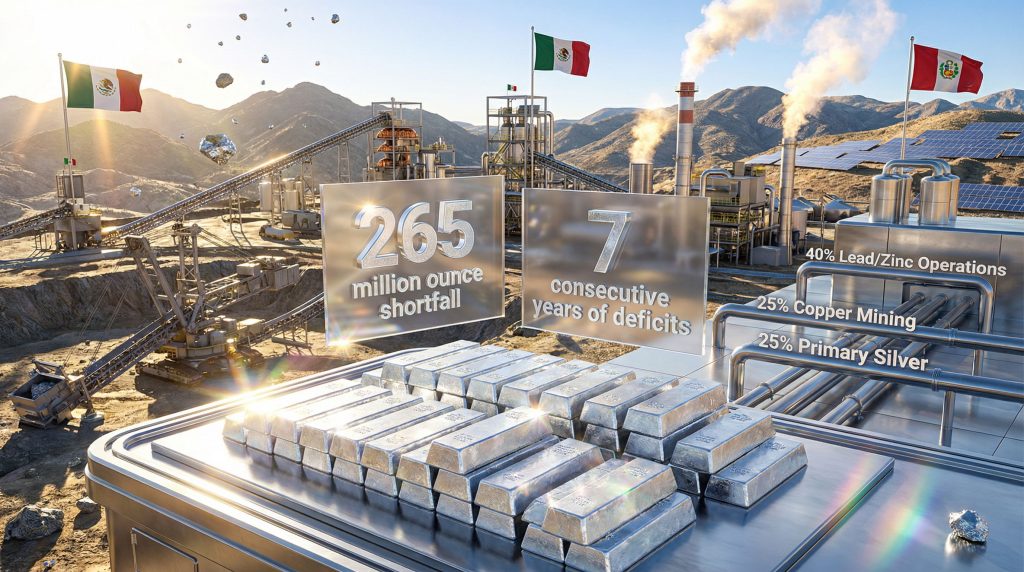
The current market environment reflects seven consecutive years of structural deficits, indicating fundamental supply-side challenges rather than temporary disruptions. These persistent shortfalls demonstrate how traditional market correction mechanisms fail to function when byproduct dependencies dominate production decisions.
When big ASX news breaks, our subscribers know first
How Byproduct Dependencies Limit Market Responsiveness
Primary Versus Secondary Silver Production
Approximately 75-80% of global silver supply emerges as a byproduct from copper, lead, zinc, and gold mining operations. This dependency means silver production responds primarily to base metal economics rather than silver price signals, creating what economists term supply inelasticity. When copper or zinc prices decline, mining operations may reduce production despite stable or rising silver prices.
Primary silver mines contribute only 20-25% of global supply, representing a small fraction capable of responding directly to silver market fundamentals. These operations face higher all-in sustaining costs and longer development timelines compared to byproduct operations, limiting their ability to rapidly increase output during price rallies.
Copper Market Disruptions Impact Silver Supply
The mining sector experienced four major disruptions in copper operations during 2025, directly affecting silver availability regardless of silver price incentives. Copper mining contributes approximately 25% of silver as byproduct, making copper market stability crucial for silver supply consistency.
Lead-zinc operations provide the largest portion of byproduct silver at roughly 40% of total production. Economic conditions affecting these base metals create cascading effects on silver supply that operate independently of silver market fundamentals. When lead-zinc operations become uneconomical, silver supply suffers proportionally.
Byproduct Production Breakdown:
- Lead/Zinc Operations: 40%
- Copper Mining: 25%
- Gold Mining: 10%
- Primary Silver Operations: 25%
This distribution explains why silver supply constraints persist even during periods of strong silver prices, as the majority of production follows base metal economics rather than precious metal market signals.
Economic Factors Driving Production Limitations
All-In Sustaining Cost Pressures
Industry-wide all-in sustaining costs range between $21-23 per ounce for many operations, creating narrow profit margins that discourage expansion investment. These elevated costs reflect increased regulatory compliance, environmental standards, and deeper mining requirements as near-surface deposits become depleted.
Modern mining operations face significantly higher capital requirements compared to historical standards. Environmental compliance and community engagement requirements add 15-25% to project development costs, while extended permitting timelines increase financing costs and project abandonment risks.
Declining Ore Grade Quality
Contemporary silver discoveries average substantially lower grades compared to historical deposits, increasing processing costs and reducing economic viability for marginal operations. Lower ore grades necessitate different processing approaches, sometimes reducing recovery rates and compounding economic challenges.
This grade deterioration affects both primary and byproduct operations, as mining companies must process larger volumes of ore to extract equivalent silver quantities. The economic threshold for viable silver extraction continues rising as easily accessible, high-grade deposits become exhausted.
Geographic Concentration Risks
Mexico and Peru Production Dominance
Mexico and Peru collectively account for approximately 40% of global silver output, creating significant geographic concentration risk. Mexico's production of 231.8 million ounces annually represents the world's largest single-country contribution, while Peru provides substantial additional volume.
Recent operational challenges in these regions, including labour disputes and geological complications, have impacted global supply stability. Furthermore, Peru's short-term production recovery of 2.4% masks longer-term concerns about mine closures and resource depletion affecting future capacity.
Jurisdictional Risk Factors
High-altitude mining operations in Peru face elevated all-in sustaining costs due to operational complexity and environmental regulations. Mexican operations encounter periodic disruptions related to labour relations and security concerns that can affect production continuity.
These regional vulnerabilities demonstrate how geographic concentration amplifies systemic risks in global silver supply. Simultaneous disruptions in Mexico and Peru could impact nearly half of global production, creating severe silver supply constraints regardless of silver prices.
Investment Pipeline Challenges
Exploration Spending Decline
The period from 2013-2020 witnessed severely reduced exploration spending due to prolonged low silver prices. This underinvestment created a pipeline shortage of development-ready projects, with new mine development typically requiring 7-10 years from discovery to production.
Primary silver mine development faces particularly challenging financing environments during low-price periods. In addition, unlike byproduct operations that can justify development based on base metal economics, primary silver projects depend entirely on silver price projections for economic viability.
Extended Development Timelines
Modern mining projects face increasingly complex permitting requirements and environmental compliance standards. Indigenous consultation requirements and community engagement processes extend development timelines beyond historical norms, particularly in major producing regions.
Typical Development Timeline Breakdown:
| Phase | Duration | Key Challenges |
|---|---|---|
| Discovery to Advanced Exploration | 2-3 years | Resource definition |
| Feasibility Studies and Permitting | 3-4 years | Regulatory approval |
| Development and Construction | 2-3 years | Capital availability |
| Ramp-up to Full Production | 1-2 years | Operational optimisation |
Physical Market Dynamics Versus Paper Trading
Trading Volume Disconnects
Paper silver markets trade approximately 200 times the volume of physical silver, creating price discovery mechanisms that may not reflect actual supply-demand fundamentals. This disconnect becomes apparent during periods of increased physical delivery demand when available inventory constraints become evident.
Above-ground silver stocks have declined significantly, with industry estimates suggesting 800 million ounces consumed over recent years. This represents a substantial reduction in immediately available supply buffers that traditionally helped balance temporary supply-demand imbalances.
Recycling Limitations
Silver recycling contributes 180-200 million ounces annually but faces economic thresholds for viability. Unlike gold recycling, which typically remains economically attractive at most price levels, silver recycling becomes economically unfeasible below $18-22 per ounce.
Industrial silver applications often result in dissipative uses where recovery becomes technically or economically impossible. Solar panel manufacturing, representing growing silver consumption, typically results in permanent silver loss due to current recycling technology limitations.
The next major ASX story will hit our subscribers first
How Trade Wars and Market Forces Compound Supply Issues?
Global trade tensions have intensified the challenges facing silver supply chains, with the US-China trade war impact creating additional uncertainty for mining operations and industrial consumers. These geopolitical factors interact with existing supply constraints to create compound effects that traditional market mechanisms struggle to address.
However, the relationship between silver supply constraints and broader market dynamics becomes particularly evident when examining relative value metrics. The gold-silver ratio analysis reveals how supply limitations in silver markets create opportunities for strategic positioning across precious metals portfolios.
Supply Constraint Investment Implications
Primary Producer Identification Strategies
Investors seeking exposure to silver supply dynamics should focus on companies with significant primary silver production rather than byproduct exposure. Primary operations demonstrate greater correlation with silver price movements and benefit more directly from supply constraint dynamics.
Geographic diversification strategies become crucial given regional concentration risks. Investment approaches should consider exposure across stable mining jurisdictions while maintaining access to major producing regions for maximum market participation.
Market Psychology Considerations
Supply constraints create asymmetric risk-reward profiles where limited downside from production costs meets potentially unlimited upside from supply-demand imbalances. Understanding these dynamics helps investors navigate market volatility while maintaining exposure to fundamental trends.
For instance, developing effective silver squeeze strategies requires recognising how supply constraints amplify market movements during periods of increased demand.
"The silver market's unique byproduct dependency structure means supply cannot respond quickly to price signals, creating persistent imbalances that traditional commodity market theories struggle to address effectively."
Regulatory and Policy Impact Factors
Environmental Standards Evolution
Increasingly stringent environmental regulations extend permitting timelines and increase operational costs, particularly affecting new mine development. These standards, while environmentally necessary, contribute to supply constraint persistence by raising development barriers.
Water management requirements in arid mining regions add substantial compliance costs and operational complexity. Jurisdictions implementing stricter environmental oversight create additional development challenges that defer potential supply additions.
Trade Policy Disruptions
International trade policies and sanctions can disrupt established supply chains, creating additional supply uncertainty beyond traditional mining risks. Consequently, these geopolitical factors add volatility to already constrained supply conditions.
Recent trade restrictions affecting certain producing regions demonstrate how policy decisions can rapidly impact global supply availability. The silver tariffs impact on global markets illustrates how policy measures can exacerbate existing supply constraints regardless of underlying mining economics or demand fundamentals.
Long-Term Supply Outlook Assessment
Production Stagnation Scenarios
Forecasts indicate global mine output will remain relatively flat, representing levels below peak production achieved in previous cycles. This production stagnation occurs despite growing industrial demand from electronics, renewable energy, and emerging technologies.
Reserve replacement rates continue falling short of depletion rates across the industry. Current exploration and development activities fail to identify sufficient new resources to maintain production levels long-term without significant price appreciation to justify higher-cost deposits.
Supply Scenario Analysis:
| Scenario | 2025-2030 Production Range | Key Assumptions | Estimated Probability |
|---|---|---|---|
| Baseline Stagnation | 820-840M oz/year | Current trends continue | 60% |
| Modest Recovery | 850-880M oz/year | New project acceleration | 25% |
| Supply Decline | 750-800M oz/year | Major disruptions occur | 15% |
Technology Impact Considerations
Emerging technologies may create additional silver demand streams that current supply projections fail to anticipate. Electric vehicle components, advanced electronics, and renewable energy infrastructure represent growing consumption categories with limited substitution possibilities.
These technological demand drivers operate independently of traditional silver market cycles, potentially creating sustained consumption growth that outpaces supply development capabilities.
Strategic Navigation Approaches
Risk Management Frameworks
Successful navigation of supply crunch challenges requires understanding the fundamental disconnect between supply responsiveness and demand growth. Traditional commodity investment approaches may prove inadequate given silver's unique market structure.
Diversification across the silver value chain, including primary producers, recycling operations, and technology applications, provides broader exposure to supply constraint benefits while managing specific operational risks.
Market Timing Considerations
Silver supply constraints create long-term structural advantages that may persist through multiple market cycles. Short-term volatility often provides entry opportunities for investors with appropriate time horizons and risk tolerance.
Understanding the difference between cyclical price movements and structural supply constraints helps distinguish temporary corrections from fundamental trend changes in the silver market.
The complexity of silver supply constraints demands sophisticated analysis that accounts for byproduct dependencies, geographic concentrations, regulatory challenges, and technological demand growth. These factors combine to create market conditions where traditional supply-demand balancing mechanisms function inadequately, resulting in persistent constraints that may define silver market dynamics for the foreseeable future.
Investors, industrial consumers, and policymakers must recognise these structural limitations when making strategic decisions involving silver markets. The unique characteristics of silver production and consumption create opportunities and risks that differ significantly from other commodity markets, requiring specialised knowledge and careful analysis for successful participation.
Want to Capitalise on Silver Supply Constraints?
Discovery Alert instantly identifies ASX mineral discoveries, including precious metals opportunities, using its proprietary Discovery IQ model to deliver real-time alerts when significant silver and other mineral discoveries are announced. Begin your 30-day free trial today to position yourself ahead of market movements and gain immediate access to actionable trading opportunities in the precious metals sector.