June 27, 2026
Silver markets worldwide are experiencing an unprecedented transformation driven by what analysts term a silver surge in structural deficit. This phenomenon represents more than typical market volatility, as industrial demand fundamentally outpaces production capacity across multiple consecutive years, creating sustained supply-demand imbalances that reshape commodity market dynamics. The current silver surge in structural deficit reflects deeper economic forces emerging during the global energy transition and technological advancement cycles.
Understanding the Silver Market's Fundamental Supply-Demand Imbalance
Structural deficits in commodity markets emerge when fundamental demand drivers outpace supply responses for extended periods, typically lasting multiple years rather than seasonal or cyclical adjustments. Unlike temporary price spikes caused by weather, geopolitical events, or speculative trading, structural imbalances reflect permanent shifts in consumption patterns that require new production capacity to resolve.
Silver's unique position stems from its dual role as both an industrial input and monetary asset. Approximately 60 percent of annual silver consumption supports industrial applications where technical specifications make substitution extremely difficult. The remaining 40 percent serves investment demand, jewellery manufacturing, and decorative purposes. This composition creates demand that economists classify as relatively inelastic, meaning consumption levels remain stable even as prices increase significantly.
Defining Structural Deficits in Commodity Markets
Economic theory distinguishes between cyclical corrections and structural imbalances based on supply response mechanisms. In healthy commodity markets, higher prices incentivise increased production, bringing supply and demand back into equilibrium within 18-24 months. Structural deficits persist when supply cannot respond elastically to price signals due to fundamental constraints.
Key characteristics of structural commodity deficits include:
- Production inelasticity: Supply cannot increase proportionally to price improvements
- Capital intensity barriers: New production requires substantial upfront investment
- Regulatory constraints: Environmental permitting and approval processes delay capacity additions
- Byproduct dependencies: Output levels determined by primary metal mining rather than the target commodity
- Long development timelines: Mine construction and commissioning typically require 5-10 years
Silver exemplifies these constraints more dramatically than most commodities. Furthermore, approximately 70 percent of global silver production occurs as a byproduct of copper, lead, and zinc mining operations. This dependency means silver producers cannot simply increase output in response to higher silver prices without coordinating with primary metal miners who prioritise their main commodities.
Silver's Unique Position in Global Commodity Markets
Industrial demand patterns distinguish silver from gold's primarily monetary function. However, silver's superior electrical conductivity, thermal properties, and antimicrobial characteristics make it irreplaceable in high-specification applications across multiple sectors. Solar photovoltaic panels, electronic components, automotive systems, and medical equipment rely on silver's technical properties rather than its monetary value.
This industrial dependency creates what economists term "sticky demand" – consumption levels that remain relatively stable despite price fluctuations. Manufacturing processes optimised around silver's performance characteristics cannot easily substitute alternative materials without compromising product specifications or requiring extensive re-engineering.
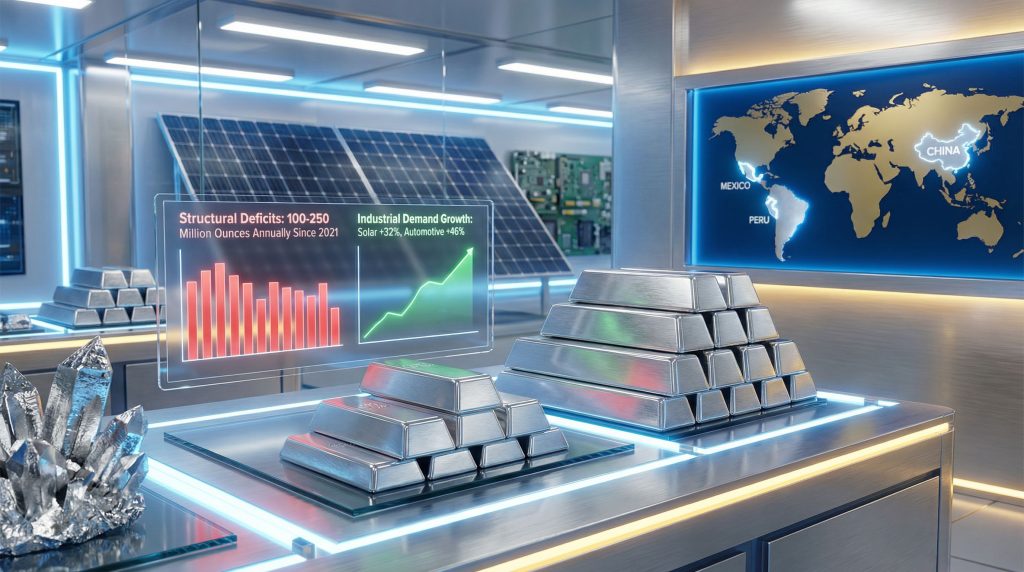
The following table illustrates projected industrial demand growth across key sectors:
| Sector | 2021 Demand (Moz) | 2025 Projected (Moz) | Growth Rate |
|---|---|---|---|
| Solar Energy | 140 | 185 | +32% |
| Electronics | 245 | 275 | +12% |
| Automotive | 65 | 95 | +46% |
| Medical/Aerospace | 45 | 58 | +29% |
Historical analysis reveals few precedents for prolonged precious metals shortages. For instance, the copper market experienced similar dynamics during China's industrialisation (2000-2010), whilst rare earth elements faced supply constraints following Chinese export restrictions (2010-2015). However, silver's dual industrial-monetary nature creates unique market dynamics not easily compared to other commodities.
When big ASX news breaks, our subscribers know first
What Factors Are Driving Silver's Persistent Supply Shortage?
Industrial demand acceleration represents the primary driver of silver's structural deficit, fundamentally altering consumption patterns since 2021. The global energy transition toward renewable power generation, electric vehicle adoption, and artificial intelligence infrastructure development has created unprecedented silver requirements across multiple sectors simultaneously.
In addition, solar photovoltaic installations consume approximately 20-25 grams of silver per kilowatt of capacity, primarily in electrical contacts and conductive pathways within solar cells. Global solar capacity additions have accelerated dramatically, with installations projected to reach 200-300 gigawatts annually through 2030. This expansion directly correlates with silver demand growth, as technological improvements in panel efficiency have not significantly reduced silver content per unit of output.
Industrial Demand Acceleration Since 2021
Green energy transition requirements have fundamentally altered silver consumption patterns. Solar panel manufacturing represents the fastest-growing demand segment, driven by government renewable energy mandates and declining installation costs. Each megawatt of solar capacity requires approximately 20-25 kilograms of silver, creating direct correlation between renewable energy deployment and metal consumption.
Electric vehicle adoption presents another significant demand driver. Modern EVs contain 25-50 grams of silver per vehicle, concentrated in battery management systems, power electronics, and charging infrastructure. High-performance vehicles and commercial trucks require substantially more silver for thermal management and electrical systems. With global EV sales projected to exceed 30 million units annually by 2030, automotive silver demand could reach 100-120 million ounces per year.
Technology sector consumption reflects the expansion of artificial intelligence infrastructure and cloud computing capacity. Consequently, data centres require silver-containing components for:
- High-speed networking equipment and optical interconnects
- Server cooling systems and thermal interface materials
- Power distribution systems and backup battery installations
- Electromagnetic shielding in sensitive computing equipment
The AI revolution has accelerated data centre construction globally, with major technology companies investing hundreds of billions in computing infrastructure. Each large-scale data centre incorporates silver-intensive components worth several million ounces over its operational lifetime.
Medical and aerospace applications continue expanding, driven by an aging global population and space industry commercialisation. Medical devices increasingly rely on silver's antimicrobial properties for surgical instruments, diagnostic equipment, and implantable devices. Aerospace applications include electrical contacts, thermal management systems, and specialised coatings for satellite and spacecraft components.
Mine Production Constraints and Byproduct Dependencies
Global silver mine production faces fundamental constraints that prevent rapid supply responses to higher prices. The 70 percent byproduct dependency means silver output levels are determined primarily by copper, lead, and zinc mining economics rather than silver valuations. Primary silver mines contribute only 30 percent of global supply, limiting the industry's ability to increase production in response to demand growth.
Byproduct mining operates according to the economics of primary metals. Copper miners optimise operations for copper recovery and profitability, treating silver as a beneficial but secondary revenue source. When copper prices decline or ore grades deteriorate, mining companies may reduce operations or close facilities, automatically decreasing silver production regardless of silver market conditions.
Furthermore, capital expenditure cycles in precious metals mining typically span 7-10 years from exploration through production. New silver mines require extensive geological evaluation, environmental permitting, infrastructure development, and equipment procurement before generating output. This timeline prevents rapid supply responses to market deficits, extending the duration of structural imbalances.
Geographic concentration creates additional supply risks. Mexico, Peru, and China account for approximately 60 percent of global silver production, exposing markets to political instability, regulatory changes, and natural disasters in key producing regions. Recent examples include:
- Regulatory delays: Environmental permitting processes extending 3-5 years for new projects
- Infrastructure constraints: Limited access to transportation, power, and water in remote mining areas
- Skilled labour shortages: Technical expertise requirements for modern mining operations
- Community relations: Indigenous land rights and local opposition to mining development
How Do Trade Policies Impact Silver Market Dynamics?
Critical minerals security has emerged as a central theme in international trade policy, particularly following supply chain disruptions during the COVID-19 pandemic and geopolitical tensions with major commodity-producing nations. Silver's classification as a critical mineral by several governments has elevated its strategic importance beyond traditional market economics.
The United States government's Section 232 investigation into critical minerals import dependency examined potential national security implications of foreign mineral reliance. This investigation framework, established under the Trade Expansion Act of 1962, authorises tariff implementation when imports threaten domestic security interests. Whilst immediate tariffs impact on silver were ultimately avoided, the investigation created significant market uncertainty and physical metal movements between trading centres.
Critical Minerals Security and National Stockpiling
Strategic reserve policies across major economies reflect growing concern about supply security for materials essential to economic and military infrastructure. Consequently, silver's applications in defence electronics, renewable energy systems, and advanced manufacturing make it a candidate for government stockpiling programmes.
The Department of Defense maintains strategic inventories of critical materials through the Defense Logistics Agency, though specific silver holdings remain classified. Commercial markets interpret government accumulation as removing available supply from private markets, potentially intensifying shortages during periods of high industrial demand.
Supply chain diversification initiatives aim to reduce dependency on single-source suppliers or geographically concentrated production. Government policies supporting domestic mining development, allied nation sourcing agreements, and recycling capacity expansion could reshape global silver trade flows over the next decade.
Key policy developments include:
- Critical minerals lists: Government designations affecting import policies and domestic production incentives
- Trade agreements: Bilateral arrangements prioritising reliable mineral supply partnerships
- Infrastructure investment: Public funding for mining-related transportation, power, and processing facilities
- Research funding: Government support for mineral exploration, extraction technology, and recycling processes
Physical Market Disruptions and Inventory Management
Trade policy uncertainty can trigger significant physical metal movements between major trading centres as market participants hedge against potential trade restrictions. London serves as the global physical silver hub, whilst New York's COMEX exchange dominates futures trading. Policy announcements affecting import duties or supply security can create arbitrage opportunities between these markets.
During periods of trade tension, large-scale physical metal transfers from London warehouses to COMEX-certified storage facilities have created artificial tightness in global inventory distribution. These movements reflect trader concerns about potential tariff implementation rather than underlying supply-demand fundamentals, though they can amplify price volatility and market perception of scarcity.
Exchange-traded fund flows versus physical holdings present another dimension of policy impact. In addition, ETFs holding physical silver bars may face redemption pressure during trade policy uncertainty as investors seek direct ownership of metal stored in domestic facilities. This dynamic can stress physical markets even when overall supply-demand balances remain stable.
"Trade policy announcements often create more immediate market impact than actual policy implementation, as traders position for potential scenarios rather than confirmed regulations."
Which Economic Indicators Signal Long-Term Silver Shortages?
Inventory-to-consumption ratios provide the most reliable indicator of developing structural deficits in commodity markets. Silver's above-ground stocks relative to annual consumption have declined systematically since 2021, reaching levels not seen since the early 2000s. Traditional inventory buffers that historically absorbed supply-demand imbalances have been depleted through consecutive years of deficit conditions.
Global silver inventories exist across multiple categories, each serving different market functions and exhibiting varying degrees of availability during shortage conditions. However, exchange-registered inventories, held in COMEX and London Bullion Market Association (LBMA) certified facilities, provide the most transparent data on immediately available supply. These inventories have experienced significant drawdowns as industrial users and investors competed for limited available metal.
Inventory-to-Consumption Ratios Analysis
Above-ground silver stocks traditionally maintained inventory-to-consumption ratios of 15-20 percent of annual demand, providing adequate buffer stock for normal market operations. Current ratios have declined to approximately 8-12 percent of annual consumption, approaching critically low levels that typically precede sustained price appreciation in commodity markets.
The composition of remaining inventories reveals additional stress indicators:
Exchange Inventories: COMEX silver stocks have declined from peak levels of 350 million ounces in 2021 to approximately 280 million ounces by early 2025, representing a 20 percent reduction during the deficit period.
Private Holdings: Bullion dealer inventories and private investor holdings are estimated at 500-800 million ounces, though this metal generally remains unavailable during normal market conditions unless prices reach extreme levels.
Industrial Stockpiles: Manufacturing companies maintain working inventories for production continuity, typically representing 2-3 months of consumption. These stocks are generally unavailable to broader markets except during extended supply disruptions.
Scrap Recovery Potential: Recycling from electronic waste, dental applications, and photographic materials contributes approximately 150-200 million ounces annually to supply. However, recovery rates depend on collection infrastructure and processing economics rather than market prices alone.
Forward curve analysis in futures markets provides additional insight into long-term supply expectations. Contango conditions (higher prices for future delivery) typically indicate expected supply improvements, whilst backwardation (higher spot prices than futures) suggests persistent shortage conditions. Silver markets have exhibited consistent backwardation since early 2023, indicating trader expectations of continued near-term supply constraints.
Investment Demand Versus Industrial Consumption Balance
Investment demand patterns reveal market psychology during structural shortage periods. Physical silver purchasing by retail investors has accelerated significantly, with coin and bar sales reaching multi-year highs during 2024-2025. This demand represents additional competition for available supply beyond industrial requirements, potentially amplifying shortage conditions.
Institutional portfolio allocation shifts provide another demand indicator. For instance, pension funds, endowments, and sovereign wealth funds have increased precious metals allocations as inflation hedging strategies, viewing silver's industrial demand growth as supporting long-term price appreciation. These institutional flows typically involve large-scale purchases that can stress physical markets.
The correlation between silver prices and broader inflation indicators has strengthened during the current deficit period. Traditional economic relationships suggest silver should outperform during inflationary periods due to its monetary heritage, whilst industrial demand provides additional price support independent of monetary considerations.
Key investment demand drivers include:
- Currency debasement concerns: Central bank monetary policies encouraging alternative store-of-value assets
- Portfolio diversification: Professional investment strategies incorporating commodity exposure
- Industrial demand validation: Investor recognition of fundamental supply-demand improvements
- Speculation on shortage duration: Trading strategies betting on extended deficit conditions
What Are the Implications for Global Manufacturing Supply Chains?
Manufacturing industries dependent on silver face unprecedented supply security challenges as structural deficits persist into their third consecutive year. Companies across electronics, automotive, renewable energy, and medical device sectors must navigate limited material availability, price volatility, and potential allocation systems during shortage periods.
Supply chain managers increasingly treat silver as a strategic material requiring long-term contracting, inventory buffers, and alternative sourcing strategies. Traditional just-in-time manufacturing approaches prove inadequate when key materials experience structural shortages, forcing operational adjustments throughout affected industries.
Critical Industries Facing Silver Availability Constraints
Solar panel manufacturing represents the most silver-intensive industry facing supply constraints. Leading manufacturers have reported difficulties securing adequate silver supplies for planned production expansions, with some projects delayed pending material availability. The industry's rapid growth compounds these challenges as new manufacturing facilities compete for limited silver supplies.
Technical specifications in solar applications present substitution challenges. Silver's superior electrical conductivity enables higher panel efficiency, directly affecting power output per installation. Furthermore, alternative materials like copper or aluminium reduce performance by 2-5 percent, making substitution economically disadvantageous for premium solar products.
Electronics production across consumer, commercial, and military applications faces similar constraints. Silver's thermal conductivity and corrosion resistance prove essential in high-reliability applications where performance degradation could cause system failures. Military and aerospace electronics specifically require silver-based components that meet strict performance specifications without acceptable alternatives.
Automotive sector supply security becomes increasingly critical as vehicle electrification accelerates. Electric vehicles contain substantially more silver than traditional internal combustion vehicles, concentrated in battery management systems, power electronics, and charging infrastructure. Supply shortages could potentially constrain EV production growth, affecting automotive manufacturers' electrification timelines.
Price Elasticity and Substitution Challenges
Economic analysis reveals limited price elasticity across silver's primary industrial applications. Most uses represent small percentages of final product costs, meaning even substantial silver price increases do not significantly affect overall manufacturing economics. A solar panel containing $50 worth of silver remains economically viable even if silver costs double to $100 per panel.
Technical substitution limitations prevent easy material replacement in critical applications:
Solar Cells: Alternative conductors reduce electrical efficiency, requiring larger installations to achieve equivalent power output
Electronics: Copper alternatives increase resistance and heat generation, potentially causing reliability issues in sensitive circuits
Medical Devices: Silver's antimicrobial properties cannot be replicated by other metals in surgical and implantable applications
Automotive Systems: High-temperature and vibration environments in vehicles require materials meeting strict performance specifications
Research and development investments in alternative materials have increased as manufacturers seek to reduce silver dependency. However, material qualification processes for critical applications typically require 2-5 years of testing and certification, preventing rapid substitution during shortage periods.
Cost-benefit analysis indicates that silver substitution often proves economically disadvantageous when performance impacts are considered. Industries generally prefer paying higher silver prices rather than accepting reduced product performance or reliability risks associated with alternative materials.
How Should Investors Approach Silver Market Exposure?
Investment strategies during structural commodity shortages differ fundamentally from approaches suitable for cyclical markets. Extended supply-demand imbalances create multi-year investment cycles where traditional valuation metrics may prove inadequate for timing decisions. Successful investing requires understanding both physical market dynamics and the various vehicles available for gaining exposure.
Physical silver ownership versus paper-based investments presents distinct risk-reward profiles during shortage periods. Direct ownership provides guaranteed exposure to metal price appreciation but involves storage costs, insurance requirements, and liquidity constraints. In contrast, exchange-traded funds and futures contracts offer greater liquidity and lower transaction costs whilst potentially introducing tracking risks during extreme market conditions.
Physical Versus Paper Market Considerations
ETF premium and discount patterns during supply stress reveal important market dynamics. Physical silver ETFs may trade at premiums to net asset value when investors prefer fund ownership over direct physical possession, or at discounts when redemption demand exceeds available shares. These pricing discrepancies create arbitrage opportunities for sophisticated investors whilst indicating market sentiment about physical availability.
Storage and insurance considerations affect the total cost of physical ownership. Professional vault storage typically costs 0.5-1.0 percent annually, whilst insurance adds another 0.1-0.3 percent depending on coverage levels and storage location. These expenses reduce net investment returns but provide security and liquidity advantages over home storage alternatives.
Furthermore, liquidity differences become apparent during volatile market conditions. Physical metal requires dealer transactions with bid-ask spreads of 3-5 percent in normal markets, potentially widening during stress periods. ETFs and futures contracts typically maintain spreads under 1 percent except during extreme volatility episodes.
Key considerations for physical versus paper exposure:
- Counterparty risk: Physical ownership eliminates financial intermediary risks present in ETFs and futures
- Convenience: Paper instruments provide easier trading and portfolio integration
- Tax implications: Physical metal may qualify for different tax treatment than financial instruments
- Minimum investment: Paper instruments allow smaller position sizes than practical physical ownership
Mining Equity Valuation Framework During Structural Deficits
Mining company valuations during structural shortages require modified analytical approaches recognising operating leverage benefits for established producers. Companies with existing production capacity can increase cash flow substantially without proportional cost increases, creating outsized returns on invested capital during favourable pricing periods.
Operating leverage manifests through several mechanisms:
Fixed Cost Absorption: Mine infrastructure, equipment, and personnel costs remain largely constant regardless of production levels, allowing higher margins at increased output rates
Contract Renegotiation: Long-term supply agreements may include price escalation clauses or renegotiation provisions during shortage periods
Expansion Optionality: Existing mines often contain additional resources that become economically viable at higher prices
Strategic Premium: Established production capabilities command valuation premiums during supply constraint periods
Development project risk-reward profiles change significantly during structural deficits. Projects that appeared marginal at historical prices may achieve exceptional returns at current price levels, whilst the certainty of sustained higher prices reduces financial risks associated with long development timelines.
Geographic and political risk assessment requires enhanced attention during shortage periods. Governments may impose export restrictions, windfall taxes, or nationalisation policies when domestic commodities command exceptional prices. Countries with stable legal frameworks and mining-friendly policies deserve valuation premiums despite potentially higher operating costs.
The next major ASX story will hit our subscribers first
What Regional Factors Influence Silver Supply Security?
Global silver production concentration creates supply security risks that extend beyond normal market economics. Mexico, Peru, China, and Chile account for approximately 65 percent of world mine production, exposing markets to political instability, regulatory changes, and natural disasters in these key regions. Supply diversification presents both challenges and opportunities for market stability.
Political frameworks affecting mining operations vary significantly across major producing countries. Mexico's mining sector faces potential policy changes affecting foreign investment, environmental regulations, and royalty structures. Peru has experienced political instability that could affect mining operations through labour disputes, permit delays, or changes in legal frameworks governing resource extraction.
Major Producing Countries and Geopolitical Considerations
Mexico ranks as the world's largest silver producer, contributing approximately 23 percent of global supply through operations concentrated in the states of Zacatecas, Chihuahua, and Durango. The country's mining industry benefits from established infrastructure, skilled labour, and generally favourable investment climate. However, recent policy proposals regarding mining royalties, environmental regulations, and foreign ownership restrictions create uncertainty for long-term investment planning.
Peru contributes approximately 18 percent of global silver production, primarily as a byproduct of copper and zinc mining in the Andes mountain regions. The country's mining sector faces ongoing challenges from:
- Community relations: Indigenous communities seeking greater participation in mining benefits
- Environmental concerns: Water usage and contamination issues in mining regions
- Political instability: Frequent government changes affecting regulatory consistency
- Infrastructure constraints: Limited transportation and power access in remote mining areas
China's silver production, representing approximately 12 percent of global output, occurs primarily in conjunction with copper and lead mining operations. The country's dual role as both major producer and consumer creates unique market dynamics. Chinese domestic demand growth could reduce export availability, effectively tightening global supply even without production declines.
Environmental regulations increasingly affect mining operations across all major producing regions. Stricter water usage restrictions, emissions standards, and habitat protection requirements add costs and delays to mining projects. These regulatory trends, whilst addressing legitimate environmental concerns, reduce the speed and scale of supply responses to market shortages.
Emerging Supply Sources and Exploration Trends
Junior mining companies represent the primary source of new silver discovery and development projects outside established mining regions. These smaller companies typically focus on exploration and early-stage development before partnering with larger producers for mine construction and operation. Current exploration activity levels indicate potential new supply sources that could emerge within 5-10 years.
Promising exploration regions include:
Australia: Advanced exploration projects in New South Wales, Queensland, and Western Australia, benefiting from established mining infrastructure and favourable regulatory environment
Canada: Silver projects in British Columbia, Ontario, and the Yukon Territory, with government support for critical minerals development
United States: Renewed exploration in Nevada, Idaho, and Alaska, driven by domestic supply security initiatives
Argentina: High-altitude projects in the Andes region, though infrastructure and political challenges affect development timelines
Recycling capacity expansion represents another potential supply source requiring less capital investment and shorter development timelines than new mines. For example, electronic waste recycling facilities can recover substantial silver quantities from discarded devices, though collection and processing infrastructure remains limited in many regions.
Technology improvements in extraction efficiency could increase silver recovery rates from existing mines and previously uneconomic resources. Advanced flotation processes, heap leaching techniques, and in-situ recovery methods may access silver deposits that were technically or economically unfeasible using traditional mining approaches.
Frequently Asked Questions About Silver's Structural Deficit
Market participants frequently seek guidance on the duration and resolution mechanisms for structural commodity shortages. Historical examples from other commodity markets provide insights into typical patterns, though silver's unique characteristics as both industrial input and monetary asset create somewhat different dynamics than purely industrial materials.
Supply response timelines depend on the type of capacity addition required to address shortages. Furthermore, existing mines can often increase production within 12-18 months through equipment upgrades, additional shifts, or process improvements. New mine development requires substantially longer timelines, typically 5-10 years from initial exploration through commercial production.
How Long Do Structural Deficits Typically Persist?
Historical analysis of commodity market shortages reveals typical duration patterns ranging from 2-7 years, depending on supply response characteristics and demand growth rates. Copper experienced structural deficits during 2003-2008 as Chinese industrialisation drove consumption growth faster than mine capacity additions. Resolution occurred through a combination of new mine development, demand moderation following economic slowdown, and efficiency improvements in copper usage.
Rare earth elements faced supply constraints from 2010-2015 following Chinese export restrictions, resolved through development of alternative supply sources in Australia, the United States, and other countries. The resolution timeline was accelerated by government intervention and strategic stockpiling programmes in consuming countries.
Silver's deficit resolution faces several unique challenges:
Byproduct dependency: Unlike primary metals, silver supply cannot increase independently of copper, lead, and zinc production decisions
Demand diversity: Industrial applications across multiple sectors create resilient consumption that does not decline easily with higher prices
Investment demand: Monetary asset characteristics mean investor purchasing can accelerate during shortage periods, amplifying supply stress
Mine development complexity: Primary silver mines require specialised expertise and infrastructure different from base metal operations
Supply response modelling suggests silver deficits could persist for 3-5 years based on current mine development pipelines and demand growth projections. However, significant price appreciation could accelerate development timelines and encourage more aggressive exploration investment.
What Price Levels Could Resolve the Supply-Demand Imbalance?
Economic modelling of supply curve responses indicates silver prices would need to reach $40-60 per ounce sustained levels to incentivise substantial new primary silver mine development. At these price levels, previously uneconomic resources become viable for development, whilst existing operations have strong incentives for expansion investment.
Demand destruction analysis suggests industrial users would not significantly reduce consumption until prices exceed $50-75 per ounce, as silver represents small percentages of final product costs in most applications. For instance, solar panel manufacturers, electronics companies, and automotive suppliers can absorb higher silver costs more easily than reducing product performance through material substitution.
Investment demand price sensitivity varies with broader economic conditions and alternative asset performance. During inflationary periods or currency debasement concerns, investment demand may actually increase at higher price levels as buyers seek inflation protection. Conversely, economic recession or superior returns from other assets could reduce investment demand even at lower silver prices.
Price scenarios for deficit resolution:
$35-45/oz: Moderate supply response through existing mine expansions and increased exploration activity
$45-60/oz: Substantial new mine development becomes economically attractive, accelerating supply additions
$60+/oz: Aggressive substitution efforts in price-sensitive applications, though technical limitations prevent complete demand destruction
Disclaimer: These price projections represent analytical estimates based on economic modelling and should not be considered investment advice. Actual market outcomes may vary significantly based on economic conditions, policy changes, and unforeseen developments.
Future Outlook: Will Silver Shortages Intensify or Resolve?
Technology sector growth projections through 2030 indicate continued acceleration in silver-intensive applications that could maintain or intensify current shortage conditions. Artificial intelligence infrastructure development, renewable energy deployment, and electric vehicle adoption represent demand drivers with multi-decade growth potential that substantially exceeds historical consumption patterns.
Global solar capacity installations are projected to reach 200-300 gigawatts annually by 2030, compared to approximately 150 gigawatts in 2023. This growth trajectory would increase solar silver demand from current levels of approximately 140 million ounces annually to potentially 200-250 million ounces by decade's end, assuming stable silver content per unit of capacity.
Technology Sector Growth Projections Through 2030
Artificial intelligence infrastructure requirements extend beyond data centre construction to encompass edge computing, autonomous vehicle systems, and industrial automation applications. Each category incorporates silver-intensive components for thermal management, electrical connectivity, and electromagnetic shielding. Conservative estimates suggest AI-related silver consumption could reach 50-75 million ounces annually by 2030, representing entirely new demand that did not exist before 2020.
Electric vehicle adoption forecasts indicate global sales could reach 40-50 million units annually by 2030, compared to approximately 10 million in 2023. Average silver content per vehicle may increase as manufacturers incorporate more sophisticated battery management systems, autonomous driving sensors, and high-power charging capabilities. Total automotive silver demand could approach 150-200 million ounces annually under aggressive electrification scenarios.
Renewable energy deployment encompasses wind power systems, energy storage installations, and smart grid infrastructure in addition to solar panels. Wind turbines require substantial silver content for generator windings and power electronics, whilst battery storage systems incorporate silver-based thermal management and safety systems. Combined renewable energy silver demand could reach 300-400 million ounces annually by 2030.
Medical and aerospace applications continue expanding with demographic trends and space industry commercialisation. An aging global population drives increased medical device usage, whilst commercial space activities create demand for specialised silver-containing components. These sectors may contribute an additional 75-100 million ounces annually to demand growth.
Mine Development Pipeline Assessment
Current mine development pipelines appear insufficient to meet projected demand growth through 2030. Major silver projects under construction or in advanced development stages would add approximately 50-100 million ounces annually to global supply over the next 5-7 years. This increase falls substantially short of demand growth projections exceeding 200-300 million ounces annually.
Capital allocation trends in precious metals exploration have historically lagged other mining sectors due to lower average project returns and longer development timelines. However, sustained higher silver prices are beginning to attract increased exploration investment, though results will not materialise as new production for several years.
The following table projects global supply-demand dynamics through 2030:
| Year | Mine Supply (Moz) | Industrial Demand (Moz) | Investment Demand (Moz) | Balance (Moz) |
|---|---|---|---|---|
| 2026 | 820 | 950 | 150 | -280 |
| 2027 | 835 | 985 | 160 | -310 |
| 2028 | 850 | 1,020 | 170 | -340 |
| 2029 | 870 | 1,060 | 180 | -370 |
| 2030 | 890 | 1,100 | 190 | -400 |
Note: Projections assume moderate growth in mine supply from development projects currently in construction or advanced planning phases. Actual outcomes depend on economic conditions, regulatory approvals, and commodity price levels.
Regulatory approval processes for new mining operations have lengthened significantly across most jurisdictions due to enhanced environmental review requirements and community consultation procedures. Projects that historically required 2-3 years for permitting now typically need 5-7 years, delaying supply responses to market shortages.
Policy Responses and Market Intervention Possibilities
Government recognition of critical minerals supply security has increased substantially since 2020, leading to policy initiatives supporting domestic mining development, strategic stockpiling, and international cooperation frameworks. These policies could significantly affect silver market dynamics over the next decade.
Strategic reserve releases during acute shortage periods represent a potential policy tool for managing extreme price volatility. However, government silver stockpiles remain limited compared to annual consumption levels, providing only temporary market relief rather than fundamental shortage resolution.
Trade policy adjustments may include:
- Import duty reductions: Eliminating tariffs on silver imports to reduce domestic supply costs
- Export restrictions: Producing countries may limit silver exports to secure domestic industrial supply
- Bilateral agreements: Trade partnerships prioritising critical minerals supply security
- Investment incentives: Tax benefits and subsidies for domestic mining development
International cooperation frameworks such as the Critical Minerals Partnership and other multilateral initiatives aim to diversify supply sources and reduce dependence on single producing countries. These efforts could accelerate development of alternative supply sources whilst providing diplomatic mechanisms for addressing supply disruptions.
The ongoing silver market squeeze reflects deeper structural issues that extend beyond temporary market imbalances. Understanding the various silver supply deficits drivers helps investors appreciate the complexity of the current market dynamics. Furthermore, the emerging silver squeeze movement demonstrates retail investor awareness of these supply constraints. Additionally, analysing gold-silver ratio insights provides perspective on silver's relative valuation during this structural deficit period.
Industry experts from the Silver Institute highlight persistent market deficits continuing into 2026, whilst market analysts note how structural supply deficits create exceptional investment opportunities for precious metals investors.
"Investment Consideration: Structural deficits in commodity markets create multi-year investment cycles where early positioning in quality assets often generates superior returns compared to waiting for obvious price signals."
The combination of accelerating demand growth and constrained supply responses suggests the silver surge in structural deficit may intensify before resolving. Investors should consider this multi-year outlook when evaluating silver market exposure and related investment opportunities across mining companies, technology stocks, and renewable energy sectors.
Disclaimer: This analysis contains forward-looking statements and projections that involve risks and uncertainties. Actual market outcomes may differ materially from the scenarios presented. Investors should conduct their own research and consult qualified financial advisors before making investment decisions.
Looking to Capitalise on Silver's Structural Deficit?
Discovery Alert's proprietary Discovery IQ model delivers real-time alerts on significant ASX mineral discoveries, including silver and precious metals opportunities that could benefit from ongoing supply constraints. With silver markets experiencing unprecedented structural deficits, discover why major mineral discoveries can lead to substantial returns by exploring historic examples of exceptional market outcomes.