
June 17, 2026
Why the Architecture of Global Gold Markets Is Being Quietly Rebuilt
For most of modern financial history, gold's fate has been decided in a single time zone. The London Bullion Market Association's twice-daily fix, the Loco London settlement standard, and the concentration of liquidity in Western trading hours have defined how the world prices and transfers physical gold for decades. Yet the fundamental economics of gold consumption have long since moved on. Asia consumes the majority of the world's physical gold, yet the infrastructure governing its trade remains anchored thousands of miles away, operating on a clock that closes before much of Asia's trading day even begins.
That misalignment is now being addressed in a concrete, institutional way. The development of the Singapore gold clearing hub, scheduled for operational launch by end-2026, represents one of the most consequential structural shifts in precious metals market architecture in a generation. Understanding why it matters requires looking beyond the mechanics of settlement and into the deeper forces reshaping who controls gold market infrastructure.
When big ASX news breaks, our subscribers know first
The Structural Problem With a Single-Node Gold Market
How London's Dominance Created a Time-Zone Deficit
The LBMA framework became the global standard for gold settlement through a combination of historical accident, colonial-era financial networks, and deep liquidity pools that reinforced themselves over time. London's gold market traces its formal roots to the late 17th century, and the twice-daily price fix, introduced in 1919, became the reference point for contracts, hedges, and valuations across the entire industry. Understanding the differences between LBMA vs COMEX gold markets helps to contextualise just how entrenched Western infrastructure has become.
The problem is structural rather than operational. When physical demand in China, India, Thailand, and Indonesia accounts for the dominant share of annual gold consumption globally, routing all settlement through a London-centric framework creates friction. Asian buyers and institutions must either trade during inconvenient hours, accept settlement risk that spans time zones, or price against a benchmark that is set without meaningful participation from their own markets.
Central bank gold buying across ASEAN has accelerated at a considerable pace over recent years, following the broader global trend of de-dollarisation and reserve diversification. These institutions need regionally accessible settlement and storage infrastructure, not just a theoretical claim on London-vaulted metal.
The gap between where gold is physically consumed and where it is legally settled has existed for decades. The Singapore clearing initiative is the most credible attempt yet to close it.
What the Singapore Gold Clearing Hub Actually Does
The Loco Singapore Standard: More Than a Name
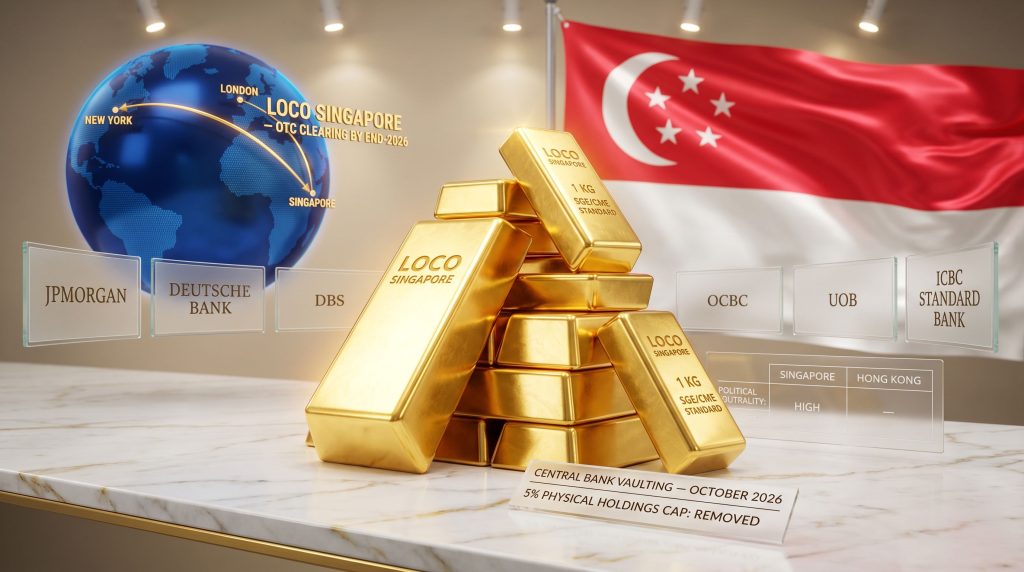
At the heart of the new system is the Loco Singapore designation, a settlement standard that defines physical gold held and transferred within Singapore's jurisdiction. This mirrors the logic of the established Loco London benchmark, which specifies gold physically located in London vaults as the settlement basis for LBMA transactions. Furthermore, London gold vault dynamics reveal just how deeply embedded this custodial infrastructure has become in global market operations.
Creating a Loco Singapore standard is not simply an administrative exercise. It establishes Singapore as a legally and operationally distinct settlement jurisdiction, capable of anchoring contracts, hedges, and price references independently of London. Over time, if liquidity builds sufficiently, it could serve as the reference point for Asian-hours gold price formation in a way that the current infrastructure cannot support.
Technical Architecture of the OTC Clearing System
The platform will operate as an over-the-counter clearing system with netting and ledger-based settlement, functioning during Asian trading hours to provide the time-zone continuity currently missing from global gold market infrastructure. According to reporting by the Singapore Bullion Market Association, the initiative is designed to serve the full spectrum of regional participants. Critically, it will support two distinct bar standards:
| Settlement Standard | Bar Type | Aligned Framework |
|---|---|---|
| Loco Singapore (large bar) | ~400 troy oz | LBMA Good Delivery |
| Loco Singapore (kilobar) | 1 kg | SGE / CME Standard |
Supporting both formats is strategically significant. The large bar standard maintains interoperability with the existing global LBMA ecosystem, while kilobar alignment connects the platform directly to the Shanghai Gold Exchange and CME standards that dominate physical trade across East and Southeast Asia. This dual compatibility is designed to attract participation from both international banks already operating in Loco London and regional institutions whose physical flows are kilobar-denominated.
The Six Founding Clearing Members
Six institutions have been confirmed as founding clearing members of the Singapore gold clearing hub:
- JPMorgan – global investment bank and major LBMA participant
- Deutsche Bank – European investment bank with significant commodities infrastructure
- DBS – Singapore's largest domestic bank
- OCBC – major Singapore-headquartered regional bank
- UOB – another leading Singapore regional institution
- ICBC Standard Bank – a joint venture between Industrial and Commercial Bank of China and Standard Bank, providing a direct conduit between Chinese capital markets and the Singapore platform
The composition is deliberate. By pairing globally recognised Western banks with both Singapore's regional institutions and a Chinese-linked entity, the founding membership creates a credibility bridge between the established LBMA ecosystem and the Asian physical market it is designed to serve. ICBC Standard Bank's presence in particular is notable, as it represents a direct institutional link to Chinese gold market flows without requiring Singapore to position itself as a China-dependent venue.
The MAS Role: Building Infrastructure, Not Just Regulating It
From Prudential Regulator to Market Architect
The Monetary Authority of Singapore is not merely providing a regulatory framework for the clearing hub. MAS is acting as the active institutional architect of a broader market infrastructure strategy. This distinction matters because it signals a level of institutional commitment that goes well beyond typical financial regulation, reflecting Singapore's long-term ambition to position itself as a primary node in global commodity markets.
Central Bank Vaulting: The Sovereign Dimension
Perhaps the most significant single policy initiative embedded in this broader strategy is MAS's plan to introduce gold-vaulting services for central banks and sovereign entities by October 2026. This transforms Singapore's role from a trading and clearing jurisdiction into a reserve management destination for sovereign institutions. In addition, central bank demand trends suggest that appetite for alternative custodial arrangements is only growing stronger.
Central banks seeking to diversify physical gold storage away from London, New York, and Zurich now have a credible alternative in a AAA-rated, politically neutral jurisdiction. For nations that are increasingly cautious about storing strategic reserves in geopolitically sensitive locations, Singapore's independent status carries genuine appeal. Several ASEAN central banks, as well as institutions from the Middle East and South Asia, have been actively evaluating their custodial arrangements in recent years.
Central bank vaulting services position Singapore not just as a trading venue, but as a sovereign reserve management destination, a function that has historically been concentrated in three Western cities.
Removing the 5% Physical Gold Holdings Cap
MAS's decision to eliminate the existing 5% cap on physical gold holdings for participating institutions is a critical enabling condition for the clearing hub's success. Without this change, the depth of physical gold that banks and institutions could hold in Singapore vaults was structurally constrained, limiting the liquidity available to support active two-way markets.
The removal of this cap is necessary but not on its own sufficient. It creates the regulatory headroom for institutions to scale up physical positions, but converting that headroom into actual liquidity requires competitive storage economics and a critical mass of participating traders willing to make markets.
Singapore's Gold History: Institutional Memory That Matters
More Than Five Decades of Market Participation
Singapore has operated a formal OTC gold market since 1969, making it one of Asia's earliest established gold trading venues. The Gold Exchange of Singapore was founded in 1978, complete with its own clearing house and futures contract infrastructure, predating many of the modern financial centres that now compete for gold market share.
This history matters for institutional confidence. Regulatory continuity, established custodial infrastructure, and decades of market integrity create a credibility foundation that cannot be replicated quickly by newer entrants. Singapore's existing ecosystem of gold refiners, logistics operators, and custodial service providers also reduces the infrastructure investment required to make the new clearing hub functional from day one.
The 2026 initiative is consequently best understood as the formalisation and modernisation of infrastructure that has existed in various forms for over 50 years, rather than a greenfield construction project.
Singapore Versus Hong Kong: Asia's Internal Competition
A nuanced but important dimension of the Singapore gold clearing hub story is the simultaneous expansion of Hong Kong's own gold market ambitions. Hong Kong has been relaunching gold futures products and developing storage capabilities of its own, positioning itself as the natural gateway for China-linked gold flows.
| Factor | Singapore | Hong Kong |
|---|---|---|
| Political Neutrality | High, independent jurisdiction | Moderate, SAR under PRC framework |
| Central Bank Appeal | High, MAS sovereign vaulting | Lower due to geopolitical sensitivity |
| ASEAN Market Access | Direct regional connectivity | Stronger China-corridor access |
| Regulatory Clarity | Established MAS framework | HKMA framework, evolving |
| Existing Gold History | OTC market since 1969 | Active gold futures, strong China links |
The decisive differentiator is political neutrality. For central banks from non-aligned nations, geopolitically cautious sovereign wealth funds, and institutions seeking to reduce concentration risk in their custodial arrangements, Singapore's independent status is a genuine and tangible advantage. Hong Kong's deep integration with mainland China's financial system makes it the preferred venue for China-corridor flows but a less attractive option for institutions that prioritise neutral jurisdiction. As the Straits Times reports, Singapore is actively capitalising on this distinction in its outreach to sovereign institutions.
The next major ASX story will hit our subscribers first
The Structural Challenges That Could Limit the Hub's Impact
The Liquidity Bootstrapping Problem
The most significant operational challenge facing the Singapore gold clearing hub is one familiar to anyone who has studied the launch of new financial venues: liquidity is self-reinforcing in both directions. Deep markets attract participants and tighten spreads. Thin markets deter them and widen spreads. The six founding clearing members provide a credible foundation, but they do not guarantee depth.
International banks such as JPMorgan and Deutsche Bank already maintain substantial liquidity commitments to London markets. Their participation in Singapore does not automatically translate into deep, competitive two-way pricing on the new platform, particularly in its early months of operation. The risk of Singapore becoming a secondary price-taking venue rather than an independent price-discovery point is real, and it will depend heavily on how aggressively founding members commit to market-making obligations.
Attracting Physical Gold Into Singapore Vaults
Building genuine physical liquidity requires convincing miners, refiners, and sovereign holders to route physical gold through Singapore vaults rather than established custodial centres. Competitive storage costs, logistical efficiency, and insurance infrastructure all factor into this calculation. The removal of the 5% holdings cap creates the regulatory space, but commercial economics will determine whether physical gold actually moves.
The Broader Shift in Global Gold Market Authority
Gold's Eastward Centre of Gravity
The Singapore clearing hub is one data point in a longer-term structural trend. The Shanghai Gold Exchange already operates the world's largest physical gold exchange by volume. Furthermore, gold in the monetary system is being reassessed by sovereign institutions at a pace not seen since the Bretton Woods era. Non-USD settlement frameworks for commodity trade are expanding across multiple markets simultaneously.
If Loco Singapore develops sufficient liquidity, the realistic long-term scenario is a genuinely multipolar gold pricing system where Singapore, Shanghai, and London each contribute to price discovery across different trading windows. This would represent a fundamental change from the current architecture, where London sets the global reference price and Asian markets largely trade against it.
The implications for gold price discovery are significant. An Asian-hours pricing mechanism with genuine liquidity depth could begin to reflect physical demand dynamics more accurately than a fix determined primarily by Western market participants. For miners, refiners, and institutional buyers operating in Asia, that would represent a material improvement in pricing efficiency.
The Singapore gold clearing hub is not a single event but a structural inflection point in a decade-long redistribution of where gold markets are governed, priced, and settled.
Frequently Asked Questions: Singapore Gold Clearing Hub
What is the Singapore OTC gold clearing system?
It is a new over-the-counter clearing and settlement platform for physical gold, scheduled for launch by end-2026, designed to support gold trading during Asian market hours under a Loco Singapore standard.
Which banks are participating in the Singapore gold clearing hub?
Six institutions have been confirmed as founding clearing members: JPMorgan, Deutsche Bank, DBS, OCBC, UOB, and ICBC Standard Bank.
When will MAS begin offering gold vaulting services to central banks?
The Monetary Authority of Singapore has indicated that sovereign gold-vaulting services will be available by October 2026.
How does Loco Singapore differ from Loco London?
Loco London refers to gold physically held and settled in London under LBMA standards. Loco Singapore refers to gold held and settled in Singapore, supporting both LBMA-aligned large bars and SGE/CME-aligned kilobars.
Is Singapore trying to replace London as the global gold trading centre?
Singapore's stated strategy is to function as a complementary regional node serving Asian trading hours and ASEAN physical demand, rather than displacing London's role in global price discovery.
Why does Singapore's political neutrality matter for sovereign gold storage?
Central banks from geopolitically cautious or non-aligned nations may be reluctant to concentrate reserve storage in politically exposed jurisdictions. Singapore's independent, neutral status makes it a credible and attractive custodial destination.
Key Metrics: Singapore's Gold Clearing Hub at a Glance
| Metric | Detail |
|---|---|
| OTC Clearing System Launch | By end of 2026 |
| Central Bank Vaulting Launch | October 2026 |
| Founding Clearing Members | 6 (JPMorgan, Deutsche Bank, DBS, OCBC, UOB, ICBC Standard Bank) |
| Physical Holdings Cap Change | 5% cap to be removed by MAS |
| Bar Standards Supported | Large bars (LBMA) and kilobars (SGE/CME) |
| Singapore Gold Market History | OTC market since 1969; GES established 1978 |
| Primary Competitive Risk | Hong Kong's parallel gold hub ambitions |
| Strategic Differentiator | Political neutrality for sovereign vaulting |
This article contains forward-looking assessments regarding market development timelines, liquidity outcomes, and structural gold market shifts. These represent analytical perspectives based on publicly available information and should not be construed as financial advice. Readers should conduct independent research before making investment decisions.
For broader analysis of precious metals market dynamics and ongoing developments in the global gold market, Gold-Eagle.com publishes regular market commentary and editorial analysis from independent market analysts.
Want to Stay Ahead of the Next Major Precious Metals Discovery?
As gold market infrastructure shifts eastward and institutional demand for physical metal intensifies, Discovery Alert's proprietary Discovery IQ model delivers real-time notifications on significant ASX mineral discoveries — instantly translating complex data across 30+ commodities into clear, actionable insights for investors at every level. Explore historic discovery returns on Discovery Alert's dedicated discoveries page and begin your 14-day free trial today to position yourself ahead of the market.