July 22, 2026
From Greenfield to Gravel: What the First Crushed Ore at Skouries Tells Us About Europe's Copper Future
The global copper mining industry has spent much of the past decade grappling with a fundamental tension: demand projections climbing steeply while new supply pipelines thin out, stall, or fail altogether. Declining ore grades at mature operations, permitting bottlenecks in traditional mining jurisdictions, and the extended lead times inherent to large-scale mine development have collectively tightened the vice on copper markets. Against this backdrop, the Skouries copper-gold project first ore crushing milestone carries weight well beyond the project itself — it becomes a data point in a global supply narrative that investors, policymakers, and industrial consumers watch closely.
The Skouries copper-gold project in northern Greece reached precisely that transition point in July 2026, when run-of-mine ore was fed through the primary crushing circuit for the first time, marking the operational boundary between construction and commissioning. For a project that has navigated regulatory complexity, financing cycles, and the particular scrutiny that comes with operating within the European Union's environmental framework, this milestone carries layered significance.
When big ASX news breaks, our subscribers know first
Understanding the Skouries Deposit: Geology, Grade, and Architecture
Skouries is a copper-gold porphyry system situated in the Halkidiki Peninsula of northern Greece, a region with a documented metallogenic history stretching back to ancient times. Porphyry deposits of this type are the world's dominant source of copper, typically characterised by large tonnages at lower grades disseminated through a broad mineralised envelope. What differentiates Skouries within its peer group is the meaningful gold content associated with the copper mineralisation.
The project's dual-method extraction architecture is worth understanding in detail. Open-pit mining accesses shallower, higher-volume ore zones, while an underground operation targets higher-grade material at depth. This configuration is not merely a design choice; it creates an ore blending capability that allows processing plant operators to manage feed grade and hardness variability across the mine life.
In porphyry systems, ore hardness — measured technically by the Bond Work Index — can vary substantially across different zones of the deposit. Having two feed sources allows the operations team to blend harder underground ore with softer open-pit material to maintain grinding circuit efficiency and protect throughput rates.
Copper-gold porphyry deposits like Skouries often contain hypogene mineralisation at depth, where primary sulphide minerals including chalcopyrite dominate. This mineralogy typically responds well to conventional froth flotation, producing a copper concentrate with recoverable gold credits. Furthermore, the gold reporting to concentrate as a by-product credit meaningfully improves project economics, effectively reducing the net cost of copper production.
What First Ore Crushing Actually Represents in Mine Commissioning
The term "first ore crushing" is frequently misunderstood outside the mining industry. It does not mean a mine is in production. It marks a specific and technically critical step within a staged commissioning sequence that unfolds over months. Understanding mine commissioning ramp-up risks helps contextualise exactly what this milestone does and does not signify.
Mine commissioning follows a structured progression:
-
Dry commissioning involves running mechanical and electrical systems without any material, verifying that motors, conveyors, and instrumentation function correctly under load.
-
Wet commissioning introduces water into the system to test slurry handling, pump performance, and process control instrumentation under conditions that approximate real operation.
-
First ore introduction feeds run-of-mine material through the crushing circuit, generating real-world performance data on throughput rates, power draw, and equipment wear against design parameters.
-
Grinding and flotation circuit commissioning progressively introduces crushed ore into downstream circuits as each is handed over from construction teams and mechanically cleared.
-
First concentrate production occurs when the flotation circuit produces saleable copper-gold concentrate meeting off-take specification.
-
Commercial production declaration follows sustained operation at nameplate throughput capacity over a defined period.
At Skouries, the July 2026 first ore milestone represents the completion of Step 3 and the beginning of Step 4. Wet and dry commissioning activities are simultaneously advancing across crushing, grinding, flotation, concentrate handling, and tailings circuits, with circuit handovers from construction to the combined commissioning and operations team occurring on a staged basis.
This parallel-path approach — where multiple circuits are in different commissioning stages simultaneously — is a deliberate strategy to compress the overall timeline to first concentrate.
Why Flotation Reagent Optimisation Matters
Technical Note: One rarely discussed aspect of porphyry commissioning is the reagent scheme optimisation required during flotation circuit startup. The specific combination of collectors, frothers, and pH modifiers required to maximise copper and gold recovery from Skouries ore will be refined empirically during commissioning. Initial recoveries typically run below design until the reagent suite is calibrated to the actual mineralogy of ore being processed, which means early concentrate production volumes will not represent the project's steady-state recovery performance.
The Ore Stockpile Strategy: Risk Management by Inventory
One of the more sophisticated aspects of Skouries' commissioning approach is the deliberate pre-building of a substantial run-of-mine ore stockpile ahead of plant startup.
| Stockpile Source | Volume (Million Metric Tons) |
|---|---|
| Open-pit run-of-mine ore | ~3.4 |
| Underground ore contribution | ~0.5 |
| Total combined stockpile | ~3.9 |
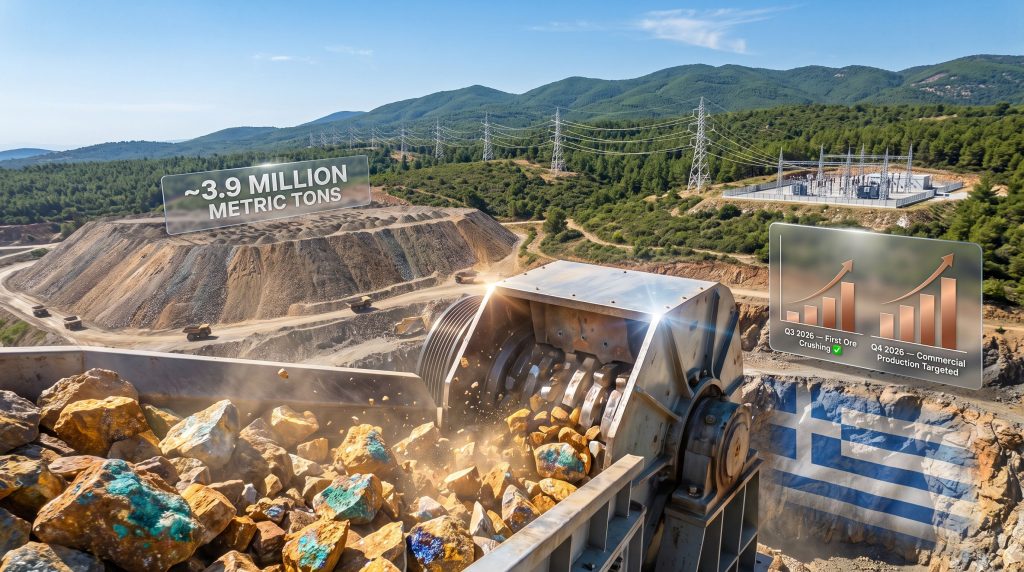
Open-pit mining at Skouries has been running ahead of its internal schedule, with the deliberate objective of accumulating this ore inventory before the processing plant required feed. The combined stockpile of approximately 3.9 million metric tons is designed to supply continuous plant feed throughout 2026, effectively severing the dependency between real-time mining rates and plant throughput during the commissioning and early production phases.
This matters more than it might appear. A persistent failure mode in mine ramp-ups globally is the scenario where the processing plant commissions successfully but mining rates are insufficient to maintain design feed, causing the plant to operate below capacity during its most capital-sensitive period. By building a multi-million tonne inventory buffer ahead of commissioning, the Skouries team has structurally eliminated feed availability as a commissioning risk variable for the remainder of the year.
The stockpile-first strategy carries an important but underappreciated subtlety: stockpiled ore degrades over time through oxidation and moisture absorption, which can affect flotation recoveries if ore sits too long before processing. Consequently, managing stockpile age, ore blending sequencing, and moisture content becomes an active operational discipline during ramp-up, not a passive inventory management exercise.
Power Infrastructure: The Final Gating Item
The most operationally significant constraint on Skouries' timeline to full production is the completion of final site energisation from the Greek national power grid. The physical construction of the power transmission infrastructure is complete; however, regulatory sign-off from the Greek power authority represents the outstanding dependency.
The completed construction scope includes:
-
All 12 transmission towers erected and conductors installed
-
A coordinated eight-hour planned grid outage successfully executed to enable installation of the final transmission tower, requiring grid-level coordination with external electricity authorities
-
Third-party substation testing completed by an independent testing group, providing technical validation of the electrical infrastructure
The remaining steps before full site energisation are:
-
Final inspection by the Greek power authority
-
Completion of metering equipment installation
-
Receipt of formal regulatory sign-off
In the interim, supplemental diesel generators have been deployed to sustain commissioning activities across the process plant. This generator strategy allows parallel commissioning to continue across multiple circuits simultaneously, preventing schedule slippage while the regulatory process concludes. However, generators cannot replicate the sustained, stable power delivery required for full integrated plant operation at nameplate capacity.
The grinding mills in particular — which are among the highest power-consuming items in a mineral processing plant — require reliable grid power to operate efficiently and continuously.
What Does the Power Timeline Mean for Investors?
Investor Note: The power authority sign-off timeline is effectively the critical path item for first concentrate production in Q3 2026. Unlike engineering commissioning risks, which the operations team can directly influence, regulatory inspection timelines involve external dependencies. This is a common and legitimate source of schedule uncertainty in mining projects globally, and its resolution at Skouries will be the clearest leading indicator of whether Q3 concentrate production and Q4 commercial production targets are achievable.
Production Milestones: Where Skouries Stands Against Its Targets
| Milestone | Target Period | Status |
|---|---|---|
| First ore through crushing circuit | Q3 2026 | Completed July 2026 |
| Grinding and flotation circuit commissioning | Q3 2026 | In Progress |
| First copper-gold concentrate production | Q3 2026 | Targeted |
| Commercial production declaration | Q4 2026 | Targeted |
The sequential dependencies that govern this timeline are well-defined. Commercial production in Q4 2026 requires, in order: final site energisation, successful integrated commissioning across all circuits under full grid power, and a sustained ramp-up to nameplate throughput capacity. Each dependency introduces discrete schedule risk, but the completion of first ore crushing on or ahead of schedule represents a meaningful positive signal that construction execution has tracked well against the project plan.
The next major ASX story will hit our subscribers first
Skouries Within the EU's Critical Minerals Calculus
Copper holds strategic raw material designation under the EU Critical Raw Materials Act, which targets domestically sourced production covering at least 10% of annual EU consumption by 2030. The EU Critical Raw Materials Act reflects a straightforward policy ambition: Europe's industrial base, and its energy transition in particular, is structurally dependent on copper that it largely imports.
The demand physics of the energy transition reinforce the copper supply urgency in quantitative terms. Indeed, the broader copper supply deficit facing Europe makes domestic projects like Skouries increasingly strategic.
| Application | Copper Intensity |
|---|---|
| Battery electric vehicle | ~83 kg per vehicle |
| Internal combustion engine vehicle | ~23 kg per vehicle |
| Offshore wind (per installed MW) | ~9.5 tonnes |
| Grid-scale battery storage | High intensity across inverters, transformers, and cabling |
| Data centre infrastructure | Significant copper in wiring and liquid cooling systems |
Copper's physical properties — specifically its combination of electrical conductivity, thermal performance, and ductility — make substitution impractical in the majority of high-efficiency electrical applications. Unlike some critical minerals where alternative materials or recycling streams can partially offset primary supply gaps, copper's role in energy infrastructure is structurally embedded.
Skouries' gold by-product stream adds a dimension to project economics that distinguishes it from single-metal copper operations. Understanding how copper-gold by-product credits function illustrates why gold revenues flowing from the concentrate effectively reduce the net cost of copper production, improving the project's breakeven copper price and providing resilience during copper price weakness.
What Schedule Adherence in Mining Actually Signals
Mining projects globally have a documented history of schedule overruns and cost escalation. The academic and industry literature on this is consistent: capital projects in the mining sector overrun their original schedules at rates significantly higher than most other industrial sectors, driven by geological surprises, regulatory delays, labour market constraints, and equipment lead times.
Against this backdrop, the Skouries project reaching its Skouries copper-gold project first ore crushing milestone on or ahead of schedule is a non-trivial signal. The open-pit mining programme running ahead of schedule, to the point of building a 3.9 million metric ton ore inventory buffer, suggests that early-stage operational execution has tracked well. While the remaining commissioning steps carry their own risks, the historical record suggests that projects executing construction and early commissioning on schedule tend to have more predictable ramp-up curves than those arriving at commissioning already behind.
Key upside and downside scenarios for the remainder of the commissioning timeline:
-
Upside: Greek power authority sign-off is received ahead of the current timeline, allowing grinding and flotation circuits to commission under full grid power and accelerating the path to first concentrate
-
Upside: Initial ore hardness characteristics fall within the lower range of design assumptions, reducing grinding energy requirements and allowing faster throughput ramp-up
-
Neutral: Flotation reagent optimisation proceeds on a standard timeline, with design copper and gold recoveries achieved progressively through Q4 2026
-
Downside: Regulatory inspection processes extend beyond current expectations, delaying full grid energisation and compressing the window available for integrated commissioning before year-end
-
Downside: Ore variability between open-pit and underground feed types requires more extensive flotation circuit calibration than anticipated, delaying concentrate specification achievement
This article contains forward-looking statements and scenario analysis based on publicly available information. Mining project timelines are subject to technical, operational, and regulatory risks. Nothing in this article constitutes financial or investment advice.
Frequently Asked Questions: Skouries Copper-Gold Project
What type of deposit is Skouries and why does the geology matter for investors?
Skouries is a copper-gold porphyry deposit, the most economically significant deposit type for global copper supply. Porphyry systems offer large-tonnage, long-life production profiles that underpin bankable project economics. The associated gold mineralisation at Skouries creates a by-product credit that materially improves project economics relative to copper-only porphyries.
What does the 3.9 million metric ton ore stockpile actually mean for operations?
The stockpile provides continuous plant feed through 2026 regardless of real-time mining rates. It structurally decouples commissioning success from short-term mining performance, which is one of the most common failure modes in mine ramp-ups globally.
Why does full grid energisation matter so much?
The grinding mills at Skouries — which reduce crushed ore to a fine particle size suitable for flotation — are among the most power-intensive equipment in the plant. Sustained, reliable grid power is required to operate them at design throughput rates. Generator-supported commissioning can progress other circuits but cannot substitute for grid power in achieving nameplate grinding capacity.
When is commercial production expected?
Eldorado Gold targets first copper-gold concentrate production in the third quarter of 2026 and commercial production in the fourth quarter of 2026. Both targets remain contingent on final site energisation, integrated commissioning success, and sustained throughput ramp-up.
Where can readers find the original reporting on this commissioning milestone?
The original report on the Skouries first ore crushing milestone was published by Engineering and Mining Journal and is available at e-mj.com, providing additional construction and commissioning context from the project operator.
Want to Catch the Next Major Copper Discovery Before the Market Does?
Discovery Alert's proprietary Discovery IQ model scans ASX announcements in real time, instantly identifying significant mineral discoveries — including copper-gold projects — and converting complex data into clear, actionable insights for investors at every level. Explore how historic discoveries have generated extraordinary returns on Discovery Alert's dedicated discoveries page, and begin your 14-day free trial today to position yourself ahead of the broader market.