June 16, 2026
The sodium cyanide supply for gold extraction represents one of the most critical yet challenging aspects of modern precious metals mining. This chemical dependency highlights the complex relationship between industrial necessity and logistical sophistication that drives global gold production. As the historic gold surge continues to reshape mining economics, understanding sodium cyanide supply dynamics becomes increasingly vital for industry stakeholders.
The Chemical Foundation of Gold Recovery
Modern gold extraction depends entirely on sodium cyanide's unique ability to dissolve gold particles from complex ore matrices. This process, known as cyanidation, creates water-soluble gold complexes that can be separated and refined into pure metal. Without this chemical reaction, most of the world's gold would remain permanently locked in rock formations.
The chemistry involves gold atoms bonding with cyanide ions in the presence of oxygen and water, forming stable complexes that dissolve readily. This reaction requires carefully maintained alkaline conditions, typically with pH levels exceeding 10.5, to prevent the formation of deadly hydrogen cyanide gas. Consequently, the process transforms insoluble metallic gold into a compound that can be extracted using conventional separation techniques.
Understanding Consumption Patterns in Modern Operations
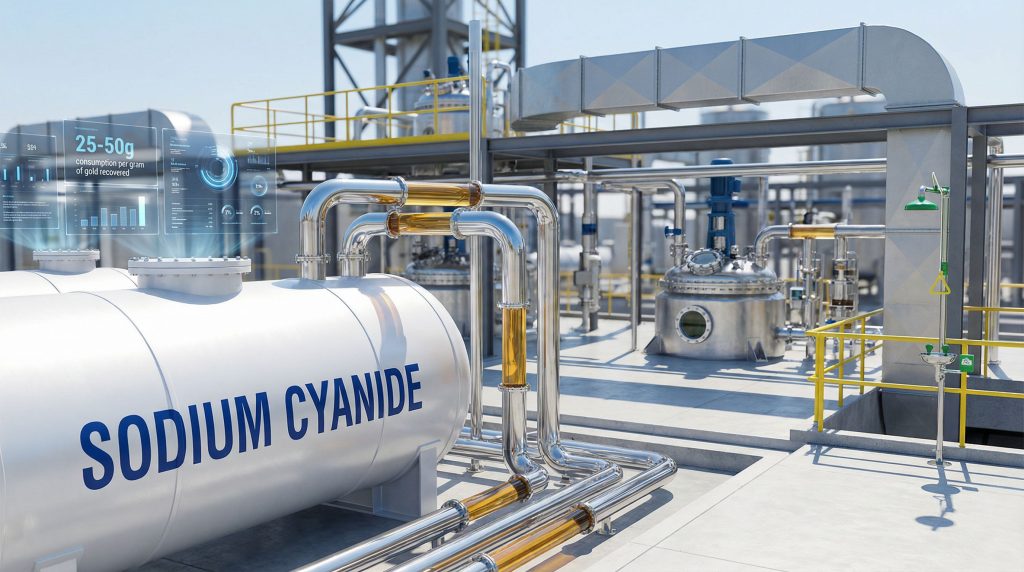
Theoretical calculations suggest minimal sodium cyanide requirements for gold extraction, but real-world mining operations face dramatically different realities. Laboratory conditions might indicate consumption rates as low as 0.5 grams of cyanide per gram of gold recovered, yet actual mining operations typically consume 25 to 50 grams per gram of gold produced.
This dramatic increase stems from ore complexity and mineral interference. Copper-bearing minerals, iron sulfides, and other reactive components consume significant quantities of cyanide before the chemical can interact with gold particles. Furthermore, these competing reactions represent the primary challenge in optimizing cyanide consumption across different ore types and geological formations.
Mining operations must process ore through multiple stages of grinding, mixing, and separation to maximise gold recovery while managing chemical consumption. Agitated tank systems provide the controlled environment necessary for consistent reaction conditions, with residence times extending from hours to days depending on ore characteristics and target recovery rates.
Industrial Processing Requirements and Constraints
Large-scale gold processing facilities require sophisticated infrastructure to handle sodium cyanide safely and efficiently. Storage systems must maintain chemical stability while preventing exposure to personnel and environmental contamination. For instance, specialised mixing equipment creates the optimal conditions for gold dissolution while monitoring solution strength throughout the process.
Ore preparation involves extensive grinding to maximise surface area exposure, creating fine particles that allow cyanide solutions to contact gold inclusions within rock matrices. The particle size distribution directly impacts both reaction kinetics and ultimate recovery efficiency, requiring precise control of grinding circuits and classification systems.
Solution management systems maintain proper chemical concentrations while removing dissolved metals and controlling pH levels. These circuits include monitoring equipment that tracks cyanide consumption rates and adjusts chemical addition to maintain optimal processing conditions across varying ore types and production schedules.
When big ASX news breaks, our subscribers know first
Supply Chain Dynamics and Market Pressures
Global sodium cyanide supply for gold extraction chains face increasing strain as gold demand reaches unprecedented levels while production capacity remains constrained. The chemical industry has struggled to expand manufacturing capacity due to regulatory complexity, environmental concerns, and significant capital investment requirements for new facilities.
Moreover, market dynamics reveal a fundamental supply-demand imbalance that has intensified over recent years. Gold mining expansion has accelerated faster than sodium cyanide production capacity, creating tightening conditions that affect pricing, availability, and supply security for mining operations worldwide.
Production Capacity and Geographic Distribution
Manufacturing facilities for sodium cyanide remain concentrated in specific regions, creating supply chain vulnerabilities for global gold mining operations. North American production centres around established industrial facilities, while European and Asian capacity serves regional mining markets with varying degrees of supply security.
The limited number of production facilities reflects the specialised nature of sodium cyanide manufacturing, which requires significant safety infrastructure, environmental controls, and regulatory compliance systems. However, new facility development faces extended approval processes and substantial capital requirements that discourage rapid capacity expansion.
Transportation infrastructure plays a critical role in supply chain efficiency, with specialised terminals and handling facilities required for safe chemical distribution. These logistics networks must accommodate hazardous material regulations while maintaining supply reliability for remote mining operations with limited transportation access.
Strategic Supply Agreement Structures
Mining companies increasingly prioritise long-term supply agreements that guarantee chemical availability and pricing stability. These contracts typically extend multiple years and include specific performance criteria related to safety, quality consistency, and delivery reliability.
Recent market developments demonstrate the strategic importance of supply partnerships. When Barrick Gold selected Draslovka for sodium cyanide supply to Nevada Gold Mines, the decision reflected evaluation criteria emphasising safety protocols, quality assurance, and supply security rather than purely cost-based considerations.
Multi-year commitments provide suppliers with the investment certainty needed for facility expansion and infrastructure development. The Memphis production facility and Carlin terminal expansion supporting the Nevada Gold Mines contract exemplifies how supply agreements enable capacity growth to meet mining industry demands.
Market Leaders and Competitive Dynamics
The sodium cyanide supply industry remains dominated by established chemical manufacturers with specialised production capabilities and safety expertise. These companies maintain competitive advantages through facility locations, technical support services, and proven reliability records with major mining operations.
Draslovka has emerged as a significant North American supplier through strategic facility positioning and operational excellence. The company's Memphis production facility serves as a regional supply hub, while terminal expansions enable direct service to major mining operations throughout the western United States.
Supplier Evaluation Criteria and Selection Factors
Mining companies evaluate sodium cyanide suppliers using comprehensive criteria that extend beyond traditional pricing considerations. Safety performance, environmental compliance, and supply reliability rank as primary factors in supplier selection processes for major gold mining operations.
Quality consistency represents another critical evaluation factor, as variations in chemical purity or composition can significantly impact processing efficiency and gold recovery rates. Therefore, suppliers must demonstrate rigorous quality control systems and testing protocols that ensure consistent product specifications across all deliveries.
Technical support capabilities distinguish leading suppliers from commodity chemical providers. Mining operations require suppliers who understand metallurgical processes, can provide troubleshooting assistance, and offer optimisation recommendations based on specific ore characteristics and processing conditions.
Regional Market Positioning and Growth Strategies
North American markets have attracted significant supplier investment due to the concentration of large-scale gold mining operations and favourable regulatory environments. Companies like Draslovka view the region as strategically important for long-term growth and market expansion.
The Nevada Gold Mines operation, characterised as the largest gold mine in the United States, represents the scale of demand that drives supplier investment in regional infrastructure. Serving operations of this magnitude requires dedicated production capacity and specialised logistics capabilities.
Market expansion strategies focus on building local production and distribution capabilities rather than relying on long-distance transportation from existing facilities. This approach reduces supply chain risks while improving service responsiveness and cost competitiveness.
Safety Protocols and Environmental Considerations
Sodium cyanide transportation and handling require specialised safety protocols due to the chemical's extreme toxicity and regulatory classification as a hazardous material. Transportation systems must comply with strict regulations governing hazardous chemical movement while maintaining supply chain efficiency.
Terminal facilities require sophisticated safety infrastructure including detection systems, emergency response equipment, and containment capabilities. These systems protect personnel during normal operations while providing rapid response capabilities in case of accidents or chemical releases.
Storage and Handling Infrastructure Requirements
Chemical storage systems must prevent contamination while maintaining product stability over extended periods. Tank materials, ventilation systems, and monitoring equipment require regular maintenance and inspection to ensure safe operating conditions.
Handling procedures involve specialised training for personnel who manage chemical transfer, mixing, and application processes. These protocols cover personal protective equipment, emergency response procedures, and environmental protection measures that prevent accidental exposure.
Processing safety focuses on preventing hydrogen cyanide formation through careful pH management and solution monitoring. Mining operations must maintain alkaline conditions throughout the extraction process while implementing detection systems that identify potentially dangerous chemical conditions.
Regulatory Compliance and Environmental Protection
International regulations govern sodium cyanide transportation, requiring specialised documentation, routing restrictions, and emergency response planning. These requirements add complexity and cost to supply chain operations while ensuring public safety during chemical movement.
Environmental impact assessments examine potential effects of chemical facilities and mining operations on surrounding ecosystems. These evaluations influence facility design, operational procedures, and emergency response planning to minimise environmental risks.
Furthermore, mining operations must implement cyanide destruction systems that neutralise chemical residues before disposal or release. These treatment processes ensure compliance with environmental regulations while protecting groundwater and surface water resources from contamination. Understanding mine reclamation strategies becomes crucial in this context.
Alternative Technologies and Market Competition
Research into alternative gold extraction methods continues to explore technologies that could reduce dependence on sodium cyanide, though none have achieved commercial viability at the scale required for major mining operations. These alternatives face significant technical and economic challenges that limit their practical application.
Thiosulfate leaching represents the most promising alternative technology, using less toxic chemicals to dissolve gold from ore matrices. Laboratory testing has demonstrated effective gold recovery across various ore types, though processing costs and complexity remain higher than conventional cyanide processing.
Technical Performance Comparison
Alternative extraction methods must demonstrate gold recovery rates comparable to cyanide processing while maintaining economic feasibility. Current alternatives typically achieve lower recovery rates or require significantly higher operating costs, limiting their adoption in commercial mining operations.
Processing efficiency comparisons reveal that sodium cyanide maintains advantages in reaction kinetics, chemical stability, and operational simplicity that alternative technologies have not yet matched. These performance characteristics explain why mining operations continue to prefer cyanide despite safety and environmental concerns.
In addition, economic analysis of alternative technologies must consider capital investment requirements, operating costs, and gold recovery rates to determine overall project economics. Most alternatives require higher initial investment and ongoing operating expenses that reduce project profitability compared to conventional processing.
Adoption Barriers and Market Resistance
Alternative gold extraction technologies face adoption challenges including higher operating costs, lower recovery rates, and limited proven track records at industrial scale, maintaining sodium cyanide supply for gold extraction dominance in the sector. Mining companies require extensive testing and validation before committing to alternative processing methods.
Regulatory approval processes for new extraction technologies can extend project development timelines and increase uncertainty about technology implementation. These delays discourage mining companies from investing in alternative methods when proven cyanide processing delivers predictable results.
Market acceptance of alternative technologies requires demonstration of long-term reliability, consistent performance, and competitive economics across diverse ore types and operating conditions. This validation process typically requires years of commercial operation before widespread adoption occurs.
Economic Factors and Pricing Dynamics
Sodium cyanide pricing reflects supply-demand balance, production costs, and transportation expenses that vary significantly across global markets. Chemical costs represent a relatively small percentage of total gold recovery expenses, but supply availability can constrain entire mining operations.
Market tightening has intensified pricing pressures as demand growth outpaces capacity expansion. Production facilities operate at high capacity utilisation rates, limiting suppliers' ability to accommodate demand increases without significant facility investments. This dynamic correlates with broader gold market cycles affecting the industry.
Cost Structure Analysis and Regional Variations
Manufacturing economics involve raw material costs, energy requirements, and specialised safety infrastructure that contribute to sodium cyanide production expenses. These fixed costs create barriers to entry for new suppliers while supporting pricing stability for established producers.
Transportation represents a significant cost component for mining operations located far from production facilities. Hazardous material shipping requirements add complexity and expense compared to conventional chemical transportation, influencing supplier selection decisions.
Regional pricing variations reflect local supply-demand conditions, transportation costs, and competitive dynamics in different geographic markets. Mining companies operating multiple sites must consider these regional differences when developing procurement strategies.
Gold Price Correlation and Demand Elasticity
Rising gold prices typically drive mining industry expansion, increasing demand for sodium cyanide and other processing chemicals. This correlation creates cyclical demand patterns that challenge supply chain planning and capacity management for chemical suppliers. The gold price forecast indicates continued pressure on supply chains.
Mining investment cycles lag gold price movements, creating delayed demand responses that can amplify supply chain pressures. When gold prices rise, mining companies expand production and develop new projects, but chemical supply capacity cannot adjust as rapidly.
Long-term demand projections must consider both gold market fundamentals and mining industry development cycles. Chemical suppliers use these forecasts to plan facility expansions and capacity investments that align with anticipated market growth.
The next major ASX story will hit our subscribers first
Process Optimisation and Consumption Management
Mining operations continuously seek to reduce sodium cyanide consumption through process optimisation, ore characterisation, and equipment improvements. These efforts focus on maximising gold recovery while minimising chemical usage and associated costs.
Ore testing programmes identify specific mineral characteristics that influence cyanide consumption, allowing mining operations to adjust processing parameters for different ore types. This characterisation enables predictive models that optimise chemical usage based on geological variations. Understanding mining permitting insights helps streamline these processes.
Impurity Management and Circuit Design
Copper minerals present the greatest challenge for cyanide consumption optimisation, as they readily react with cyanide solutions before gold dissolution occurs. Advanced circuit designs incorporate copper removal systems or selective processing techniques that minimise chemical waste.
Pre-treatment processes can remove or neutralise reactive minerals that consume excess cyanide during gold extraction. These systems require additional capital investment but can significantly reduce operating chemical costs for operations processing complex ores.
Real-time monitoring systems track cyanide consumption patterns and automatically adjust chemical addition rates based on ore characteristics and processing conditions. This automation improves chemical efficiency while maintaining optimal gold recovery rates.
Operational Excellence and Best Practices
Successful cyanide optimisation requires systematic approaches that combine:
- Comprehensive ore characterisation and testing programmes
- Circuit design optimisation for specific mineral assemblages
- Advanced process control and monitoring systems
- Regular equipment maintenance and calibration procedures
- Continuous operator training and process improvement initiatives
Equipment maintenance programmes ensure optimal performance of grinding, mixing, and separation systems that influence chemical efficiency. Properly maintained equipment provides consistent processing conditions that minimise chemical waste while maximising gold recovery.
Staff training programmes educate operators on process optimisation techniques, safety procedures, and efficiency improvement methods. Well-trained personnel can identify optimisation opportunities and implement corrective actions that reduce chemical consumption.
Future Market Developments and Industry Outlook
Sodium cyanide supply for gold extraction capacity expansion will likely accelerate as market tightening intensifies and gold demand continues growing. Chemical suppliers are evaluating new facility investments and existing capacity upgrades to address market imbalances.
Technology improvements in chemical manufacturing could enhance production efficiency and reduce environmental impacts of sodium cyanide production. These developments may enable capacity expansion while addressing regulatory and environmental concerns that constrain facility development.
What Are the Key Capacity Planning Challenges?
New production facilities require extensive planning, regulatory approval, and capital investment that extend development timelines significantly. These lead times create challenges in matching capacity expansion with demand growth, particularly during periods of rapid mining industry expansion.
Existing facility optimisation represents a shorter-term approach to capacity increases, involving equipment upgrades, process improvements, and operational efficiency enhancements. These investments can provide meaningful capacity increases with shorter implementation timelines.
Regional capacity development focuses on serving major mining markets with local production capabilities. This strategy reduces transportation costs and supply chain risks while improving service responsiveness for mining operations.
Market Consolidation and Strategic Partnerships
Industry consolidation trends may reshape competitive dynamics as chemical suppliers seek scale advantages and geographic expansion opportunities. Mergers and acquisitions could create larger, more capable suppliers serving global mining markets.
Strategic partnerships between chemical suppliers and mining companies are becoming more common as both industries recognise mutual benefits from long-term collaboration. These relationships enable capacity planning, investment coordination, and operational optimisation that benefit all parties.
Vertical integration possibilities exist for major mining companies that could invest in sodium cyanide production capacity to ensure supply security. Such strategies would require substantial capital investment and chemical industry expertise but could provide long-term supply advantages.
The sodium cyanide supply industry will continue evolving to meet growing gold mining demand while addressing safety, environmental, and regulatory challenges. Success will require sustained investment in production capacity, safety infrastructure, and technological advancement to support the global precious metals industry's continued growth.
This analysis is based on publicly available information and industry reports. Investment decisions should consider multiple sources and professional advice, as commodity markets and supply chains involve inherent risks and uncertainties.
Looking for Your Next Gold Mining Investment Opportunity?
Discovery Alert's proprietary Discovery IQ model delivers instant notifications on significant ASX mineral discoveries, empowering subscribers to identify actionable investment opportunities ahead of the broader market. Explore how major mineral discoveries have generated substantial returns by visiting Discovery Alert's dedicated discoveries page, then begin your 14-day free trial to position yourself ahead of market movements.