June 30, 2026
The global energy storage market stands at a critical juncture where sodium-ion battery cost parity with lithium-ion alternatives has emerged as a transformative reality rather than a distant possibility. This technological and economic convergence represents more than simple price competition; it signals a fundamental shift in how energy storage economics operate across diverse applications. Furthermore, recent developments in battery recycling breakthrough technologies and the broader critical minerals transition underscore the importance of cost-effective alternatives.
Technical Infrastructure Behind Battery Economic Models
Modern energy storage economics operate through complex multi-layered cost frameworks that extend far beyond simple per-kilowatt-hour calculations. Battery cost analysis requires sophisticated modeling approaches that account for manufacturing scale dynamics, supply chain resilience factors, and real-world deployment scenarios across diverse applications.
The sodium-ion battery cost parity phenomenon represents a convergence of several technical and economic forces. Unlike traditional battery comparisons focused solely on cell-level pricing, contemporary analysis demands comprehensive evaluation of system-level integration costs, operational performance parameters, and total lifecycle economic impact.
Understanding Multi-Dimensional Cost Structures
Economic equivalence between battery technologies involves multiple cost layers that compound differently across applications. Cell manufacturing represents only the foundation layer, with additional costs emerging through pack assembly, system integration, installation infrastructure, and ongoing operational requirements.
Manufacturing economics follow predictable learning curve patterns, where production volume increases drive unit cost reductions through process optimisation and material efficiency improvements. Current sodium-ion manufacturing benefits from existing lithium-ion infrastructure compatibility, enabling rapid scale-up without entirely new capital investment requirements.
Energy density variations create cascading economic effects throughout deployment scenarios. Lower energy density translates to larger installation footprints, increased structural requirements, and modified thermal management systems. However, these penalties affect different applications unequally, with stationary storage applications showing minimal economic sensitivity to energy density variations.
Operational Performance Economic Integration
Temperature performance characteristics significantly influence total cost of ownership calculations. Sodium-ion batteries demonstrate superior operational temperature ranges compared to lithium-ion alternatives, reducing auxiliary heating and cooling requirements in extreme climate deployments.
Cycle life durability directly impacts levelised cost calculations through replacement frequency modelling. Recent research indicates sodium-ion battery cells are already near lithium-ion cost parity and maintain high cycle performance across cost-optimised scenarios, with full cycle counts exceeding 300 cycles whilst achieving superior energy-to-power ratios in the 6-7 hour range.
Supply chain stability factors introduce risk-adjusted cost considerations. Sodium-ion technology utilises abundant raw materials, reducing exposure to commodity price volatility that affects lithium-based alternatives. This stability provides predictable long-term cost trajectories essential for infrastructure investment planning.
When big ASX news breaks, our subscribers know first
Current Market Position and Competitive Dynamics
Contemporary sodium-ion battery cost parity represents achieved reality rather than future projection. Commercial deployment evidence demonstrates utility-scale installations at 100 MWh scales, indicating institutional confidence in current economic competitiveness.
Present-Day Cost Analysis Framework
| Technology | Cell Level (€/kWh) | System Level (€/kWh) | LCOS 2050 (€/MWh) |
|---|---|---|---|
| Sodium-Ion (High Learning) | Near Parity | 28.5-51.9 | 11.2-13.6 |
| Lithium-Ion (Low Learning) | Near Parity | 28.5-51.9 | 15.8-22.1 |
| Literature Reference | – | – | 19.5-29.4 |
Manufacturing flexibility through drop-in technology classification enables immediate production capability on existing lithium-ion manufacturing lines. This compatibility eliminates major capital barriers whilst providing supply chain redundancy for manufacturers facing lithium supply disruptions.
Current deployment patterns demonstrate utility-scale adoption leadership, with commercial facilities being constructed and commissioned at unprecedented scales. China Southern Power Grid's 10 MWh installation in Guangxi Zhuang region exemplifies operational confidence in sodium-ion economics at current cost levels.
Regional Manufacturing Maturity Assessment
Chinese manufacturing capabilities currently lead global sodium-ion production scale, benefiting from established battery manufacturing infrastructure and supply chain integration. Production volumes in China enable economies of scale that support current cost parity achievement.
European and North American manufacturing development follows different timelines, with technology transfer and joint venture approaches accelerating capability development. The drop-in technology advantage allows rapid deployment of sodium-ion capability within existing regional manufacturing facilities.
Investment patterns indicate manufacturing capacity expansion across multiple regions, with supply chain establishment becoming the primary constraint rather than fundamental technology economics. Additionally, established companies are developing comprehensive lithium supply strategy alternatives to reduce dependency on critical minerals.
Application-Specific Economic Leadership Patterns
Market segmentation reveals distinct economic advantage patterns across different deployment scenarios. Stationary energy storage applications demonstrate the clearest path to economic superiority, whilst mobile applications face trade-offs between cost and performance density requirements.
Grid-Scale Storage Economic Advantages
Utility-scale energy storage deployment prioritises cost per megawatt-hour over energy density constraints that limit mobile applications. Grid storage installations benefit from sodium-ion's superior energy-to-power ratios, achieving 6-7 hour duration capabilities compared to 4-6 hour ranges in alternative technologies.
Why Energy Density Matters Less for Grid Storage?
Stationary installations face minimal space constraints compared to mobile applications, allowing larger footprint systems to optimise for cost rather than volumetric efficiency. Grid storage values duration and cycle life over compact form factors.
Cycle durability advantages translate directly to reduced replacement frequency and lower levelised storage costs. High cycle count performance across cost-optimised scenarios supports long-term asset value in grid applications.
Long-duration storage economic modelling favours sodium-ion characteristics, particularly for applications requiring extended discharge periods. The technology's energy-to-power ratio advantages align with grid balancing requirements for renewable energy integration.
Transportation Market Segmentation
Vehicle applications present more complex economic trade-offs due to energy density limitations. Current sodium-ion technology suits low-cost vehicle segments where absolute energy density takes secondary priority to cost competitiveness.
Two-wheeler and micro-mobility applications demonstrate strong economic alignment with sodium-ion characteristics. These segments prioritise cost reduction over maximum energy density, enabling near-term adoption potential.
Commercial fleet considerations include total cost of ownership factors beyond initial battery costs. Fleet operators evaluate maintenance requirements, operational temperature performance, and replacement scheduling in economic decisions.
Raw Material Economics and Supply Chain Resilience
Fundamental economic advantages stem from raw material abundance and supply chain stability characteristics. Sodium-ion technology reduces exposure to critical mineral supply constraints that affect lithium-based alternatives.
Material Cost Stability Framework
Sodium carbonate sourcing utilises globally abundant materials with established supply networks, reducing price volatility exposure compared to lithium carbonate markets. This stability enables predictable long-term cost projections essential for infrastructure investment decisions.
Supply chain resilience provides economic insurance against disruption scenarios. Manufacturing flexibility allows rapid production shifts between sodium-ion and lithium-ion technologies based on material availability or price conditions.
Critical mineral security considerations increasingly influence technology selection decisions. Sodium-ion reduces dependence on geographically concentrated lithium resources, supporting supply chain diversification strategies, especially given current lithium market challenges.
Manufacturing Scale Economics
Production volume impact follows established learning curve patterns, with cost reductions accelerating as manufacturing scales increase. Current sodium-ion production benefits from lithium-ion manufacturing expertise transfer, accelerating the learning curve progression.
Capital expenditure requirements for sodium-ion production remain lower than lithium-ion alternatives due to drop-in technology advantages. Existing facilities require only minor modifications rather than complete reconstruction.
Technology transfer mechanisms enable rapid capability development across multiple manufacturers and regions, supporting distributed production capacity development.
Performance Trade-off Economic Modelling
Real-world cost calculations must integrate performance characteristics that affect system-level economics beyond simple cell pricing. Energy density, cycle life, and operational temperature ranges influence total deployment costs across different applications.
Energy Density Impact Analysis
Space and weight penalties in mobile applications create system-level cost multipliers that affect sodium-ion competitiveness in certain segments. However, stationary applications demonstrate minimal sensitivity to energy density variations.
Installation and infrastructure costs vary with energy density requirements, particularly in space-constrained deployments. Grid storage installations typically accommodate larger footprints without significant cost penalties.
Scenario Analysis: Cost Per Usable Energy Over System Lifetime
| Application | Energy Density Impact | Economic Sensitivity | Sodium-Ion Advantage |
|---|---|---|---|
| Grid Storage | Minimal | Low | High |
| Commercial Fleet | Moderate | Medium | Medium |
| Premium Automotive | High | High | Low |
Cycle Life and Degradation Economics
Levelised cost of storage calculations incorporate cycle life performance and degradation rates over system operational lifetime. Sodium-ion demonstrates high cycle durability across cost-optimised scenarios, supporting favourable LCOS calculations.
Replacement frequency planning affects long-term economic projections, with higher cycle life technologies reducing operational disruption and replacement capital requirements.
Temperature performance advantages reduce auxiliary system requirements in extreme climate deployments, lowering total system costs and improving operational reliability.
Future Cost Trajectory Projections
Economic modelling through 2050 indicates continued cost reduction potential for sodium-ion technology, with learning curve effects and scale economics driving competitive advantages over lithium-ion alternatives.
Learning Curve and Scale Projections
Cost Trajectory Timeline by Application Segment:
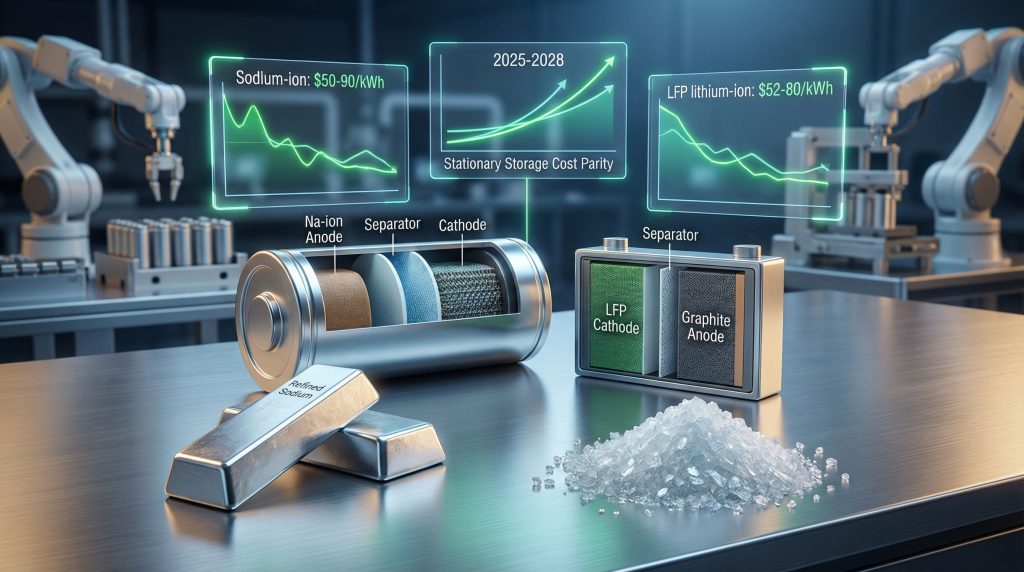
- Stationary Storage: Current cost parity achieved, economic leadership by 2025-2028
- Low-Cost Transportation: Economic competitiveness emerging 2028-2032
- Premium Applications: Market penetration potential 2032-2035
Manufacturing scale milestones require significant capacity investment, with global sodium-ion production needing substantial expansion to support widespread adoption. Current production levels support niche applications but require scale increases for market transformation.
Investment requirements focus on supply chain establishment rather than fundamental technology development. Manufacturing capability exists through drop-in technology advantages, with supply route development becoming the primary constraint.
Technology Development Acceleration Factors
Chemistry optimisation continues advancing sodium-ion performance characteristics, with cathode material improvements and electrolyte formulation development addressing remaining performance gaps.
Solid-state sodium-ion development represents longer-term potential for addressing energy density limitations whilst maintaining cost advantages. This technology pathway could expand sodium-ion applicability to premium market segments currently dominated by lithium-ion alternatives.
Policy support mechanisms increasingly recognise supply chain resilience benefits of sodium-ion technology, with government incentives supporting domestic production capacity development and critical mineral security objectives. Furthermore, sodium-ion battery cost reduction research continues to validate these economic advantages.
The next major ASX story will hit our subscribers first
Manufacturing Leadership and Innovation Pathways
Global sodium-ion development concentrates among established battery manufacturers with existing lithium-ion capabilities. Technology leadership emerges through manufacturing scale achievement and supply chain establishment rather than fundamental research breakthroughs, particularly as the broader mining industry innovation supports this transition.
Production Capacity Leadership
Chinese manufacturers currently lead global sodium-ion production capacity, leveraging existing battery manufacturing infrastructure and established supply chain relationships. Production scale advantages support current cost competitiveness whilst enabling continued cost reduction through learning curve effects.
European production initiatives focus on technology transfer and joint venture approaches, enabling rapid capability development without extensive capital investment requirements. Manufacturing partnerships accelerate market entry timelines whilst sharing development risks.
North American production strategies emphasise supply chain security and domestic manufacturing capability development. Government support programmes incentivise sodium-ion production as part of critical mineral security and energy independence objectives.
Technology Innovation Acceleration
Cathode material optimisation drives performance improvements whilst maintaining cost advantages. Advanced sodium-ion chemistries address energy density limitations whilst preserving manufacturing cost competitiveness.
Electrolyte formulation advances improve operational temperature ranges and cycle life performance, expanding application suitability across diverse deployment scenarios.
Manufacturing process innovations reduce production costs whilst improving quality consistency. Drop-in technology advantages accelerate process optimisation by leveraging lithium-ion manufacturing expertise.
Market Disruption and Acceleration Scenarios
Several potential scenarios could accelerate sodium-ion adoption beyond current projections, including supply chain disruptions, policy interventions, and technological breakthroughs that expand application suitability.
Supply Chain Disruption Impact Modelling
Lithium supply chain disruptions would immediately advantage sodium-ion alternatives due to abundant raw material availability and manufacturing flexibility. Historical commodity price shock parallels suggest rapid market share shifts during supply constraint periods.
Price volatility in critical mineral markets increasingly favours technologies with stable supply chains and predictable cost trajectories. Sodium-ion provides economic insurance against lithium market instability whilst offering comparable performance in key applications.
Case Study Parallel: Historical transitions during rare earth supply constraints demonstrate how supply security considerations can override pure cost comparisons in technology adoption decisions. Similar dynamics could accelerate sodium-ion adoption during lithium supply disruptions.
Policy and Regulatory Acceleration
Government incentives for domestic battery production increasingly recognise supply chain security benefits of sodium-ion technology. Critical mineral security legislation supports technologies that reduce dependence on geographically concentrated resources.
Carbon pricing mechanisms may favour sodium-ion due to lower manufacturing energy requirements and reduced transportation costs from abundant raw material sources.
Strategic autonomy considerations drive policy support for technologies that enhance energy security through diversified supply chains and domestic production capability.
Investment Strategy and Market Entry Timing
Investment decisions require balancing early adoption advantages against technology maturity risks. Current sodium-ion battery cost parity achievement reduces technology risk whilst maintaining upside potential from market expansion.
Strategic Investment Approaches
Early adopter advantages include supply chain partner access, manufacturing capacity allocation, and market positioning before widespread adoption. Current cost parity reduces technology risk compared to earlier development stages.
Technology maturity assessment indicates commercial readiness for stationary storage applications whilst mobile applications require continued development. Investment timing can align with application-specific maturity levels.
Supply chain partnership development becomes crucial for securing raw material access and manufacturing capacity as market adoption accelerates. Strategic relationships with sodium-ion suppliers provide competitive advantages.
Technology Portfolio Diversification
Hybrid production strategies enable manufacturers to optimise technology selection based on application requirements and market conditions. Drop-in technology compatibility supports flexible production planning.
Application-specific technology selection frameworks allow optimisation across diverse market segments. Sodium-ion suits cost-sensitive applications whilst lithium-ion maintains advantages in energy density-critical segments.
Risk management strategies include maintaining capability in both technologies whilst optimising production allocation based on market dynamics and supply chain conditions.
Long-Term Economic and Strategic Implications
Sodium-ion cost parity achievement represents a fundamental shift in energy storage economics with implications extending beyond battery markets into renewable energy deployment, grid modernisation, and geopolitical supply chain dynamics.
Energy Storage Market Transformation
Projected Global Battery Demand by Technology (2025-2050):
| Technology | 2025 (TWh) | 2035 (TWh) | 2050 (TWh) |
|---|---|---|---|
| Lithium-Ion | 15-20 | 35-45 | 45-65 |
| Sodium-Ion | 1-3 | 15-25 | 25-45 |
| Other Technologies | 2-5 | 8-15 | 15-25 |
Disclaimer: These projections represent scenario modelling based on current trends and should not be considered investment advice. Actual market development may vary significantly based on technological developments, policy changes, and market dynamics.
Cost reduction acceleration enables renewable energy deployment expansion through affordable long-duration storage. Grid modernisation benefits from diverse technology options that optimise system economics across different applications.
Market expansion potential increases as storage costs decline below critical thresholds for widespread adoption. Lower storage costs enable new applications and business models previously constrained by economics.
Geopolitical and Supply Chain Resilience
Reduced dependence on critical mineral imports enhances national energy security through diversified supply chains. Sodium-ion adoption supports strategic autonomy objectives whilst maintaining economic competitiveness.
Distributed manufacturing capability development reduces geopolitical supply chain risks whilst enabling regional economic development. Technology transfer and domestic production support employment and technological capability development.
Strategic autonomy implications extend beyond energy storage to broader renewable energy deployment and grid modernisation initiatives. Secure supply chains enable long-term infrastructure investment planning with reduced geopolitical risk exposure.
Investment Disclaimer: This analysis is for informational purposes only and should not be considered investment advice. Battery technology markets involve significant risks including technological obsolescence, regulatory changes, and market volatility. Potential investors should conduct independent research and consult qualified financial advisors before making investment decisions.
Ready to Invest in the Next Battery Technology Breakthrough?
Discovery Alert's proprietary Discovery IQ model delivers real-time notifications on significant ASX mineral discoveries, instantly empowering subscribers to identify actionable opportunities ahead of the broader market in critical minerals powering the battery revolution. Begin your 30-day free trial today and secure your market-leading advantage in this rapidly evolving sector.