
July 12, 2026
The Storage Gap That Could Determine America's Energy Future
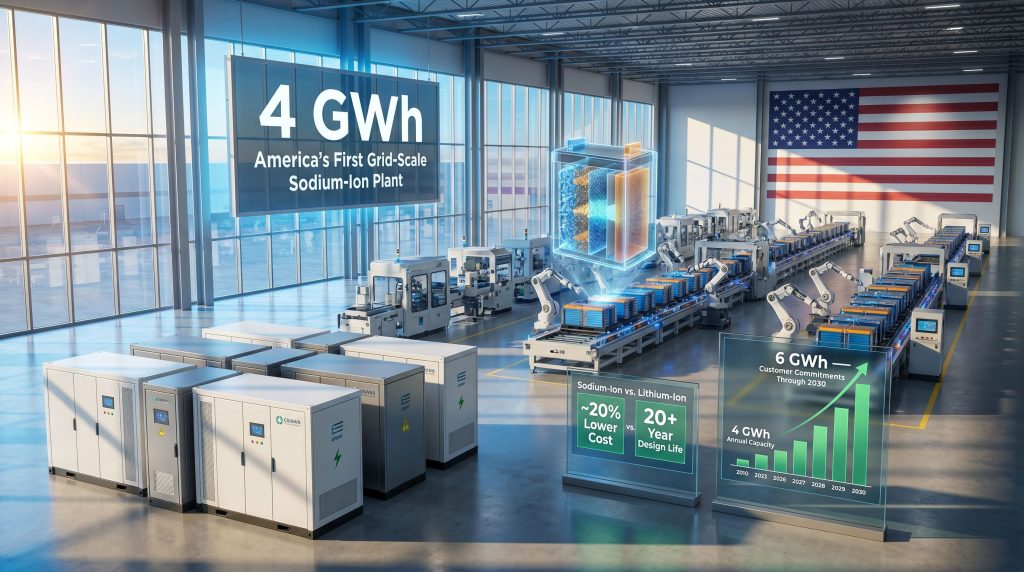
Every decade or so, a technology emerges that shifts the underlying architecture of an entire industry. For the U.S. electricity sector, that technology may not arrive in the form of a new power plant or a smarter transmission line. It could come from a 183,000-square-foot building near Sacramento International Airport, where a company called Peak Energy is constructing what will be the first grid-scale sodium-ion battery plant in Sacramento and, indeed, in the entire United States.
The pressures driving this investment have been building for years. Variable renewable generation has expanded rapidly, but the infrastructure needed to store and dispatch that energy has not kept pace. At the same time, artificial intelligence and the data centre boom are rewriting electricity demand forecasts at a pace most grid planners had not modelled.
Against that backdrop, the strategic vulnerability created by dependence on Chinese-controlled lithium supply chains has moved from an industry talking point to a policy-level concern. The critical minerals demand underlying modern battery technologies sits at the heart of this challenge.
The Sacramento plant, developed by Peak Energy and founded in 2023, sits at the intersection of all three of these forces.
When big ASX news breaks, our subscribers know first
Why Grid-Scale Storage Has Become a Critical Infrastructure Priority
The Demand Surge That Is Outpacing the Grid
U.S. electricity demand growth was relatively modest for the better part of two decades following the 2008 financial crisis. Efficiency gains in appliances, lighting, and industrial processes largely offset population and economic growth. That structural balance is now breaking down rapidly.
Data centre power consumption in the United States is projected to reach 66 gigawatts by 2027, representing a doubling of 2025 levels, according to analysis from Goldman Sachs. The primary driver is the computational intensity of artificial intelligence workloads, which consume orders of magnitude more electricity per unit of output than conventional web services.
This is not a demand signal that can be managed through modest capacity additions or demand-response programmes. It requires firm, dispatchable power, which is where grid-scale storage becomes structurally indispensable. Solar and wind generation are variable by nature, producing at their peak during periods that do not always coincide with demand peaks. Storage acts as the critical intermediary, absorbing excess generation and releasing it precisely when the grid needs it most.
The Lithium Supply Chain Problem
Beyond demand, there is a supply chain dimension to this story that adds a layer of geopolitical complexity rarely acknowledged in mainstream energy coverage. The global lithium-ion battery industry has, over roughly fifteen years, become heavily concentrated in China. Chinese firms control the dominant share of lithium processing capacity, cathode and anode manufacturing, and cell assembly.
Even batteries assembled in the United States or Europe frequently rely on Chinese-processed materials upstream. The energy security implications of this concentration are increasingly difficult to ignore at a national policy level.
This concentration creates a single point of failure in U.S. energy infrastructure planning. Furthermore, lithium market volatility has been significant, with spot prices swinging dramatically during the electric vehicle boom and subsequent demand corrections. For utility procurement teams trying to plan storage deployments years in advance, price unpredictability in the core input material is a serious operational risk.
Sodium-ion chemistry addresses both problems simultaneously, which is precisely why the technology has moved from laboratory curiosity to commercial investment at this particular historical moment.
Understanding Sodium-Ion Technology: What Makes It Different
The Electrochemistry Behind the Advantage
Sodium-ion batteries operate on the same fundamental electrochemical principle as lithium-ion cells: ions shuttle between an anode and a cathode through an electrolyte, storing and releasing energy in the process. The critical difference is the charge carrier. Sodium ions, derived from sodium salt compounds, replace lithium ions as the working element of the cell.
This substitution has profound practical consequences. Sodium is one of the most abundant elements in the Earth's crust and is distributed globally, including in large domestic quantities within the United States. There is no analogous supply chain dependency to the one that characterises lithium. Sodium feedstock cannot be strategically withheld or price-manipulated by a single national supplier in the way lithium effectively can be.
From a safety standpoint, sodium-ion cells exhibit lower thermal reactivity than their lithium-ion counterparts. Lithium-ion batteries carry a well-documented risk of thermal runaway, a self-reinforcing exothermic reaction that can result in fires difficult to extinguish. This characteristic is a significant consideration for densely populated deployment environments, utility substations in urban areas, and installations near critical infrastructure.
Head-to-Head: Sodium-Ion vs. Lithium-Ion for Grid Applications
| Attribute | Sodium-Ion | Lithium-Ion |
|---|---|---|
| Raw material abundance | Extremely high, globally distributed | Geographically concentrated |
| Thermal safety profile | Lower ignition and runaway risk | Higher thermal runaway potential |
| Active cooling requirement | No (passive thermal management) | Yes (fans or liquid cooling systems) |
| Designed operational life | 20+ years, minimal maintenance | Regular servicing intervals required |
| Estimated cost differential | Approximately 20% lower than Li-ion | Established but price-volatile |
| Supply chain exposure | Diversified, domestically accessible | Heavily China-dependent upstream |
The Passive Cooling Advantage That Gets Overlooked
One of the least-discussed technical advantages of sodium-ion systems at grid scale is the elimination of active thermal management. Lithium-ion battery installations require mechanical cooling infrastructure, including fans, liquid cooling circuits, and the associated control systems, to maintain cells within safe operating temperature ranges. This equipment represents both a capital expenditure and an ongoing maintenance obligation.
Peak Energy's sodium-ion systems are engineered for passive thermal management, removing mechanical cooling components from the equation entirely. The operational implications are significant:
- Reduced facility construction costs due to the absence of cooling infrastructure
- Lower ongoing energy consumption, as cooling systems themselves draw power
- A 99% guaranteed uptime performance metric, enabled in part by the elimination of mechanical components that can fail
- A designed operational life exceeding 20 years without scheduled maintenance, a specification that materially changes the lifecycle economics for utility buyers
For utility procurement teams comparing storage options, the total cost of ownership over a twenty-year horizon tells a different story than the upfront capital cost comparison alone. In addition, advances in lithium extraction technology continue to evolve in parallel, meaning the broader energy storage landscape remains highly competitive.
Inside Peak Energy's Sacramento Gigafactory
Facility Specifications and Production Targets
| Specification | Detail |
|---|---|
| Developer | Peak Energy (founded 2023) |
| Location | Metro Air Park, Sacramento, California |
| Facility footprint | 183,000 square feet |
| Annual production capacity | Up to 4 gigawatt-hours (GWh) |
| Equivalent household coverage | Approximately 4 million homes per year |
| Total capital investment | Up to $71 million |
| Phase 1 employment | 239 jobs within 18 months, average wage exceeding $90,000 |
| Full workforce projection | Approximately 350 employees |
| Commercial shipments commence | Q1 2027 |
| Full operational status | End of 2027 |
The capital efficiency embedded in these numbers deserves closer attention. A $71 million investment to construct and equip a fully automated gigafactory capable of producing 4 GWh annually is notably lean compared to the multi-billion dollar capital requirements associated with lithium-ion gigafactories at equivalent output scales. Part of this capital efficiency flows directly from the passive cooling architecture: the building itself does not require the elaborate thermal management infrastructure that lithium-ion manufacturing and storage facilities demand.
From Pilot Validation to Full Production
Peak Energy deployed a small-scale pilot sodium-ion unit to an operational grid in August 2025, providing real-world performance validation before committing to full-scale manufacturing. This sequencing, from grid-connected pilot to commercial gigafactory, follows the technology maturation pathway that procurement-focused utility buyers require before committing to long-term purchase agreements.
The facility at Metro Air Park is not a demonstration project. It is configured for automated, utility-grade mass production, targeting the procurement cycles of municipal utilities, independent power producers, and grid operators, not consumer electronics or electric vehicle markets. Consequently, the shifts occurring at the battery raw materials market level will have a direct bearing on how quickly sodium-ion manufacturing can scale across the industry.
Pre-Production Demand: A Market Already Forming
Perhaps the most commercially significant data point associated with the Sacramento facility is the demand picture that existed before a single production unit shipped. Peak Energy had secured more than 6 gigawatt-hours in customer commitments through 2030 prior to commencing full production. That figure exceeds the plant's entire first year of production capacity, meaning the facility enters commercial operation with a committed order backlog rather than a speculative demand assumption.
A strategic partnership with General Motors has provided cross-sector validation of the technology platform. Kurt Kelty, General Motors' Vice President of Batteries, Propulsion and Sustainability, stated in a 2025 press release that the market for grid-scale batteries and backup power has moved beyond expansion into something resembling essential infrastructure, with electricity demand on a trajectory that only points upward and a compelling need for storage solutions that can be deployed quickly, economically, and domestically. (Source: General Motors, July 2025 press release.)
SMUD, the Sacramento Municipal Utility District, has been identified as a probable early customer, given geographic proximity and California's aggressive clean energy integration mandates. America's first grid-scale sodium-ion battery factory has attracted considerable attention from clean energy observers tracking this commercial milestone.
The Competitive Landscape: CATL, China, and the Sodium-Ion Race
CATL's TENER System: Benchmarking the Competition
Contemporary Amperex Technology Co., Limited, known as CATL and recognised as the world's largest battery manufacturer by volume, has launched its own sodium-ion grid storage product under the TENER brand. Domestic Chinese deliveries of the TENER system are scheduled to begin in September 2026, with global shipments planned for 2027, placing CATL and Peak Energy on an almost identical commercial timeline for their respective sodium-ion products.
CATL's stated rationale for the TENER investment centres on reducing exposure to lithium price volatility and advancing energy independence across its customer base internationally. William Wu, Director of CATL's energy storage system technical centre, was quoted by the South China Morning Post describing stable and sufficient raw material supply as a foundational concern for the energy storage industry, with CATL framing its sodium-ion push as a commitment to promoting energy independence globally.
Why This Technology Creates a More Level Playing Field
The strategic importance of the timing cannot be overstated. In lithium-ion technology, China did not simply gain a manufacturing advantage; it built a decade-long integrated advantage spanning raw material processing, cell chemistry development, manufacturing scale, and cost reduction. By the time Western manufacturers recognised the competitive deficit, the gap had become structural rather than cyclical.
Sodium-ion is different. Both the United States and China are commercialising this chemistry at roughly the same point on the technology maturity curve. Neither country has a ten-year head start. The competitive race is, in a meaningful sense, open. For U.S. industrial policy, this represents a window of opportunity that lithium-ion never offered.
Sodium-ion technology represents one of the few areas in advanced battery manufacturing where the United States enters the commercial race without a significant structural disadvantage relative to Chinese competitors.
California as the Proving Ground
Why the Sacramento Location Is Strategically Sound
California's grid operator, CAISO, manages what is known as the duck curve problem: solar generation peaks in the middle of the day, often oversupplying the grid, then drops sharply in the early evening precisely when residential demand spikes. Dispatchable storage is the primary tool for managing this mismatch, making California simultaneously one of the highest-demand markets for grid-scale storage in the world and one of the most sophisticated testing environments for new storage technologies.
The Metro Air Park location places Peak Energy within the service territories of both SMUD and Pacific Gas and Electric, creating a natural early-deployment corridor for systems coming off the production line. California's clean energy mandates, which rank among the most stringent in the United States, create a structural procurement imperative for utilities operating in the state. Notably, analysts have highlighted that the plant could power millions of homes once it reaches full production capacity, underscoring the scale of its potential contribution to grid resilience.
Regional Economic Impact
The workforce profile of the Sacramento facility adds a dimension that extends beyond energy policy:
- 239 direct manufacturing jobs created within the first 18 months of operation
- Average wages exceeding $90,000, well above California's median household income
- Total workforce projected to reach approximately 350 employees at full operational maturity
- Metro Air Park's logistics infrastructure supports efficient inbound materials handling and outbound shipment of finished systems
The prospect of high-wage advanced manufacturing employment anchored to Northern California aligns with a broader industrial policy interest in rebuilding domestic manufacturing capacity in sectors with long-term strategic relevance.
The next major ASX story will hit our subscribers first
Scenario Analysis: What Happens If the Model Scales?
The Sacramento facility is a single data point in a much larger potential trajectory. If the commercial model validates at the 4 GWh annual production scale, the replication economics become compelling.
| Scenario | Outcome |
|---|---|
| Single Sacramento facility at 4 GWh/year | Validates commercial model, serves California utility base |
| Five facilities nationally at 4 GWh each | 20 GWh/year domestic sodium-ion capacity, meaningful supply chain diversification |
| National network at 20+ GWh/year | Competitive challenge to Chinese sodium-ion exports, significantly improved domestic grid resilience |
The capital efficiency of the Peak Energy model is central to this scaling argument. At $71 million per facility, replicating the Sacramento model nationally is a feasible industrial policy objective rather than an aspirational target requiring extraordinary capital mobilisation.
Frequently Asked Questions
What is being built at the Sacramento sodium-ion battery plant?
Peak Energy is constructing the United States' first manufacturing facility dedicated exclusively to grid-scale sodium-ion battery energy storage systems. The 183,000-square-foot plant at Metro Air Park near Sacramento International Airport will produce up to 4 GWh of storage systems annually.
When does production begin?
Commercial shipments are scheduled to commence in Q1 2027, with the facility reaching full operational status by the end of 2027.
How does sodium-ion compare to lithium-ion for utilities?
For grid-scale applications, sodium-ion offers no active cooling requirement, lower thermal risk, domestically accessible raw materials, a designed lifespan exceeding 20 years without scheduled maintenance, and an estimated cost reduction of approximately 20% relative to comparable lithium-ion systems.
How much customer demand has already been secured?
Peak Energy had secured over 6 GWh in customer commitments through 2030 before commencing full production, including a strategic partnership with General Motors.
Has the technology been validated in real grid conditions?
Peak Energy connected a pilot sodium-ion unit to an operational grid in August 2025, providing real-world performance data ahead of the full commercial production ramp. The grid-scale sodium-ion battery plant in Sacramento therefore enters commercial operation with both real-world validation and a committed customer base already in place.
Disclaimer: This article is intended for informational purposes only and does not constitute financial or investment advice. Projections, timelines, and market forecasts referenced in this article are based on publicly available information and are subject to change. Readers should conduct their own due diligence before making any investment decisions.
Want To Stay Ahead Of The Next Major Energy Storage Discovery On The ASX?
Discovery Alert's proprietary Discovery IQ model delivers real-time alerts on significant ASX mineral discoveries across critical battery materials — including the sodium, lithium, and related commodities driving the global energy storage revolution — instantly empowering subscribers to identify actionable opportunities ahead of the broader market. Explore historic examples of exceptional discovery returns or start your 14-day free trial today to position yourself at the forefront of the critical minerals boom.