June 23, 2026

The Hidden Economics of What Mines Throw Away
Every tonne of ore processed through a gold plant tells two stories. The first is the one mine operators celebrate: the ounces recovered, the grades achieved, the tonnes moved. The second story is quieter and considerably more expensive: the gold that slips through conventional processing circuits and disappears into tailings dams or process water streams, never to be recovered.
What is changing now is the emergence of specialised filtration technologies capable of targeting exactly these particle classes, turning what was once considered unrecoverable waste into a meaningful revenue stream. The Sofi Alchemist gold recovery at Endomines Pampalo mine represents one of the clearest demonstrations yet that this technological shift is moving from laboratory concept to full commercial reality.
When big ASX news breaks, our subscribers know first
Why Ultrafine Gold Loss Is More Damaging Than It Appears
The Physics Behind the Problem
Gold liberation in ore processing is never perfectly uniform. Even in well-optimised grinding circuits, a proportion of gold particles will be ground to ultrafine sizes, typically below 10 to 20 microns, either because the gold itself occurs in fine-grained form within the host rock or because mechanical forces during comminution push particles past their optimal size range.
At these scales, conventional separation mechanisms begin to fail. Gravity separation relies on density differential, but ultrafine particles experience surface tension and hydrodynamic drag forces that overwhelm the gravitational pull used to separate them. Flotation circuits can capture some fine gold, but performance drops sharply below certain particle size thresholds. Consequently, a disproportionate share of gold losses in a typical processing plant is concentrated in the finest particle fraction.
The Compounding Cost Over Time
What makes ultrafine gold loss particularly damaging from an economic standpoint is its cumulative nature. Even a loss rate of 1% to 2% of total gold processed, compounded across years of continuous operation, can represent a substantial portion of a mine's lifetime revenue potential. At an operation like Pampalo, which reported production of approximately 14,304 ounces in 2024 against a broader reserve base estimated at close to 500,000 ounces across the Pampalo area and the Karelian Gold Line, the arithmetic of incremental recovery improvement becomes significant quickly.
The Pampalo plant's historical recovery rate of 82% to 84% is not unusual for an underground gold operation processing fine-grained ore. However, it does illustrate the gap that exists between what is extracted and what the ore theoretically contains — a gap that advanced filtration technologies are now targeting directly. Reviewing current gold price outlook data makes this recovery gap even more financially consequential.
What Makes the Sofi Alchemist System Different
Targeting the Fraction Conventional Methods Miss
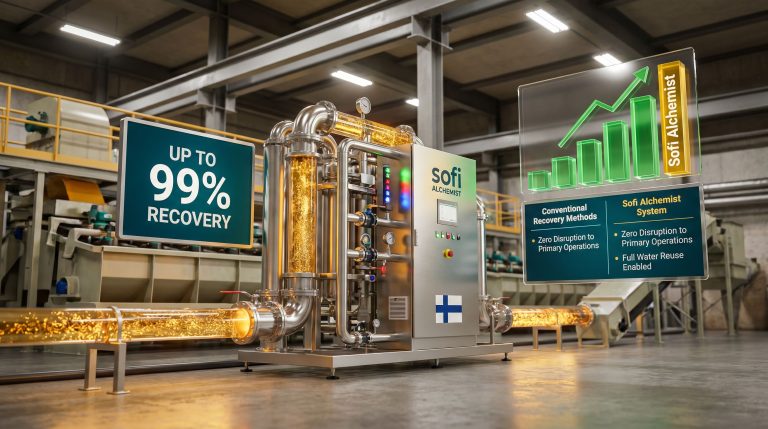
The Sofi Alchemist system is engineered specifically to intercept ultrafine gold concentrate particles that remain suspended in process water after primary concentration steps have been completed. Rather than replacing existing flotation or gravity circuits, the system operates as a complementary stage, inserted into the plant's water handling loop to capture what the main circuit leaves behind.
This is an important design distinction. Because the Sofi Alchemist operates on process water rather than on the primary ore stream, it does not require modifications to the core concentration circuit and creates no production interruption during installation or operation. The full-scale deployment at Pampalo proceeded through the plant's complete production cycle without any operational downtime attributable to the technology integration.
Dual Function: Recovery and Water Quality
Beyond gold recovery, the system delivers a secondary benefit that is increasingly important in the context of modern mining sustainability transformation: the production of clean, recirculated water. By stripping suspended mineral content from process water before it re-enters the plant circuit, the Sofi Alchemist reduces the load on tailings storage infrastructure and improves the quality of water being reused within the operation.
In Finland's regulatory environment, water stewardship in mineral processing is subject to strict oversight, and operations that can demonstrate genuine reductions in process water contamination carry a meaningful compliance advantage. Furthermore, the capacity to recirculate cleaner water also reduces freshwater demand, a factor that is becoming a material consideration for mining operations in Nordic jurisdictions where water licensing conditions are tightening.
Key Performance Metrics at Pampalo
| Performance Indicator | Reported Outcome |
|---|---|
| Gold Recovery Rate from Process Water | Up to 99% |
| Integration Disruption to Plant Operations | Zero disruption during full production cycle |
| Operational Model | Recovery-as-a-Service (RaaS) |
| Capital Burden on Mine Operator | Shifted from capex to opex |
| Water Outcome | Enables clean water reuse within plant circuit |
According to reporting by Mining Magazine, achieving up to 99% recovery of fine gold concentrate from process water represents a fundamental shift in what mines can extract from streams previously treated as unrecoverable losses. This is not a marginal improvement; it is a category-level change in process capability.
Understanding the Pampalo Operating Environment
Geology and Production Context
The Pampalo mine sits within the Karelian Gold Line in eastern Finland, a structurally controlled gold belt that has been mined through a combination of underground and open-pit methods. The ore at Pampalo is characterised by gold occurring in fine-grained form within sulphide-bearing host rocks, a geological setting that inherently produces a higher proportion of ultrafine gold during processing than would be encountered in coarser free-milling ore bodies.
This geological characteristic is precisely what makes Pampalo a demanding but highly relevant proving ground for ultrafine recovery technology. If the Sofi Alchemist can deliver near-total fine gold capture in an ore environment that is structurally predisposed to producing difficult-to-recover particle sizes, it demonstrates a level of robustness that would translate well to other geologically similar operations.
Production and Reserve Overview
| Metric | Figure |
|---|---|
| 2024 Gold Production | ~14,304 ounces |
| Historical Plant Recovery Rate | 82 to 84% |
| Estimated Reserves (Pampalo Area and Karelian Gold Line) | ~500,000 ounces |
The combination of a mid-scale production profile and a substantial reserve base gives Pampalo a meaningful long operational runway over which incremental recovery improvements can compound into significant additional value.
From Trial to Full Commercial Deployment
What the Pilot Phase Established
Before the full-scale rollout, Sofi Filtration conducted plant-scale trials at Pampalo that validated the core performance claim of up to 99% fine gold recovery from process water under actual operating conditions. These trials were critical because laboratory performance and real-plant performance often diverge significantly in mineral processing, particularly when variables such as ore variability, process water chemistry, and plant throughput fluctuations are introduced.
The successful transition from trials to full commercial operations confirms that the technology performs consistently in a live industrial environment. As detailed in coverage by the Canadian Mining Journal, this distinction matters considerably when evaluating the technology's readiness for broader deployment across the global gold sector.
The Recovery-as-a-Service Structure
The commercial model underpinning the Pampalo deployment is arguably as significant as the technology itself. Under the Recovery-as-a-Service (RaaS) framework, Sofi Filtration retains ownership of the system and assumes operational responsibility for its performance. The mine operator incurs no upfront capital expenditure. Instead, the cost structure is converted into an operating expense, directly linked to the recovery outcomes the technology delivers.
This model removes what has historically been the primary barrier to technology adoption at mid-tier mining operations: the requirement to commit scarce capital to unproven equipment. It also creates a powerful alignment of incentives, because Sofi Filtration's revenue is tied to recovery performance, giving the provider a direct financial interest in maintaining and optimising the system throughout the life of the contract.
How Recovery-as-a-Service Compares to Traditional Procurement
| Dimension | Traditional Equipment Purchase | Recovery-as-a-Service (RaaS) |
|---|---|---|
| Upfront Capital Requirement | High | None |
| Operational Responsibility | Mine operator | Technology provider |
| Performance Risk | Borne by mine | Shared and provider-aligned |
| Balance Sheet Impact | Capex | Opex |
| Technology Upgrade Pathway | Operator-managed | Provider-managed |
| Adoption Barrier for Mid-Tier Mines | High | Low |
The structural parallel worth noting here is the similarity to outcome-based models that have transformed other capital-intensive industries. Aviation engine leasing, for instance, demonstrated decades ago that separating asset ownership from operational use can unlock adoption at scale. The RaaS model in mineral processing follows comparable logic, with performance risk redistributed toward the party best positioned to manage it.
The next major ASX story will hit our subscribers first
The Economics of Closing the Recovery Gap
What Incremental Improvement Means in Practice
The gap between Pampalo's current recovery baseline and the theoretical ceiling that advanced filtration could support is not merely an engineering metric. It represents real ounces and real revenue. The table below illustrates how even modest improvements in overall plant recovery translate into meaningful additional production based on the operation's 2024 output.
| Scenario | Plant Recovery Rate | Estimated Annual Ounces | Additional Ounces vs. Baseline |
|---|---|---|---|
| Historical Baseline | 83% | ~14,304 oz | Baseline |
| Moderate Improvement | 85% | ~14,648 oz | +344 oz |
| Optimistic Improvement | 87% | ~14,992 oz | +688 oz |
Note: Figures are illustrative estimates based on publicly available production data and are not forward-looking projections or financial guidance.
At gold prices above US$3,000 per ounce, which the market has sustained through much of 2025 and into 2026, even the moderate improvement scenario translates to more than US$1 million in additional annual revenue from the same ore body, without any increase in mining activity, processing throughput, or capital expenditure on new plant.
The economic argument for ultrafine recovery technology strengthens at precisely the moment the gold price is highest. When margins are wide, incremental ounces carry maximum value. When the price corrects, recovery improvements buffer the revenue impact.
ESG Dimensions: More Than a Marketing Narrative
Tailings Management Implications
One aspect of the Sofi Alchemist gold recovery at Endomines Pampalo mine that deserves more attention is its impact on tailings facility management. When ultrafine concentrate particles are captured from process water before that water reaches the tailings storage facility, the mineral load deposited in the TSF is reduced. Over time, this reduces the volume and complexity of material that must be managed, monitored, and eventually remediated during closure.
Given that tailings storage facilities represent one of the mining industry's most significant long-term environmental liabilities, technologies that reduce the mineral burden entering these structures carry genuine value beyond simple gold recovery economics. In addition, regulatory pressure on TSF management is intensifying globally, particularly in the European Union, where Finland operates under some of the world's most rigorous mining environmental frameworks. Understanding broader mine reclamation trends helps contextualise why reducing TSF mineral loads matters increasingly to long-term mine planning.
Water Stewardship as an Operational Priority
Finland's approach to water management in mining contexts is worth understanding in some depth. The country's water legislation requires mining operators to minimise contamination of both surface and groundwater, and environmental permits typically specify strict limits on the quality of process water that can be discharged or reused. A technology that demonstrably improves process water quality before recirculation therefore delivers both a compliance benefit and an operational one.
For mine operators navigating increasingly complex ESG reporting obligations, the ability to document measurable reductions in process water contamination through the deployment of a specific technology represents a concrete, auditable improvement rather than a narrative aspiration.
Which Mines Stand to Benefit Most
Operational Profiles Best Suited to Ultrafine Recovery Systems
Not every gold mine presents the same opportunity for ultrafine recovery technology. The operations where systems like the Sofi Alchemist are likely to deliver the greatest value share several characteristics:
- Ore bodies where gold occurs in fine-grained or refractory form within sulphide host rocks
- Processing circuits that already achieve reasonable overall recovery but exhibit persistent fine-fraction losses
- Operations with water management constraints or high tailings disposal costs
- Mid-tier producers where the RaaS model's elimination of upfront capital is particularly compelling
- Jurisdictions with tightening environmental regulation around water quality and tailings management
Geographic Markets Where Adoption Is Most Probable
The Nordic and broader European gold mining sector represents the most immediate addressable market for this technology, given both the regulatory environment and the prevalence of fine-grained ore bodies in Archaean and Proterozoic greenstone and schist belt settings. However, the underlying physics of ultrafine gold loss are universal, meaning operations in West Africa, the Americas, and Australia processing structurally similar ore types face equivalent challenges.
The Pampalo deployment's value as a reference site should not be underestimated. In mineral processing technology commercialisation, independently validated performance data from a real operating mine carries significantly more weight than pilot plant results. Every subsequent adoption decision by another operator will be influenced by what was demonstrated in Finland. Reviewing broader gold exploration trends further illustrates how the pipeline of future operations likely to face these same challenges continues to grow.
Frequently Asked Questions
What is the Sofi Alchemist system?
The Sofi Alchemist is a specialised filtration system designed to capture ultrafine gold concentrate particles suspended in process water within mineral processing plants. It operates alongside existing concentration circuits without interrupting normal production flows.
What recovery rate has the system achieved at Pampalo?
During trials at the Endomines Pampalo mine in Finland, the Sofi Alchemist achieved up to 99% recovery of fine gold concentrate from process water. This performance was subsequently validated through full-scale commercial deployment.
What is Recovery-as-a-Service in mining?
Recovery-as-a-Service is a commercial model in which the technology provider owns, installs, and operates the recovery system on-site, with costs structured as an operating expense rather than requiring the mine to commit upfront capital. The provider's revenue is linked to recovery performance, aligning incentives between both parties.
Why is ultrafine gold recovery technically challenging?
Gold particles below approximately 10 to 20 microns in diameter are too small for conventional gravity and flotation circuits to capture reliably. At these sizes, surface tension and hydrodynamic forces outweigh gravitational separation effects, and particles remain suspended in water long enough to report to tailings or process water streams as losses.
How much gold does the Pampalo mine produce?
Pampalo produced approximately 14,304 ounces of gold in 2024, with total reserves estimated at around 500,000 ounces across the broader Pampalo area and the Karelian Gold Line in eastern Finland.
Key Takeaways for the Gold Processing Sector
The Pampalo deployment delivers several insights that extend well beyond the specifics of a single Finnish mine. Furthermore, the implications for how the broader sector approaches process efficiency and capital allocation are considerable.
-
Up to 99% fine gold recovery from process water is achievable at commercial scale, not just in laboratory conditions, validating a performance threshold that would have seemed implausible to most process engineers a decade ago.
-
The Recovery-as-a-Service model fundamentally changes the adoption calculus for mid-tier operations by removing the capital barrier that has historically stalled technology uptake at mines without major balance sheet capacity.
-
Pampalo's 82 to 84% recovery baseline defines a clear opportunity space, where incremental gains compound into substantial additional value over the mine's reserve life at current gold prices.
-
Clean water recirculation adds a material ESG dimension that is increasingly relevant to regulatory compliance, investor reporting, and long-term tailings closure liability management.
-
The transition from pilot to full-scale production without operational disruption is a technically critical milestone that validates the system's real-world integration capability, not just its performance under controlled conditions.
-
Fine-grained sulphide-hosted ore bodies represent the highest-opportunity target profile for this class of technology, and the Karelian Gold Line's geological character makes Pampalo an ideal reference case for operators processing geologically similar material globally.
For those evaluating whether a project is commercially viable before committing to such technologies, a thorough definitive feasibility study remains an essential step in quantifying the incremental revenue potential that ultrafine recovery improvements can deliver.
Want to Stay Ahead of the Next Major ASX Mineral Discovery?
Discovery Alert's proprietary Discovery IQ model scans ASX announcements in real time, instantly identifying significant mineral discoveries and turning complex data into actionable investment insights — explore historic discoveries and their returns to understand the potential, then begin your 14-day free trial at Discovery Alert to position yourself ahead of the broader market.