May 12, 2026
The economics of solar panel recycling fundamentally depend on the concentration and recoverability of valuable materials embedded within photovoltaic modules. Modern solar installations represent one of the most significant concentrations of industrial silver in the renewable energy sector, creating substantial opportunities for silver recovery from solar panels as panels reach their operational lifespan.
Understanding Silver Content in End-of-Life Solar Panels
Quantifying Silver Concentrations in Photovoltaic Modules
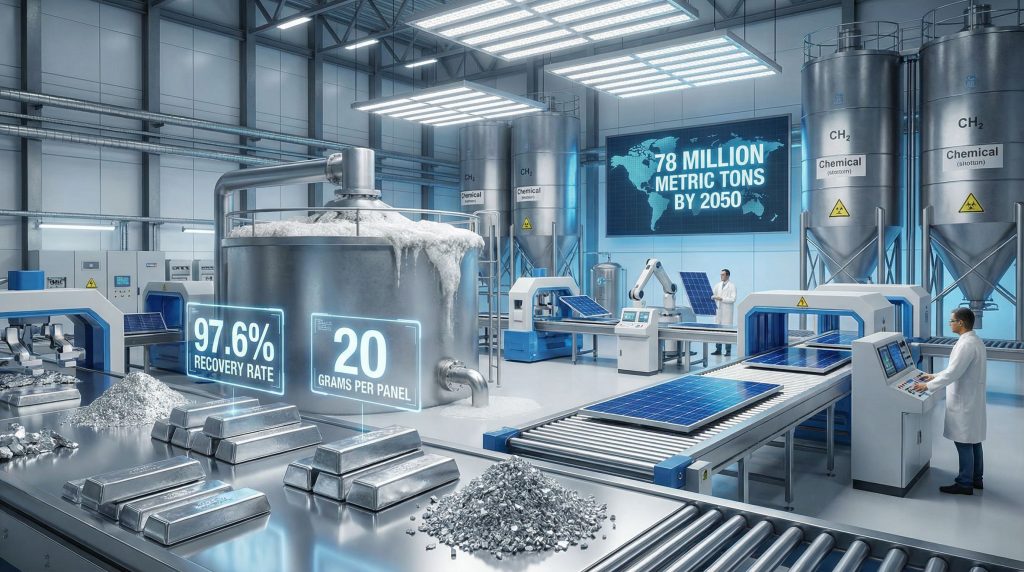
Each standard residential solar panel contains approximately 20 grams of silver, primarily concentrated in the metallization paste used for electrical conductivity. When processed into fine concentrate, end-of-life panels achieve remarkable silver grades of 977 grams per metric ton, representing exceptional concentrations compared to conventional mining operations.
This concentration dramatically exceeds typical silver ore grades found in active mining operations. High-grade silver mines typically process material containing 150-300 grams per metric ton, making solar panel waste streams nearly three times more concentrated than premium mining deposits. The economic threshold for viable silver recovery operations becomes highly attractive when processing costs can be maintained below $800-1,200 per metric ton of material.
The distribution of silver within panel components varies significantly across different photovoltaic technologies. Crystalline silicon panels contain the highest silver content, while thin-film technologies utilise substantially less metallic silver in their manufacturing processes. This variation directly impacts the economic viability of different waste streams entering recycling facilities.
Global Solar Waste Projections and Metal Value
| Region | 2025 (Mt) | 2035 (Mt) | 2050 (Mt) |
|---|---|---|---|
| Asia-Pacific | 0.8 | 12.5 | 38.2 |
| Europe | 0.3 | 8.9 | 18.7 |
| North America | 0.2 | 5.4 | 12.8 |
| Rest of World | 0.1 | 3.2 | 8.3 |
| Global Total | 1.4 | 30.0 | 78.0 |
The International Renewable Energy Agency projects approximately 78 million metric tons of photovoltaic waste accumulation globally by 2050, representing an unprecedented concentration of recoverable materials. At current installation rates and panel lifespans, this waste stream contains an estimated 1.5 billion ounces of silver valued at more than $110 billion.
Supply chain implications extend beyond immediate material recovery opportunities. Industrial silver demand continues expanding across energy storage systems, electric vehicle components, and advanced electronic applications. This silver market squeeze could potentially supply 15-20% of global industrial silver demand by 2040, reducing pressure on primary mining operations and providing supply chain resilience for critical technology applications.
When big ASX news breaks, our subscribers know first
How Do Modern Silver Recovery Technologies Work?
Contemporary silver recovery from photovoltaic waste employs multiple technological approaches, each optimised for specific operational parameters and economic constraints. Understanding these methodologies provides insight into the technical feasibility and commercial potential of large-scale solar panel recycling operations.
Mechanical Separation Methods
Froth flotation processes represent the most efficient mechanical separation technology currently available for solar panel silver recovery. This method achieves 97.6% recovery rates within 3-minute processing cycles, utilising specialised surfactants and controlled bubble formation to separate silver particles from other panel components.
The comminution stage requires precise particle size optimisation to maximise liberation efficiency. Crushing operations typically target 80% passing 150 micrometers, followed by grinding circuits that achieve 95% passing 75 micrometers. This particle size distribution ensures optimal silver particle exposure whilst minimising energy consumption during mechanical processing.
Environmental Advantage: Mechanical separation methods eliminate the need for aggressive chemical leaching agents, reducing environmental impact and regulatory compliance requirements for processing facilities.
Flotation reagent consumption remains economically favourable, with typical dosage rates of 200-400 grams per metric ton of processed material. Recovery efficiency demonstrates strong correlation with grinding intensity, though energy costs must be balanced against improved silver liberation rates in commercial operations.
Chemical Leaching Approaches
Water-based proprietary solutions have demonstrated 89.8% silver extraction rates under controlled laboratory conditions, representing a significant advancement in environmentally sustainable metal recovery. These solutions operate effectively at 72 degrees Fahrenheit, eliminating energy-intensive heating requirements common in traditional hydrometallurgical processes.
Temperature and concentration variables significantly influence reaction kinetics and overall processing efficiency. Higher solution concentrations achieve 82.2% recovery within one hour, compared to 81.3% recovery over four hours using standard concentration parameters. This relationship between dosage rates and processing time directly impacts facility throughput capacity and operational economics.
| Leaching Agent | Recovery Rate | Processing Time | Environmental Impact |
|---|---|---|---|
| Water-based Proprietary | 89.8% | 2-4 hours | Minimal |
| Thiourea Solutions | 85-92% | 6-8 hours | Moderate |
| Cyanide-based | 95-98% | 12-24 hours | High |
| Thiosulfate Systems | 80-87% | 8-12 hours | Low |
Solution recycling capabilities represent a critical factor in commercial viability. Preliminary testing suggests 85-90% solution recovery rates through precipitation and filtration processes, though comprehensive evaluation requires extended operational trials to quantify consumption behaviour and reagent makeup requirements.
Advanced Processing Technologies
Laser debonding techniques offer precision separation of silver nanoparticles from panel substrates, generating high-purity silver materials suitable for direct industrial reuse. These systems operate at 1064-nanometer wavelengths with nanosecond pulse durations, achieving selective material removal without thermal damage to recovered silver particles.
Electrowinning integration provides downstream purification capabilities for chemically extracted silver solutions. Current densities of 200-400 amperes per square meter achieve 99.9% purity silver cathodes within 24-48 hour processing cycles. Power consumption averages 2.8-3.4 kilowatt-hours per kilogram of recovered silver, representing acceptable energy costs for high-value material recovery.
Heat treatment methods utilise controlled atmospheric conditions at 660-1000°C operational ranges to volatilise organic components whilst preserving metallic silver content. These thermal processes require specialised refractory materials and emissions control systems, increasing capital investment requirements but providing comprehensive waste stream processing capabilities.
What Are the Economic Drivers Behind Solar Panel Silver Recovery?
The financial viability of silver recovery from solar panels depends on multiple interconnected factors including processing costs, silver market dynamics, infrastructure requirements, and regulatory frameworks. Understanding these economic drivers provides essential insight into commercial deployment timelines and investment opportunities.
Cost-Benefit Analysis of Recovery Operations
Processing costs for solar panel silver recovery typically range between $450-850 per metric ton of waste material, depending on technology selection and operational scale. These costs encompass collection logistics, mechanical processing, chemical extraction, and material purification stages required for commercial-grade silver production.
Silver price sensitivity analysis indicates break-even thresholds at approximately $18-22 per ounce for efficient recovery operations processing high-grade concentrates. Current silver prices of $24-26 per ounce provide favourable margins for commercial deployment, though price volatility requires careful financial planning and risk management strategies.
Infrastructure investment requirements vary significantly across processing technologies:
- Mechanical flotation facilities: $8-15 million for 50,000 metric ton annual capacity
- Chemical leaching operations: $12-22 million for equivalent throughput
- Integrated processing complexes: $25-45 million for comprehensive material recovery
Break-Even Analysis: Commercial recycling facilities require minimum processing volumes of 25,000-30,000 metric tons annually to achieve sustainable operational profitability at current silver price levels.
Working capital requirements include raw material inventory, reagent stockpiles, and finished goods storage, typically representing 15-25% of annual operating costs for established facilities. Seasonal variations in panel availability necessitate strategic inventory management and flexible processing schedules.
Market Dynamics and Supply Chain Integration
Industrial silver demand growth continues accelerating across multiple technology sectors, with photovoltaic manufacturing, energy storage systems, and electronic components driving consumption increases of 4-6% annually. This demand trajectory supports favourable pricing environments for recovered silver materials. Furthermore, current precious metals analysis indicates robust market fundamentals.
Primary silver mining faces increasing challenges from declining ore grades, environmental regulations, and operational cost inflation. Average silver mine grades have decreased from 12-15 grams per metric ton in the 1990s to 8-11 grams per metric ton currently, making high-grade solar waste streams increasingly attractive alternatives.
Regional processing capacity development requires strategic positioning near major solar installation concentrations. California, Texas, and Florida represent priority locations for North American facilities, whilst European operations benefit from proximity to Germany's substantial installed base and emerging regulatory requirements for panel recycling.
Hypothetical Scenario: If 50% of projected solar waste silver content entered recovery operations by 2040, recycled silver could supply approximately 750 million ounces, representing 65-75% of current annual global silver mine production and significantly altering supply-demand dynamics across industrial markets.
Which Recovery Methods Offer the Highest Efficiency?
Comparative analysis of silver recovery technologies reveals significant performance variations across efficiency metrics, processing requirements, and environmental considerations. These differences directly impact commercial viability and technology selection for specific operational contexts.
Performance Benchmarking Across Technologies
| Technology | Recovery Rate | Processing Time | Energy Usage | Environmental Score |
|---|---|---|---|---|
| Froth Flotation | 97.6% | 3 minutes | 45 kWh/mt | Excellent |
| Proprietary Leaching | 89.8% | 2-4 hours | 15 kWh/mt | Very Good |
| Electrochemical | 87-100% | 6-12 hours | 85 kWh/mt | Good |
| Thermal Processing | 94-98% | 4-8 hours | 320 kWh/mt | Fair |
| Laser Debonding | 99.2% | Variable | 180 kWh/mt | Excellent |
Froth flotation demonstrates superior efficiency combining rapid processing times with minimal chemical inputs and exceptional recovery rates. The technology's maturity and widespread industrial application provide operational reliability and established equipment supply chains, supporting commercial deployment confidence.
New environmentally friendly processes achieve near-complete silver extraction approaching 99% recovery rates through multi-stage processing. This hybrid approach requires increased operational complexity but provides flexibility for varying feed material compositions and quality specifications.
Electrochemical processes offer 87-100% recovery efficiency depending on solution chemistry and operating parameters. Energy consumption considerations become significant at commercial scales, though high-purity product quality justifies additional processing costs for specialised applications requiring minimal impurities.
Operational Scalability Assessment
Throughput capacity limitations vary dramatically across recovery technologies, directly impacting facility sizing and capital investment requirements. Mechanical separation systems demonstrate excellent scalability, with individual flotation cells processing 50-200 metric tons daily through proven industrial designs.
Energy consumption profiles significantly influence operational economics at commercial scales:
- Mechanical systems: 35-55 kWh per metric ton processed
- Chemical leaching: 15-25 kWh per metric ton processed
- Thermal treatment: 280-350 kWh per metric ton processed
- Electrochemical: 75-95 kWh per metric ton processed
Integration complexity with existing waste processing infrastructure requires careful evaluation of material handling systems, utility requirements, and regulatory compliance frameworks. Facilities co-located with established e-waste operations benefit from shared logistics, administrative systems, and environmental permitting advantages.
What Challenges Face Commercial Implementation?
Large-scale deployment of silver recovery from solar panels encounters multiple technical, regulatory, and economic obstacles that require systematic resolution for successful commercial operations. Understanding these challenges enables informed investment decisions and strategic planning for market entry.
Technical and Regulatory Barriers
Standardisation needs across heterogeneous solar panel designs create significant operational complexity for recycling facilities. Panel manufacturers utilise varying encapsulation materials, frame designs, and metallisation patterns that require adaptive processing protocols and specialised handling equipment.
Critical technical challenges include:
- Automated disassembly systems for different panel configurations
- Contamination control for mixed waste stream processing
- Quality assurance protocols for recovered silver purity
- Process optimisation across varying feed material compositions
Waste collection and logistics infrastructure gaps represent substantial barriers to commercial viability. Solar installations span diverse geographic locations with varying decommissioning schedules, creating irregular material availability and elevated transportation costs for centralised processing facilities. However, effective mining waste management solutions offer insights for addressing these logistics challenges.
Environmental permitting requirements for processing facilities vary significantly across jurisdictions, with some regions requiring comprehensive environmental impact assessments, groundwater monitoring systems, and air quality compliance programmes that extend project development timelines by 12-24 months.
Regulatory Framework Development: Emerging legislation in multiple jurisdictions mandates solar panel recycling requirements, though specific technical standards and compliance mechanisms remain under development, creating regulatory uncertainty for facility operators.
Economic and Market Challenges
Capital intensity requirements for specialised processing equipment create significant barriers to entry for new market participants. Complete processing facilities require $15-35 million initial investment, with additional working capital needs of $3-8 million for inventory and operational requirements.
Competition with primary silver mining economics requires sustained silver prices above $20-22 per ounce to maintain operational profitability. Price volatility in commodity markets creates financial risks that require sophisticated hedging strategies and flexible operational planning.
Seasonal variations in end-of-life panel availability complicate facility utilisation planning and inventory management. Solar installations typically undergo decommissioning during specific weather windows, creating concentrated material availability periods followed by extended supply gaps.
Quality specifications for recovered silver in industrial applications demand rigorous purity standards and consistent material properties. Electronics manufacturers require 99.99% purity silver with controlled trace element concentrations, necessitating advanced purification capabilities and comprehensive quality control systems.
How Will Solar Panel Silver Recovery Scale Globally?
Global scaling of silver recovery operations requires coordinated development across regional markets, technology deployment, and regulatory frameworks. Understanding scaling dynamics provides insight into investment timing, geographic priorities, and infrastructure development requirements.
Regional Development Strategies
Australia faces particularly acute challenges with projected accumulation of 1+ million tonnes of photovoltaic waste by 2050, driven by aggressive renewable energy deployment and favourable solar irradiance conditions. The continent's geographic isolation necessitates domestic processing capabilities rather than export-based solutions.
European Union circular economy mandates establish specific recycling targets requiring 85% material recovery from end-of-life solar panels by 2030. These regulatory requirements create guaranteed demand for processing services whilst establishing technical specifications for recovered materials.
China's domestic processing capacity expansion plans target 15-20 million metric tons annual solar waste processing capability by 2035, leveraging existing manufacturing infrastructure and established supply chains for equipment production and technology deployment.
Case Study Analysis: Pilot facility operations in Arizona demonstrated processing capabilities of 150 metric tons daily with 94% silver recovery rates and $340 per metric ton operating costs, providing baseline performance metrics for commercial facility planning and investment evaluation.
Technology Integration and Automation
Machine learning optimisation enables real-time adjustment of processing parameters based on feed material characteristics, solution chemistry monitoring, and product quality specifications. These systems demonstrate 8-12% efficiency improvements compared to static operational protocols.
Automated sorting and quality control systems utilise advanced spectroscopic analysis and robotic handling to segregate different panel types and identify contaminated materials. These technologies reduce labour requirements by 60-75% whilst improving processing consistency and material throughput rates.
Integration with broader e-waste recycling operations provides operational synergies through shared infrastructure, administrative systems, and regulatory compliance frameworks. Combined facilities demonstrate 15-25% lower operating costs compared to standalone solar panel processing operations.
| Region | Current Capacity | 2030 Target | 2040 Projection |
|---|---|---|---|
| North America | 50,000 mt/year | 800,000 mt/year | 3.2 million mt/year |
| Europe | 75,000 mt/year | 1.2 million mt/year | 4.8 million mt/year |
| Asia-Pacific | 120,000 mt/year | 2.8 million mt/year | 8.5 million mt/year |
| Rest of World | 15,000 mt/year | 300,000 mt/year | 1.5 million mt/year |
The next major ASX story will hit our subscribers first
What Role Does Silver Recovery Play in Sustainable Energy Transition?
Silver recovery from solar panels represents a critical component of sustainable materials management within the broader energy transition framework. This circular economy approach addresses resource security, environmental impact reduction, and economic efficiency across renewable energy systems.
Circular Economy Integration
Material flow analysis reveals that comprehensive solar panel recycling could supply 40-50% of silver requirements for new photovoltaic manufacturing by 2040. This closed-loop approach reduces dependency on primary mining operations whilst maintaining material quality standards required for high-performance solar cells. Indeed, sustainable mining innovations can learn from these recycling approaches.
Reduced primary mining pressure through recycling substitution provides significant environmental benefits. Silver mining operations typically require processing 200-400 metric tons of ore to produce one kilogram of refined silver, compared to 5-8 metric tons of solar panel waste for equivalent silver recovery through recycling processes.
Carbon footprint analysis demonstrates 75-85% lower greenhouse gas emissions for recovered silver compared to primary mining operations. This reduction stems from eliminated ore extraction, reduced processing energy requirements, and shortened transportation distances for recycled materials.
Environmental Impact Quantification: Each metric ton of recovered silver from solar panels prevents approximately 180-220 metric tons of CO2 equivalent emissions compared to primary silver production, supporting climate objectives across renewable energy supply chains.
Strategic Resource Security Implications
Critical mineral supply chain resilience benefits from diversified silver sources including recycled materials from renewable energy infrastructure. Solar panel silver recovery reduces exposure to geopolitical risks, mining supply disruptions, and price volatility associated with traditional silver markets. This becomes increasingly important given the critical minerals energy transition context.
Import dependency reduction becomes particularly relevant for nations with substantial solar installations but limited domestic silver mining capacity. Countries like Germany, Japan, and Australia could achieve 30-45% silver self-sufficiency through comprehensive solar panel recycling programmes.
Industrial stockpiling considerations for recovered materials require strategic planning across government and private sector entities. Recovered silver demonstrates identical properties to mined silver for most industrial applications, enabling seamless integration into existing supply chains and inventory management systems.
Technology transfer and knowledge sharing frameworks facilitate global deployment of recovery technologies whilst supporting developing nations in establishing domestic processing capabilities. These initiatives promote technology access, workforce development, and sustainable industrial development aligned with circular economy principles.
Future Outlook for Solar Panel Silver Recovery
The trajectory of silver recovery from solar panels points toward substantial technological advancement, market expansion, and integration within global materials management systems. Understanding future developments enables strategic positioning for emerging opportunities and challenges.
Technology Development Roadmap
Next-generation processing efficiency targets aim for 95%+ silver recovery rates whilst reducing energy consumption by 40-50% compared to current technologies. Research priorities focus on advanced separation techniques, artificial intelligence process optimisation, and integrated material recovery systems.
Cost reduction pathways through process optimisation demonstrate potential for 25-35% operating cost decreases within five years through automation implementation, reagent recycling improvements, and economy of scale benefits from larger facility deployments.
Integration with silicon and other metal recovery systems creates comprehensive waste stream processing capabilities. Combined recovery operations targeting silicon, aluminium, copper, and silver from solar panels improve overall facility economics whilst maximising material utilisation from end-of-life panels.
Research Priorities: Breakthrough technologies under development include selective laser ablation systems, bio-leaching processes utilising specialised microorganisms, and molecular-level separation techniques achieving near-perfect material recovery with minimal environmental impact.
Market Evolution and Investment Opportunities
Projected processing facility deployment timelines indicate 150-200 commercial-scale facilities required globally by 2035 to handle anticipated waste volumes. This expansion represents $4-7 billion in total capital investment opportunities across equipment manufacturing, facility development, and supporting infrastructure.
Investment requirements for commercial-scale operations range from $20-40 million per facility depending on processing capacity and technology selection. Financial returns demonstrate attractive metrics with internal rates of return typically exceeding 15-20% for well-positioned operations.
Partnership models between solar manufacturers and recyclers are evolving toward integrated service agreements where panel producers assume responsibility for end-of-life material management. These arrangements provide guaranteed feed stocks for recycling facilities whilst ensuring manufacturer compliance with emerging regulatory requirements.
Hypothetical Scenario: Implementation of mandatory recycling regulations across major solar markets could accelerate facility deployment timelines by 3-5 years whilst establishing minimum processing requirements that guarantee economic viability for recovery operations, fundamentally altering investment risk profiles and market dynamics.
Investment in silver recovery from solar panels involves inherent risks including commodity price volatility, technological obsolescence, regulatory changes, and market demand fluctuations. Prospective investors should conduct comprehensive due diligence and consult with qualified financial advisors before making investment decisions.
Are You Looking for Investment Opportunities in the Critical Minerals Sector?
Discovery Alert's proprietary Discovery IQ model delivers real-time alerts on significant ASX mineral discoveries, including precious metals and critical materials that are essential for renewable energy transitions. Join thousands of investors who rely on Discovery Alert's mining discovery expertise to identify actionable opportunities ahead of the broader market. Start your 14-day free trial today and position yourself to capitalise on the next wave of resource discoveries driving the global energy transformation.