
May 23, 2026
South Africa's industrial sectors are increasingly turning to solar power in South Africa as a strategic response to grid instability and rising electricity costs. Major mining companies, manufacturing facilities, and processing plants are securing long-term renewable energy contracts to ensure operational continuity whilst reducing carbon footprints. However, this energy transition presents complex challenges around grid integration, financing access, and technological selection that require careful evaluation.
Energy-intensive industries are responding to these challenges through strategic procurement of renewable energy solutions that offer both operational stability and cost predictability. This shift represents a fundamental transformation in how industrial companies approach power procurement, moving from passive grid consumers to active energy market participants through long-term contractual arrangements.
Understanding South Africa's Solar Energy Transformation
The Grid Crisis That Sparked a Renewable Revolution
South Africa's industrial economy continues to rely heavily on coal-fired power generation, creating vulnerabilities for energy-intensive operations that require consistent electricity supply. Load-shedding events and grid instability have disrupted business continuity across multiple sectors, forcing companies to evaluate alternative energy procurement strategies.
The national utility Eskom faces operational challenges that affect industrial productivity and economic growth trajectories. Manufacturing facilities and mining operations have experienced production delays, equipment damage, and supply chain disruptions during periods of grid instability. These operational risks have accelerated private sector investment in renewable energy solutions that operate independently of national grid constraints.
Industrial companies are implementing energy diversification strategies to reduce dependency on centralised grid infrastructure. Furthermore, this approach includes corporate power purchase agreements, on-site renewable generation, and hybrid energy systems that combine grid connection with independent power sources.
Solar Resource Assessment: Why South Africa's Geography Matters
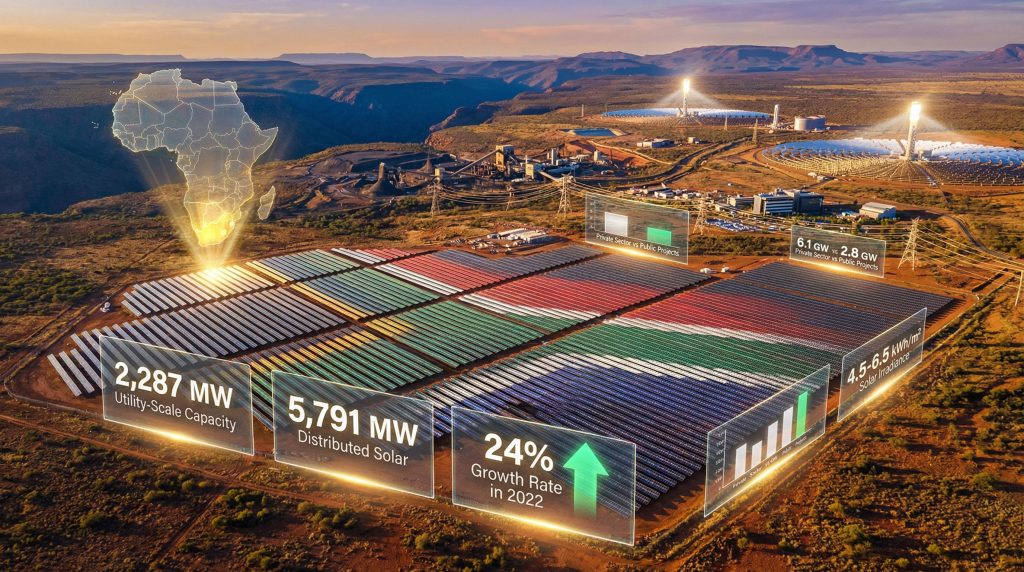
South Africa's geographic positioning provides exceptional solar irradiance levels that support efficient photovoltaic energy generation across multiple provinces. Daily solar irradiance measurements range from 4.5 to 6.5 kWh/m² across different regions, creating favourable conditions for utility-scale solar installations.
Regional variations in solar potential influence project development patterns and technology selection for industrial applications. For instance, the Northern Cape province demonstrates particularly strong solar resources, while Limpopo province offers advantages for mining sector applications due to proximity to mineral extraction operations.
Comparative analysis with other African markets indicates South Africa's solar resource quality provides competitive advantages for industrial renewable energy projects. In addition, consistent irradiance patterns support predictable energy generation profiles that align with industrial operational requirements.
When big ASX news breaks, our subscribers know first
What Are the Current Solar Power Market Dynamics in South Africa?
Capacity Breakdown by Sector (2024 Analysis)
| Solar Segment | Installed Capacity | Growth Trajectory | Primary Applications |
|---|---|---|---|
| Utility-Scale PV | 2,287 MW | Expanding rapidly | Grid-connected industrial projects |
| Distributed Solar | 5,791 MW | Accelerating adoption | Commercial and residential installations |
| Concentrated Solar Power | 500 MW | Emerging technology | Thermal storage applications |
| Corporate PPAs | 148 MW verified | Industrial focus | Mining and manufacturing sectors |
The Bolobedu solar facility represents a significant milestone in corporate renewable energy procurement, with 148 megawatts of installed capacity generating 300 gigawatt-hours annually for a single mining operation. This project demonstrates the scale of industrial solar applications and validates the technical feasibility of utility-scale renewable energy supply to energy-intensive operations.
Investment Flows and Financial Models
Private sector investment dominates South Africa's renewable energy market development, with corporate entities leading capacity additions across multiple sectors. Energy-intensive industries are securing private renewable energy agreements to reduce costs, improve reliability, and meet climate targets.
Corporate power purchase agreement structures enable companies to secure long-term electricity pricing whilst transferring development and operational risks to renewable energy developers. These arrangements typically span 15-25 years, providing revenue certainty for project developers and price stability for industrial consumers.
Wheeling arrangements through South Africa's solar power landscape allow renewable energy projects to supply distant industrial consumers without requiring dedicated transmission infrastructure. This model reduces project development costs whilst utilising existing grid assets more efficiently.
How Are Industrial Companies Adopting Solar Solutions?
Mining Sector Solar Integration Strategies
The mining industry has emerged as a leading adopter of solar power in South Africa, driven by operational necessity and financial optimisation objectives. Richards Bay Minerals, a Rio Tinto subsidiary, has contracted 300 gigawatt-hours of solar power annually through a long-term agreement with Voltalia's Bolobedu facility.
This arrangement demonstrates how multinational mining corporations are implementing renewable energy procurement strategies at substantial scale. The project addresses multiple strategic objectives:
- Operational risk mitigation through reduced grid dependency
- Cost stability via long-term fixed pricing agreements
- Environmental compliance with international ESG standards
- Supply chain resilience through diversified energy sourcing
Mining operations require consistent power supply for continuous processing equipment, ventilation systems, and material handling infrastructure. Solar power generation aligns effectively with daytime operational peaks in many mining applications, reducing demand on national grid infrastructure during high-consumption periods.
Wheeling System Implementation
The wheeling system enables electricity transmission from renewable energy facilities to industrial consumers through Eskom's existing grid infrastructure without requiring direct physical connection. This technical arrangement separates power generation from transmission, allowing distributed renewable projects to serve distant industrial consumers.
Electricity from the Bolobedu plant reaches Richards Bay Minerals through Eskom's transmission grid using sophisticated metering and billing allocation systems. This model requires grid code compliance, synchronisation protocols, and interconnection standards adherence to ensure stable power delivery and accurate energy accounting.
Transmission cost structures include wheeling charges for grid utilisation, but these fees are typically predictable and transparent compared to general grid tariff volatility. Consequently, industrial consumers can evaluate total energy costs including generation, transmission, and distribution components when assessing renewable energy procurement options.
What Technologies Are Driving Solar Adoption?
Photovoltaic System Configurations
Grid-tied solar installations dominate utility-scale renewable energy projects in South Africa, leveraging existing transmission infrastructure whilst avoiding battery storage costs. The Bolobedu facility operates as a 148-megawatt grid-connected photovoltaic installation that delivers electricity through Eskom's transmission network.
System configuration choices reflect both regulatory frameworks and economic optimisation strategies. Grid-tied systems provide transmission efficiency and reduce capital requirements compared to standalone installations with battery storage. Industrial consumers benefit from grid connection stability whilst accessing renewable energy pricing advantages.
Annual generation of 300 gigawatt-hours from 148MW capacity indicates a capacity factor of approximately 23.1%, reflecting typical utility-scale photovoltaic performance in South African climate conditions. This performance metric provides a benchmark for evaluating additional industrial solar projects and system efficiency expectations.
Concentrated Solar Power (CSP) Developments
Concentrated solar power technology offers unique advantages for industrial applications requiring thermal energy or dispatchable electricity generation. CSP systems utilise molten salt thermal storage to provide 24-hour power generation capability, addressing intermittency concerns associated with photovoltaic installations.
Thermal storage capabilities enable CSP facilities to generate electricity during evening peak demand periods when photovoltaic systems are not operational. This dispatchable renewable energy characteristic provides additional value for grid stability and industrial power supply reliability.
Current CSP development in South Africa remains limited compared to photovoltaic installations, but emerging projects may demonstrate technology viability for specific industrial applications requiring thermal energy or extended generation periods.
Which Regions Lead South Africa's Solar Development?
Provincial Solar Capacity Distribution
Limpopo province has emerged as a significant location for industrial solar development, with the Bolobedu facility representing major utility-scale deployment in the region. The province's proximity to mining operations creates synergies between renewable energy generation and industrial energy demand.
The Northern Cape province continues to attract utility-scale solar projects due to exceptional solar resource quality and available land for large installations. This region benefits from high irradiance levels and minimal cloud cover, supporting efficient photovoltaic system performance.
Furthermore, Western Cape province demonstrates strong growth in distributed solar installations, particularly amongst commercial and industrial consumers seeking on-site renewable energy solutions. This market segment includes manufacturing facilities, processing plants, and commercial developments implementing rooftop solar systems.
Economic Development Through Solar Projects
The Bolobedu project created approximately 800 construction jobs, including targeted recruitment of young workers and women. This employment generation demonstrates how renewable energy projects can contribute to local economic development whilst building domestic capacity in emerging technology sectors.
Workers received formal training in solar installation and technical support during the construction phase, creating transferable skills for ongoing renewable energy sector expansion. This workforce development component addresses historical employment inequities whilst building domestic capabilities for future projects.
Skills development in renewable energy technologies positions local communities to participate in the growing solar industry whilst supporting energy transition objectives across multiple economic sectors.
Local procurement and community benefit programmes create additional economic multiplier effects in project development regions. These initiatives demonstrate how renewable energy projects can contribute to inclusive economic growth beyond direct employment creation.
How Does Solar Power Address South Africa's Energy Security?
Grid Stability and Peak Demand Management
Solar power in South Africa contributes to grid stability by providing distributed generation that reduces transmission losses and strain on centralised infrastructure. Daytime solar generation aligns effectively with industrial consumption patterns in mining, manufacturing, and commercial sectors.
Peak demand management benefits emerge when solar generation coincides with high electricity consumption periods during business hours. This alignment reduces pressure on coal-fired power plants during peak demand periods whilst providing clean energy for industrial operations.
Integration with existing transmission infrastructure enables solar facilities to contribute to grid reliability without requiring extensive new transmission construction. The wheeling system allows distributed generation to serve distant consumers whilst maintaining grid interconnection benefits.
Carbon Emissions Reduction Impact
The Bolobedu facility will reduce carbon emissions by more than 237,000 tonnes annually, demonstrating substantial decarbonisation benefits for industrial operations. This emissions reduction reflects coal displacement in the energy supply mix and contributes to South Africa's climate commitments.
Industrial companies face increasing pressure from investors, customers, and regulators to reduce carbon footprints and demonstrate environmental responsibility. Solar power procurement provides measurable emissions reductions that support ESG reporting requirements and international market access.
Coal displacement calculations indicate that each megawatt-hour of solar generation reduces reliance on carbon-intensive alternatives. For mining operations with substantial energy requirements, renewable energy procurement can significantly impact corporate carbon footprint measurements through comprehensive electrification and decarbonisation strategies.
The next major ASX story will hit our subscribers first
What Are the Economic Benefits of Solar Power Adoption?
Cost Competitiveness Analysis
Levelised cost of electricity (LCOE) for utility-scale solar installations has achieved competitive parity with conventional generation sources in South African market conditions. Long-term power purchase agreements provide price stability compared to fossil fuel price volatility and grid tariff increases.
Corporate energy cost reduction strategies increasingly focus on renewable energy procurement as a financial optimisation tool rather than solely an environmental initiative. Industrial consumers can evaluate total cost of ownership over contract periods when comparing renewable energy options with grid power procurement.
Predictable electricity pricing through long-term contracts enables better financial planning and operational cost forecasting for energy-intensive industries. This price certainty provides competitive advantages for companies managing volatile input costs in international markets.
Investment Return Considerations
Payback periods for renewable energy investments vary based on system size, financing structure, and electricity consumption patterns. Industrial consumers can evaluate investment returns through multiple financial metrics including net present value, internal rate of return, and payback period analysis.
Financing options include corporate power purchase agreements that require minimal upfront capital, build-own-operate arrangements, and direct ownership models. Each approach offers different risk profiles and return characteristics that companies must evaluate based on capital availability and risk tolerance.
Government incentive programmes and tax benefits may enhance project economics, though companies should evaluate these benefits conservatively given potential policy changes over long-term contract periods.
What Challenges Face Solar Power Expansion?
Infrastructure and Grid Integration Issues
Transmission capacity limitations in some regions may constrain renewable energy project development, particularly for utility-scale installations requiring substantial grid connection capacity. Interconnection approval processes can create project development delays and additional costs.
Grid code compliance requirements necessitate sophisticated technical coordination between renewable energy facilities and national transmission infrastructure. These standards ensure system stability but may increase project complexity and development timelines.
Wheeling system implementation requires regulatory clarity and standardised procedures to enable efficient market transactions between renewable energy developers and industrial consumers. However, administrative complexity in current procedures may limit market participation by smaller players.
Financial Access and Market Barriers
Capital requirements for utility-scale projects can exceed financing capacity for some project developers, particularly local companies seeking to participate in renewable energy market development. International financing may be required for larger installations.
Small-scale financing availability remains limited for distributed solar installations, potentially constraining adoption amongst smaller industrial consumers. Access to affordable project financing affects market penetration rates across different customer segments.
Regulatory complexity for independent power producers includes licensing requirements, grid connection procedures, and environmental impact assessments that may create barriers to market entry. Streamlined approval processes could accelerate project development timelines.
What Does the Future Hold for Solar Power in South Africa?
Capacity Expansion Projections
Industry projections indicate potential solar power in South Africa capacity expansion to 8,400 MW by 2030, driven by industrial demand and policy support for renewable energy development. Pipeline projects under development suggest continued growth across utility-scale and distributed segments.
Technology cost reduction trends support economic viability for additional renewable energy projects, particularly as solar panel efficiency improvements and system cost declines continue. These cost trajectories enhance project economics and expand potential market applications, aligning with broader mining industry trends towards sustainable operations.
Energy storage integration may become increasingly important for industrial applications requiring dispatchable renewable energy or backup power capabilities. Battery storage costs are declining, potentially enabling hybrid renewable systems for comprehensive energy transition security.
Policy Framework Evolution
The Renewable Energy Independent Power Producer Programme (REIPPPP) provides a structured framework for utility-scale renewable energy development, though additional rounds may be required to meet capacity expansion targets.
Embedded generation regulations enable smaller-scale renewable installations without full independent power producer licensing requirements. These regulations support distributed solar adoption amongst commercial and industrial consumers.
Energy transition roadmap implementation includes renewable energy targets and policy support mechanisms, though specific implementation timelines and support levels may evolve based on economic conditions and political priorities.
How Can Businesses Evaluate Solar Power Opportunities?
Site Assessment and Feasibility Analysis
Solar resource measurement requires evaluation of local irradiance levels, weather patterns, and shading factors that affect system performance. Professional solar assessments can quantify generation potential and support financial modelling accuracy.
Grid connection evaluation includes assessment of transmission capacity, interconnection requirements, and utility coordination procedures. Companies must understand grid connection costs and timelines when evaluating renewable energy project feasibility.
Economic modelling should incorporate multiple scenarios for electricity pricing, system performance, and financing costs to evaluate project viability under different conditions. Sensitivity analysis helps identify key risk factors and potential mitigation strategies.
Procurement Strategy Development
Build-own-operate versus power purchase agreement structures offer different risk and return profiles that companies must evaluate based on capital availability, technical expertise, and risk tolerance. Each approach requires different internal capabilities and financial commitments.
Risk allocation in solar contracts includes performance guarantees, maintenance responsibilities, and force majeure provisions that affect long-term project economics. Legal and technical due diligence helps companies understand contractual obligations and risk exposures.
Performance monitoring and maintenance considerations include system monitoring requirements, preventive maintenance schedules, and performance guarantee enforcement mechanisms. These factors affect long-term system reliability and financial returns, particularly as companies explore innovation expo insights for advanced monitoring technologies.
Frequently Asked Questions About Solar Power in South Africa
What is the average solar generation capacity in South Africa?
Current installed capacity includes verified projects like the 148-megawatt Bolobedu facility generating 300 gigawatt-hours annually. Total national capacity continues expanding through private sector development and government procurement programmes.
Generation efficiency varies across different regions based on solar resource quality, with capacity factors typically ranging from 20% to 25% for utility-scale photovoltaic installations. System performance depends on technology selection, site conditions, and maintenance practices.
Capacity factor comparisons with international markets indicate South African solar installations achieve competitive performance levels due to favourable climate conditions and solar resource availability.
How does wheeling work for solar power projects?
Virtual power purchase agreement mechanics enable renewable energy transactions without direct physical connection between generator and consumer. Electricity flows through existing grid infrastructure whilst contractual arrangements allocate generation and consumption through sophisticated metering systems.
Grid transmission charges include wheeling fees for utilisation of Eskom's transmission network, typically calculated based on energy volumes and transmission distances. These charges are generally transparent and predictable compared to standard grid tariff volatility.
Regulatory requirements for wheeling arrangements include grid code compliance, metering standards, and billing coordination between multiple parties. Administrative procedures may require coordination between renewable energy developers, grid operators, and industrial consumers.
What financing options exist for solar installations?
Commercial lending products for renewable energy include project finance arrangements, corporate credit facilities, and development finance institution support. Financing terms vary based on project size, technology selection, and borrower credit profile.
Government incentive programmes may include accelerated depreciation allowances, renewable energy certificates, or tax credits that enhance project economics. Companies should evaluate incentive availability and potential policy changes when structuring financing arrangements.
International development finance availability includes multilateral development bank support and export credit agency financing for qualifying renewable energy projects. These sources may offer favourable terms compared to commercial financing alternatives, particularly as large-scale solar projects continue developing across the region.
Disclaimer: This analysis is for informational purposes only and does not constitute investment advice. Solar energy investments involve various risks including technology performance, regulatory changes, and market conditions. Companies should conduct thorough due diligence and consult with qualified professionals before making investment decisions. Financial projections and capacity estimates are subject to various assumptions and uncertainties that may affect actual results.
Looking to Identify Renewable Energy Investment Opportunities?
Discovery Alert's proprietary Discovery IQ model delivers real-time alerts on significant ASX mineral discoveries, including companies advancing critical minerals essential for solar technology and energy transition infrastructure. With major renewable energy projects like South Africa's Bolobedu facility demonstrating the massive scale of industrial solar adoption, subscribers gain immediate insights into actionable trading opportunities ahead of the broader market. Begin your 14-day free trial today to position yourself at the forefront of the energy transition investment wave.