June 27, 2026
Understanding Energy Storage Evolution
Solid-state batteries emerge from decades of electrochemical research aimed at overcoming fundamental limitations in conventional energy storage systems. The technology's development trajectory reflects broader shifts in materials science, where researchers pursue enhanced performance through architectural changes at the molecular level.
The global energy storage landscape faces increasing pressure from multiple directions: electric vehicle manufacturers demand higher energy densities, grid operators require safer large-scale storage solutions, and consumer electronics push for faster charging capabilities. These converging demands create market conditions favourable to transformative battery technologies that can address multiple performance constraints simultaneously.
Current lithium-ion technology approaches theoretical limits in several key areas, particularly energy density and thermal management. This constraint environment drives substantial research investment into alternative architectures that promise breakthrough performance characteristics whilst maintaining commercial viability. Furthermore, the emergence of critical minerals transition programmes supports the development of next-generation energy storage solutions.
When big ASX news breaks, our subscribers know first
The Electrolyte Revolution in Battery Chemistry
Solid-state battery architecture fundamentally reimagines energy storage by replacing liquid electrolytes with solid ionic conductors. This transition eliminates the need for flammable organic solvents that characterise traditional battery systems, creating opportunities for enhanced safety profiles and operational flexibility.
The ionic conduction mechanisms in solid electrolytes differ substantially from liquid systems. Lithium ions traverse crystalline lattice structures or polymer networks through vacancy diffusion processes, enabling controlled ion transport without the safety risks associated with liquid electrolyte decomposition under stress conditions.
Multiple solid electrolyte categories have emerged from research efforts, each offering distinct advantages and limitations. Sulfide-based electrolytes demonstrate high ionic conductivity but require careful moisture control during manufacturing. Oxide-based systems provide superior chemical stability whilst presenting processing challenges that affect production scalability.
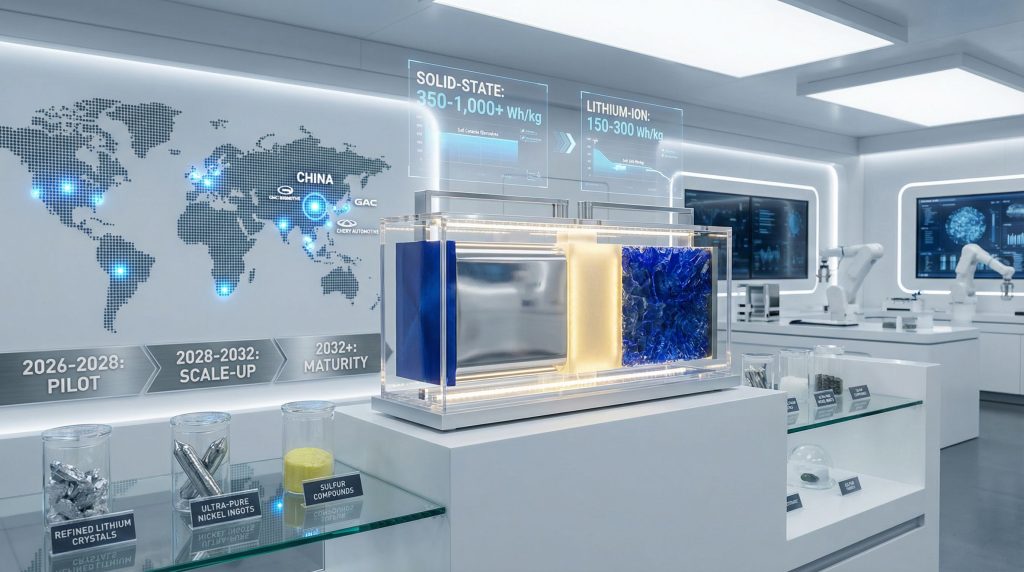
Manufacturing progress in 2025 demonstrated significant advances in solid electrolyte production. According to Argus Media analysis, multiple battery producers achieved all-solid-state battery samples with energy densities ranging from 400-500 Wh/kg during the year. These developments represent substantial improvements over conventional lithium-ion performance metrics.
Electrode Configuration and Material Science Advances
Solid-state architecture enables the integration of metallic lithium anodes, which store significantly more energy per unit volume compared to graphite alternatives used in conventional batteries. This configuration change represents one of the most significant factors driving energy density improvements in solid-state systems.
The compatibility between solid electrolytes and high-capacity electrode materials creates new possibilities for cathode design. Ultra-high-nickel cathode materials become viable in solid-state configurations due to enhanced thermal stability characteristics, potentially expanding performance boundaries beyond current industry standards.
Interface engineering between solid electrolyte layers and electrode materials presents ongoing technical challenges. Maintaining consistent contact during thermal cycling and mechanical stress requires precise manufacturing control and advanced materials engineering to prevent performance degradation over operational lifetimes.
Performance Metrics That Drive Industry Investment
The technical advantages of solid-state batteries extend beyond energy density improvements, encompassing safety characteristics, operational temperature ranges, and cycle life potential that collectively justify substantial research investments across the global battery industry.
Energy density achievements in solid-state systems demonstrate clear advantages over conventional alternatives. Chery's Rhino S all-solid-state battery module achieved 600 Wh/kg energy density in 2025 testing, supporting a theoretical range exceeding 1,200 kilometres according to Argus Media reporting. These performance levels represent 2-3x improvements over typical lithium-ion specifications.
Safety profile enhancements stem from the elimination of flammable liquid electrolytes. Solid electrolytes maintain structural integrity under thermal stress conditions that would cause conventional batteries to enter thermal runaway scenarios. This characteristic proves particularly valuable for large-scale applications where safety considerations influence system design requirements.
Current production costs remain 3-5 times higher than conventional lithium-ion batteries according to Argus Media analysis. This cost differential reflects specialised material requirements, complex manufacturing processes, and limited production scale that characterises emerging technology development phases. However, investments in battery metals investment continue to support the technological advancement required for cost reduction.
Safety Profile and Thermal Management
Solid electrolytes exhibit superior thermal stability compared to liquid alternatives, with operating characteristics that reduce thermal management complexity in battery pack designs. This advantage becomes particularly significant in applications where weight and space constraints limit cooling system options.
The absence of flammable solvents eliminates thermal runaway propagation risks that affect conventional battery pack design. Engineers can optimise system configurations for performance and cost rather than primarily focusing on safety containment, creating opportunities for more efficient packaging solutions.
Temperature tolerance improvements enable operation across wider environmental ranges, expanding application possibilities in harsh climate conditions or high-performance scenarios where conventional batteries face operational limitations.
Energy Density Implications for Electric Vehicles
The energy density advantages demonstrated in solid-state prototypes translate directly into extended driving ranges or reduced battery pack weights for equivalent performance levels. GAC's pilot production line targets energy density exceeding 400 Wh/kg, which theoretically enables driving ranges beyond the 1,000-kilometre threshold according to Argus Media reporting.
Vehicle integration benefits extend beyond simple range improvements. Higher energy densities create design flexibility for automotive engineers, allowing optimised weight distribution, enhanced interior space utilisation, or reduced overall vehicle weight for improved efficiency.
Charging speed improvements represent another significant advantage for vehicle applications. Whilst specific data varies by system design, solid-state architectures demonstrate potential for faster charging rates due to improved thermal characteristics and reduced internal resistance.
The next major ASX story will hit our subscribers first
Technical Bottlenecks in Solid-State Battery Production
Despite promising laboratory results and pilot production achievements, solid-state batteries manufacturing faces significant engineering obstacles that currently limit commercial viability. These challenges span materials science, production processes, and quality control systems that require technological advancement before mass production becomes feasible.
Manufacturing complexity represents a primary barrier to commercialisation. According to Argus Media analysis, producing all-solid-state batteries often requires strictly controlled dry rooms immune to moisture and oxygen, necessitating specialised and costly equipment. This environmental control requirement adds substantial complexity compared to conventional battery production.
Material costs significantly exceed conventional battery components. Key materials, including solid electrolytes, especially sulfide-based systems, and compatible high-performance electrodes remain substantially more costly than traditional alternatives. Supply chain immaturity further inhibits economies of scale, maintaining elevated cost structures.
Interface Stability and Contact Resistance
Maintaining consistent contact between solid electrolyte layers and electrode materials during battery operation presents ongoing technical difficulties. Thermal expansion differences, mechanical stress from electrochemical cycling, and interface chemistry evolution can create gaps that increase resistance and reduce performance over time.
Quality control systems must address interface consistency across large-scale production runs. Current pilot facilities focus on optimising these processes, but scaling to mass production volumes requires additional technological development in manufacturing precision and process reliability.
Manufacturing Process Complexity
Solid-state battery production involves multiple specialised steps that differ substantially from conventional lithium-ion manufacturing. Environmental controls, material handling procedures, and assembly techniques require dedicated equipment and trained personnel, contributing to elevated production costs.
Research and industrialisation remain largely at pilot and validation stages, with mass production not anticipated before around 2030 according to Argus Media analysis. This timeline reflects the complexity of scaling laboratory processes to commercial manufacturing volumes whilst maintaining quality and cost targets.
Cost Structure Analysis
Production cost premiums reflect multiple factors beyond material expenses. Equipment investment requirements, specialised facility construction, environmental control systems, and limited supplier networks contribute to the 3-5x cost differential compared to conventional batteries.
The absence of mature supply chains inhibits economies of scale across the production ecosystem. As Argus Media reports, this supply chain immaturity keeps costs elevated whilst the industry develops supplier networks and manufacturing capabilities necessary for commercial viability.
Global Innovation Landscape and Strategic Partnerships
The solid-state battery sector features diverse participants ranging from automotive manufacturers to specialised battery technology firms, each pursuing distinct technical approaches and market strategies. This diversity reflects the technology's potential applications across multiple industries and the various pathways toward commercialisation.
Asian Market Leadership
Chinese manufacturers accelerated development timelines through government support and industrial collaboration throughout 2025. Development of the global solid-state battery sector underwent marked acceleration during the year, with particularly notable progress achieved in China through technological breakthroughs, production line deployments, and industrial collaboration according to Argus Media reporting.
Major Chinese Developments:
- GAC (Guangzhou Automobile Group): Commissioned pilot production line in late November 2025 targeting energy density exceeding 400 Wh/kg, with small-scale vehicle testing planned for 2026 and mass production scaling from 2027-2030
- Chery Automotive: Unveiled Rhino S all-solid-state battery module in early October 2025 achieving 600 Wh/kg energy density, supporting over 1,200km range capability, with vehicle integration beginning 2027
- BYD and Chang'an Auto: Both accelerated all-solid-state battery development targeting initial small-scale production around 2027
Industry standardisation progress occurred in May 2025 when the China Society of Automotive Engineering released Criteria for Judging All-Solid-State Batteries, providing the first clear industry definition and establishing foundations for standardised testing and technological upgrades according to Argus Media reporting.
International Strategic Alliances
Cross-border partnerships characterise global industry development, with companies leveraging complementary expertise in materials science, manufacturing, and market access to advance solid-state technology commercialisation.
Key Partnerships:
- Posco Future M + Factorial Energy: South Korean materials supplier partnered with US solid-state battery technology firm in early December 2025 for joint development collaboration
- Toyota + Sumitomo Metal Mining: Agreed in October 2025 to jointly develop and produce cathode materials for all-solid-state batteries in battery electric vehicles
These collaborations demonstrate industry recognition that solid-state battery development requires diverse expertise across materials science, manufacturing technology, and market integration capabilities.
Technology Approach Diversification
Companies pursue varied technical strategies reflecting different market priorities and technological capabilities. Sulfide-based electrolytes offer higher ionic conductivity but present moisture sensitivity challenges, whilst oxide-based systems provide superior stability with processing complexity.
Lithium consumption in sulfide-based solid electrolytes can exceed eight times that of conventional lithium iron phosphate batteries according to industry estimates reported by Argus Media. This material intensity creates significant supply chain implications for widespread adoption. Consequently, lithium brine market insights become increasingly important for strategic planning.
Supply Chain Implications and Resource Requirements
Solid-state batteries adoption will fundamentally alter demand patterns for critical materials, creating new market dynamics for mining, processing, and recycling industries. These changes extend beyond simple volume increases to qualitative shifts in material specifications and supply chain structures.
Lithium Consumption Patterns
Sulfide-based solid electrolytes demonstrate dramatically higher lithium requirements compared to conventional systems. The eight-fold increase in lithium consumption reported by Argus Media reflects both electrolyte composition requirements and the transition toward lithium metal anodes from graphite alternatives.
This lithium intensity creates potential supply chain constraints as solid-state adoption scales. Mining companies, processing facilities, and recycling operations must prepare for substantially different demand patterns that could strain existing infrastructure capacity. However, developments in battery-grade lithium refinery technology may help address these supply challenges.
Supply chain planning considerations include geographic concentration risks, processing capacity limitations, and recycling infrastructure development necessary to support sustainable solid-state battery deployment at scale.
Nickel Market Opportunities
Ultra-high-nickel cathode materials become viable in solid-state systems due to improved thermal stability characteristics. This development creates opportunities for premium nickel suppliers capable of meeting enhanced purity and consistency requirements for high-performance applications.
The transition toward higher-nickel content cathodes could increase total nickel demand whilst simultaneously upgrading quality specifications throughout the supply chain. Producers focusing on premium grades may benefit from improved pricing power in solid-state applications.
Emerging Material Requirements
New material categories enter battery supply chains as solid-state technology advances:
- Sulfur compounds: Essential for sulfide electrolyte production, representing entirely new demand streams for sulfur mining and chemical processing industries
- Silicon-carbon composites: Intermediate anode solutions during the transition period before lithium metal anodes achieve widespread adoption
- Rare earth elements: Required for enhanced ionic conductivity in certain ceramic electrolyte systems
- Ultra-pure processing chemicals: Specialised materials for controlled atmosphere manufacturing environments
Graphite Demand Implications
The transition toward lithium metal anodes creates potential displacement effects for graphite suppliers traditionally serving battery markets. Whilst demand reduction may not occur immediately due to hybrid approaches during technology development, long-term trends favour alternative anode materials.
During transition periods before lithium metal anodes achieve widespread adoption, battery manufacturers are expected to increase silicon-carbon anode material usage, which may gradually reduce traditional graphite anode demand according to Argus Media analysis. In addition, advances in battery recycling breakthrough technologies may help offset supply constraints during this transition period.
Diversified Market Opportunities for Solid-State Technology
Whilst electric vehicles dominate solid-state batteries development focus, numerous applications benefit from the technology's unique characteristics, creating multiple market entry points and revenue streams that support commercial development.
Beyond electric vehicles, solid-state batteries demonstrate significant potential in applications such as drones, electric vertical take-off and landing aircraft (eVTOLs), grid energy storage, consumer electronics, and humanoid robots according to Argus Media reporting. These diverse applications reflect the technology's versatility across performance requirements.
Aerospace and Defence Applications
High energy density and enhanced safety characteristics make solid-state batteries attractive for aerospace applications where weight reduction and safety considerations drive technology selection decisions.
Key Applications Include:
- Electric aircraft development: Urban air mobility and regional aviation benefit from weight reduction and safety improvements
- Satellite power systems: Extended mission duration capabilities and harsh environment tolerance
- Defence equipment: Enhanced safety and performance characteristics for mission-critical applications
- Space exploration: Reliable power sources for long-duration missions with minimal maintenance requirements
The aerospace sector's tolerance for premium pricing during technology maturation phases provides potential early market opportunities for solid-state battery commercialisation.
Grid-Scale Energy Storage
Utility-scale applications leverage solid-state advantages in safety, thermal management, and operational longevity that reduce total cost of ownership despite higher initial investment requirements.
Utility Benefits:
- Safety improvements: Reduced fire risk enables simplified facility design and lower insurance costs
- Thermal management: Simplified cooling systems and wider operating temperature ranges reduce operational complexity
- System longevity: Extended cycle life potential reduces replacement frequency and maintenance costs
- Modular deployment: Scalable system design for renewable energy integration applications
Grid applications may provide volume markets for solid-state technology as manufacturing scales and costs decline from initial aerospace and premium automotive deployment.
Consumer Electronics Evolution
Portable device applications capitalise on form factor flexibility, fast charging capabilities, and enhanced safety characteristics that align with consumer preferences for convenience and reliability.
Device Applications:
- Smartphones and tablets: Faster charging capabilities and improved safety in compact form factors
- Wearable devices: Extended battery life and reduced weight for comfort improvements
- Laptop computers: Higher energy density enables thinner designs or extended runtime
- Gaming devices: Enhanced performance and thermal characteristics for demanding applications
Consumer electronics markets offer high-volume potential with established supply chains that could accelerate solid-state technology adoption across other applications.
Industrial and Robotics Integration
Emerging applications in automation and robotics benefit from solid-state batteries' energy density and operational reliability characteristics.
Industrial Applications:
- Humanoid robots: High energy density for extended operation periods without frequent charging
- Autonomous systems: Reliable power for industrial automation with reduced maintenance requirements
- Medical devices: Enhanced safety profiles for implantable and portable medical equipment
- IoT sensor networks: Long-life power sources for remote monitoring applications
These applications often justify premium pricing for enhanced performance, creating market opportunities during technology development phases.
Timeline Analysis and Market Penetration Scenarios
Commercial solid-state battery deployment follows a graduated timeline, with initial applications in premium segments before broader market penetration as manufacturing scales and costs decline. Understanding this progression helps stakeholders plan investment and adoption strategies.
Near-Term Development Milestones (2026-2028)
Current industry projections indicate limited commercial deployment during the initial phase, focused on validation and premium applications willing to accept cost premiums for performance advantages.
Expected Developments:
- Pilot production scaling: Limited manufacturing for testing and validation across multiple applications
- Premium vehicle integration: High-end automotive applications in luxury segments with cost tolerance
- Specialty applications: Aerospace, medical, and defence sectors accepting performance premiums
- Technology refinement: Continued optimisation of materials, processes, and manufacturing techniques
GAC's timeline exemplifies near-term development expectations, with small-scale vehicle testing planned for 2026 and mass production scaling projected from 2027-2030 according to Argus Media reporting.
Medium-Term Commercialisation (2028-2032)
Scaling expectations include broader automotive market entry as production volumes increase and costs decline toward competitive levels with conventional battery technologies.
Anticipated Progress:
- Automotive market expansion: Mid-range vehicle integration as cost differentials narrow
- Manufacturing infrastructure: Dedicated production facilities with improved yields and economies of scale
- Supply chain maturation: Established supplier networks for key materials and components
- Performance standardisation: Industry-wide specifications and testing protocols for quality assurance
This phase represents the transition from technology demonstration to commercial viability across multiple market segments.
Long-Term Market Transformation (2032+)
Mature market characteristics include cost parity with conventional batteries and widespread adoption across applications, fundamentally altering the energy storage industry landscape.
Market Maturity Indicators:
- Cost competitiveness: Pricing parity or advantages compared to conventional battery technologies
- Mass market adoption: Widespread integration across consumer, automotive, and industrial applications
- Technology evolution: Next-generation solid-state improvements and alternative chemistries
- Infrastructure optimisation: Charging systems and grid integration optimised for solid-state characteristics
Long-term success depends on overcoming current technical bottlenecks and achieving manufacturing scale necessary for cost reduction.
Market Transformation and Investment Implications
Solid-state battery commercialisation represents a multi-trillion-dollar market opportunity that will reshape energy storage economics, automotive industry dynamics, and global supply chains. Understanding these implications helps stakeholders prepare for significant industry transformation.
Investment Capital Requirements
Industry estimates suggest substantial global investment requirements for solid-state battery commercialisation, spanning research and development, manufacturing infrastructure, supply chain development, and market deployment activities.
Investment Categories:
- Manufacturing infrastructure: Specialised production facilities requiring environmental controls and custom equipment
- Research and development: Continued technology advancement and manufacturing process optimisation
- Supply chain development: Mining expansion, processing capacity, and component manufacturing
- Market deployment: Vehicle integration, charging infrastructure, and support systems development
The scale of required investment reflects the transformative nature of solid-state technology and the infrastructure changes necessary for widespread adoption.
Competitive Landscape Shifts
Market dynamics will favour companies with advanced solid-state capabilities, integrated manufacturing approaches, and strategic partnerships that enable technology development and market access.
Competitive Advantages:
- Technology leadership: Companies with proven solid-state battery capabilities and intellectual property
- Vertical integration: Control over materials, manufacturing, and market deployment
- Strategic partnerships: Collaborative approaches combining expertise across technology and market domains
- Geographic positioning: Locations with supportive policies, resource access, and skilled workforce availability
Industry consolidation may occur as companies with limited solid-state capabilities seek partnerships or acquisition opportunities to remain competitive.
Economic Multiplier Effects
Broader economic impacts extend beyond direct battery manufacturing to encompass job creation, energy independence, industrial competitiveness, and innovation spillovers that affect multiple sectors.
Economic Benefits:
- Employment creation: High-skilled manufacturing, engineering, and research positions
- Energy security: Reduced dependence on fossil fuel imports and enhanced domestic energy storage
- Industrial advantage: Enhanced manufacturing capabilities in clean technology sectors
- Innovation transfer: Technology advances applicable across electronics, automotive, and energy industries
These multiplier effects justify public policy support and private investment in solid-state battery development despite current cost challenges.
Investment Considerations:
Potential investors should consider solid-state battery technology represents both significant opportunities and substantial risks. Current cost premiums, technical challenges, and uncertain commercialisation timelines create complex investment decision environments requiring careful analysis of technology progress, market development, and competitive positioning.
The timeline for achieving cost competitiveness remains uncertain, with mass production not anticipated before around 2030 according to Argus Media analysis. This extended development period requires patient capital and strategic planning for companies pursuing solid-state technology development or deployment.
Disclaimer: This analysis is based on current industry information and projections that may change as technology development progresses. Actual commercialisation timelines, cost structures, and market adoption rates may differ significantly from current projections. Readers should conduct independent research and consult qualified advisors before making investment decisions related to solid-state battery technology or related markets.
Want to Invest in the Next Battery Technology Breakthrough?
Discovery Alert's proprietary Discovery IQ model delivers instant notifications when significant ASX mineral discoveries are announced, helping investors identify opportunities in critical materials essential for solid-state battery development, including lithium, nickel, and rare earth elements. Begin your 30-day free trial today to gain early insights into mining discoveries that could power the battery revolution and position yourself ahead of the market.