July 20, 2026
The Engineering Crisis Hidden Inside Tomorrow's Most Promising Battery
Every major technological transition in energy storage has carried a hidden vulnerability, a structural weakness that only becomes apparent once scale and repeated use expose the gap between laboratory promise and real-world performance. The shift from lead-acid to lithium-ion batteries took decades longer than early optimists predicted. The transition from lithium-ion to solid-state batteries is following a strikingly similar trajectory, not because the technology lacks potential, but because the physics of failure proved far harder to understand than the physics of performance.
Understanding why solid-state batteries fail has been one of the most consequential open questions in energy materials science for over a decade. Two independent research breakthroughs published in 2026 have now supplied answers that were previously missing, transforming an exploratory scientific puzzle into a tractable engineering discipline.
When big ASX news breaks, our subscribers know first
What Makes the Solid Electrolyte Both the Breakthrough and the Bottleneck
In a conventional lithium-ion cell, a liquid electrolyte acts as the medium through which lithium ions travel between the anode and cathode during each charge and discharge cycle. This liquid performs an underappreciated secondary function: it accommodates stress. It flows around structural irregularities, redistributes ion concentration across electrode surfaces, and partially buffers the mechanical changes that occur as electrode materials expand and contract.
A solid electrolyte does none of these things. It offers higher theoretical energy density, eliminates the flammable liquid that makes thermal runaway dangerous, and can theoretically enable lithium-metal anodes that hold far more energy per unit of weight than graphite alternatives. However, rigidity — the very property that makes solid electrolytes attractive from a safety and energy density standpoint — is also the source of every major failure mode the technology has exhibited.
The Four Mechanisms Behind Solid-State Battery Failure
Solid-state battery failures do not stem from a single cause. Research has identified four distinct but interconnected mechanisms that degrade cell performance and ultimately trigger catastrophic internal short circuits.
1. Dendrite Penetration Through the Electrolyte
Dendrites are microscopic needle-like lithium structures that nucleate at the anode surface during charging. In liquid-electrolyte cells, the electrolyte can partially redistribute around growing structures, slowing their propagation. In solid-state cells, no such accommodation is possible. Dendrites grow laterally through grain boundaries or pre-existing microscopic defects in the solid electrolyte material until they bridge the gap between the anode and cathode, triggering an internal short circuit. The insidious nature of this failure mode is that engineers could observe the outcome — the short circuit — but lacked the real-time imaging tools needed to observe nucleation as it occurred. For instance, lithium dendrite formation in solid-state batteries has been studied using advanced NMR techniques to better visualise this propagation process.
2. Pressure-Induced Electrolyte Fracture
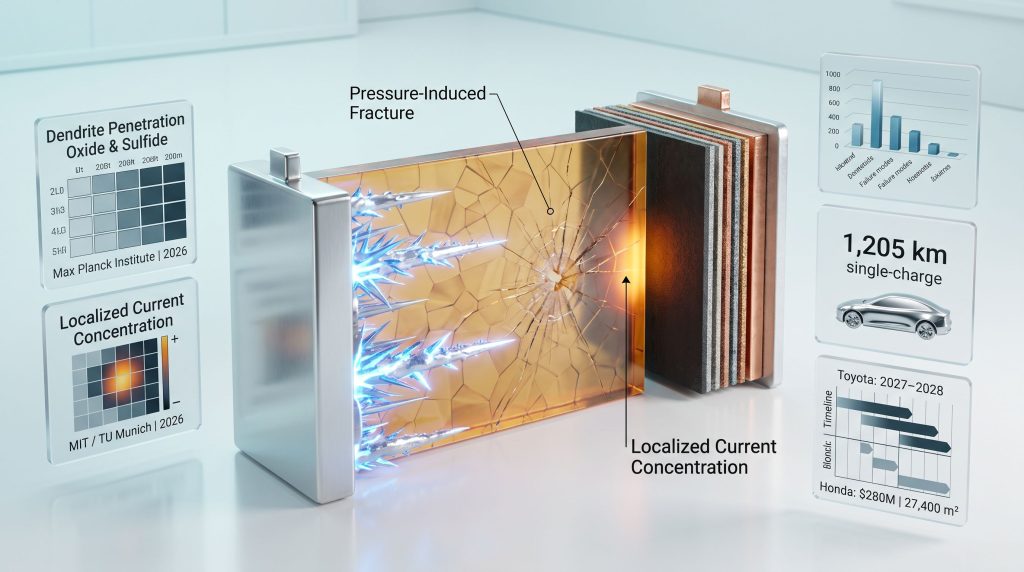
Research published in Nature by scientists at Germany's Max Planck Institute for Sustainable Materials revealed a failure mechanism that operates independently of, and often prior to, dendrite formation. As lithium deposits accumulate on the anode surface during charging, they generate compressive stress within the cell stack. This internal pressure is sufficient to crack the solid electrolyte from within, creating fracture pathways that subsequently accelerate dendrite penetration.
The critical insight is that this damage originates from electrochemical activity inside the cell, not from external mechanical forces. Both sulfide-based and oxide-based electrolytes are vulnerable, though their specific fracture characteristics differ due to their distinct mechanical properties.
3. Localised Current Concentration
A complementary study published in Nature Nanotechnology by researchers from MIT, the Technical University of Munich, and collaborating institutions identified a third failure pathway rooted in electrical non-uniformity. Microscopic variations in ionic conductivity across the solid electrolyte surface create zones where current density is disproportionately elevated. These electrical hot spots preferentially attract lithium deposition, seeding the initial nucleation sites from which both dendrites and pressure fractures then propagate.
Critically, this mechanism is self-reinforcing: once a localised deposition site forms, it concentrates further current in subsequent cycles, accelerating failure with each charge-discharge iteration. Furthermore, MIT's 2026 discovery helps explain precisely how this electrical non-uniformity contributes to the broader pattern of why solid-state batteries fail.
4. Interface Delamination and Electrochemical Decomposition
Unlike liquid electrolytes that conform continuously to electrode surfaces, solid electrolytes maintain contact only at discrete interface points. Electrode materials expand and contract during cycling; a liquid can accommodate this movement, but a rigid solid cannot. The result is progressive delamination — a physical separation between the electrolyte and electrode surface that steadily increases contact resistance and reduces ionic transport efficiency.
Additionally, many solid electrolyte materials are electrochemically unstable at the high voltages required by energy-dense cathode chemistries. This instability produces interfacial decomposition layers that behave as ionic insulators, compounding capacity fade over time.
Failure Mechanism Comparison
| Failure Mode | Primary Driver | Electrolyte Most Affected | Key Research Body |
|---|---|---|---|
| Dendrite Penetration | Lithium nucleation at grain boundaries | Oxide and Sulfide | Multiple institutions |
| Pressure-Induced Fracture | Internal stress from lithium deposition | Sulfide and Oxide | Max Planck Institute (2026) |
| Localised Current Concentration | Electrical non-uniformity in electrolyte | All solid types | MIT / TU Munich (2026) |
| Interface Delamination | Volume cycling stress | All solid types | Multiple institutions |
| Electrochemical Decomposition | High-voltage cathode instability | Oxide | Multiple institutions |
Why These 2026 Discoveries Represent a Genuine Scientific Turning Point
The significance of the Max Planck and MIT-TU Munich findings extends beyond the specific mechanisms identified. Two independent research teams, using different methodologies and examining different aspects of the same failure problem, arrived at findings that are mechanistically complementary rather than contradictory. This dual confirmation substantially strengthens the scientific consensus around root cause identification.
Before these studies, the field was engaged in what might be described as empirical trial and error. Engineers knew the symptom — internal short circuits — but without mechanistic understanding, design improvements were essentially informed guesses. The 2026 findings convert the problem from a scientific mystery into an engineering specification. Researchers now know that preventing electrolyte fracture requires managing internal pressure generated by lithium deposition, and that suppressing anomalous lithium growth requires achieving uniform ionic conductivity across the full electrolyte surface.
What remains unresolved is equally important: identifying the precise threshold stress conditions under which fractures initiate, and developing manufacturing processes that can eliminate current non-uniformity across full-scale electrolyte sheets at automotive production volumes.
A Less-Discussed Dimension: The Sulfide vs. Oxide Trade-Off
One underappreciated complexity in the battery metals landscape involves the choice of electrolyte material class — a decision that carries cascading implications for cell performance, failure susceptibility, and manufacturing process design.
Oxide electrolytes, such as lithium garnet (LLZO), offer excellent electrochemical stability and can operate at higher voltages without decomposing. However, their mechanical hardness makes them brittle. They fracture more catastrophically under cycling stress and are difficult to process into thin films at scale.
Sulfide electrolytes, the class favoured by Toyota, Honda, and Idemitsu, exhibit higher ionic conductivity at room temperature and can be processed at lower temperatures, simplifying manufacturing. However, they are chemically sensitive to atmospheric moisture, requiring dry-room manufacturing environments with stringent humidity controls that substantially increase production costs. Sulfide electrolytes also remain vulnerable to pressure-induced fracture under cycling, as the Max Planck study confirmed.
This trade-off means there is no universally superior electrolyte material. The optimal choice depends on the specific application, target voltage window, manufacturing capability, and acceptable cost structure. Consequently, the wider battery raw materials supply chain must adapt to serve multiple electrolyte chemistries simultaneously.
How Manufacturers Are Engineering Around These Failure Modes
Major automakers have not waited for the science to be fully resolved before committing capital to production infrastructure.
Honda has invested approximately $280 million in a 27,400-square-metre pilot production facility in Sakura City, Japan. The facility replicates the complete manufacturing sequence from electrode material preparation through cell formation and module assembly. A notable feature of Honda's manufacturing approach is roll-pressing, a process that compresses the solid electrolyte during cell assembly to minimise microscopic voids that would otherwise contribute to current non-uniformity and dendrite nucleation. This directly targets the localised current concentration mechanism identified in the MIT-TU Munich research. Honda has also developed thinner thermal management systems made possible by the improved thermal stability of solid electrolytes relative to liquid alternatives.
Toyota's commercialisation pathway depends partly on securing a reliable supply of sulfide solid electrolyte material. Idemitsu is constructing a pilot-scale production facility to manufacture lithium sulfide-based electrolytes, using sulfur recovered as a byproduct of petroleum refining as a feedstock. Toyota has targeted 2027-2028 for its first commercial vehicles using this technology.
Mercedes-Benz has advanced beyond laboratory testing. A modified EQS equipped with lithium-metal cells supplied by Factorial Energy completed a single-charge journey of 1,205 kilometres between Stuttgart and Malmö, finishing with an estimated 137 kilometres of range remaining. BMW is testing large-format cells supplied by Solid Power in an i7 operating on public roads near Munich, examining cell expansion behaviour, operating pressure requirements, and thermal management under real-world conditions.
| Manufacturer | Technology Partner | Investment Scale | Target Timeline |
|---|---|---|---|
| Honda | Proprietary sulfide process | ~$280M, 27,400 m² facility | Second half of 2020s |
| Toyota | Idemitsu sulfide electrolyte | Pilot plant under construction | 2027-2028 |
| Mercedes-Benz | Factorial Energy lithium-metal | EQS prototype, 1,205 km run | Active road testing |
| BMW | Solid Power large-format cells | Parsdorf prototype cell line | Active road testing |
| Samsung SDI / CATL | Internal programs | Expanded pilot production | Mid-to-late 2020s |
The next major ASX story will hit our subscribers first
The Barriers That Science Alone Cannot Remove
Mechanistic understanding of failure modes is a prerequisite for commercialisation, not a guarantee of it. Even with the 2026 research findings in hand, several non-scientific obstacles remain formidable.
- Manufacturing consistency: Producing defect-free solid electrolyte sheets at automotive volumes requires process controls that do not yet exist at commercial scale. A single microscopic defect in a cell destined for a vehicle pack can seed the failure pathway that the 2026 research identified.
- Cycle life validation: Automotive standards typically require batteries to retain a substantial proportion of their original capacity after more than 1,000 charge-discharge cycles under thermal and mechanical stress conditions representative of actual vehicle use. Laboratory cells routinely fall short of this target, and translating cycle life from small-format test cells to full automotive packs introduces additional degradation mechanisms.
- Cost competitiveness: Mature lithium-ion production benefits from decades of process optimisation and supply chain scale. Solid-state cells currently cost substantially more per kilowatt-hour to produce, and cost parity requires both manufacturing breakthroughs and significant production volume.
- Supply chain readiness: Sulfide electrolyte materials and lithium-metal anode foils are not yet produced at the volumes required for mass-market vehicle deployment. Building those supply chains takes years and capital commitments that must be made before demand is confirmed. In addition, advances in direct lithium extraction will play a critical role in securing the upstream lithium supply that solid-state production demands.
Solving the scientific question of why solid-state batteries fail is a necessary condition for commercialisation, but it is not a sufficient one. The transition from mechanistic knowledge to manufacturable, cost-competitive, cycle-proven cells represents an industrial challenge of comparable magnitude to the scientific one that preceded it.
Frequently Asked Questions: Why Solid-State Batteries Fail
What is the main reason solid-state batteries fail?
The primary failure drivers identified by 2026 research are pressure-induced electrolyte fracture, caused by internal stress from lithium deposition during charging, and localised electrical imbalances within the electrolyte that concentrate lithium growth at specific nucleation sites. Both mechanisms ultimately create pathways for internal short circuits.
Are solid-state batteries safer than lithium-ion despite these failure modes?
Solid-state designs eliminate the flammable liquid electrolyte that underlies thermal runaway risk in lithium-ion cells, which is a meaningful safety advantage. However, the mechanical brittleness of solid electrolytes introduces different failure modes — primarily fracture and delamination — that must be engineered out before the theoretical safety benefits are fully realised in commercial products.
What types of solid electrolytes are most prone to failure?
Oxide electrolytes such as LLZO are harder and more brittle, making them highly susceptible to fracture under cycling stress. Sulfide electrolytes offer better ionic conductivity and somewhat greater mechanical compliance, but remain vulnerable to pressure-induced cracking and require moisture-controlled manufacturing environments that add cost complexity. Furthermore, the emerging battery recycling breakthrough in processing sulfide-based materials may eventually help reduce these cost pressures.
When will solid-state batteries appear in commercial electric vehicles?
Toyota is targeting 2027-2028 for its first commercial deployment. Honda is aiming for the second half of the 2020s. Mercedes-Benz and BMW have prototype vehicles operating on public roads as of 2026, with broader commercial availability in the early 2030s considered a plausible scenario if manufacturing scale-up proceeds as planned.
Did the 2026 research studies solve the solid-state battery problem?
The studies identified the root physical and electrochemical causes of the two most critical failure mechanisms — a significant advance that converts an unresolved scientific mystery into a defined engineering target. Translating that knowledge into manufacturing processes that work reliably at automotive scale remains an active challenge.
The Commercialisation Race Has a New Starting Line
The broader significance of the 2026 research findings is strategic as much as scientific. For years, the inability to explain why solid-state batteries fail meant that design iterations lacked a clear theoretical foundation. Progress was possible but slow, guided more by empirical observation than mechanistic understanding.
The manufacturers and materials scientists who most effectively translate pressure management, uniform ionic conductivity, and interface engineering into manufacturable cell architectures will determine who leads the next generation of electric vehicle energy storage. This transition will, in turn, reshape demand across the entire battery storage expansion sector, from upstream mining through to grid-scale deployment. The scientific phase of the solid-state battery challenge is not over, but its nature has fundamentally changed. What was once a question of discovery is now a question of engineering execution.
This article is intended for informational purposes only and does not constitute financial or investment advice. Forward-looking statements regarding commercialisation timelines, manufacturer targets, and technology development reflect publicly available information and independent analysis. Actual outcomes may differ materially from projections cited herein.
Want to Stay Ahead of the Next Major Battery Minerals Discovery?
As solid-state battery technology edges closer to commercialisation, demand for critical minerals — from lithium to sulphur-based electrolyte feedstocks — is set to intensify significantly. Discovery Alert's proprietary Discovery IQ model delivers real-time ASX mineral discovery alerts, transforming complex geological data into actionable investment insights, so subscribers can position themselves ahead of the broader market. Explore historic discoveries and their returns to understand the scale of opportunity, and begin your 14-day free trial today.