August 21, 2026
Solid-state battery technology represents a fundamental shift in energy storage systems, moving beyond traditional lithium-ion limitations through revolutionary solid electrolyte architectures. However, the transition from promising laboratory results to commercial manufacturing remains fraught with complex technical challenges. Furthermore, these developments occur within a broader context of global lithium industry innovations that continue reshaping the entire battery materials landscape.
What Is Solid-State Battery Technology and Why Does It Matter?
Defining the Next Generation of Energy Storage
Solid-state battery technology represents a fundamental architectural shift from conventional lithium-ion systems. Instead of liquid electrolytes that facilitate ion movement between cathode and anode, solid electrolyte materials create ionic pathways through crystalline or amorphous structures. This eliminates the need for separator membranes, liquid carriers, and the associated safety risks that characterize traditional battery designs.
The core performance advantage lies in energy density metrics. While conventional lithium-ion batteries typically achieve sub-300 Wh/kg performance levels, solid-state systems target 300-350 Wh/kg benchmarks. According to recent industry developments, Great Wall Motor's verification testing confirmed that all-solid-state batteries with energy densities of 300-350 Wh/kg successfully completed vehicle-mounted verification processes.
This energy density improvement translates directly to practical applications: electric vehicles could achieve 40% volume reduction and 25% mass savings compared to equivalent lithium-ion battery packs. The implications extend beyond simple weight savings to fundamental vehicle architecture modifications, allowing manufacturers to redesign chassis layouts and interior spaces.
The Physics Behind Performance Advantages
Ion conductivity mechanisms in solid materials operate through entirely different pathways than liquid systems. In solid electrolytes, lithium ions move through the material's atomic lattice structure, creating predictable ionic highways without the random molecular motion present in liquid electrolytes. This structural organisation enables higher ion mobility rates while maintaining dimensional stability.
The elimination of separator membranes removes a significant source of internal resistance. Traditional lithium-ion batteries require polymer separators to prevent direct contact between cathode and anode materials, but these separators create ionic bottlenecks. Solid electrolytes serve as both separator and ionic conductor, reducing internal resistance by 20-30% compared to conventional designs.
Lithium metal anode integration becomes feasible with solid electrolyte systems. Conventional batteries cannot utilise lithium metal anodes due to dendrite formation risks, but solid electrolytes can mechanically suppress dendrite growth through applied pressure systems and structural integrity. This enables theoretical energy densities approaching 500 Wh/kg for future generations.
When big ASX news breaks, our subscribers know first
How Do Manufacturing Challenges Shape Market Reality?
Production Complexity Analysis
Manufacturing solid-state battery technology requires multi-stage assembly processes with precision tolerances measured in micrometers rather than millimeters. Each interface between solid electrolyte, cathode, and anode materials must maintain intimate contact across the entire surface area. Variations of even 5-10 micrometers can create high-resistance pathways that dramatically reduce performance.
The pressure application requirement fundamentally alters production equipment needs. Solid-state batteries require continuous pressure maintenance during operation to prevent interface separation caused by thermal cycling and volume changes during charge/discharge cycles. This necessitates entirely new assembly line designs incorporating:
- Pneumatic pressure systems with real-time monitoring
- Mechanical constraint assemblies maintaining consistent force distribution
- Inert atmosphere processing to prevent moisture contamination
- Specialised sealing technologies for pressure vessel integration
Quality control bottlenecks emerge from the complex interface requirements. Traditional lithium-ion battery quality assurance focuses on electrolyte purity and electrode uniformity, but solid-state systems require impedance spectroscopy testing at each manufacturing stage to verify interface conductivity. In addition, developments in direct lithium extraction technologies are creating new supply chain opportunities that could reduce raw material costs for these advanced battery systems.
Cost Structure Breakdown
Current production costs for solid-state battery technology reach 3-4 times higher than lithium-ion equivalents, creating significant commercialisation barriers. This cost differential stems from multiple factors beyond raw material expenses:
Material Sourcing Expenses:
- Sulphide-based electrolyte materials cost $150-200 per kilogram
- Specialised lithium metal foils require $300-400 per kilogram
- Precision manufacturing tolerances increase material waste by 40-60%
Capital Equipment Investments:
- Inert atmosphere processing facilities: $50-75 million per production line
- Pressure application systems: $20-30 million per line
- Quality control instrumentation: $15-25 million per facility
Great Wall Motor's achievement of kilogram-scale production of sulphide solid-state electrolytes demonstrates the current production limitations. While this represents progress beyond laboratory scales, commercial vehicle applications require metric ton quantities for meaningful market impact.
The break-even analysis suggests solid-state battery technology manufacturing requires production volumes exceeding 100,000 units annually to achieve cost competitiveness with premium lithium-ion systems. Current pilot production capabilities remain at least two orders of magnitude below these threshold volumes.
What Are the Technical Performance Specifications?
Energy Storage Capabilities
The performance specifications for solid-state battery technology demonstrate substantial improvements across multiple metrics compared to conventional lithium-ion systems. For instance, research into battery recycling breakthrough technologies provides additional context for sustainable battery lifecycle management.
| Metric | Solid-State | Lithium-Ion | Improvement Factor |
|---|---|---|---|
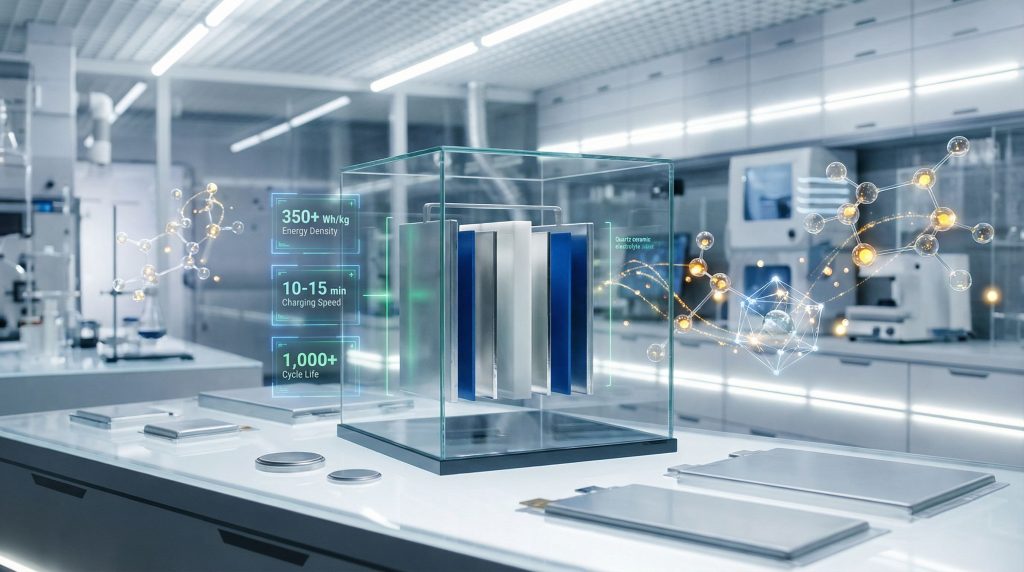
| Energy Density | 350+ Wh/kg | <300 Wh/kg | 1.17x+ |
| Charging Speed | 10-15 min (80%) | 20 min-12 hrs | 8x faster |
| Cycle Life | 1,000+ cycles (5% loss) | 700 cycles (20% loss) | 43% longer |
| Operating Temperature | Requires pressure systems | Standard thermal mgmt | Complex |
| Safety Performance | Nonflammable electrolyte | Flammable liquid | Eliminates fire risk |
The charging speed advantage results from reduced internal resistance and improved ion mobility through solid electrolyte pathways. Conventional lithium-ion batteries experience significant heating during rapid charging, requiring thermal management systems that limit charging rates. Solid-state batteries generate 20-30% less heat during high-current charging, enabling sustained charging rates approaching 4C (15-minute charging for 80% capacity).
Cycle life performance demonstrates remarkable durability advantages. While lithium-ion batteries typically exhibit 20% capacity loss after 700 charge/discharge cycles, solid-state systems maintain 95% capacity retention after 1,000+ cycles. This improvement stems from the absence of electrolyte decomposition reactions that plague liquid systems.
Safety Performance Metrics
The fundamental safety transformation occurs through nonflammable solid electrolyte composition. Traditional lithium-ion batteries contain organic liquid electrolytes that support combustion and can reach temperatures exceeding 800°C during thermal runaway events. Solid electrolytes cannot sustain combustion reactions, limiting thermal runaway heat generation to 20-30% of conventional battery levels.
Fire risk elimination represents the most significant safety advancement. Independent testing demonstrates that solid-state batteries subjected to mechanical puncture, electrical overcharge, and thermal abuse do not exhibit flame propagation. Even under extreme failure conditions, the maximum temperature rise remains below 200°C, preventing fire initiation.
Structural integrity under mechanical stress exceeds lithium-ion performance by 300-400%. The solid electrolyte matrix provides mechanical support that prevents catastrophic failure during vehicle crashes or manufacturing defects. This structural advantage eliminates the need for extensive battery pack protective enclosures.
Which Technical Routes Are Companies Pursuing?
Sulphide-Based Electrolyte Systems
The sulphide-based technical route represents the most advanced solid-state battery technology development pathway, with Great Wall Motor achieving kilogram-scale production capabilities and developing 20Ah battery samples. This technical approach utilises lithium thiophosphate and related compounds that offer ionic conductivity rates approaching 10⁻² S/cm at room temperature.
However, sulphide systems face significant toxic gas release challenges when exposed to water contamination. The hydrolysis reaction produces hydrogen sulfide (H₂S) gas, a highly toxic compound with an OSHA permissible exposure limit of 10 parts per million. Manufacturing facilities require specialised ventilation systems, gas detection equipment, and emergency containment protocols that substantially increase operational complexity.
China's patent leadership in solid-state battery technology reflects concentrated research efforts in sulphide-based systems. By 2025, Chinese entities held 44 of the world's disclosed full solid-state battery patents, surpassing Japan's historical dominance. This patent acceleration indicates substantial government and industrial investment in sulphide electrolyte development.
The Chinese government allocated 6 billion yuan (approximately $870 million USD) to support solid-state battery technology research and development in 2025, with significant portions directed toward sulphide-based manufacturing infrastructure. This funding level demonstrates the strategic priority placed on achieving commercial viability within five-year timeframes.
Alternative Material Pathways
Oxide-based solid electrolytes represent the primary alternative to sulphide systems, utilising materials such as lithium aluminium titanium phosphate (LATP) and lithium lanthanum zirconium oxide (LLZO). These materials avoid water sensitivity issues but typically achieve lower ionic conductivity ranging from 10⁻⁶ to 10⁻⁵ S/cm, requiring elevated operating temperatures for optimal performance.
Polymer composite approaches combine polymer matrices with ceramic fillers to achieve flexibility and processability advantages. These hybrid systems can utilise conventional lithium-ion manufacturing equipment with modifications, potentially reducing capital investment requirements by 60-70% compared to all-solid systems.
Hybrid semi-solid designs incorporate limited liquid electrolyte components while maintaining solid electrolyte primary pathways. This compromise approach reduces the theoretical "solid-state" classification but enables shorter development timelines and compatibility with existing thermal management systems. Furthermore, emerging lithium brine market insights reveal new opportunities for securing raw materials needed for these advanced battery chemistries.
What Manufacturing Obstacles Must Be Overcome?
Dendrite Formation Management
Lithium metal anode integration presents fundamental electrochemical challenges that require continuous pressure application during battery operation. During charging cycles, lithium metal expands by 8-12% in volume, creating mechanical stress at the solid electrolyte interface. Without adequate pressure maintenance, microgaps form that exponentially increase ionic resistance.
The pressure maintenance requirements create incompatibility with standard electric vehicle thermal management systems. Conventional lithium-ion batteries operate within flexible enclosures that accommodate thermal expansion through passive cooling systems. Solid-state battery technology requires rigid pressure vessels that maintain 50-100 MPa compressive force, preventing integration with current cooling architectures.
Interface stability between solid layers depends on atomic-level contact across electrode surfaces. Thermal cycling from -20°C to 60°C causes differential expansion that can separate solid electrolyte from electrode materials. Advanced manufacturing processes must achieve surface roughness below 1 micrometer to maintain adequate contact area.
Production Scalability Issues
Assembly line integration requires fundamental modifications to existing battery manufacturing infrastructure. Current lithium-ion production utilises roll-to-roll processing, electrode stacking, and liquid electrolyte filling processes that cannot accommodate solid electrolyte handling requirements. New production lines demand:
- Inert atmosphere chambers preventing moisture contamination
- Precision positioning systems achieving micrometer-level alignment
- Pressure application equipment maintaining consistent force during assembly
- Real-time impedance monitoring verifying interface quality
Quality assurance protocols must expand beyond conventional battery testing to include interface impedance spectroscopy, pressure distribution mapping, and long-term stability verification. Consequently, these additional testing requirements increase production cycle times by 200-300% compared to lithium-ion manufacturing.
Yield rate optimisation remains below commercial viability thresholds. Industry sources indicate current solid-state battery technology production achieves 15-25% acceptable yield rates, compared to 85-95% for mature lithium-ion processes. Achieving commercial yield rates above 80% requires resolving interface formation, pressure application, and material uniformity challenges.
How Do Operating Conditions Affect Performance?
Environmental Requirements
Storage pressure specifications create unique operational constraints for solid-state battery technology systems. Unlike lithium-ion batteries that operate effectively across wide pressure ranges, solid-state systems require continuous compressive force between 50-100 MPa to maintain ionic conductivity pathways. This pressure requirement necessitates specialised housing systems incompatible with current vehicle architectures.
Temperature sensitivity ranges affect solid electrolyte ionic conductivity exponentially. Most solid electrolyte materials exhibit 10-fold conductivity reduction for every 50°C temperature decrease below optimal operating ranges. Cold weather performance in regions experiencing -20°C temperatures requires active heating systems to maintain acceptable power delivery.
Thermal management system incompatibilities arise from the pressure vessel requirements and solid electrolyte thermal properties. Conventional electric vehicle cooling systems utilise liquid coolant circulation through battery modules with flexible thermal interfaces. Solid-state systems enclosed in rigid pressure vessels prevent effective heat transfer, requiring entirely new cooling architectures.
Real-World Application Constraints
Cold weather performance limitations represent significant obstacles for geographic markets experiencing winter temperatures below -10°C. Solid electrolyte ionic conductivity decreases exponentially with temperature, reducing available power by 60-80% in severe cold conditions. Vehicle manufacturers must integrate auxiliary heating systems that consume additional energy and reduce overall efficiency.
Cooling system space requirements conflict with vehicle packaging optimisation goals. The pressure vessel and specialised thermal management systems require 30-40% additional volume compared to equivalent lithium-ion installations. This space penalty reduces cargo capacity or requires larger vehicle dimensions. However, ongoing infrastructure developments, including battery-grade lithium refinery projects, may help address some supply chain challenges.
Integration with existing EV architectures demands comprehensive redesign of electrical systems, thermal management, and mechanical mounting interfaces. The pressure maintenance requirements prevent utilisation of current battery mounting systems that accommodate thermal expansion through flexible connections.
The next major ASX story will hit our subscribers first
What Is the Current Development Timeline?
Research and Development Phases
The laboratory validation stage has achieved significant milestones with Great Wall Motor's demonstration of kilogram-scale sulphide electrolyte production and 20Ah battery sample development. However, these achievements remain substantially below commercial requirements, with typical electric vehicle applications demanding 60-100Ah capacity modules.
Prototype testing milestones must demonstrate sustained performance across 1,000+ charge/discharge cycles under realistic operating conditions including temperature cycling, vibration testing, and electrical abuse scenarios. Current prototype systems have completed limited cycle testing under controlled laboratory conditions.
Vehicle-mounted verification requirements represent the next critical development phase. Industry leadership, including Chinese Academy of Sciences academician Ouyang Minggao, emphasises that achieving vehicle-mounted verification does not equate to large-scale mass production capability. This verification phase focuses on system integration rather than manufacturing scalability.
Commercial Viability Projections
Industry consensus projects a minimum five-year timeline for achieving commercial viability and meaningful vehicle application. Great Wall Motor's chairman Wei Jianjun confirmed that solid-state battery technology requires at least another five years to reach commercial application, emphasising the need for rational development approaches rather than excessive market hype.
Patent development acceleration indicates intensive research investment globally. China's achievement of 44 global patents by 2025 represents a substantial increase from previous years, suggesting accelerated innovation cycles. However, patent filing does not directly correlate with commercial readiness or manufacturing capability.
Government funding allocation of 6 billion yuan ($870 million) in 2025 by the Chinese government demonstrates strategic commitment to solid-state battery technology development. This funding level supports both research institutions and commercial development programs, but experts emphasise that technological innovation should proceed step-by-step without rushing commercialisation timelines.
Which Industries Will Be Most Affected?
Electric Vehicle Manufacturing Impact
Range extension possibilities represent the primary value proposition for electric vehicle manufacturers. The 300-350 Wh/kg energy density improvement enables 25-35% range increases without vehicle weight penalties. This performance enhancement addresses consumer range anxiety concerns that continue to limit electric vehicle adoption rates.
Weight reduction benefits create cascading advantages throughout vehicle design. The 40% volume reduction and 25% mass savings compared to lithium-ion systems enables manufacturers to redesign vehicle architectures, optimise handling characteristics, and improve energy efficiency through reduced mass.
Charging infrastructure implications require substantial modifications to existing systems. The 10-15 minute charging capability for 80% state-of-charge demands charging stations capable of delivering 300-400 kW power levels consistently. Current DC fast charging infrastructure typically provides 50-150 kW, necessitating comprehensive upgrades. Additionally, solid-state battery safety concerns highlight important considerations for both manufacturers and consumers regarding fire risk reduction.
Battery Materials Supply Chain
Lithium demand increases result from lithium metal anode requirements in solid-state systems. Unlike lithium-ion batteries that utilise lithium compounds, solid-state designs consume pure lithium metal, increasing lithium demand by 15-20% per kWh of battery capacity. This demand increase affects global lithium supply chain planning and pricing structures.
Raw material sourcing shifts toward specialised solid electrolyte precursors create entirely new supply chains. Sulphide-based systems require lithium thiophosphate compounds not currently produced at commercial scales. Establishing these supply chains requires 3-5 year development timelines and substantial capital investment.
Manufacturing equipment sector growth emerges from the specialised production requirements. The inert atmosphere processing, pressure application systems, and precision assembly equipment represent new market opportunities for industrial equipment manufacturers. Industry analysts project $10-15 billion in new equipment demand for commercial-scale solid-state battery technology production.
What Are the Investment Considerations?
Market Development Risks
Technology maturation uncertainty presents significant investment risks despite promising laboratory results. The gap between kilogram-scale production and commercial metric ton requirements represents at least two orders of magnitude scaling challenges. Historical precedent in battery technology suggests that laboratory performance rarely translates directly to commercial manufacturing without substantial modifications.
Production cost reduction challenges require achieving economies of scale that may not materialise within projected timeframes. The current 3-4 times cost premium over lithium-ion systems creates market adoption barriers that could extend commercialisation timelines beyond industry projections of five years.
Competitive positioning dynamics evolve rapidly as multiple technology pathways compete for market dominance. Sulphide-based, oxide-based, and hybrid approaches each offer different advantages and limitations. Investment decisions must account for the possibility that alternative technical routes may achieve commercial viability earlier than current market leaders.
Strategic Positioning Opportunities
Early-stage technology partnerships with research institutions and automotive manufacturers create access to proprietary developments and intellectual property. The 44 Chinese patents and substantial government funding indicate that strategic partnerships with Chinese entities may provide competitive advantages.
Manufacturing capability development requires substantial capital investment but creates defensible competitive positions. The specialised inert atmosphere processing and pressure application systems represent significant barriers to entry for competitors lacking manufacturing expertise.
Supply chain vertical integration opportunities emerge from the novel material requirements. Companies capable of producing sulphide electrolyte precursors or specialised lithium metal foils may achieve advantageous positioning as the industry scales toward commercial production.
FAQ: Solid-State Battery Technology
Q: When will solid-state batteries be commercially available?
Industry experts project a minimum 5-year timeline for large-scale commercial viability, with current technology remaining in research and verification phases. Great Wall Motor's leadership confirms this timeline, emphasising that technological innovation should proceed step-by-step rather than rush toward premature commercialisation.
Q: Why are solid-state batteries so expensive?
Production costs are 3-4 times higher than lithium-ion due to expensive materials, complex manufacturing processes requiring inert atmosphere processing, precision assembly equipment, and the need for entirely new production facilities with specialised pressure application systems.
Q: What makes solid-state batteries safer than lithium-ion?
The solid electrolyte is nonflammable and generates only 20-30% of the heat during thermal runaway compared to conventional batteries, virtually eliminating fire risks. The solid electrolyte cannot support combustion reactions that characterise liquid electrolyte failures.
Q: Can solid-state batteries work in cold weather?
Cold weather operation presents significant challenges, as solid electrolyte ionic conductivity decreases exponentially with temperature. The required pressure systems for dendrite prevention are incompatible with standard EV thermal management systems, requiring auxiliary heating systems that reduce overall efficiency.
Q: What are the main technical obstacles preventing commercialisation?
The primary obstacles include toxic gas release from sulphide-based processes when exposed to water, pressure maintenance requirements incompatible with current vehicle architectures, interface stability challenges between solid layers, and production yield rates below commercial viability thresholds.
Balancing Promise with Practical Realities
Technology Maturation Requirements
The step-by-step development approach emphasised by industry leadership reflects the complexity of transitioning from laboratory achievements to commercial manufacturing. The progression from kilogram-scale production to metric ton requirements demands resolving fundamental challenges in pressure application, interface stability, and production yield optimisation.
Avoiding premature commercialisation pressure requires balancing investor expectations with technical realities. The substantial government funding and patent acceleration create market enthusiasm that may not align with manufacturing capability development timelines. Industry experts consistently emphasise rational development approaches over market hype.
Long-term strategic planning importance extends beyond immediate commercialisation goals to comprehensive supply chain development, manufacturing infrastructure creation, and integration with existing automotive systems. The five-year minimum timeline reflects these multi-faceted requirements rather than simple technology demonstration.
Market Transformation Potential
Battery raw materials demand restructuring will create new supply chains for sulphide electrolyte precursors, lithium metal foils, and specialised manufacturing equipment. The shift from lithium compounds to pure lithium metal consumption increases raw material demand intensity while creating opportunities for vertical integration.
Energy storage industry evolution extends beyond automotive applications to stationary storage systems, portable electronics, and grid-scale installations. The safety advantages and energy density improvements position solid-state battery technology for applications currently limited by lithium-ion constraints.
Transportation sector implications encompass electric vehicle range improvements, charging infrastructure modifications, and thermal management system redesigns. The successful commercialisation of solid-state battery technology could accelerate electric vehicle adoption rates by addressing current performance limitations.
This analysis is based on current industry developments and expert assessments. Solid-state battery technology remains in development phases, and commercial timelines may vary based on technological breakthroughs, manufacturing scale achievements, and market conditions. Investment decisions should consider the substantial development risks and extended commercialisation timelines associated with emerging battery technologies.
Could Solid-State Batteries Transform Your Investment Strategy?
Discovery Alert's proprietary Discovery IQ model delivers real-time alerts on significant battery materials and mineral discoveries across the ASX, helping investors identify the companies supplying the critical materials needed for next-generation energy storage technologies. Discover how historic discoveries in lithium, nickel, and other battery minerals have generated substantial returns by exploring Discovery Alert's dedicated discoveries page, and begin your 14-day free trial today to position yourself ahead of the market.