May 23, 2026
The global transition toward electrification has catalysed unprecedented innovation in energy storage manufacturing, with traditional battery production methods facing increasing scrutiny regarding efficiency, safety, and environmental impact. Modern lithium-ion battery manufacturing relies heavily on energy-intensive processes that require extensive industrial infrastructure, complex solvent management systems, and sophisticated environmental controls. As demand for grid-scale storage and electric vehicle batteries continues to surge, manufacturers are exploring revolutionary approaches that could fundamentally reshape how electrodes are produced at commercial scale. Furthermore, recent developments in battery recycling breakthrough and battery-grade lithium refinery operations are complementing these manufacturing innovations.
Understanding Solvent-Free Cathode Manufacturing Technologies
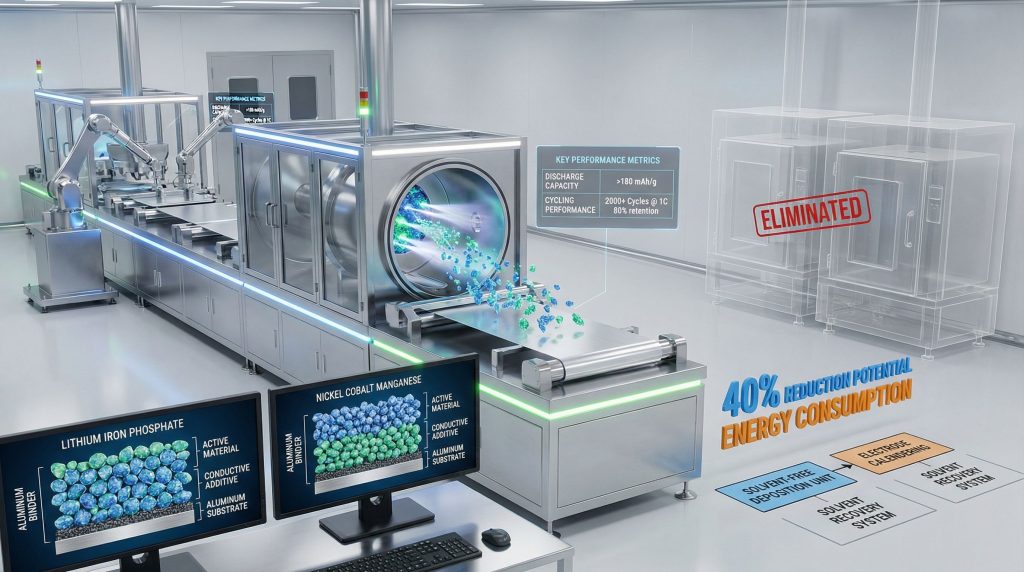
Traditional battery electrode production depends on wet slurry-casting methodologies that disperse active materials in organic solvents alongside polymeric binders. This conventional approach requires subsequent evaporation through large industrial drying ovens, often exceeding 100 metres in length, followed by complex solvent recovery systems. Solvent-free cathode manufacturing represents a paradigm shift that eliminates these requirements entirely, enabling direct particle-to-substrate bonding through mechanical or plasma-based processes.
The fundamental chemistry underlying solvent-free processing centres on alternative bonding mechanisms that maintain electrode integrity without chemical solvents. Rather than relying on polymer dissolution and subsequent film formation, these methods utilise physical forces such as high-velocity particle impact, mechanical compression, or plasma-induced surface activation to achieve durable adhesion between active materials and current collectors.
Recent validation studies have demonstrated that solvent-free cathode manufacturing can preserve the crystal structure of active materials during processing. Laboratory testing conducted through the NSF-supported Centre for Solid-State Electric Power Storage framework at South Dakota School of Mines & Technology confirmed that lithium iron phosphate (LFP) cathode materials maintained their crystalline integrity during high-velocity deposition processes, addressing a critical technical risk previously associated with mechanical bonding methods.
Primary Manufacturing Approaches
Three distinct technological pathways have emerged as viable alternatives to conventional wet processing:
- Dry Supersonic Deposition (DSD): Accelerates powder particles at supersonic velocities in inert gas streams
- Mechanical Fibrillation: Utilises thermoplastic binders activated through controlled shear forces
- Plasma-Enhanced Coating: Employs cold plasma techniques for direct particle bonding without polymeric binders
When big ASX news breaks, our subscribers know first
Comparative Analysis of Manufacturing Methods
Dry Supersonic Deposition Performance Characteristics
DSD technology has demonstrated remarkable versatility in producing cathodes with tunable electrochemical properties. Recent validation work revealed distinct performance characteristics between as-deposited and thermally treated configurations:
| Configuration | Electrochemical Behavior | Optimal Applications |
|---|---|---|
| As-deposited | Broader redox features, higher polarisation | Fast-charging, power applications |
| Annealed | Sharp peaks, doubled peak current | Energy storage, grid applications |
The technical mechanism behind DSD involves high-velocity particle acceleration in controlled inert atmospheres, typically using nitrogen or argon carrier gases. Particles achieve sufficient kinetic energy to mechanically bond with aluminium current collectors while maintaining their essential electrochemical properties.
Scanning electron microscopy analysis has revealed continuous heterogeneous surfaces with plastically deformed particles creating strong mechanical interlocking without chemical adhesives. In addition, these advances complement other innovative approaches in lithium processing, such as the direct lithium extraction boost recently demonstrated in commercial operations.
Temperature management during deposition proves critical for preserving material integrity. The process operates at controlled temperatures that prevent thermal degradation while enabling particle deformation necessary for robust adhesion. Post-deposition annealing can partially restore crystalline order in LFP materials, as evidenced by sharper electrochemical peaks and improved capacity retention during slower cycling protocols.
Alternative Processing Techniques
Mechanical fibrillation processes utilise PTFE-based dry mixing combined with calendering techniques to activate thermoplastic binders through controlled shear forces. This approach can produce self-supporting electrode foils without requiring separate current collector substrates, potentially simplifying downstream battery assembly processes.
Plasma-enhanced coating methods represent the most radical departure from conventional approaches, eliminating polymeric binders entirely through cold plasma particle binding mechanisms. These systems can produce thick electrodes exceeding 200 micrometres while maintaining uniform coating distribution and strong substrate adhesion.
Laboratory validation has demonstrated that solvent-free processes can achieve electrode formation timescales measured in minutes rather than the hours required for traditional drying processes, representing substantial manufacturing efficiency gains.
Manufacturing Infrastructure and Operational Advantages
Energy Efficiency Improvements
Solvent-free cathode manufacturing offers significant energy consumption reductions compared to conventional wet processing. Traditional facilities require massive thermal energy inputs for solvent evaporation, typically consuming 40% more energy than solvent-free alternatives. The elimination of drying infrastructure removes the need for:
- Large-scale industrial ovens spanning 100+ metres
- High-temperature air circulation systems
- Solvent recovery through energy-intensive distillation
- Facility cooling systems for vapour management
Process Simplification Benefits
Manufacturing complexity decreases substantially when solvent handling requirements are eliminated. Traditional wet processing demands sophisticated infrastructure including specialised ventilation systems, solvent storage facilities, waste management protocols for hazardous chemicals, and extensive worker safety equipment. Solvent-free cathode manufacturing streamlines these requirements while improving workplace safety through the elimination of volatile organic compound exposure risks.
Production cycle times accelerate dramatically with solvent-free methods. Where conventional slurry-casting requires hours for complete solvent evaporation and recovery, direct deposition techniques can complete electrode formation in minutes. This timeline compression enables higher manufacturing throughput while reducing work-in-progress inventory requirements.
What Are the Safety and Environmental Considerations?
The elimination of organic solvents addresses multiple regulatory and environmental challenges simultaneously:
- Volatile Organic Compound (VOC) Emissions: Complete elimination of solvent vapours
- Fire Hazard Reduction: Removal of flammable chemical handling and storage
- Waste Stream Simplification: No hazardous solvent waste requiring special disposal
- Permitting Requirements: Reduced environmental regulatory compliance burden
Electrochemical Performance and Battery Integration
Electrode Density and Morphological Control
Solvent-free cathode manufacturing enables precise control over electrode density and porosity characteristics that directly impact battery performance. DSD processes produce thin, dense deposited layers with mechanical interlocking into aluminium substrates, creating robust electrical contacts throughout the active material matrix.
Porosity can be tuned through particle size distribution and deposition parameters, ensuring optimal electrolyte infiltration during battery assembly. This controllability proves particularly valuable for thick electrode applications exceeding 25 mg/cm² loading, where uniform electrolyte access becomes increasingly challenging with conventional wet processing methods.
Electrochemical Cycling Performance
Validation testing has revealed that solvent-free electrodes demonstrate distinct cycling characteristics depending on processing parameters. As-deposited cathodes maintain higher surface area and broader redox features, supporting superior performance during rapid charge-discharge cycles. This behaviour makes them ideally suited for applications requiring frequent cycling such as grid frequency regulation or fast-charging electric vehicle systems.
Thermally treated electrodes show improved capacity retention during slower cycling protocols, with cyclic voltammetry revealing sharper, more stable electrochemical peaks and nearly doubled peak current compared to as-deposited configurations. This performance profile aligns well with stationary energy storage applications where energy density takes precedence over power delivery speed.
However, these innovations are part of a broader transformation in energy storage, including developments in revolutionizing lithium batteries and electric vehicles transforming mining operations.
Manufacturing Equipment Requirements
Solvent-free cathode manufacturing requires specialised but simplified equipment compared to conventional wet processing facilities:
Essential Processing Equipment:
- High-shear dry mixing systems for powder preparation
- Supersonic particle acceleration chambers with inert gas management
- Precision powder metering and substrate positioning systems
- Temperature-controlled processing environments
Quality Control Infrastructure:
- Scanning electron microscopy for adhesion and microstructure analysis
- Electrochemical testing capabilities for performance validation
- Mechanical strength evaluation systems for durability assessment
The elimination of solvent recovery infrastructure represents the most significant capital cost distinction between solvent-free and traditional manufacturing facilities. Traditional plants require extensive drying ovens, solvent distillation equipment, vapour management systems, and specialised environmental controls that can represent substantial portions of total facility investment.
Market Applications and Commercial Viability
Grid-Scale Energy Storage Integration
Solvent-free cathode manufacturing aligns particularly well with the requirements of stationary energy storage systems, where cost optimisation and manufacturing scalability take precedence over absolute energy density. The ability to produce thick electrodes with controlled porosity supports high-capacity cell designs suitable for grid applications.
The simplified manufacturing process reduces facility complexity and associated operational costs, potentially improving the economic viability of domestic battery production for grid storage applications. As data centre growth and renewable energy integration drive demand for large-scale storage capacity, manufacturing cost reductions become increasingly critical for market competitiveness.
Electric Vehicle Applications
The tunability of solvent-free electrode performance characteristics enables optimisation for specific automotive requirements. Fast-charging capabilities demonstrated by as-deposited cathodes address growing consumer demands for reduced charging times, while the mechanical robustness of solvent-free electrodes may improve battery durability under automotive operating conditions.
What About Solid-State Battery Development?
Solvent-free cathode manufacturing offers particular advantages for next-generation solid-state battery architectures. The elimination of organic solvents removes potential contamination sources that could interfere with solid electrolyte interfaces, while the precise thickness control enables integration with ceramic or polymer electrolyte layers.
The mechanical bonding achieved through solvent-free processes may provide superior interface stability compared to polymer-bonded electrodes, addressing one of the critical technical challenges in solid-state battery commercialisation.
Economic Analysis and Cost Considerations
Capital Expenditure Comparisons
Traditional wet processing facilities require substantial infrastructure investments that solvent-free cathode manufacturing can eliminate or significantly reduce:
| Cost Category | Traditional Processing | Solvent-Free Processing |
|---|---|---|
| Drying Equipment | High (100m+ industrial ovens) | Eliminated entirely |
| Solvent Recovery | Major ongoing operational cost | Not applicable |
| Energy Consumption | High (evaporation/recovery) | 40% potential reduction |
| Facility Ventilation | Complex vapour management | Simplified requirements |
| Environmental Controls | Extensive (solvent handling) | Reduced complexity |
Operational Cost Benefits
Beyond capital expenditure reductions, solvent-free cathode manufacturing offers ongoing operational advantages through eliminated solvent procurement, reduced energy consumption, and simplified waste management protocols. These factors combine to potentially improve manufacturing economics while reducing environmental impact.
The next major ASX story will hit our subscribers first
Technical Limitations and Development Challenges
Scale-Up Considerations
While laboratory validation has demonstrated technical feasibility, commercial scale-up presents several challenges requiring continued development:
- Uniform coating thickness control across large substrate areas
- Consistent particle distribution in high-velocity deposition systems
- Quality assurance protocols for continuous production environments
- Material compatibility optimisation across different cathode chemistries
Material System Limitations
Current validation work has focused primarily on LFP cathode chemistry, though the principles of solvent-free cathode manufacturing should extend to other active materials including nickel cobalt manganese (NCM) and lithium cobalt oxide (LCO) systems. Each chemistry may require specific optimisation of processing parameters and equipment configurations.
Binder selection for mechanical fibrillation processes requires careful consideration of material compatibility, thermal stability, and electrochemical inertness. Conductive additive optimisation becomes more critical when polymer binders are eliminated, potentially requiring reformulation of electrode recipes.
Future Development Pathways
Industry Adoption Trends
Major battery manufacturers are beginning to evaluate solvent-free cathode manufacturing through pilot programmes and technology licensing agreements. The potential for significant cost reductions and environmental benefits is driving increased industry interest, particularly as regulatory pressure on manufacturing emissions continues to intensify.
Geographic deployment strategies will likely favour regions with strong environmental regulations and high energy costs, where the advantages of solvent-free processing provide the greatest economic benefit. Supply chain integration will require coordination between equipment manufacturers, material suppliers, and battery producers to ensure compatibility across the production ecosystem.
Research and Development Priorities
Continued development efforts are focusing on several key areas:
- Advanced binder chemistry for mechanical fibrillation processes
- Process optimisation for improved coating uniformity and consistency
- Quality control methodologies suitable for high-speed production environments
- Equipment design optimisation for commercial-scale implementation
The integration of solvent-free cathode manufacturing with downstream battery assembly processes represents another critical development area, as interface compatibility and cell performance optimisation require systematic investigation across different battery architectures.
Market Expansion Potential
As solvent-free cathode manufacturing technology matures, application-specific customisation opportunities will emerge across different market segments. Power-focused applications may benefit from as-deposited electrode configurations, while energy-dense applications could utilise thermally optimised processing protocols.
Competitive advantage development will likely centre on proprietary processing parameters, equipment designs, and quality control methodologies that enable consistent production of high-performance electrodes at commercial scale.
Disclaimer: This article contains forward-looking statements and technical analysis that involve uncertainties and assumptions. Manufacturing scalability, commercial viability, and performance claims should be independently verified. Battery technology development involves significant technical and commercial risks that may affect outcomes described herein.
Ready to Invest in the Next Energy Storage Breakthrough?
Discovery Alert instantly identifies significant ASX mineral discoveries powering the battery revolution using its proprietary Discovery IQ model, helping investors spot lithium, cobalt, and critical mineral opportunities before they reach mainstream attention. Begin your 14-day free trial today to secure your market-leading advantage in the rapidly evolving energy storage sector.