
June 19, 2026
The Conditions That Must Come Before the Mandate: Evaluating South Africa's Beneficiation Policy
Industrial policy rarely fails because its objectives are wrong. It fails because the instruments chosen to pursue those objectives arrive in the wrong order, applied to conditions they were not designed to resolve. South Africa beneficiation policy offers a near-textbook illustration of this sequencing problem. The country possesses one of the most extraordinary mineral endowments on the planet, yet the policy architecture now being deployed to convert that endowment into downstream industrial value contains a fundamental mismatch between what the instruments can do and what the underlying economy actually requires.
When big ASX news breaks, our subscribers know first
What South Africa's Beneficiation Policy Actually Proposes
South Africa's Department of Trade, Industry and Competition published its Industrial Development Strategy on 8 June 2026, introducing a framework that ties binding local-processing conditions directly to the issuance and retention of mineral rights. Under this structure, a company granted the right to mine chrome ore must commit to domestic smelting as a condition of holding that right. The strategy is not aspirational guidance. It attaches commercial obligations to property interests at the licensing stage.
For the chrome sector specifically, the framework proposes three interlocking instruments:
- An export tax on raw chrome ore shipments
- Volume quotas limiting unprocessed ore exports
- The establishment of two dedicated processing zones to concentrate smelting activity
The legislative instruments underpinning this approach span multiple frameworks, each with a distinct function.
| Policy Instrument | Primary Function |
|---|---|
| Industrial Development Strategy (2026) | Binds processing obligations to mineral rights allocation |
| Mineral and Petroleum Resources Development Act (MPRDA) | Governs licensing conditions and rights issuance |
| Mining Charter | Mandates local economic participation across the value chain |
| Industrial Policy Action Plan (IPAP) | Directs industrial financing and investment incentives |
| Special Economic Zones (SEZs) | Concentrates processing infrastructure in designated areas |
The stated ambition is to move South Africa from being a price-taker in global mineral markets to a position where domestic processing capacity gives it meaningful influence over value capture. That objective is economically coherent. However, the instruments chosen to pursue it are not matched to the conditions that determine whether processing is commercially viable.
Why Electricity Cost Is the Variable That Overrides Everything Else
Ferrochrome production is among the most electricity-intensive industrial processes in the mining value chain. Power accounts for an estimated 35% to 40% of total ferrochrome production costs, making tariff levels the single most important determinant of whether smelting operations can generate a positive margin. This is not a peripheral input that can be offset by favourable licensing conditions or export tax structures. It is the primary cost variable, and it sits entirely outside the licensing mechanism the strategy relies upon.
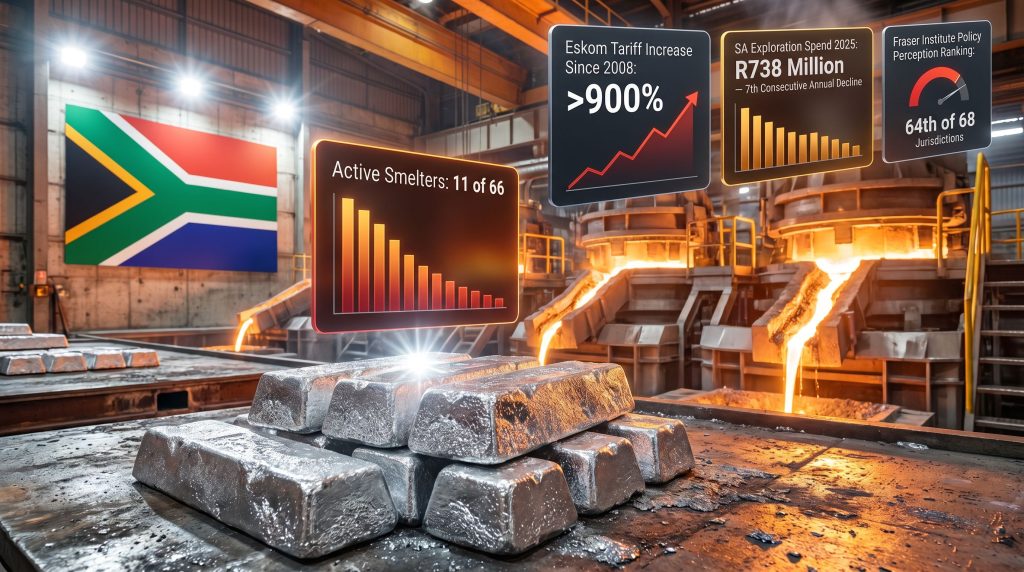
South Africa holds the world's largest chrome ore reserves, yet it progressively ceded ferrochrome processing market share to China over the preceding two decades. The mechanism driving that shift was not a policy failure in the conventional sense. It was arithmetic. After Eskom electricity tariffs increased by more than 900% between 2008 and the mid-2020s, the cost structure of domestic smelting deteriorated past the point of commercial viability for most operators.
By early 2026, only 11 of 66 ferrochrome smelters remained in operation, a collapse in productive capacity that predates and is entirely independent of the new Industrial Development Strategy. Furthermore, South African ferroalloys had already been losing ground in global markets well before these latest policy interventions were announced.
The government's own conduct in April 2026 is instructive. Eskom established a preferential electricity tariff of 62 cents per kilowatt-hour for the two largest ferrochrome producers, reduced from agreed rates of 136 cents per kilowatt-hour under their original commercial agreements. Government projections associated with this single tariff adjustment estimate that up to 45 smelters could return to operation by December 2026.
Critical insight: The projected restart of 45 smelters is driven entirely by a power cost reduction. Not by an export tax. Not by a processing obligation attached to a mining right. The electricity tariff intervention is the operative catalyst, and it operates through an entirely separate mechanism from the licensing framework the beneficiation strategy depends upon.
This creates a fundamental policy sequencing problem. Export taxes make it more expensive to ship unprocessed ore, but they do not reduce the electricity input cost that determines whether smelting is worth doing in the first place. A mining right condition cannot make a smelter economically viable. It can only mandate that ore stays within the country while the economics of processing it remain unresolved.
Freight Rail: The Logistics Constraint the Strategy Does Not Address
Domestic mineral processing does not simplify a producer's logistics requirements. It compounds them. Where raw ore moves on a single freight corridor to port, an integrated processing operation requires the movement of alloys, reductants, fluxes, and other industrial inputs across the same network. That network is already failing to clear the volumes it currently carries.
Transnet rail freight throughput declined from approximately 226 million tons in 2017/18 to roughly 152 million tons in 2023/24, a contraction of approximately 33% over six years. South African coal exports fell to a thirty-year low during this period, illustrating the severity of the degradation in network performance. This is the logistics infrastructure onto which the beneficiation strategy proposes to layer additional processing complexity.
The rail recovery effort underway is proceeding independently of the Industrial Development Strategy. Transnet has granted network access to 11 private rail operators on its main export corridors, targeting a throughput recovery toward 250 million tons annually. This reform was not initiated by the beneficiation framework and is not contingent on its success.
A processing obligation attached to a mineral right adds no track, no locomotives, and no additional freight capacity to the network. In addition, mining beneficiation SEZs face similar infrastructure constraints, highlighting that these challenges extend well beyond the chrome sector alone.
Infrastructure development at the scale required for expanded processing is a foundational precondition for realising beneficiation objectives. It is not an outcome that follows from policy mandates. Imposing processing conditions before the logistics constraints are resolved places additional operational burden on a supply chain that is already performing below minimum viable capacity.
The Indonesia Nickel Model: Why the Comparison Does Not Hold
The Indonesian nickel export ban of 2020 is the most frequently cited precedent by those advocating mandatory beneficiation. By the mid-2020s, Indonesia's share of global refined nickel supply reached approximately 60%, representing a dramatic reorientation of the commodity's processing geography. The comparison to South Africa's chrome ambitions appears compelling on the surface. However, it requires careful disaggregation before it can inform regulatory design.
| Structural Variable | Indonesia (Nickel) | South Africa (Chrome) |
|---|---|---|
| Global reserve share | ~42% of world nickel reserves | Significant reserves but buyers have alternatives |
| Commodity pricing power | High, as a dominant single-commodity supplier | Moderate, chrome buyers retain substitution options |
| Domestic power cost | Coal market obligations cap local prices near 25% of world rate | Eskom tariffs rose over 900% since 2008 |
| Capital source for smelters | Chinese foreign direct investment financed and owns processing infrastructure | Foreign capital deterred by regulatory uncertainty |
| Market concentration | Single dominant buyer relationship | More diversified buyer base |
The power cost comparison is particularly instructive. Indonesia's nickel model was financed and operated largely by Chinese capital, and domestic electricity costs were artificially suppressed through coal market obligations that kept local prices near a quarter of the international rate. South Africa cannot replicate this. Its power cost structure is moving in the opposite direction, and the preferential tariff arrangements being used to restart smelters are bilateral agreements with individual producers, not a sustainable sector-wide framework.
The Indonesian record also contains consequences that its proponents frequently omit from the analysis.
- The processing margin generated by Indonesian nickel smelters accrues predominantly to foreign capital owners, not to the Indonesian state or its domestic workforce
- The rapid capacity buildout contributed to a decline of approximately 46% in the London Metal Exchange nickel price between 2022 and late 2025
- This price collapse forced refiners globally to reduce output and cut employment
- Jakarta implemented production quota restrictions in 2026 in response to the oversupply conditions it had helped create
Indonesia exchanged one form of structural dependence for another. It moved from dependence on raw ore export revenue to dependence on foreign capital inflows and a concentrated buyer relationship with China. That is not a development template. It is a risk transfer.
The Exploration Crisis That Undermines the Strategy's Own Supply Base
The deepest structural problem facing South Africa beneficiation policy is one that rarely features prominently in the policy debate itself. The strategy depends on a future supply of ore flowing into domestic processing facilities. That supply is generated by exploration investment made today. And exploration investment has been declining for seven consecutive years.
South African mining exploration expenditure fell to R738 million in 2025, representing less than 1% of total global exploration spending. This compares to a historical share of approximately 5%. The country's portion of African exploration expenditure declined from 35% to approximately 7% over the same period, a regional competitive position loss that signals sustained capital flight rather than a cyclical correction.
The Fraser Institute's 2025 Annual Survey of Mining Companies ranked South Africa 64th out of 68 jurisdictions on its Policy Perception Index. The ranking reflects regulatory environment concerns, not geological ones. South Africa's mineral endowment remains world-class. The problem is the investment climate surrounding access to that endowment.
Two regulatory events are particularly significant in explaining the capital withdrawal:
- An amendment bill that imposed ownership conditions at the prospecting stage, before subsequently withdrawing those conditions, creating material uncertainty about the durability of rights granted under the framework
- A licensing system that rejected 700 of 795 prospecting right applications in a single year, representing an 88% rejection rate that signalled systemic dysfunction rather than routine quality control
Exploration capital has consequently shifted toward competing mining jurisdictions such as Zambia and the Democratic Republic of the Congo, both of which offer more predictable regulatory environments for early-stage investment. The decision to attach processing obligations to mineral rights at the licensing stage converts what investors treat as a property interest into a discretionary policy instrument. That conversion fundamentally alters the risk profile of the asset and the attractiveness of the jurisdiction.
Furthermore, South Africa is not alone in deploying resource nationalism measures to assert greater control over mineral value chains, though the effectiveness of such measures varies considerably depending on the underlying enabling conditions.
The long-cycle risk: With discovery-to-production timelines averaging approximately 17 years in the mining sector, exploration capital deterred in 2026 translates directly into absent processing capacity in the early-to-mid 2040s. A beneficiation strategy that depends on future ore supply is structurally undermined by policies that reduce the exploration investment generating that supply.
The next major ASX story will hit our subscribers first
What a Viable Sequencing Framework Would Require
The economic rationale for capturing more mineral value domestically is sound. Raw commodity exports yield a fraction of the revenue available at the processed or manufactured product stage, and South Africa's development priorities require the employment that processing industries generate. The challenge is not the objective. It is the sequence in which instruments are deployed.
Beneficiation mandates function as effective industrial policy instruments when the underlying cost structure makes domestic processing commercially viable without continuous state subsidy. When mandates are imposed ahead of that threshold, they function as production taxes on the upstream sector without generating the downstream activity they are designed to encourage. According to South Africa's published beneficiation strategy, enabling conditions have always been central to the framework's logic, yet implementation has repeatedly outpaced the resolution of those preconditions.
The preconditions that must be addressed before export restrictions and processing mandates can be effective include:
- Electricity cost stability at a sector-wide level, through tariff structures that do not depend on bilateral negotiation with individual producers and that provide long-term capital commitment certainty
- Freight rail throughput recovery toward at least 220 to 250 million tons annually, with private operator access fully operationalised across main export corridors
- Exploration investment recovery, requiring licensing approval rates and regulatory predictability sufficient to attract early-stage capital back from competing jurisdictions
- Demonstrated smelter viability, confirming that a critical mass of ferrochrome operations can sustain positive margins under current cost conditions before additional ore processing obligations are introduced
Special Economic Zones designated for platinum group metals, titanium, and polymer processing offer a more targeted instrument than sector-wide export taxes. Research from the Trade & Industrial Policy Strategies organisation supports this view, noting that geographic concentration of infrastructure incentives tends to produce more durable outcomes than broad-based regulatory mandates applied prematurely. By concentrating infrastructure investment and incentive provision in defined geographic areas, SEZs allow the state to sequence capital deployment before extending processing obligations across the broader sector.
Key Data Summary: South Africa Beneficiation Policy Landscape
| Metric | Figure | Significance |
|---|---|---|
| Electricity share of ferrochrome production cost | 35–40% | Primary viability determinant |
| Eskom tariff increase since 2008 | Over 900% | Root cause of smelter capacity collapse |
| Preferential tariff rate (April 2026) | 62c/kWh, down from 136c/kWh | Confirms power cost as operative variable |
| Active ferrochrome smelters (early 2026) | 11 of 66 | Scale of processing capacity loss |
| Projected smelter restarts by December 2026 | Up to 45 | Tariff-driven, not export-tax-driven |
| Transnet rail freight decline | 226Mt (2017/18) to 152Mt (2023/24) | Logistics constraint on expanded processing |
| Private rail operator throughput target | 250 million tons annually | Recovery trajectory independent of strategy |
| South Africa exploration spend (2025) | R738 million | Seventh consecutive annual decline |
| South Africa share of global exploration | Less than 1%, down from approximately 5% | Structural capital flight |
| South Africa share of African exploration | Approximately 7%, down from 35% | Regional competitive position loss |
| Fraser Institute Policy Perception ranking (2025) | 64th of 68 jurisdictions | Regulatory environment assessment |
| Prospecting applications rejected (single year) | 700 of 795, or 88% | Licensing system dysfunction |
| Indonesia refined nickel market share post-ban | Approximately 60% | Conditions-dependent benchmark outcome |
| LME nickel price decline (2022 to late 2025) | Approximately 46% | Downstream consequence of capacity buildout |
| Average discovery-to-production timeline | Approximately 17 years | Long-term consequence of exploration deterrence |
The Verdict on Sequencing
South Africa possesses the geological foundations for a genuine beneficiation success story. Its chrome, platinum group metals, and manganese resources represent comparative advantages that downstream processing could leverage into durable industrial value. The policy ambition embedded in the 2026 Industrial Development Strategy is aligned with that potential.
The implementation sequence, however, inverts the logic of the enabling conditions. Export taxes applied before electricity costs are stable, before rail capacity is restored, and before exploration investment recovers do not create processing capacity. They redirect ore toward a processing sector that lacks the power, logistics, and capital conditions to absorb it economically. The instrument cannot substitute for the preconditions. It can only impose costs on the upstream sector while those preconditions remain unresolved.
The April 2026 tariff intervention by Eskom, which is projected to restart up to 45 smelters through power cost reduction alone, demonstrates precisely where the operative lever sits. Consequently, South Africa beneficiation policy debate needs to reorient around that finding. Sustainable downstream processing capacity is built from the enabling conditions inward, not from the export restriction outward.
This article presents analysis of publicly available data and policy documents for informational purposes. It does not constitute financial or investment advice. Projections and estimates referenced are drawn from government announcements, industry surveys, and publicly available research and are subject to change.
Want to Track the ASX Mineral Discoveries Shaping Global Commodity Markets?
Discovery Alert's proprietary Discovery IQ model delivers real-time alerts on significant ASX mineral discoveries, transforming complex geological and commodity data into actionable investment insights for both short-term traders and long-term investors. Explore how major mineral discoveries have historically generated substantial returns by visiting Discovery Alert's dedicated discoveries page, and begin your 14-day free trial today to position yourself ahead of the broader market.