June 22, 2026
The Hidden Cost of a Broken Network: Why Logistics Failure Is Africa's Biggest Export Problem
Across global commodity markets, the difference between a resource-rich nation and a competitive exporter often comes down to a single variable: the ability to move product reliably from mine to market. Infrastructure bottlenecks, not geological scarcity, frequently determine which countries capture value from their mineral endowments and which ones watch that value erode on congested roads or at idle rail sidings. Nowhere is this dynamic more visible right now than in South Africa, where a decade of freight rail deterioration has quietly hollowed out one of the continent's most strategically important logistics systems, and where the opening of the South Africa freight rail network to private operators represents the most consequential structural reform in over a century.
When big ASX news breaks, our subscribers know first
How a World-Class Network Deteriorated Into a Structural Liability
The scale of what has been lost is striking. South Africa operates Africa's largest freight rail network, spanning more than 20,000 kilometres of track that once formed the circulatory system of the country's industrial economy, connecting inland mining zones in the Northern Cape, Mpumalanga, and Limpopo to deep-water export terminals at Richards Bay, Saldanha Bay, Durban, and Cape Town. At its operational peak, this network was benchmarked alongside the world's most advanced bulk commodity transport systems.
South Africa's mining decline has compounded logistics challenges significantly, and understanding what went wrong requires looking beyond the headline policy announcement to the market architecture underneath.
What Drove a Decade of Compounding Failures?
The decline of Transnet's freight rail operations did not happen overnight. It accumulated across multiple compounding failure modes over roughly ten years, each one reinforcing the others in a cycle that proved difficult to interrupt.
The core failure drivers include:
- Chronic underinvestment in rolling stock and track maintenance, leaving ageing locomotives increasingly unreliable and key corridors operating below engineered capacity
- Widespread infrastructure vandalism and cable theft, which became a systemic operational hazard rather than an isolated security problem
- Governance failures and procurement irregularities within Transnet, which diverted capital away from operational maintenance and into contested contract processes
- Volume attrition, as frustrated shippers progressively moved cargo onto road networks at significantly higher per-tonne cost, further reducing the revenue base available for rail reinvestment
The financial and economic consequences have been severe. Industry estimates suggest the logistics breakdown has cost the South African economy billions of dollars in foregone export revenue, with the damage concentrated in the country's most export-intensive commodity sectors.
| Metric | Pre-Decline Benchmark | Current Position |
|---|---|---|
| Annual freight volumes (target) | ~250 million tonnes | ~180 million tonnes |
| Rail network length | 20,000+ km | Severely constrained operationally |
| Cargo modal shift | Minimal road reliance | Significant shift to higher-cost road freight |
| Export competitiveness | Strong | Materially weakened |
Mining companies operating on South Africa's key export corridors have been among the most vocal about the damage. Glencore and Kumba Iron Ore, a subsidiary of Anglo American, have both previously identified logistics bottlenecks as a direct constraint on their export volumes, even during periods when global commodity prices were strong enough to justify maximum throughput.
The divergence between commodity market opportunity and logistical capacity to capture it represents a structural value destruction that neither company nor government could indefinitely absorb. Furthermore, the broader picture of African mining finance trends suggests that investor confidence tracks closely with infrastructure reliability.
The rail crisis is not simply an infrastructure maintenance problem. It represents a compounding drag on South Africa's ability to monetise its resource base at precisely the moment when global demand for critical minerals is accelerating.
The Open-Access Reform: What Has Actually Changed
From State Monopoly to Multi-Operator Market Architecture
Transnet Rail Infrastructure Manager (TRIM), the division of Transnet responsible for managing the physical rail network, has concluded formal rail access agreements with 11 private train operating companies (TOCs). This structural step ends what had been an unbroken period of exclusive state operation stretching back over 100 years, and it fundamentally redefines how freight moves across South Africa's rail corridors.
The reform is built on a principle of infrastructure separation: Transnet retains ownership and management of the physical track, signalling, and related assets, while licensed private operators gain the right to run their own trains across designated corridors. This mirrors open-access rail architectures that have been implemented across the European Union, where regulatory mandates required the separation of infrastructure management from train operations as a condition for market competition.
It is important to understand what this reform is not. It is not full privatisation. The infrastructure itself remains in state hands. What has changed is the operational layer sitting above that infrastructure, which is now open to competitive participation. This distinction matters enormously for assessing long-term investment incentives and regulatory design requirements.
The Five Corridors and 41 Routes Now Open to Competition
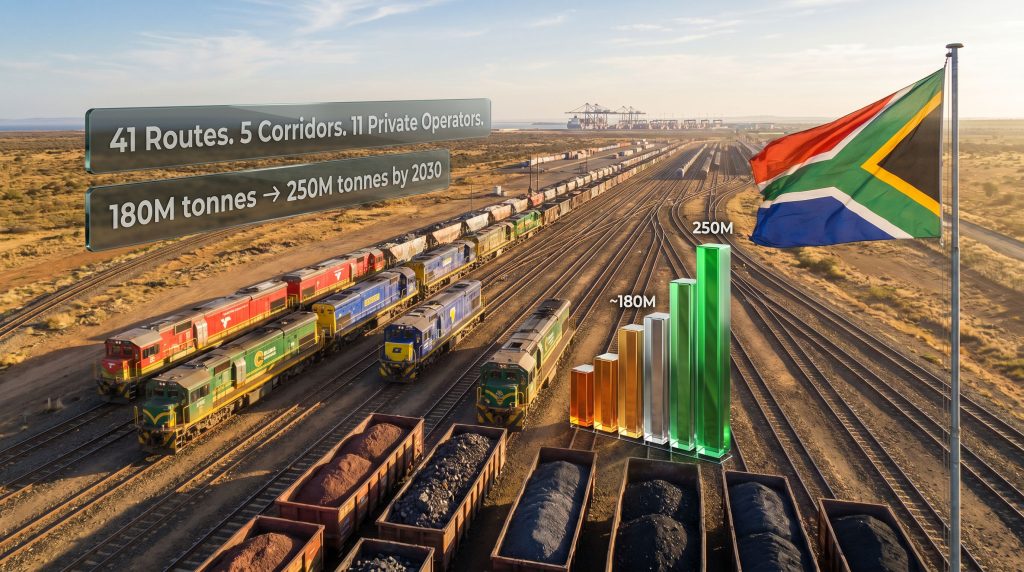
Private operators will access 41 routes spanning five freight corridors, each reflecting a distinct segment of South Africa's commodity export economy.
| Corridor | Primary Commodities | Key Export Terminal |
|---|---|---|
| Coal corridors | Thermal and coking coal | Richards Bay Coal Terminal |
| Iron ore corridors | Iron ore | Saldanha Bay Port |
| Manganese corridors | Manganese ore | Northern Cape to port |
| Container and fuel corridors | Containerised goods, petroleum products | Durban, Cape Town |
| General freight corridors | Agricultural produce, industrial goods | Multiple terminals |
The corridor design reflects the commodity composition of South Africa's export economy. Coal and iron ore have historically dominated rail volumes. However, the inclusion of manganese corridors has taken on added significance given rising demand for manganese in lithium-ion battery cathode chemistry, particularly in the transition toward higher-manganese, lower-cobalt battery formulations that battery manufacturers are increasingly pursuing.
The Eleven Approved Operators: Profiles and Capital Commitments
The approved private train operating companies span a range of profiles, from established logistics conglomerates to mining-linked operators and newer entrants.
- ARC South Africa (African Rail Company) — reportedly pursuing approximately $170 million in financing for locomotive and wagon acquisition
- Grindrod — an established logistics group with existing exposure to port and rail operations
- Barberry
- Interlinks
- IRACEMA
- Menar
- Minrail
- Motheo Logistics
- Sharp Logistics
- The Railway Corporation
- TLD Marine (with MSC participating in the structure)
Separately, Traxtion has signalled a R3.4 billion rolling-stock investment, which functions as a strong independent signal of private sector conviction in the reformed market's commercial viability, even before the first private train has run a revenue service.
Capacity, Timelines, and the LeaseCo Entry Mechanism
What the Volume Numbers Actually Mean
Transnet has indicated that the 11 approved private operators are expected to contribute approximately 24 million tonnes of additional freight capacity in the near term, with the potential to scale that figure to 52 million tonnes over five years as operators expand their fleets and operational footprints.
The government's headline target is to lift annual rail freight volumes from the current ~180 million tonnes to 250 million tonnes by 2030, a ~39% increase that would require sustained parallel investment in both private operations and the underlying network infrastructure.
Operational Timeline
- 2026: Select private operators are targeting service commencement before year-end, with capital raising already underway
- 2027: The majority of approved operators are expected to reach operational status as locomotive and wagon procurement completes
- 2028–2030: Volume ramp-up phase as operators build freight books and expand corridor coverage
LeaseCo: Lowering the Capital Barrier to Entry
One of the less-discussed but operationally critical aspects of the reform is Transnet's decision to revive its LeaseCo rolling stock leasing business. The upfront capital cost of procuring locomotives and wagons represents the single largest barrier to entry for new operators, particularly smaller or mining-linked companies without existing balance sheet capacity for major asset acquisitions.
By making rolling stock available through a leasing structure, LeaseCo effectively lowers the financial threshold for market participation, enabling a broader and more competitive operator base than would otherwise be achievable. This is a structurally important design choice that distinguishes South Africa's approach from simply granting access rights on paper without enabling genuine participation in practice.
Global Benchmarks: How South Africa's Model Compares
South Africa's open-access approach is not without international precedent, but its specific hybrid architecture has distinct characteristics worth understanding.
| Reform Model | Infrastructure Ownership | Train Operations | Competition Mechanism |
|---|---|---|---|
| South Africa (2025 model) | State (Transnet/TRIM) | Mixed private and state TOCs | Open access on shared network |
| European Union | Separated public entities | Multiple private operators | Regulated open access |
| Australia (bulk corridors) | State and private mix | Private haulage companies | Negotiated third-party access |
| Latin America | Private concessionaires | Concession-holding companies | Concession-based exclusivity |
The EU model is the closest structural parallel: European rail liberalisation directives mandated infrastructure and operations separation specifically to enable multi-operator competition, driving measurable efficiency improvements on key freight corridors over the following decade. Australia's bulk commodity corridors offer a different precedent, with private haulage operators accessing government-owned track on negotiated terms. This is particularly relevant to iron ore and coal export corridors, and echoes some of the resource export challenges that have shaped policy responses in the Asia-Pacific region.
What South Africa has not adopted is the Latin American concession model, which transfers long-term operational and infrastructure responsibility to private entities under exclusive franchise agreements. The decision to retain infrastructure in state hands preserves public control over network investment decisions. However, it also means that track rehabilitation and signalling investment remains dependent on Transnet's financial capacity rather than being driven by private capital incentives.
The Critical Minerals Dimension: Why This Reform Has Global Significance
The timing of South Africa's rail reform intersects with a structural shift in global commodity demand that elevates the strategic stakes considerably. The accelerating transition toward electric vehicles, grid-scale battery storage, and clean energy infrastructure has generated intense competition for the minerals needed to manufacture these technologies — a dynamic central to the broader critical minerals energy transition now reshaping global supply chains.
South Africa holds substantial reserves of several minerals occupying central positions in this transition:
- Manganese: South Africa holds some of the world's largest manganese reserves, and manganese is increasingly critical for next-generation battery cathode chemistries that battery manufacturers are developing to reduce dependence on cobalt
- Platinum group metals (PGMs): South Africa dominates global PGM supply, and while the primary demand driver has historically been automotive catalysts, emerging applications in hydrogen fuel cells represent a long-term demand catalyst
- Vanadium: Used in vanadium redox flow batteries increasingly deployed for grid-scale energy storage applications
The ability to export these materials reliably and competitively is directly dependent on rail logistics. Countries with superior logistics infrastructure will attract disproportionate downstream investment in mineral processing and beneficiation, capturing more value per tonne extracted rather than simply shipping unprocessed ore.
Countries that control reliable logistics corridors to port will increasingly determine where mineral processing investment lands in the energy transition supply chain. Logistics infrastructure is becoming a form of strategic resource in its own right.
The competitive threat from neighbouring corridors is real. Angola, Zambia, and Tanzania are all attracting significant capital into new railway infrastructure designed to move copper, cobalt, and other critical minerals to port more efficiently. Each kilometre of new competing corridor reduces South Africa's positional advantage as the continent's dominant mineral export gateway. Furthermore, the longer the domestic rail system underperforms, the more irreversible that competitive erosion becomes. Efforts around mining decarbonisation in Africa are also closely linked to logistics modernisation, as cleaner rail freight forms part of broader sector sustainability strategies.
The next major ASX story will hit our subscribers first
Investment Signals and Sector Exposure
Reading Capital Flows as a Leading Indicator
The capital commitments already visible in the market provide a useful forward indicator of institutional conviction in the reform's trajectory.
- ARC South Africa's $170 million financing effort indicates institutional investor appetite is forming around the reformed access framework
- Traxtion's R3.4 billion rolling-stock commitment is reported to represent the largest single private rail investment in South Africa's recent history
- Multiple operators are actively raising capital ahead of service commencement, suggesting commercial due diligence has been conducted and the economics are viewed as viable at current access pricing and freight rate assumptions
Mining sector participants with the most direct exposure to rail corridor performance include coal producers feeding the Richards Bay Coal Terminal, iron ore producers including Kumba Iron Ore on the Saldanha Bay corridor, and manganese miners in the Northern Cape. Agricultural exporters and automotive manufacturers dependent on general freight corridors also stand to benefit from improved reliability.
Risks and Structural Challenges That Could Derail the Reform
The Local Content Procurement Dispute
A significant commercial and political tension has emerged around the procurement dimension of the broader rail infrastructure upgrade programme. Business group Guma has formally challenged Transnet's engagement with foreign original equipment manufacturers from China, France, Japan, and the United Kingdom for railway rail supply contracts. The Black Business Council has aligned with these concerns, arguing that state-owned enterprises carry an obligation not to structurally exclude domestic and black-owned suppliers from major infrastructure contracts.
This dispute introduces a source of regulatory friction and reputational risk that, if unresolved, could slow elements of the infrastructure rehabilitation programme on which private operator performance ultimately depends.
Operational Risk Factors
Even with access agreements in place, private operators will be running trains on a network that has experienced sustained underinvestment. The key operational risk factors include:
- Track and signalling condition: Deferred maintenance has left portions of the network operating below engineered specifications, creating both speed restrictions and reliability risks
- Vandalism and security: Systemic cable theft and infrastructure vandalism affected Transnet's own operations severely; private operators face the same threat environment unless physical security is substantially improved
- Rolling stock lead times: Locomotive and wagon manufacturing involves procurement cycles measured in years, meaning fleet build-outs will take time even with capital commitments in place
- Regulatory maturity: Open-access rail requires sophisticated slot allocation, access pricing, and dispute resolution frameworks; South Africa's regulatory infrastructure for multi-operator management is still being developed
TRIM's Institutional Capacity as the Central Variable
Transnet Rail Infrastructure Manager's effectiveness as a neutral infrastructure manager is arguably the single most critical variable in the reform's success. Managing train path allocation across multiple competing operators on a shared network requires advanced traffic management capability, transparent scheduling processes, and credible dispute resolution mechanisms.
Moshe Motlohi, Chief Executive of TRIM, has described the access agreements as creating a functional and competitive rail marketplace. The institutional challenge now is building the operational machinery to make that vision functional in practice.
Frequently Asked Questions: South Africa Freight Rail Network Private Operators
How does the open-access model work step by step?
- A private operator applies for and receives a rail access agreement from TRIM
- The operator procures or leases locomotives and wagons, potentially through Transnet's LeaseCo structure
- TRIM allocates train path slots across designated corridors based on slot availability and priority rules
- The operator runs trains on the shared network, paying regulated access charges to TRIM
- Freight is delivered to port or industrial destination under commercial agreements between the operator and cargo owners
Which corridors offer the strongest commercial potential for private operators?
The coal corridor to Richards Bay has historically carried the highest volumes and represents the most immediately scalable commercial opportunity. The iron ore corridor to Saldanha Bay is critical for steel industry supply chains and has seen documented volume suppression during the Transnet operational crisis. Container traffic through Durban represents the highest value-density freight category. Manganese corridors, furthermore, are gaining strategic importance given battery industry demand dynamics.
What is the difference between this reform and full rail privatisation?
Full privatisation would involve transferring ownership of the physical rail infrastructure to private entities, with private operators managing both the track and the trains. South Africa's model retains public ownership of the infrastructure while opening train operations to private competition. This distinction has significant implications for long-term investment incentives, because private infrastructure owners have stronger financial incentives to invest in track rehabilitation, whereas state-owned infrastructure remains dependent on public capital allocation.
Will this reform reduce road freight volumes and logistics costs?
A successful modal shift back to rail would reduce truck volumes on key arterial routes connecting mining regions to ports. Lower logistics costs would consequently improve the price competitiveness of South African commodity exports, particularly bulk materials where transport cost represents a meaningful proportion of total delivered cost. The road freight industry may face structural volume pressure on certain corridors if rail reliability is genuinely restored.
The Conditions That Separate Success From Another False Start
South Africa has attempted various forms of rail sector improvement over the past decade without achieving sustained results. The current reform is structurally more significant than previous efforts, but success is not guaranteed. The conditions that need to be met for the South Africa freight rail network to deliver on its potential include:
- Regulatory clarity and stability: Private operators need confidence that access pricing, slot allocation rules, and operating terms will remain predictable over the investment horizon required to justify fleet procurement
- Parallel infrastructure investment: Access rights alone are insufficient; the underlying network must be rehabilitated to a standard that enables reliable operations
- Resolution of the local content dispute: Sustained political friction over procurement could delay infrastructure upgrade timelines
- Sufficient freight volume: Private operator economics require adequate cargo volumes to generate returns on fleet investment; early operational scale matters
- Security infrastructure: Sustained reduction in vandalism and cable theft is a prerequisite for reliable multi-operator operations across the network
Achieving the 2030 target of 250 million tonnes of annual freight would place South Africa's rail network back within reach of its designed operational purpose and restore a meaningful portion of the export competitiveness that has eroded over the past decade. The economic prize is large. The institutional and operational challenge of capturing it is equally substantial.
This article contains forward-looking analysis, volume projections, and investment observations that reflect available information and industry estimates at the time of writing. Readers should conduct independent assessment before making investment decisions. All financial and operational projections involve uncertainty and actual outcomes may differ materially from forecasts cited.
Ready to Capitalise on the Next Major Resource Discovery?
While South Africa's rail reforms reshape commodity export corridors, Discovery Alert's proprietary Discovery IQ model scans the ASX daily to deliver real-time alerts on significant mineral discoveries — instantly converting complex data across 30+ commodities into actionable insights for investors at every level. Explore Discovery Alert's dedicated discoveries page to see how historic finds have generated substantial returns, and begin your 14-day free trial today to position yourself ahead of the market.