August 12, 2026
South Africa fuel tax cuts extension: what it means in 2026
When an oil-importing economy is hit by an external energy shock, fuel taxes can become a frontline policy tool. That is the basic context behind the South Africa fuel tax cuts extension in May and June 2026. Rather than allowing higher imported fuel costs to flow fully and immediately into pump prices, the government extended temporary levy relief to soften the blow to consumers, transport networks, and inflation.
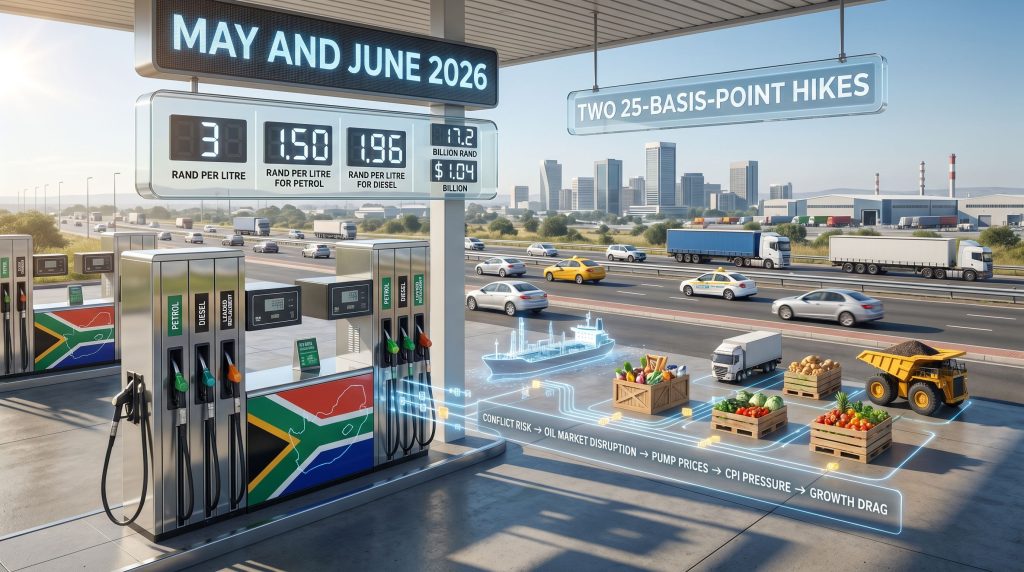
In practical terms, the policy keeps the fuel levy reduction at 3 rand per litre for both petrol and diesel in May 2026. In June 2026, the relief is reduced to 1.50 rand per litre for petrol and 1.96 rand per litre for diesel. Authorities said the estimated fiscal cost is 17.2 billion rand, roughly $1.04 billion based on public reporting at the time.
Why does this matter? Because fuel in South Africa is not just a transport cost. It is a major transmission channel for imported inflation, business margins, food distribution costs, and consumer confidence. In a net fuel-importing economy, a spike in global oil prices can move into domestic prices faster than many other shocks.
“Temporary fuel levy relief works as a short-run inflation buffer, but it also shifts pressure onto tax revenue and later budget decisions.”
How the policy works as a macro shock absorber
The best way to understand the South Africa fuel tax cuts extension is not as a routine tax tweak, but as an attempt to interrupt an inflation chain reaction.
A simplified transmission pathway looks like this:
- Geopolitical conflict risk
- Higher crude and refined fuel prices
- More expensive imports for fuel-importing countries
- Higher domestic pump prices
- Transport and logistics cost increases
- Pressure on food prices and broader CPI
- Potential interest-rate tightening and weaker growth
This matters because South Africa remains exposed to several external variables at the same time:
- international crude oil price trends
- exchange-rate sensitivity
- shipping and supply disruption risk
- refined fuel import costs
- second-round inflation effects across the economy
Furthermore, public reporting on the 2026 decision linked the extension to rising energy costs associated with the ongoing U.S.-Israel-Iran conflict, alongside broader supply disruption concerns affecting fuel-importing economies. Reuters-reported statements from the finance and petroleum ministries said the aim was to ease inflation pressure and reduce harm to growth.
In addition, official commentary around the measure aligns with the government's short-term fuel relief measures, which framed the intervention as temporary support rather than a structural overhaul.
Importantly, this was presented as a temporary intervention, not a permanent restructuring of South Africa’s fuel tax system.
Key numbers readers should know first
The core data points behind the South Africa fuel tax cuts extension are relatively straightforward, but they carry broad macro implications.
| Policy element | May 2026 | June 2026 | Why it matters |
|---|---|---|---|
| Petrol levy reduction | R3.00/litre | R1.50/litre | Direct relief for motorists and transport-linked inflation |
| Diesel levy reduction | R3.00/litre | R1.96/litre | Important for freight, farming, mining, and delivery costs |
| Extension period | 1 month | 1 month | Signals the measure is temporary |
| Estimated fiscal cost | Part of R17.2bn total | Part of R17.2bn total | Shows real budget trade-offs |
| Approximate USD equivalent | $1.04bn total | Useful for international comparison | |
| Possible market rate response later in 2026 | Two 25-basis-point hikes flagged by markets | Shows the inflation stakes | |
| Historical precedent | Similar temporary relief used in 2022 | Indicates this is not unprecedented |
Currency note: dollar conversion is based on public reporting at the time of the announcement and may vary with exchange-rate movements.
The government also said the revenue shortfall would be absorbed through:
- stronger-than-expected revenue collection
- underspending in other parts of the budget
That last point is crucial. The economic story is not only about petrol stations. It is equally about whether the 2026 budget framework can hold together after forgoing billions in levy income.
Why fuel levy relief was extended instead of allowing full pass-through
Governments usually tolerate market pricing until fuel starts behaving like a system-wide inflation accelerant. That appears to be the logic here.
Allowing full pass-through of imported fuel costs would likely have hit several layers of the economy at once:
- household disposable income
- freight and logistics margins
- commuting costs
- food distribution expenses
- retail pricing power in low-income demand segments
- business confidence in already fragile conditions
South Africa used a similar emergency lever in 2022 after the oil shock that followed Russia’s invasion of Ukraine. That earlier episode showed both the usefulness and the difficulty of such interventions. Relief can slow the first wave of inflation, but once introduced, it can become politically awkward to remove.
Moreover, recent reporting on fuel tax relief extension highlighted the same balancing act between cushioning consumers now and preserving fiscal room later.
In 2026, the design appears more controlled. Relief remains meaningful in May, then narrows in June, creating a partial glide path rather than a sudden cliff edge.
Inflation, interest rates, and household spending impact
Fuel has an outsized role in inflation expectations because its effects are both direct and indirect.
Direct effects
- pump prices for petrol and diesel
- private vehicle commuting costs
- public and informal transport fare pressure
Indirect effects
- food delivery and wholesale distribution
- agricultural diesel usage
- courier, warehousing, and last-mile costs
- broader pricing decisions by businesses facing transport cost inflation
Public reporting indicated that South African inflation edged higher in March 2026, suggesting price pressure was already building before this extension. That helps explain why markets began discussing the possibility of two 25-basis-point interest-rate hikes later in 2026 if fuel-driven inflation persists.
For instance, wider oil price volatility can feed quickly into inflation expectations, especially when exchange rates and shipping costs also move against importers.
Household savings scenarios
The exact impact depends on how much fuel a household or business uses. A simple scenario table helps illustrate the temporary savings.
| Monthly fuel consumption | Savings in May at R3/litre | Savings in June petrol at R1.50/litre | Savings in June diesel at R1.96/litre |
|---|---|---|---|
| 40 litres | R120 | R60 | R78.40 |
| 80 litres | R240 | R120 | R156.80 |
| 120 litres | R360 | R180 | R235.20 |
| 200 litres | R600 | R300 | R392 |
For a commuter buying 80 litres per month, the May relief alone translates to R240 in temporary savings. For diesel-intensive users such as small delivery operators, the June benefit remains somewhat larger than for petrol users because the cut is R1.96 per litre rather than R1.50.
“This policy can ease immediate household stress, but it does not remove the underlying exposure to global oil prices.”
The fiscal trade-offs behind the 17.2 billion rand cost
A temporary tax cut can stabilise the economy in the short term while weakening the budget in the same move. That tension sits at the centre of this policy.
The estimated R17.2 billion revenue sacrifice needs to be judged across four lenses:
- Inflation relief
- Growth protection
- Fiscal durability
- Political reversibility
The government’s argument is effectively that near-term macro stabilisation may justify the revenue loss, especially if the cost prevents wider inflation damage and softer household demand.
Still, several questions remain important for policy credibility:
- Is the offset from stronger revenues a one-off windfall or something repeatable?
- Which spending areas are being underspent, and are they economically sensitive?
- If oil prices remain elevated, does a temporary measure create pressure for another extension?
A key risk with all short-run fuel relief is that it can improve today’s inflation print while making future budget choices harder. Consequently, the broader impact on consumer prices will be watched closely alongside tax receipts and deficit management.
Why South Africa is vulnerable to global oil shocks
For fuel-importing economies, geopolitical conflict does not need to occur domestically to hit local households. The price transmission can arrive through global markets first.
South Africa is particularly sensitive to:
- disruptions to crude and refined fuel supply chains
- higher freight and insurance costs on energy shipments
- refinery bottlenecks
- sanctions-related market dislocation
- currency weakness amplifying import costs
Warnings from international energy agencies about possible supply disruptions can affect expectations before any physical shortage is visible at the local forecourt. Traders reprice risk early, importers pay more, and consumer inflation concerns rise quickly.
That is why the South Africa fuel tax cuts extension matters beyond motorists. It is also a response to external vulnerability in a globally priced commodity market, especially amid rising geopolitical trade tensions.
Which sectors feel the biggest effect
Transport and logistics
Road freight operators are among the most immediate beneficiaries. Diesel costs feed directly into fleet budgets, delivery pricing, and contract margins.
Agriculture and food distribution
Diesel matters in both production and movement. Relief can help slow the pass-through from farm gate to retail shelf, especially where distribution distances are long.
Retail and consumer goods
Retailers face transport, warehousing, and replenishment cost pressure. Temporary levy relief can support margin management in price-sensitive segments.
Mining and heavy industry
Many operations are diesel-intensive, whether through haulage, backup generation, or transport links. The policy is not sector-specific support, but it can still slightly reduce operating cost pressure where fuel exposure is material. In that sense, wider commodity price impacts also matter for sectors already dealing with volatile input costs.
Is the extension smart cushioning or a risky precedent?
| Policy lens | Short-term benefit | Long-term risk | What to watch |
|---|---|---|---|
| Inflation relief | Lowers immediate pump-price pressure | May only delay full pass-through | CPI releases and transport inflation |
| Growth support | Supports consumption and business cash flow | Relief fades if oil remains high | Retail sales and freight cost trends |
| Fiscal impact | Buys time during external volatility | Reduces tax intake | Revenue collection and spending offsets |
| Reversibility | Structured taper in June helps | Political pressure may build for renewal | Government stance after June |
The case for the extension
- It can smooth a sudden imported price shock
- It may reduce second-round inflation effects
- It offers short-term support to households and businesses
- It buys policymakers time during external volatility
The case against the extension
- It weakens near-term revenue collection
- It can blur price signals that normally encourage adjustment
- It may become harder to unwind if oil remains elevated
- It is reactive rather than structural energy reform
How fuel tax cuts compare with other relief tools
| Tool | Speed | Targeting precision | Fiscal cost | Inflation impact | Political feasibility |
|---|---|---|---|---|---|
| Fuel levy cuts | Fast | Broad, not targeted | High if large and prolonged | Immediate on fuel | Usually high in a crisis |
| Direct cash support | Medium | Can be targeted | Depends on design | Indirect | Harder to implement quickly |
| Transport subsidies | Medium | More targeted to mobility | Moderate to high | Limited but useful | Mixed |
| Monetary policy tightening | Slow to households | Economy-wide, not targeted | No direct budget cost | Broad inflation response | Often unpopular |
| Energy resilience investment | Slow | Structural | High upfront | Long-term | Strong if financed well |
Fuel levy cuts are attractive because they work quickly. However, they are blunt. High-income and low-income users both benefit, and the state absorbs the fiscal hit immediately.
Scenarios to watch after June 2026
Scenario 1: Oil prices stabilise
If global energy markets cool, the relief may expire without major disruption. That would help budget credibility and reduce pressure for new intervention.
Scenario 2: Oil remains elevated
If imported costs stay high, the political and economic pressure for another extension could return, raising fresh fiscal trade-offs.
Scenario 3: Inflation broadens anyway
If fuel pressure spills more deeply into food, transport, and services, temporary levy cuts may prove insufficient and rate hikes could still materialise.
Scenario 4: Budget offsets disappoint
If stronger revenue collection or underspending fails to cover the gap, the government may face tougher reprioritisation decisions later in the fiscal year.
“The real test is not whether fuel relief lowers prices today. It is whether the state can remove that relief later without reigniting inflation or undermining fiscal discipline.”
FAQ: South Africa fuel tax cuts extension
How long is South Africa extending fuel tax cuts?
The announced extension runs through May and June 2026.
How much is the levy being reduced?
The reduction is R3 per litre for petrol and diesel in May, then R1.50 for petrol and R1.96 for diesel in June.
How much will the extension cost?
The estimated fiscal impact is R17.2 billion, approximately $1.04 billion based on reported currency conversion at the time.
Is the fuel tax cut permanent?
No. The measure has been described as temporary relief, not permanent tax reform.
Why was the fuel tax cut extended?
The stated goal is to soften inflation pressure and protect households and economic activity from higher imported energy costs.
Could this affect interest rates?
Indirectly, yes. If fuel-led inflation continues to build, pressure for tighter monetary policy can increase.
Final take
The South Africa fuel tax cuts extension is best understood as a temporary inflation-management tool with real fiscal costs. Its importance lies less in the mechanics of a levy adjustment and more in what it reveals about South Africa’s exposure to external energy shocks, the sensitivity of household budgets to imported fuel costs, and the constant balancing act between consumer relief and budget discipline.
This article is for informational purposes only and should not be treated as investment, tax, or policy advice. Some forward-looking points, including inflation paths, interest-rate outcomes, and post-June scenarios, are inherently uncertain and depend on global oil prices, exchange rates, and future government decisions.
Want Earlier Insight Into Market-Moving Resource News?
For investors tracking how global energy shocks, inflation and commodity moves ripple through ASX opportunities, Discovery Alert delivers real-time mineral discovery alerts powered by its proprietary Discovery IQ model. See how major discoveries have historically driven exceptional returns on the Discovery Alert discoveries page and start a 14-day free trial today.