
June 6, 2026
The Capital Rotation Reshaping African Gold: Why Shallow Beats Deep
For most of the twentieth century, the investment thesis for gold mining was straightforward: go deep, go large, and extract as much as infrastructure and capital could sustain. South Africa built an entire industrial civilisation around that logic. The South Africa gold revival now underway is dismantling that model — not by falling gold prices, but by a fundamental reassessment of where value can actually be generated in the ground.
The current wave of activity emerging across South Africa's goldfields does not resemble the sector's historical identity. There are no mega-projects requiring decade-long construction timelines, no armies of workers descending kilometres below the surface, and no single operation that will restore the country to its former position atop global production rankings. What is materialising instead is something arguably more sustainable: a collection of smaller, modular, efficiency-driven projects rewriting the economics of South African gold mining from the ground up.
Understanding why this matters requires looking at both the structural conditions that created the decline and the specific forces now making selective recovery possible.
When big ASX news breaks, our subscribers know first
From Global Dominance to Near Irrelevance: The Scale of South Africa's Contraction
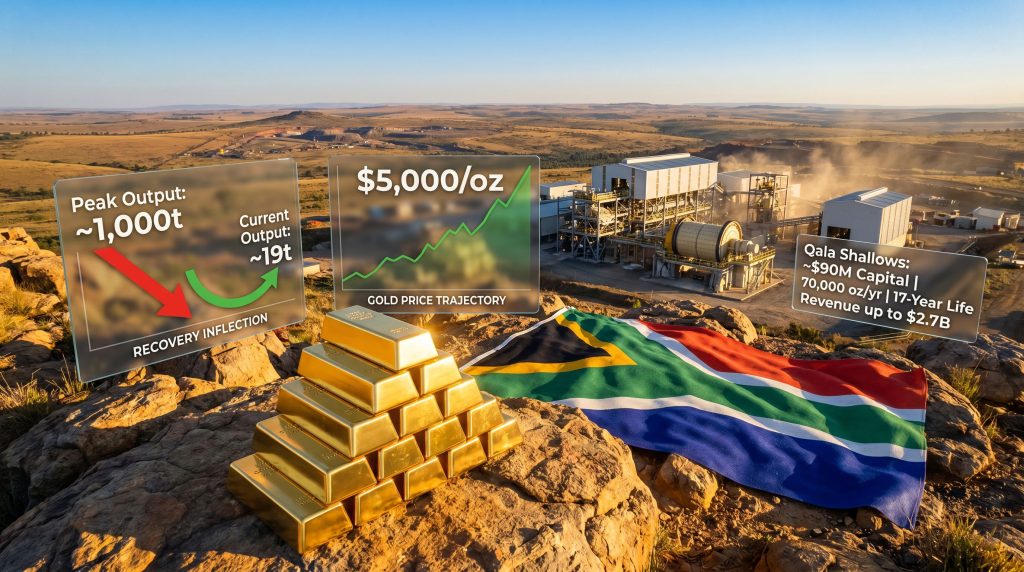
The numbers describing South Africa's fall from gold supremacy are genuinely staggering. At its peak, the country contributed more than 70% of global gold production annually, with output reaching approximately 1,000 metric tonnes per year. Today, that figure sits at roughly 19 metric tonnes, representing a contraction exceeding 98% from peak levels. The country's share of global gold production has compressed from over 70% to approximately 3%.
The employment consequences have been equally severe. The sector's workforce has contracted to fewer than 90,000 workers, a fraction of the hundreds of thousands employed during the industry's peak decades in the 1980s. Furthermore, in 2019, the symbolic threshold was crossed: Ghana formally overtook South Africa as Africa's leading gold producer, a milestone that underscored just how comprehensively the structural decay had accumulated.
What makes the decline analytically interesting is that it was not caused by any single catastrophic event. Instead, it reflected a compounding interaction between several deteriorating conditions over multiple decades:
- Rising electricity tariffs that disproportionately impacted energy-intensive deep-level operations
- Labour cost escalation in a heavily unionised sector, compressing margins on ageing ore bodies
- Infrastructure aged beyond its original design parameters, built for production volumes that no longer existed
- Regulatory uncertainty extending permitting timelines and deterring long-horizon capital
- The progressive exhaustion of accessible high-grade ore at depth, forcing ever-greater capital expenditure per ounce extracted
The result was a sustained outward migration of mining capital toward West Africa, where Ghana, Mali, and Burkina Faso offered shallower deposits, lower cost structures, and more straightforward extraction economics. South Africa's competitive disadvantage was not merely cyclical — it was structural.
Why the South Africa Gold Revival Is Different This Time
The South Africa gold revival gaining momentum in 2025 and 2026 is not a repeat of previous false starts. It is being driven by a fundamentally different project architecture than anything the country has attempted in recent memory.
The critical distinction is depth. South Africa's historical production came overwhelmingly from ultra-deep mining, with operations routinely descending below 3,000 metres. At those depths, the cost structure becomes punishing. Ventilation, cooling, hoisting, and ground support requirements escalate exponentially with depth, consuming capital and energy at rates that are difficult to justify unless ore grades are exceptionally high and prices reliably elevated.
The new generation of projects deliberately avoids this cost trap. Developers are targeting shallow legacy deposits and historical underground workings, where the geological parameters are already well understood and the extraction economics are fundamentally different. For a broader view of how this fits into the gold price outlook for miners globally, the competitive cost advantage of shallow operations becomes even clearer.
The modular approach being adopted by the current generation of South African gold developers compresses construction timelines, reduces upfront capital exposure, and allows projects to reach cashflow generation faster than conventional purpose-built processing infrastructure could achieve.
Two projects currently advancing illustrate this thesis with particular clarity.
The Mpumalanga Model: Reviving a Dormant Goldfield Through Modular Technology
Theta Gold Mines Ltd., an Australian-listed miner, is advancing the TGME Gold Project near Pilgrim's Rest in Mpumalanga. The location carries significant historical weight. Pilgrim's Rest was a cornerstone of South Africa's early gold economy, its origins tracing to an 1873 gold rush that drew prospectors from across the region. The last major operation closed in 1972, leaving behind a cluster of historical underground workings that have sat largely dormant for more than five decades.
The project is designed to treat gold-bearing ore extracted from those legacy workings through a newly constructed processing facility. The key project parameters are as follows:
| Metric | Detail |
|---|---|
| Processing Rate | 540,000 tonnes per annum |
| Estimated Mine Life | Approximately 13 years |
| Total Projected Output | Approximately 1.24 million ounces |
| Initial Recovery Target | More than 1.08 million ounces |
| Plant Commissioning Target | End of 2026 |
| First Ore Processing | Q1 2027 |
| Processing Technology | 900kW modular ball mill circuit |
| Equipment Supplier | MechProTech (South African manufacturer) |
The decision to procure a 900-kilowatt modular ball mill circuit from local manufacturer MechProTech is not merely a logistical preference. It reflects a deliberate strategy to compress construction timelines and reduce the financial exposure associated with greenfield plant construction. Executive Chairperson Bill Guy has indicated that the equipment procurement reflects a firm commitment to commission the plant by the end of 2026, with first ore processing to follow in the opening quarter of 2027.
Once extracted, the ore will be crushed and processed to separate gold from surrounding rock material before being refined into a usable form. The sourcing of processing equipment from a domestic South African manufacturer simultaneously addresses lead time risk and keeps a portion of project capital expenditure within the local economy.
The modular ball mill circuit approach is worth examining more closely as a technical concept. Traditional ball mills are large, purpose-built grinding units designed for specific throughput volumes and ore characteristics. Modular variants are prefabricated in standardised units that can be assembled on site faster than custom-engineered alternatives, with lower civil construction requirements and greater flexibility if processing parameters need adjustment. For a project operating at 540,000 tonnes per annum, a 900-kilowatt configuration represents an appropriately scaled solution that avoids the capital overhead of oversized infrastructure. Mining Weekly's coverage of similar Johannesburg-area developments further illustrates how resource estimate upgrades are strengthening the revival outlook.
The Witwatersrand Re-entry: Shallow Economics Near Johannesburg
The second major project currently advancing is Wits Mining Ltd.'s Qala Shallows development, located near Johannesburg and targeting ore within the Witwatersrand Basin. This formation is arguably the most consequential gold-bearing geological structure in human history, having contributed approximately 40% of all gold ever mined globally.
The Qala Shallows project is structured around a fundamentally different financial architecture than South Africa's legacy deep-level operations:
- Capital requirement: Approximately $90 million, modest by global mining standards
- Annual production target: Approximately 70,000 ounces per year
- Project life: 17 years
- All-in operating costs: Forecast below $1,300 per ounce
- Total revenue potential: Up to $2.7 billion over the project life, based on feasibility modelling
- Processing arrangement: Ore to be treated at an existing plant owned by Sibanye Stillwater Ltd., eliminating greenfield processing infrastructure costs
The processing partnership with Sibanye Stillwater is strategically significant. Rather than constructing a new processing facility, Wits Mining has arranged to utilise existing infrastructure owned by one of South Africa's most established mining groups. This arrangement reduces the project's capital requirements, eliminates construction risk associated with new processing plant development, and compresses the timeline between first ore extraction and first revenue generation.
A multidisciplinary due diligence review completed in 2026 has materially strengthened the project's credibility with the investment community. The review has been characterised as positioning the project as a meaningful entry point for new capital into a sector that has seen very limited greenfield development over the past decade and a half.
Comparative Project Metrics
| Metric | TGME (Mpumalanga) | Qala Shallows (Witwatersrand) |
|---|---|---|
| Project Operator | Theta Gold Mines Ltd. | Wits Mining Ltd. |
| Mine Life | ~13 years | ~17 years |
| Total Projected Output | ~1.24 million oz | ~1.19 million oz (est.) |
| Processing Rate | 540,000 tpa | Not publicly disclosed |
| Capital Cost | Not publicly disclosed | ~$90 million |
| Operating Cost | Not publicly disclosed | Below $1,300/oz |
| Revenue Potential | Not disclosed | Up to $2.7 billion |
| First Production Target | Q1 2027 | Q1 2026 |
| Processing Infrastructure | New modular plant (MechProTech) | Existing Sibanye Stillwater facility |
Disclaimer: Revenue projections and operating cost forecasts are based on publicly available feasibility modelling and are forward-looking estimates subject to material change. They should not be interpreted as guaranteed outcomes. Investors should conduct their own independent due diligence before making investment decisions.
Why South Africa Lost Its Position and What It Would Take to Compete Again
Ghana's rise to the top of the African gold production ranking in 2019 was not a surprise to anyone who had been watching capital flows in the sector. The country's ascension reflected a multi-year shift in investment toward deposits that were shallower, more accessible, and cheaper to develop than anything remaining in South Africa's deep-level mining pipeline. Reviewing the landscape of the largest gold mines globally reinforces just how far South Africa's flagship operations have fallen behind in terms of scale and cost competitiveness.
The West African competitive advantage is structural rather than cyclical. Countries including Ghana, Mali, and Burkina Faso expanded gold output by targeting formations where ore bodies sit at manageable depths, strip ratios are lower, and energy costs per tonne extracted are significantly less burdensome. South Africa's deep reef operations simply could not match these economics as electricity costs escalated and ore grades at accessible depths declined.
The structural headwinds South Africa continues to face are well-documented:
- Energy cost escalation: Electricity tariffs have risen sharply over the past decade, creating a persistent cost disadvantage for operations that consume large quantities of power for ventilation, cooling, and hoisting at depth.
- Labour economics: A heavily unionised workforce with rising real wage expectations continues to compress operating margins, particularly for labour-intensive underground operations.
- Infrastructure age: Much of the mining infrastructure serving South Africa's gold sector was built to support production volumes that have not existed for decades, requiring capital-intensive maintenance without the revenue base to justify it.
- Illegal mining pressure: Abandoned shafts and dormant workings are increasingly occupied by informal operators. This creates safety liabilities, complicates re-entry by legitimate developers, and generates unquantified production volumes that do not contribute to formal sector output or fiscal revenues.
- Regulatory timeline complexity: Permitting processes continue to extend project lead times relative to competing jurisdictions, deterring capital that could otherwise be deployed into South African development.
The realistic scenario for South Africa's gold sector is not a restoration of its former dominance, but a selective efficiency-driven recovery concentrated in shallow legacy deposits and modular-scale operations where the cost structure is fundamentally different from the deep-level model that defined the twentieth century.
The next major ASX story will hit our subscribers first
The Witwatersrand Basin: Why Geological Heritage Still Matters for Investors
The Witwatersrand Basin deserves specific attention as a geological and investment concept, because its significance extends well beyond historical output statistics. The basin is one of the most thoroughly studied gold-bearing geological formations on Earth. Decades of exploration, sampling, and underground development have generated an exceptional body of geological data covering ore distribution, grade profiles, and structural characteristics.
For investors and developers, this matters for a specific reason: known geological complexity is priced differently than frontier exploration risk. A project targeting a well-characterised portion of the Witwatersrand Basin carries significantly less technical uncertainty than a greenfield deposit in a jurisdiction with limited exploration history. The geological parameters are established, the ore behaviour during processing is understood, and the infrastructure corridors are largely pre-existing.
The shallow mining thesis that underlies the current project pipeline exploits precisely this dynamic. By focusing on ore zones within the Witwatersrand Basin that do not require ultra-deep extraction, developers are accessing known geological resources at cost structures that are genuinely competitive under current gold price conditions, without the technical and capital risk associated with frontier development. Furthermore, tracking gold mining equities closely reveals how the market is beginning to price in this structural shift toward shallower, lower-cost South African assets.
Three Scenarios for South Africa's Gold Sector Through 2030
The trajectory of the South Africa gold revival through the remainder of this decade will be shaped by several interacting variables. The following scenario framework outlines the range of plausible outcomes:
| Scenario | Key Conditions | Output Trajectory | Capital Flow Implication |
|---|---|---|---|
| Bull Case | Gold prices sustained above $4,000/oz; energy reform gains traction; regulatory timelines shorten | Gradual recovery; new project pipeline expands beyond current developments | Renewed entry of international capital into junior and mid-tier developers |
| Base Case | Prices moderate to $3,000–$4,000/oz range; structural challenges persist but stabilise | Modest growth concentrated in shallow legacy deposits and modular operations | Capital remains selective, focused on de-risked near-production assets |
| Bear Case | Prices retreat materially; energy and labour costs escalate further; illegal mining intensifies | Continued output erosion; project pipeline stalls | Capital redirects to West Africa and other lower-cost jurisdictions |
These scenarios are illustrative analytical frameworks, not forecasts. Actual outcomes will depend on gold price movements, policy developments, and operational execution, all of which carry inherent uncertainty.
The variable most analysts consider most important is energy. South Africa's electricity supply challenges have been the single most consistent constraint on mining sector competitiveness over the past decade. Progress on power reliability and tariff stabilisation would materially alter the economics of the broader project pipeline, not merely the two flagship developments currently in focus.
A secondary variable that receives less attention is political risk redistribution. Mali and Burkina Faso, two of the West African jurisdictions that attracted significant gold mining capital over the past decade, have experienced substantial political instability. To the extent that capital seeks stable jurisdictions for long-horizon projects, South Africa's comparatively more predictable institutional environment may become a more prominent consideration in capital allocation decisions.
What the Lean Mining Model Means Beyond Production Statistics
The shift toward smaller, modular, lower-cost mining operations in South Africa carries implications that extend beyond headline production figures. Each new project creates direct employment in communities where alternative economic opportunities are limited, supplies a portion of its capital expenditure into regional supply chains, and generates tax and royalty revenues that contribute to public finances.
The revival of dormant goldfields such as Pilgrim's Rest also carries a dimension that pure economic analysis tends to underweight. These are communities whose identity and economic foundation were built around mining activity that ended decades ago. The reactivation of processing infrastructure and underground workings in such locations is not merely a production decision — it reconnects local populations to economic activity that had disappeared from their region within living memory.
Modular and smaller-scale operations also tend to exhibit higher local procurement ratios than mega-projects, which typically source specialised equipment and services from international suppliers. The deliberate choice to source processing equipment from a South African manufacturer, as demonstrated by the TGME project's arrangement with MechProTech, exemplifies this dynamic in practice. In addition, global gold production trends suggest that the shift toward modular, regionally sourced operations is not unique to South Africa — it reflects a broader recalibration across producing nations.
Key Variables for Investors to Monitor
For investors tracking the South Africa gold revival, the following variables represent the most important indicators of whether the current wave of project development translates into sustained sector recovery:
- Gold price trajectory: Projects operating with all-in costs below $1,300 per ounce carry meaningful margin at current price levels, but price movements will determine the viability of the broader pipeline beyond the two flagship developments
- Energy reform progress: Improvements in electricity reliability and tariff stabilisation represent the single most impactful structural variable for operating cost competitiveness
- Project execution timelines: Both the TGME and Qala Shallows projects are operating against specific commissioning and first-production targets; delays would affect investor confidence in the sector's revival narrative
- Illegal mining management: The degree to which authorities address informal occupation of abandoned workings will determine how many legacy deposits can be practically re-entered by legitimate operators
- West African political risk evolution: Capital flows between South Africa and West African gold jurisdictions are partially determined by relative political stability; deterioration in Mali or Burkina Faso could accelerate reallocation toward South African assets
Furthermore, gold M&A activity in the Australian market — where several of the key South African project operators are listed — provides a useful parallel indicator of how institutional capital is positioning itself ahead of expected production milestones. The South Africa gold revival underway in 2025 and 2026 is real, but it is narrow and conditional. It is being built on efficiency, modular technology, known geology, and a deliberate retreat from the cost structures that made the sector uncompetitive. Whether that foundation proves sufficient to sustain a broader recovery depends on forces that extend well beyond the mine gate.
This article is intended for informational purposes only and does not constitute financial advice. References to project economics, production forecasts, and revenue projections are based on publicly available feasibility data and forward-looking estimates that are subject to material uncertainty. Readers should conduct independent research and seek professional financial advice before making investment decisions. Further coverage of African commodity markets and mining sector developments is available at Business Insider Africa.
Want to Catch the Next Major ASX Mineral Discovery Before the Broader Market Does?
Discovery Alert's proprietary Discovery IQ model delivers real-time alerts on significant ASX mineral discoveries — instantly transforming complex geological data into actionable investment insights for both short-term traders and long-term investors. Explore historic discoveries and their exceptional returns, then begin your 14-day free trial to position yourself ahead of the market.