May 20, 2026
When Stability Becomes the Rarest Commodity in African Gold Mining
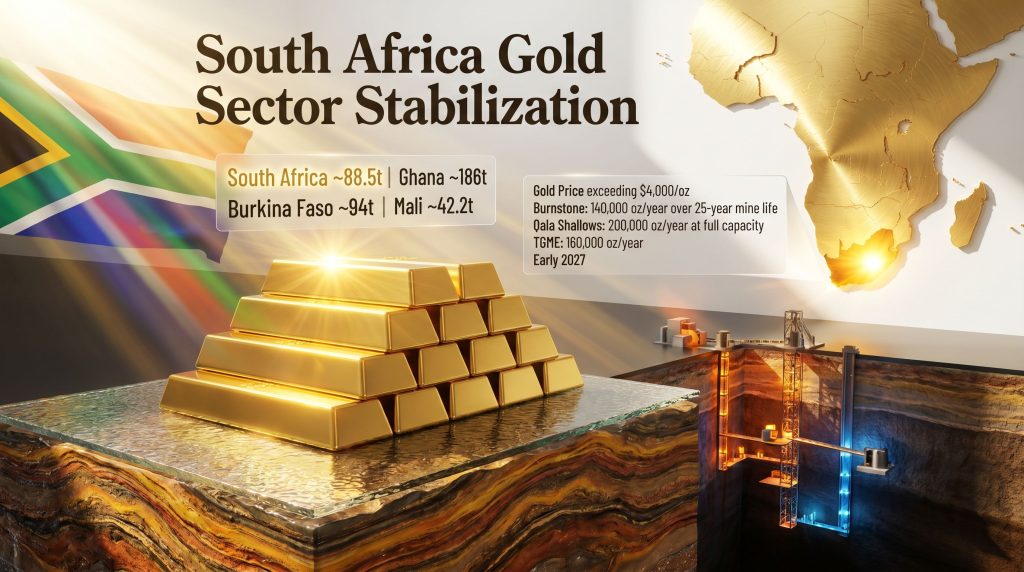
Across Africa's gold-producing belt, the dominant narrative of 2025 was one of extremes. Nations surged to record outputs on the back of artisanal booms while others collapsed under the weight of sovereign-operator disputes. Burkina Faso posted a 47% production jump. Mali's industrial output fell by nearly a quarter. Ghana added more than a million ounces through a single year of artisanal sector reform. Against this backdrop of violent swings, South Africa gold sector stabilization emerged as a genuinely distinctive story. South Africa's gold output declined by less than 2%, holding near a structural floor that its peers cannot seem to find. In a sector where volatility has become the norm, that kind of predictability is worth examining seriously.
When big ASX news breaks, our subscribers know first
Why South Africa's Gold Industry Defies the Decline Narrative
The Gap Between Perception and Operational Reality
South Africa's gold sector carries the weight of its own history. The country once produced approximately 1,000 tonnes annually at its 1970 peak, a figure so dominant that it defined global gold supply for decades. By 1990, output had already fallen to 605 tonnes. By 2025, the Minerals Council of South Africa reported production of approximately 88.5 tonnes, representing a roughly 91% decline from that historical high.
The instinct is to read this as a story of irreversible deterioration. That reading, however, conflates two concepts that operate on entirely different timescales and through entirely different mechanisms: long-term geological and structural decline on one hand, and near-term operational stabilization on the other.
A sector can be in structural decline from its historical peak while simultaneously achieving operational stability at its new, lower equilibrium. South Africa is doing exactly this. The distinction matters enormously for capital allocators, project developers, and policy analysts who need to assess the country's mining investment environment based on current realities rather than historical comparisons.
The more useful performance metric in this context is not volume versus historical peak. It is the consistency and predictability of output relative to current capacity, the trajectory of new project commitments, and the stability of the operational environment. By these measures, South Africa's picture looks considerably more constructive.
What Stabilization Actually Means in This Context
South Africa gold sector stabilization does not mean a return to 1970-era production levels. It refers instead to something more technically specific: the convergence of labour certainty, commodity price-driven asset viability, and renewed capital commitment that collectively reduce operational volatility to a level that supports rational investment planning.
This stabilization is measurable across three distinct dimensions:
- Labour relations stability through multi-year wage agreements that compress the probability of disruptive industrial action
- Regulatory and fiscal alignment through tariff adjustments and beneficiation incentives that improve unit economics
- New project pipeline formation after a development drought exceeding 15 years, signalling renewed investor confidence in the jurisdiction
Each of these dimensions represents a departure from the conditions that characterised South African gold mining through much of the 2010s and early 2020s, when recurring strike cycles, policy uncertainty, and energy cost escalation drove global majors toward more attractive jurisdictions.
How Does South Africa's Gold Output Compare to Its African Peers in 2025?
A Continental Production Snapshot
The 2025 production landscape across Africa's major gold-producing nations reveals a continent of dramatically diverging trajectories. The following data draws from the Minerals Council South Africa, the Ghana Chamber of Mines as cited by Reuters, and the World Gold Council, as reported by Ecofin Agency in April 2026.
| Country | 2024 Output (approx.) | 2025 Output (approx.) | YoY Change | Primary Driver |
|---|---|---|---|---|
| Ghana | ~149t (4.8M oz) | ~186t (6M oz) | +25% | Artisanal sector reform |
| Mali | ~100t | ~42.2t (industrial) | -22.9% | Loulo-Gounkoto standoff |
| Burkina Faso | ~64t | ~94t | +47% | Artisanal mining surge |
| Sudan | ~73.8t | ~70t | -5% | Civil conflict disruption |
| Côte d'Ivoire | ~58t | Growth trajectory | Continued rise | Multi-mine pipeline |
| South Africa | ~90t | ~88.5t | -1.9% | Structural floor holding |
The Stability Premium: Why Low Volatility Has Strategic Value
A surface reading of this table suggests South Africa is underperforming. Ghana surged 25%, Burkina Faso posted a 47% gain, and Côte d'Ivoire maintained an unbroken decade of growth. South Africa fell slightly. However, unpacking the quality and sustainability of each country's output reveals a fundamentally different picture.
Ghana's headline growth is impressive, but it rests on a fragile foundation. Artisanal production jumped from 1.9 million to 3.1 million ounces in a single year, while industrial mine output remained flat at 2.9 million ounces. Artisanal and small-scale mining (ASM) is highly responsive to gold prices, formalization incentives, and regulatory frameworks. It can expand rapidly under favourable conditions and contract equally rapidly when those conditions reverse.
The Ghana Chamber of Mines has flagged that a proposed reform raising the maximum mining royalty rate from the current 3%–5% range to 12% could constrain the expected contribution of incoming industrial mines, according to Chamber President Kenneth Ashigbey. If enacted, this policy shift could alter the trajectory of Ghana's headline output in ways the 2025 figures do not anticipate.
Ghana's growth story is partially built on artisanal production that jumped more than 60% in a single year. That kind of expansion carries inherent regulatory reversibility risk that institutional capital must price carefully.
Burkina Faso's record output of 94 tonnes is similarly dependent on artisanal formalisation, which contributed an unprecedented 42 tonnes in 2025, a 19-tonne increase over prior-year levels. Sustaining this pace requires continued formalisation, investor retention, and a political environment conducive to resource development. Resource nationalism in Burkina Faso has already prompted some operators to redirect capital to neighbouring jurisdictions. The headline figure is genuine, but its structural foundations are fragile.
Mali's experience illustrates the most severe scenario. As Africa's second-largest producer in 2024 with 100 tonnes per World Gold Council data, Mali saw industrial production fall 22.9% to 42.2 tonnes in 2025 following a protracted dispute between the government and Barrick Mining over the Loulo-Gounkoto complex. An agreement was reached in late November 2025, allowing production to resume, but full-year 2026 volumes remain subject to operational ramp-up timelines.
Sudan's situation is structurally different again. Finance Minister Gibril Ibrahim estimated 2025 output at approximately 70 tonnes, but the country's civil war, ongoing since April 2023, has created conditions where a significant share of volumes continues to move through smuggling networks rather than formal channels. Official production figures for Sudan carry a reliability discount that makes investment planning effectively impossible in the near term.
Against this backdrop, South Africa's -1.9% year-on-year variance represents something genuinely distinctive: the narrowest production band among major African gold producers. This is not accidental. It reflects institutional depth, labour framework maturity, and a regulatory architecture that, despite its costs, provides the predictability that capital markets require. Furthermore, the gold price outlook for 2025 and beyond has only reinforced the relative attractiveness of jurisdictions offering this kind of operational certainty.
What Is Driving the South Africa Gold Sector Stabilization?
Stabilising Force #1: Multi-Year Labour Agreements Reducing Strike Risk
South Africa's gold sector has historically been one of the most labour-intensive and dispute-prone mining environments globally. Wildcat strikes, protracted wage negotiations, and organised industrial action have cost the sector billions in lost production value across the 2010s and early 2020s. The shift toward multi-year wage agreements represents a structural response to this pattern.
DRDGold secured a five-year wage agreement effective 2025, incorporating annual increases of 6%–7.5% above inflation, alongside performance incentives and housing support provisions. Sibanye-Stillwater and Harmony Gold have pursued similar extended wage frameworks. When wage frameworks are locked in for three to five years, project finance models become more predictable.
Labour certainty functions as a capital allocation signal. Multi-year wage frameworks reduce the strike probability that project finance models must account for, effectively lowering the risk premium on South African mining assets.
Stabilising Force #2: Record Gold Prices Reviving Marginal Asset Economics
Gold prices exceeding $4,000 per ounce in 2025 have fundamentally altered the viability calculus for South Africa's deep, high-cost deposits. In rand-denominated terms, the gold price has traded in a range of approximately R800,000 to R1,200,000 per kilogram. At the upper end of this range, deposits and processing operations that were previously sub-economic become commercially viable.
This dynamic is particularly significant for South Africa's tailings reprocessing segment. DRDGold's surface operations, which process legacy tailings deposits from decades of deep-level Witwatersrand mining, have seen materially improved unit economics at elevated price levels. Surface tailings operations require significantly lower capital intensity than greenfield underground development. At $4,000/oz gold, these operations generate returns that were impossible to model at the $1,200–$1,500/oz prices that prevailed during much of the 2010s.
South Africa holds one of the world's most extensive inventories of legacy tailings deposits, accumulated over more than a century of deep-level Witwatersrand mining. In addition, the relationship between gold and mining equities has become more pronounced at these elevated price levels, as investor interest in South African operators has correspondingly increased. The elevated price environment has also challenged the "sunset industry" characterisation that dominated commentary on South African gold through the early 2020s.
Stabilising Force #3: Fiscal and Regulatory Incentive Architecture
The policy environment has contributed meaningfully to improving the economics of South African gold production. A 15% reduction in refined gold export tariffs provides direct cost relief for producers with downstream refining exposure, improving net realisations on exported product. Tax incentive structures supporting local beneficiation have contributed to a reported 25% increase in domestic refining capacity, positioning South Africa as a downstream processing hub.
Mining Charter provisions emphasising local value-addition further reinforce this positioning. With global gold demand projected at approximately 4,500 tonnes annually, South Africa's targeted contribution of around 140 tonnes carries greater economic significance when domestic refining margins are captured locally rather than exported with the raw material.
What New Projects Signal Renewed Investment Confidence?
The Qala Shallows Project: A 15-Year First
West Wits Mining's Qala Shallows project, located in the Witwatersrand Basin, carries symbolic weight that extends beyond its production profile. It is the first new underground gold mine announced in South Africa in more than 15 years. The company's decision to divest its Australian Mt Cecelia asset specifically to concentrate capital on this South African development represents a counter-cyclical bet on the residual potential of the world's most historically productive gold geological system.
Initial production is targeted at 70,000 ounces per year, with a scale-up pathway to 200,000 ounces per year at full capacity. This phased approach reflects a rational capital management strategy in a jurisdiction where development timelines carry meaningful regulatory and operational complexity. According to the Minerals Council, new mine developments represent genuine milestones for communities and the broader economy, not merely production additions.
Theta Gold Mines and the TGME Timeline
Theta Gold Mines is targeting commissioning of its TGME operation by early 2027, with a projected output of 160,000 ounces per year over the first five years of operation. This timeline adds to a project pipeline that had been effectively dormant for over a decade, and its advancement is directly tied to the improved economics created by elevated gold prices.
Sibanye-Stillwater's Burnstone Decision
The most consequential near-term capital allocation signal in South Africa's gold sector is Sibanye-Stillwater's pending final investment decision on the Burnstone project, expected by mid-2026. Burnstone was suspended in 2021 when gold prices and operational conditions made the project's economics uncompelling. Its reassessment under the current price environment reflects the material change in the sector's viability parameters.
If the investment decision proceeds, Burnstone is projected to produce approximately 140,000 ounces of gold per year over a 25-year mine life. That 25-year duration is the most significant number in this project's profile. It signals a level of institutional confidence in South Africa's jurisdictional stability that short-duration projects do not require and therefore cannot demonstrate.
| Project | Operator | Expected Start | Annual Capacity | Mine Life |
|---|---|---|---|---|
| Qala Shallows (initial) | West Wits Mining | TBC | 70,000 oz | TBC |
| Qala Shallows (full) | West Wits Mining | TBC | 200,000 oz | TBC |
| TGME | Theta Gold Mines | Early 2027 | 160,000 oz | 5+ years |
| Burnstone | Sibanye-Stillwater | Post mid-2026 FID | 140,000 oz | 25 years |
What Structural Challenges Continue to Constrain Full Recovery?
The Depth Problem: Geology as a Cost Ceiling
South Africa's Witwatersrand deposits are among the deepest commercially mined gold formations on Earth. Some operations extend beyond 3.5 kilometres below surface, creating extraction challenges that have no low-cost engineering solution. Each additional metre of shaft depth correlates directly with higher ventilation requirements, more complex logistics, elevated safety risk profiles, and greater energy consumption per tonne of ore processed.
This structural reality creates a permanent cost premium relative to shallower West African deposits or open-pit operations in Australia and the Americas. It is the primary reason why South Africa will not recapture its 605-tonne output of 1990, much less the approximately 1,000-tonne peak of 1970. The geological resource remains, but extracting it economically requires gold prices that were structurally unavailable for most of the past three decades.
Eskom's Cost Burden and Infrastructure Decay
Escalating electricity tariffs from Eskom represent one of the most significant controllable cost pressures facing South African gold producers. Power supply unreliability adds a layer of operational risk beyond price: unplanned outages in deep underground operations create safety challenges, equipment damage, and productivity losses that are disproportionate to the duration of the interruption itself.
Regulatory reforms ending Eskom's generation monopoly offer medium-term relief potential, but the transition has not yet delivered material cost reductions at the mine level. Environmental compliance requirements have meanwhile increased compliance expenditure by an estimated 30%, adding another layer to an already demanding cost structure. South Africa's broader infrastructure deterioration adds further indirect burdens, compounding the geological cost disadvantage that deep-shaft operations already face.
The Majors' Retreat: A Signal Worth Contextualising
AngloGold Ashanti has maintained zero operational presence in South Africa since 2020. Gold Fields has reduced its South African footprint to a single operating asset. These decisions by globally diversified operators reflect considered judgements that South Africa's cost structure does not compete favourably with their West African, Australian, or Americas portfolios at normalised gold prices.
Consequently, it is mid-tier operators and project developers, not global majors, who are making the capital commitments that underpin the current positive signals. This carries a different risk-return profile: higher operational leverage to gold prices, less portfolio diversification buffer, but potentially greater upside concentration in a sustained high-price environment.
The next major ASX story will hit our subscribers first
How Does South Africa's Stabilization Compare to Peer Country Risk Profiles?
A Risk-Adjusted Perspective on African Gold Production
Headline production rankings provide an incomplete picture of the investment environment across African gold jurisdictions. A risk-adjusted framework reveals meaningfully different underlying dynamics:
- Ghana faces fiscal uncertainty from proposed royalty reforms that could raise the maximum rate from 3%–5% to 12%, potentially deterring new project development and creating cost headwinds for existing operations
- Côte d'Ivoire operates with a significant undeclared artisanal production layer estimated by NGO SWISSAID at 30–40 tonnes per year, representing fiscal leakage that inflates the country's economic contribution from gold beyond what formal revenues capture
- Burkina Faso achieved its 2025 record through artisanal formalisation in an environment of pronounced resource nationalism that has already prompted capital reallocation to neighbouring jurisdictions
- Mali demonstrated the full severity of sovereign-operator conflict through the Loulo-Gounkoto dispute, with industrial production falling 22.9% before an agreement was reached in November 2025
- Sudan remains effectively uninvestable in the near term, with active civil conflict disrupting operations and smuggling networks undermining the reliability of official production data
| Country | Primary Risk Factor | Risk Category | Investment Outlook |
|---|---|---|---|
| Ghana | Royalty reform uncertainty | Fiscal/Regulatory | Cautious near-term |
| Mali | Sovereign-operator conflict | Geopolitical | Recovering, fragile |
| Burkina Faso | Resource nationalism | Political | Constrained |
| Sudan | Active civil conflict | Security | Uninvestable near-term |
| Côte d'Ivoire | Artisanal regulation gap | Structural | Positive medium-term |
| South Africa | Cost structure/energy | Operational | Stabilising |
South Africa's primary risks are operational and cost-based. These respond to engineering solutions, price cycles, and policy reform. The risks facing Mali, Sudan, and Burkina Faso are geopolitical and security-based, and far less amenable to commercial mitigation strategies.
This distinction is foundational for investment decision-making. Operational risk can be modelled, hedged, and managed through capital structure and operational efficiency programmes. Geopolitical and security risk cannot be engineered away. It resolves through political processes that operate on timelines and through mechanisms entirely outside an operator's control.
What Does the Stabilization Mean for Investors and Capital Allocators?
The Mid-Tier Opportunity Thesis
With global majors having largely exited or significantly reduced their South African gold exposure, the stabilisation story is being constructed by mid-tier operators and project developers. This creates a differentiated investment thesis with specific characteristics that institutional and sophisticated retail investors should understand clearly. Furthermore, the broader case for gold as strategic investment in an inflationary, geopolitically uncertain environment makes this mid-tier South African exposure increasingly compelling.
Mid-tier operators carry higher operational leverage to gold prices. When gold trades above $4,000/oz, the improvement in their project economics is proportionally larger than for diversified majors whose portfolios average across higher and lower-cost assets. This amplification cuts both ways: a sustained price correction to the $2,000–$2,500/oz range would re-impair the economics of many South African projects currently attracting capital interest.
The Burnstone FID timeline of mid-2026 and the TGME commissioning target of early 2027 will function as near-term capital allocation signals for the broader sector. If these projects proceed on schedule, they validate the investment thesis for South African gold development at current price levels. Delays or deferrals would signal that operational challenges continue to exceed what elevated prices can compensate.
Tailings Reprocessing as a Low-Capital Entry Point
Surface tailings reprocessing represents a structurally distinct investment category within South African gold. It offers gold price exposure without the capital intensity, timeline risk, or depth-related cost challenges of greenfield underground development. South Africa's century-long history of deep-level Witwatersrand mining has created an extensive inventory of surface tailings deposits containing residual gold at grades that are viable at current prices.
At gold prices above $4,000/oz, the economics of reprocessing these legacy deposits are materially compelling. DRDGold has established the operational template for this approach, and its experience provides a benchmark for assessing new tailings reprocessing ventures across the Witwatersrand. For investors seeking South African gold exposure, there is also a broader category of undervalued gold stocks worth examining alongside tailings operators, particularly given the current price environment.
The Deeper Question: Does Production Volume Define Success?
Reframing the Performance Metric for African Gold Mining
Across Africa's gold-producing nations, headline output figures command the attention of analysts, media, and policymakers. However, volume rankings obscure questions that are arguably more important for long-term economic development: how much of the value generated by gold extraction is captured domestically, formally, and sustainably?
Côte d'Ivoire's estimated 30–40 tonnes of undeclared artisanal production per year represents economic activity that bypasses formal taxation entirely. Burkina Faso's artisanal surge, while impressive in volume terms, raises legitimate questions about worker safety standards, environmental management obligations, and the long-term stewardship of a non-renewable resource. Sudan's approximately 70-tonne output is partly channelled through smuggling networks that redirect value away from state revenues and formal economic channels.
South Africa's Institutional Advantage
Despite its cost challenges, South Africa operates within one of Africa's most developed and institutionally mature mining regulatory frameworks. Environmental compliance standards are established and enforceable. Labour relations systems are formal and legally structured. Capital markets infrastructure supports transparent project financing and ownership reporting.
This institutional depth means that gold extracted in South Africa is more likely to be fully declared, formally taxed, and subject to enforceable environmental remediation obligations than in several peer jurisdictions. The Mining Charter's local beneficiation requirements further ensure that a meaningful share of value-added processing occurs domestically. In addition, the ongoing gold M&A activity in comparable markets underscores how institutional stability underpins the confidence required for major transactional commitments.
The ultimate measure of a gold sector's contribution is not the number of tonnes produced in any given year. It is the degree to which mineral wealth translates into infrastructure investment, quality employment, fiscal revenue, and sustained community development. Viewed through this lens, South Africa's stabilisation carries more structural integrity than volume-surge narratives in jurisdictions where the governance architecture to translate production into development outcomes remains nascent.
South Africa's position is, as Ecofin Agency noted in April 2026, ultimately less unfavourable than raw production comparisons suggest. The sector's stabilisation may not generate the headlines of a 47% output surge. But in a landscape defined by sovereign disputes, artisanal volatility, and conflict-driven fragility, a narrow, predictable production band and a reviving project pipeline represent a genuinely distinctive proposition for capital allocators with multi-year investment horizons.
Disclaimer: This article contains forward-looking statements, production projections, and financial analysis based on publicly available information as of mid-2026. Mineral exploration and mining investments involve significant risks, and past production levels are not indicative of future performance. Readers should conduct independent due diligence before making any investment decisions. Production forecasts for specific projects, including Burnstone, TGME, and Qala Shallows, are subject to final investment decisions, permitting, operational variables, and commodity price movements that could materially alter outcomes.
Want to Identify the Next Major Mineral Discovery Before the Market Does?
While South Africa's gold sector stabilisation offers compelling signals for patient capital, Discovery Alert's proprietary Discovery IQ model scans ASX announcements in real time, instantly alerting subscribers to significant mineral discoveries across gold and more than 30 other commodities — explore historic discovery returns on Discovery Alert's discoveries page to understand what early positioning can mean for a portfolio, and begin your 14-day free trial today.