May 21, 2026
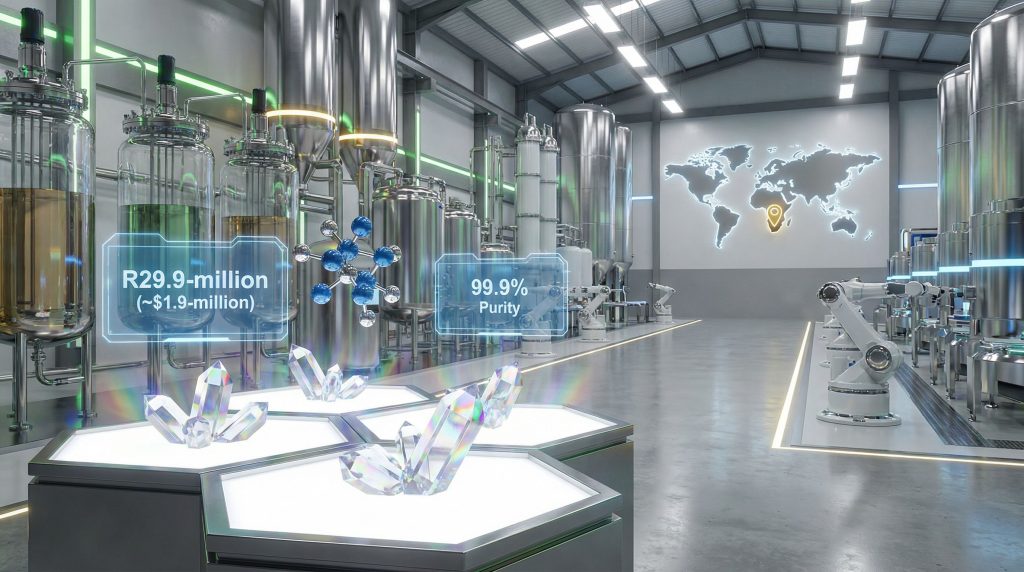
South Africa's strategic commitment to strengthen its position in the global electric vehicle supply chain represents a pivotal moment for continental industrial development. The nation's recent R29.9 million investment in high-purity manganese sulphate monohydrate (HPMSM) production through the Industrial Development Corporation demonstrates how African economies are transitioning from raw material exporters to sophisticated processing powerhouses. This investment aligns perfectly with the critical minerals energy transition driving global energy transformation.
The shift from traditional commodity extraction toward value-added manufacturing reflects broader changes in how nations approach resource monetisation. Rather than simply exporting raw manganese ore, South Africa invests in EV battery supply chain development by capturing premium pricing through advanced processing capabilities.
Strategic Positioning Through High-Purity Manganese Processing
South Africa's calculated entry into specialised battery materials processing targets a critical gap in global supply chains. The funding supports Giyani Metals' demonstration facility in Johannesburg, which has successfully validated essential operational parameters including reagent consumption optimisation and crystalliser operation protocols.
The facility's validation achievements enable progression toward definitive feasibility study completion by Q2 2026. This milestone incorporates real-world operational data into commercial-scale planning, demonstrating methodical approach to industrial development.
Investment Structure and Scale:
- Initial demonstration plant funding: R29.9 million
- Total expanded IDC loan facility: R329.9 million
- Facility location: Johannesburg, South Africa
- Commercial application: K.Hill project, Botswana
- Target completion: Definitive Feasibility Study Q2 2026
The significant scaling of IDC's total commitment represents an 11x increase from initial funding levels. This expansion demonstrates institutional confidence in HPMSM production economics and market positioning within the broader battery metals investment landscape.
Technical Specifications and Market Differentiation
HPMSM production requires exceptional purity standards that differentiate processed materials from commodity manganese exports. Battery-grade HPMSM typically demands minimum purity levels of 99.7-99.95% with iron contamination limits below 100 ppm.
These specifications command substantial pricing premiums compared to raw manganese ore. While raw manganese ore trades at approximately $3.50-4.50 per tonne, high-purity manganese sulphate monohydrate commands $2,500-3,500 per tonne, representing a 600-1000x value enhancement through processing.
Critical Quality Parameters:
- Combined cobalt and nickel contamination: <50 ppm
- Optimised particle size distribution: 5-15 micrometers
- Controlled crystalline structure for electrochemical stability
- Consistent chemical composition across production batches
Operational Validation and Process Optimisation
The Johannesburg demonstration plant has validated several critical operational parameters essential for commercial-scale production. These include reagent consumption efficiency, minimising chemical inputs per unit of finished HPMSM whilst reducing production costs and environmental footprint.
Furthermore, crystalliser operation parameters require precise temperature, pH, and residence time control for target specifications. The facility has also validated large-scale process management, translating laboratory protocols to production volumes whilst maintaining quality consistency.
These operational insights will inform the planned commercial-scale facility at the K.Hill project in Botswana. The integration represents a methodical approach to scaling specialised chemical processing operations within Africa's evolving mining industry evolution.
When big ASX news breaks, our subscribers know first
Policy Framework Integration and Industrial Strategy Alignment
South Africa's HPMSM investment operates within a comprehensive policy framework designed to incentivise electric vehicle supply chain development. The government has implemented strategic measures including a 150% tax deduction on qualifying EV production capital investments between 2026-2036.
Additional policy instruments include Automotive Production and Development Programme (APDP) amendments and Production Rebate Certificates for customs duty relief. These measures create favourable conditions for battery materials processing investments whilst supporting broader industrial diversification objectives.
Key Policy Incentives:
- National Critical Minerals Strategy development with World Bank partnership
- Manufacturing sector support representing 11-12% of GDP
- Employment creation for approximately 1.6 million workers
- Skills enhancement and technical capacity building initiatives
Manufacturing Sector Context and Employment Creation
HPMSM production requires skilled workers capable of operating sophisticated chemical processing equipment and quality control laboratories. This employment profile aligns with South Africa's industrial development priorities emphasising technical capacity building.
The transition toward higher-value processing activities supports job creation in specialised manufacturing roles. However, this contrasts with traditional mining employment patterns, requiring workforce development programmes and skills transfer initiatives.
Regional Integration and Continental Supply Chain Development
The investment strategy extends beyond individual project funding toward regional supply chain integration. South Africa's established industrial infrastructure, combined with abundant manganese reserves, positions the nation as a potential processing hub for Sub-Saharan African battery materials.
Regional resource coordination opportunities include cross-border mineral processing agreements and shared technology development initiatives. In addition, coordinated infrastructure investment and skills transfer programmes across African nations support continental integration within the critical raw materials transition.
Battery Industry Demand Dynamics and Growth Projections
Global lithium-ion battery production capacity reached approximately 2,000 GWh in 2023, with projections indicating expansion to 4,500+ GWh by 2030. This dramatic capacity increase drives corresponding demand for cathode precursor materials including HPMSM.
Global EV sales reached 13.6 million units in 2023, representing 14% of total vehicle sales. Projected EV sales by 2030 indicate 35 million units annually, representing 50% of new car sales in developed markets.
Market Demand Drivers:
- Manganese demand from battery sector: 200,000 tonnes annually (2023) to 400,000+ tonnes by 2030
- African EV market growth: 25-30% year-over-year potential
- Current African representation: <1% of global EV market
- Significant expansion opportunities across continental markets
Cathode Chemistry Evolution and Manganese Applications
Battery cathode chemistry continues evolving with manganese playing increasingly important roles across multiple formulations. Primary applications include LiMn₂O₄ (Lithium Manganese Oxide) offering high-temperature stability and moderate energy density.
Furthermore, NMC (Nickel-Manganese-Cobalt) provides higher energy density and wide deployment in EV applications. LMFP (Lithium Manganese Iron Phosphate) represents emerging chemistry combining manganese with iron for cost advantages.
The transition from cobalt-dominant chemistries toward manganese-rich formulations significantly increases manganese demand. This trend supports long-term demand growth for high-purity manganese compounds whilst reducing reliance on geopolitically sensitive materials, reflecting broader global lithium market trends.
Technical Requirements and Performance Impact
Metallic impurities in manganese precursors directly correlate with battery performance degradation, validating premium pricing for ultra-pure HPMSM. Iron contamination above 200 ppm reduces cycle life by 10-15%, whilst nickel and cobalt contamination creates preferential ionic migration pathways.
Impurity Impact on Battery Performance:
- Calcium and magnesium contamination increases electrolyte consumption during cycling
- Particle size inconsistency affects cathode powder manufacturing efficiency
- Quality variations create performance inconsistencies across battery cells
- Contamination levels determine battery warranty and lifecycle expectations
These performance dependencies justify investment in advanced purification technologies and validate market premiums for materials meeting stringent specifications.
Competitive Positioning and Global Market Context
South Africa enters an HPMSM market currently dominated by Asian producers, particularly Chinese companies with integrated supply chains connecting ore sources, processing facilities, and battery manufacturers. However, geographic diversification trends create opportunities for non-Asian production capacity.
Current Global Production Landscape:
- China: Dominant market position with 50%+ global market share
- Japan: Specialised ultra-high-purity applications
- Europe: Limited capacity focused on niche applications
- South Africa: Emerging capacity targeting regional and international markets
Resource Advantages and Competitive Positioning
South Africa possesses exceptional manganese resource endowments supporting HPMSM production development. The nation holds 4 billion tonnes of measured and indicated manganese ore reserves, representing 80% of global identified manganese ore resources.
Current production reaches 6.2 million tonnes annually, representing 30% of global manganese ore production. These resource advantages provide feedstock security and cost advantages for local processing operations compared to international competitors.
High-grade ore availability, typically containing 40-50% manganese content, reduces transportation costs and processing requirements. Consequently, this positioning offers significant competitive advantages in global markets.
Environmental Credentials and Sustainability Positioning
Battery manufacturers increasingly incorporate supply chain sustainability criteria into procurement decisions. This creates opportunities for renewable energy-powered HPMSM production, leveraging South Africa's solar and wind energy potential.
Sustainability Competitive Factors:
- Renewable energy availability for processing operations
- Reduced transportation emissions through regional supply chains
- Ethical mining practices and labour standards
- Corporate ESG compliance support for battery manufacturers
Major automotive OEMs including Volkswagen, BMW, and Tesla have established supply chain sustainability targets. These favour low-carbon material sources, potentially creating pricing premiums for renewable energy-powered HPMSM production.
Investment Analysis and Market Opportunities
The South African HPMSM investment creates multiple investment exposure channels ranging from direct equity participation to broader thematic positioning. Direct investment channels include Giyani Metals equity exposure (TSX: EMM) and IDC co-investment opportunities in related projects.
Private equity participation in downstream battery manufacturing and venture capital investment in battery technology startups provide additional exposure. However, investors must evaluate these opportunities within broader market contexts and competitive landscapes.
Comparative Investment Analysis
South Africa's $1.9 million initial investment represents modest scale compared to major international battery materials initiatives. Indonesia has committed $15+ billion to nickel processing and battery manufacturing, whilst Chile invested $2.6 billion in lithium extraction and processing expansion.
Australia allocated $1.2 billion to critical minerals processing initiatives, leveraging Asian market proximity. While smaller in absolute terms, South Africa's investment represents proof-of-concept validation supporting larger future investments.
Investment Comparison Analysis:
| Country | Investment Scale | Focus Area | Strategic Positioning |
|---|---|---|---|
| Indonesia | $15+ billion | Nickel processing and battery manufacturing | Integrated supply chain dominance |
| Chile | $2.6 billion | Lithium extraction and processing expansion | Lithium triangle advantages |
| Australia | $1.2 billion | Critical minerals processing initiatives | Asian market proximity |
| South Africa | $1.9 million (initial) | HPMSM demonstration and validation | Technology development foundation |
Supply Chain Investment Themes
Value chain positioning opportunities span raw material extraction and beneficiation through chemical processing and refining capabilities. Battery component manufacturing and recycling initiatives offer additional investment themes across the continental supply chain.
Each value chain segment offers distinct risk-return profiles and capital requirements. HPMSM production occupies a strategic middle position, capturing significant value addition whilst requiring moderate capital investment compared to full battery manufacturing facilities.
Risk Assessment and Market Challenges
HPMSM production faces several operational and market risks requiring careful investor evaluation. Technical and operational risks include process scaling challenges, maintaining purity standards at commercial volumes, and equipment reliability for specialised chemical processing operations.
Furthermore, skilled workforce development presents ongoing challenges requiring technical expertise for sophisticated processing operations. Quality consistency across batch-to-batch variation control represents another critical operational consideration.
Market Competition and Positioning Risks
South African HPMSM production faces established competition from integrated Asian producers with several competitive advantages. Chinese integrated supply chains offer ore-to-battery vertical integration, whilst Australian proximity advantages provide geographic closeness to Asian battery manufacturers.
Competitive Challenges:
- Chilean resource concentration within lithium triangle ecosystem benefits
- Indonesian government backing through state-supported nickel processing initiatives
- Established customer relationships and supply agreements
- Scale advantages in production and distribution networks
Infrastructure and Logistics Considerations
Critical success factors include reliable electricity supply for energy-intensive processing and transportation infrastructure for raw materials and finished products. Port capacity for international shipments and regulatory compliance with international battery material standards remain essential requirements.
South Africa's established industrial infrastructure provides advantages in these areas. However, electricity supply reliability remains a concern requiring attention through renewable energy development or alternative supply arrangements.
The next major ASX story will hit our subscribers first
Long-Term Strategic Implications for African Energy Markets
South Africa's battery materials investment represents a broader strategic shift toward continental participation in global energy transition supply chains. Success in HPMSM production could catalyse additional investments across the battery materials value chain.
Continental energy security benefits include reduced dependence on imported battery technologies and enhanced energy storage capabilities for renewable energy integration. Additionally, improved electric vehicle affordability through local supply chains and strengthened regional energy cooperation frameworks support continental development.
Future Development Pathways
The demonstration plant validation enables several potential development trajectories including commercial-scale HPMSM production at K.Hill project, Botswana. Downstream battery component manufacturing leveraging local HPMSM supply offers additional opportunities.
Regional processing hub development serving Sub-Saharan African markets and technology transfer initiatives could support broader African battery materials capacity. These developments align with continental industrialisation objectives and energy transition requirements.
Projected Development Timeline:
| Timeline | Development Milestone | Projected Impact |
|---|---|---|
| Q2 2026 | Definitive Feasibility Study completion | Commercial viability validation |
| 2027-2028 | Commercial-scale facility construction | Regional production capacity establishment |
| 2029-2030 | Full commercial operations | Sub-Saharan African market supply |
| 2030+ | Potential expansion and downstream integration | Continental energy transition support |
Global Supply Chain Resilience Contribution
African participation in battery supply chains offers important geographic diversification benefits including reduced Asian concentration in critical materials processing. Alternative sourcing options for international battery manufacturers and transportation cost optimisation for certain market segments provide additional advantages.
Ethical supply chain practices supporting corporate sustainability goals represent increasingly important competitive factors. These diversification benefits become valuable as battery supply chains scale to support global energy transition objectives.
According to CNBC Africa's analysis, South Africa's battery manufacturing opportunity extends beyond raw materials to encompass broader manufacturing capabilities. Furthermore, Forbes Africa reports that whilst Africa's EV revolution shows promise, several challenges continue holding back broader continental adoption.
Investment Considerations and Market Psychology
Investor interest in African battery materials reflects broader themes of supply chain diversification, resource security, and energy transition acceleration. However, investment decisions must balance growth potential against execution risks and competitive positioning challenges.
Key investment considerations include technology validation risk between demonstration plant success versus commercial-scale operation. Market penetration challenges involve competition with established Asian producers, whilst infrastructure requirements demand supporting investments in power, transportation, and logistics.
Market Psychology and Sector Sentiment
Battery materials investments currently benefit from strong thematic tailwinds including supply chain diversification mandates from major automotive OEMs. Critical minerals security concerns among developed economies and ESG investment criteria favouring sustainable supply chains support sector sentiment.
African industrialisation themes attracting development finance provide additional momentum. However, investors must also consider execution risks and extended timelines typically required for mining and processing project development.
The investment represents a strategic foundation for South Africa invests in EV battery supply chain development, positioning the nation within global energy transition supply chains whilst supporting continental industrial diversification objectives.
Want to Capitalise on Battery Metal Discoveries Before the Market?
Discovery Alert delivers instant notifications on significant ASX mineral discoveries using its proprietary Discovery IQ model, helping investors identify actionable opportunities in critical battery metals before broader market awareness. Explore historic discoveries that have delivered exceptional returns, and begin your 14-day free trial today to position yourself ahead of the evolving energy transition market.