
July 17, 2026
When Price Tailwinds Die, Structural Cracks Emerge
Mining economies built on commodity price cycles share a common vulnerability: the moment prices retreat, the underlying weaknesses that strong revenues once concealed become impossible to ignore. South Africa mine production weakens as commodity price support fades, and the sector is currently navigating precisely this transition. For much of the period between mid-2025 and early 2026, elevated gold and platinum group metals (PGMs) prices provided a powerful buffer, inflating mineral sales revenues and sustaining operational activity even as fundamental cost pressures continued to build beneath the surface. That buffer is now thinning.
The data from May 2026 confirms what many sector analysts had been anticipating: South Africa mine production weakens as commodity price support fades, exposing a sector that remains deeply dependent on price cycles it cannot control, and structurally ill-equipped to grow output through volume improvements alone. Furthermore, this trend connects to a broader pattern of South Africa mining decline that has been building for some time.
When big ASX news breaks, our subscribers know first
Decoding the May 2026 Contraction: Two Numbers That Tell Different Stories
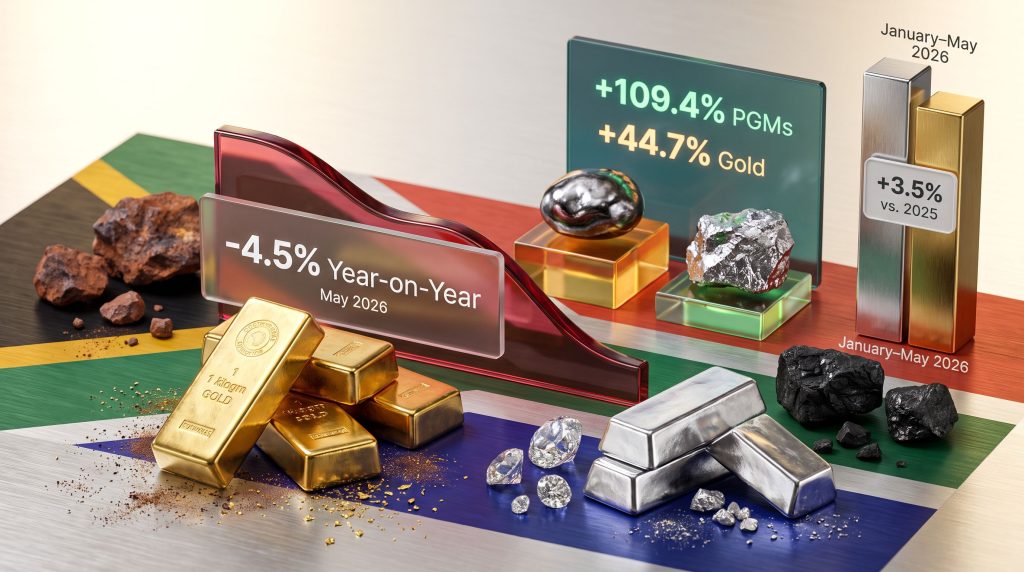
At face value, a 4.5% year-on-year contraction in mine output during May 2026 sounds unambiguous. However, the monthly picture complicates that narrative. Total mining production actually rose 1.3% month-on-month in May, with gold output climbing 2.3% on a short-term basis. This divergence is not a statistical quirk; it reflects a fundamental dynamic in how mining operations respond to price signals.
When commodity prices remain elevated relative to historical averages, mine managers tend to sustain or even incrementally increase output on a short-term basis, even as the year-on-year trend deteriorates. The lagging effect of price signals on operational decisions means the monthly data can appear resilient precisely when the annual trajectory is rolling over.
The Five-Month Picture and the Deceleration Pattern
Looking at the broader January to May 2026 window, cumulative output remained 3.5% above the same period in 2025, which on the surface appears encouraging. However, the pace of monthly expansion decelerated consistently throughout this period, a pattern that in mining economics typically signals a production recovery cycle that has reached its ceiling.
The following table contextualises May 2026's contraction within the recent output history:
| Period | Year-on-Year Change | Primary Driver |
|---|---|---|
| May 2025 | -5.4% | Operational disruptions |
| November 2025 | -2.7% | Coal and iron ore declines |
| Jan-May 2026 (cumulative) | +3.5% | Gold and PGM price surge |
| May 2026 | -4.5% | Price retreat and geopolitical shock |
The pattern is instructive. South Africa's mine output has oscillated between contraction and recovery not because of fundamental production capacity improvements, but primarily because commodity prices have shifted. For context on how iron ore price trends influence this broader dynamic, the relationship between pricing cycles and output decisions is well established.
The Strait of Hormuz Effect: How a Distant Conflict Reached South African Mining Operations
One of the less commonly appreciated mechanisms in global commodity markets is the speed at which geopolitical disruptions in oil-producing regions transmit cost pressures to mining operations on entirely different continents. The escalation of Middle East conflict in May 2026 disrupted oil trade flows through the Strait of Hormuz, a maritime chokepoint through which approximately one-fifth of global oil supply transits daily.
The consequences for South African miners were direct and measurable. In addition, the broader oil price rally triggered by geopolitical tensions compounded an already difficult cost environment:
- Petrol and diesel prices reached their highest levels of 2026 in May, compressing operational margins across surface and underground mining operations
- Supply chain logistics costs elevated, as haulage and transport fuel surcharges increased simultaneously
- Broader commodity market sentiment shifted from expansion to capital preservation, suppressing demand signals from key importing nations
The geopolitical transmission mechanism here is worth understanding in depth. Mining operations are among the most diesel-intensive industrial activities in any economy. Underground ventilation, haul trucks, processing plant generators, and surface logistics all carry significant fuel cost exposure. When diesel prices spike sharply and rapidly, the margin impact is felt within weeks, not quarters.
Manganese and Chrome: The Stockpiling Exception
Among the uniformly negative annual growth rates recorded across major commodities in May 2026, two stood apart: manganese and chrome. Both recorded positive year-on-year output performance, underpinned by accelerated stockpiling activity from Chinese buyers seeking to secure supply amid global uncertainty.
China remains South Africa's largest export market for both commodities. When geopolitical risk elevates supply chain anxiety, Chinese industrial buyers have historically responded with pre-emptive stockpiling rather than demand reduction. This dynamic temporarily supports production volumes and pricing for suppliers, but it is critical to interpret this correctly.
The manganese and chrome resilience in May 2026 was a defensive procurement response, not evidence of genuine underlying demand growth. Stockpiling cycles eventually exhaust themselves, and when Chinese buyers have accumulated sufficient inventory, the demand signal can reverse sharply. Treating this buffer as durable recovery would be analytically incorrect.
The Mineral Sales Paradox: Extraordinary Revenue Built on Fragile Foundations
Perhaps the most striking feature of South Africa's mining sector performance in early 2026 was the extraordinary divergence between production volumes and mineral sales revenues. Despite softening output, total mineral sales for January to May 2026 were approximately R100-billion higher than the corresponding period in 2025. According to Mining Weekly's analysis of South Africa's output performance, this price-driven revenue inflation has masked the fragility of the sector's underlying production base.
The commodity-level breakdown reveals how concentrated this revenue surge was:
| Commodity | Jan-May 2026 Sales Growth vs. 2025 |
|---|---|
| PGMs | +109.4% |
| Gold | +44.7% |
| Chromium | +37.3% |
| Nickel | +21.8% |
These are not volume-driven gains. They are price-level effects, meaning the revenue surge reflects the exceptional price environment of late 2025 through early 2026 rather than any expansion in physical production capacity. This distinction carries profound implications for how the sector's financial health should be interpreted.
Revenue built on price premiums is inherently more volatile than revenue built on production growth. When prices retreat, as they began to do in May 2026 and continued through June and into July, the revenue buffer compresses rapidly. Operations whose cost structures were rendered viable only by elevated price assumptions face renewed viability pressure as the price cycle turns. Understanding commodity prices and mining performance is, consequently, essential to assessing the sustainability of these revenue figures.
The Hidden Danger for Marginal Producers
A less widely understood dynamic in mining economics is what happens to marginal producers during commodity price supercycles. When prices surge, operations that would otherwise sit below the economic viability threshold become temporarily profitable. This encourages production maintenance and even modest capacity expansion. When prices retreat, these same operations are often the first to face care-and-maintenance decisions or outright closure.
South Africa's diamond and coal sectors are particularly exposed to this dynamic in the current environment. Without the price premium that sustained them through early 2026, their underlying cost structures tell a different story.
Three Commodity Sectors Under Compounding Structural Pressure
Coal: Losing Its Domestic Anchor
Coal production for the January to May 2026 period was 5.8% lower year-on-year, and the primary driver was not international market weakness but domestic demand deterioration. Eskom, South Africa's state power utility, has seen electricity generation and consumption contract, reducing its offtake requirements from local coal suppliers.
This creates an uncomfortable paradox. The same energy infrastructure that inflates input costs for miners is simultaneously contracting as a revenue source for coal producers. South African coal miners are caught between a weakening domestic buyer and export markets constrained by rail logistics failures.
Iron Ore: A Logistics Problem Masquerading as a Demand Problem
Iron ore production fell 7.8% year-on-year for the five-month period to May 2026, but the cause is not softening international demand. The dynamics surrounding China steel and iron ore demonstrate that global appetite from Asian steel producers has not collapsed. The constraint is entirely supply-side: persistent rail network failures are preventing ore from moving efficiently from mining operations to export terminals.
This is a critically important distinction for investors and policymakers. A demand-side decline would require a market recovery to resolve. A logistics-side constraint can, in theory, be resolved through infrastructure reform. The iron ore sector's production weakness is therefore not structurally inevitable; it is a policy-solvable problem that is currently being left unsolved.
Diamonds: Beyond Cyclical Weakness
Diamond production contracted 6.1% year-on-year, and the sector's distress is qualitatively different from cyclical commodity softness. Multiple operations have announced production stoppages and issued formal Section 189 retrenchment notices, the statutory process under South African labour law that precedes large-scale workforce reductions and potential mine closures.
The diamond sector faces a structural challenge that price recovery cannot fully address: the competitive pressure from laboratory-grown diamonds has fundamentally altered the demand architecture for natural rough diamonds in certain market segments. Combined with global demand softness and South Africa's high production cost environment, the sector faces existential questions that policy inaction will only accelerate toward permanent capacity destruction.
South Africa's Electricity Cost Problem: The 1,185% Tariff Escalation
No analysis of South African mining competitiveness is complete without confronting the electricity cost trajectory. The cost per kilowatt-hour for mining operations has increased by approximately 1,185% since 2003, a rate of escalation that has fundamentally altered the global cost competitiveness of South African producers across virtually every commodity class.
To put this in perspective:
- South African gold mining is among the deepest in the world, with some operations exceeding 3,500 metres below surface, making electricity-intensive ventilation, cooling, and hoisting systems non-negotiable operating requirements.
- Deep-level mining's electricity intensity means that tariff escalation hits South African gold producers proportionally harder than shallower operations in competing jurisdictions.
- A lower electricity tariff dispensation exists for select operations but has not been extended sector-wide, creating an uneven competitive landscape even within the domestic industry.
The Minerals Council South Africa has identified four structural reform priorities as the minimum threshold for restoring sustainable output growth:
| Reform Area | Current Constraint | Required Intervention |
|---|---|---|
| Electricity cost | 1,185% tariff increase since 2003 | Extend lower tariff dispensation sector-wide |
| Rail access | State-owned freight bottlenecks | Expand private sector rail access and allocations |
| Transmission infrastructure | Investment backlog | Expedite Independent Transmission Programme |
| Exploration pipeline | Insufficient new project development | Introduce targeted tax and licensing incentives |
The next major ASX story will hit our subscribers first
South Africa's Gold Sector: Price Windfalls Cannot Reverse Structural Decline
South African gold output has contracted by approximately 84% since 1994, a decline that reflects the intersection of deep-seam ore depletion, rising extraction costs, and a labour-intensive production model that has not kept pace with mechanisation advances seen in peer producing nations such as Australia and Canada.
The 44.7% surge in gold sales revenues during January to May 2026 generated welcome income for producers but did nothing to address this structural trajectory. Furthermore, price windfalls tend to delay the difficult capital allocation decisions required to develop new production horizons and extend mine life. According to the Minerals Council's published performance data, when prices retreat, the underlying depletion problem reasserts itself with renewed urgency.
Scenario Analysis: Reform vs. Policy Inaction Through 2026 and Beyond
Scenario A: Structural Reform Accelerated
- Electricity tariff relief reduces the cost burden on marginal producers, keeping otherwise viable operations open
- Rail reform unlocks iron ore and coal export volumes currently stranded by logistics constraints
- Exploration incentives attract new capital into greenfield and brownfield development
- Outcome: Production growth gradually shifts from price-dependent to volume-driven, improving resilience against commodity cycles
Scenario B: Policy Inaction Continues
- Ongoing electricity cost escalation forces additional operations into care and maintenance status
- Rail constraints remain unresolved, capping iron ore and coal export recovery regardless of international demand
- Diamond sector closures accelerate, with permanent capacity and skills destruction
- Outcome: South Africa mine production weakens as commodity price support fades further, leaving output increasingly hostage to price cycles that domestic policy cannot influence
Frequently Asked Questions: South Africa Mine Production 2026
Why did South Africa's mine production fall in May 2026?
Mine output contracted 4.5% year-on-year in May 2026, ending five consecutive months of growth. The reversal was driven by retreating gold and PGM prices, diesel cost inflation linked to Middle East conflict disruptions through the Strait of Hormuz, and continued structural headwinds in coal, iron ore, and diamonds.
Which commodities showed resilience during the May 2026 contraction?
Manganese and chrome were the only major commodities to record positive annual growth rates in May 2026, supported by Chinese stockpiling activity in response to global supply chain uncertainty rather than genuine demand expansion.
How did mineral sales perform despite falling production volumes?
Total mineral sales for January to May 2026 were approximately R100-billion higher than the same period in 2025, driven primarily by PGM sales growth of 109.4% and gold sales growth of 44.7%. These gains reflected elevated price levels rather than volume increases, making them structurally fragile as prices moderate.
What is the biggest structural constraint on South African mining competitiveness?
Electricity cost escalation of approximately 1,185% since 2003 is the single most pervasive competitiveness destroyer, compounded by rail logistics failures that prevent export-ready commodities from reaching terminals and an insufficient exploration pipeline limiting future production development.
Is the diamond sector at risk of further mine closures?
Yes. With production down 6.1% year-on-year and multiple operations already issuing formal Section 189 retrenchment notices, further closures represent a near-term risk. The sector faces structural demand pressures from laboratory-grown diamond competition that commodity price recovery alone is unlikely to resolve.
Disclaimer: This article contains forward-looking analysis, scenario projections, and commentary on commodity market dynamics. It does not constitute financial or investment advice. Commodity markets are inherently volatile and outcomes may differ materially from those projected. Readers should conduct independent research before making investment decisions.
Want to Identify the Next Major Mineral Discovery Before the Broader Market?
While South Africa's mining sector grapples with structural headwinds and price-driven revenue fragility, Discovery Alert's proprietary Discovery IQ model scans ASX announcements in real time, instantly alerting subscribers to significant mineral discoveries across gold, PGMs, and more than 30 other commodities — visit the Discovery Alert discoveries page to see how historic finds have generated substantial returns, and begin your 14-day free trial today to position yourself ahead of the market.