August 7, 2026
The Hidden Arithmetic of Energy Vulnerability
Every modern economy runs on a simple but rarely examined assumption: that fuel will be available tomorrow because it was available today. This assumption holds until it doesn't. When geopolitical shocks fracture global shipping corridors, nations discover very quickly whether their energy buffers are genuine protection or bureaucratic theatre. For most of the past decade, South Africa has been operating with the latter, and South Africa strategic oil reserves have become a matter of urgent national concern.
Understanding how exposed South Africa truly is requires stepping back from policy language and engaging with the raw numbers. A country consuming more than 600,000 barrels of oil per day that holds fewer than 14 days of strategic cover is not managing risk, it is simply hoping disruption does not arrive. The July 2026 draft policy released by the Department of Mineral Resources and Energy (DMRE) represents the most substantive governmental acknowledgement of this problem in a generation, and it arrives with both a credible diagnosis and a financing question that remains unresolved.
When big ASX news breaks, our subscribers know first
Understanding the Structural Vulnerability Behind South Africa Strategic Oil Reserves
Consumption, Coverage, and the Gap in Between
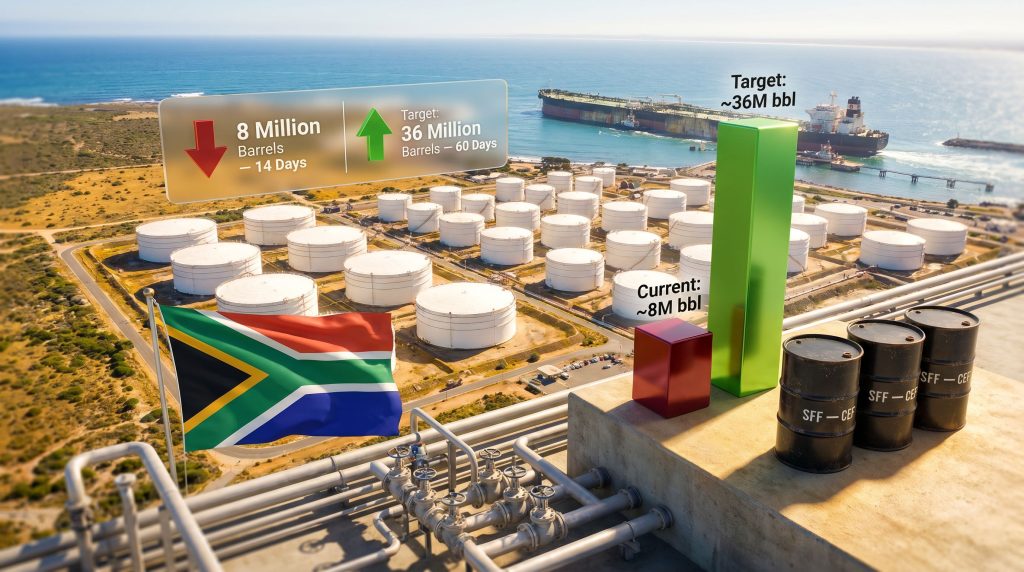
The fundamental mismatch between what South Africa consumes and what it currently holds in reserve is difficult to overstate. Daily oil consumption exceeding 600,000 barrels places South Africa firmly among Africa's most fuel-dependent economies. Yet its strategic petroleum stockpile sits at approximately 8 million barrels, translating to coverage of barely 13 to 14 days at current consumption rates.
The International Energy Agency (IEA) sets a binding benchmark of 90 days of net import coverage for its member states. South Africa is not an IEA member, but the benchmark remains the globally recognised standard against which energy security is measured. The country's current position falls so far short of that standard that even the government's own revised proposal, which targets 60 days of coverage, represents a pragmatic compromise rather than full alignment with international norms.
What makes this gap particularly consequential is the structural shift in South Africa's domestic energy landscape. Over the past decade, multiple refinery closures have fundamentally altered the country's fuel supply architecture. Rather than producing a meaningful share of its own refined petroleum products, South Africa now functions primarily as an importer of finished fuels. This creates a double exposure: vulnerability on both the supply side and the logistics side, including shipping route reliability and import infrastructure capacity. Furthermore, oil supply disruptions of the kind seen in recent years demonstrate precisely how quickly this double exposure can translate into economic damage.
Official modelling indicates that a sustained domestic fuel shortage could drain the South African economy of approximately R1 billion, equivalent to around USD $61 million, per day. That figure reframes the cost of strategic reserve underinvestment not as an abstract policy failure but as a concrete daily liability.
Why Refinery Losses Complicate the Reserve Calculus
A detail that receives insufficient attention in discussions of South Africa strategic oil reserves is the distinction between crude oil reserves and refined product reserves. Crude oil stored in a terminal is not the same as diesel or petrol available for immediate use. It must be processed first, and that processing requires functional refinery capacity.
The DMRE's proposed reserve composition targets approximately 70% crude oil and 30% refined petroleum products. This ratio matters enormously given South Africa's current refining situation. With domestic refinery capacity significantly reduced, a crude-heavy reserve can only fulfil its protective function if the country can either refine that crude domestically through remaining facilities, or offload it to regional partners with processing capacity. Neither pathway is currently well-developed at the scale the proposed reserve would require.
This creates a strategic planning challenge that the draft policy does not fully resolve: stockpiling crude oil without a credible refining pathway attached to it is a partial solution, not a complete one.
What the 2026 Draft Policy Actually Proposes
The 60-Day Target: A Five-Fold Expansion
The DMRE released its draft strategic petroleum reserve policy framework on 9 July 2026, opening it for public comment. The core proposal calls for building South Africa's reserves to a level equivalent to 60 days of national fuel consumption.
| Metric | Detail |
|---|---|
| Current stockpile volume | ~8 million barrels |
| Daily national consumption | 600,000+ barrels |
| Current coverage | ~13 days |
| Target coverage | 60 days |
| Required stockpile volume | ~36 million barrels |
| Additional barrels needed | ~28 million barrels |
| Reserve composition | ~70% crude oil, ~30% refined products |
Reaching the 36-million-barrel target from the current 8-million-barrel baseline represents a nearly five-fold expansion. Consequently, this becomes the largest proposed build-up of South Africa strategic oil reserves since the country constructed the Saldanha Bay facility during the apartheid era. The Financial Post has reported this as the country's first significant strategic oil boost since that era, underscoring the historic scale of the ambition.
Governance Architecture and the Role of SANPC
Under the proposed framework, oversight responsibilities are distributed across multiple institutions:
- The Strategic Fuel Fund Association (SFF), a non-profit state entity wholly owned by the Central Energy Fund (CEF), retains its existing role managing strategic petroleum stocks
- The newly formed South African National Petroleum Company (SANPC) assumes oversight of the refined petroleum product component of the reserve
- The National Treasury and SANPC are jointly tasked with developing financing mechanisms and guarantee instruments to fund the expansion
- Licensed fuel distributors and importers face a mandatory obligation to maintain 21 days of commercial fuel stocks as an additional buffer layer
The dual mandate assigned to National Treasury and SANPC signals an intention to explore blended financing approaches, combining sovereign balance sheet capacity with commercially structured instruments, rather than relying on a single funding pathway.
The financing architecture remains incomplete at the time of the draft policy's release. The language referring to developing instruments suggests a design process still in progress, which is both an honest acknowledgement of complexity and a potential source of implementation delay.
From Sanctions to Scandal: The History That Shaped This Moment
Engineering Self-Sufficiency Under International Isolation
South Africa's relationship with strategic petroleum stockpiling has a longer and more complicated history than most policy discussions acknowledge. During the apartheid era, international oil embargoes severed the country's access to conventional global supply chains. Rather than accepting fuel insecurity, the government engineered around the problem, constructing the Saldanha Bay crude oil storage facility on the country's west coast with a nameplate capacity of 45 million barrels.
The Saldanha Bay installation was not merely a storage tank farm. It was a deliberate piece of national security infrastructure, purpose-built to provide the country with multi-month insulation against politically motivated supply disruptions. At its peak utilisation, it represented one of the largest government-held petroleum storage complexes on the African continent.
The 2015 Disposal: A Self-Inflicted Reserve Crisis
The trajectory from that robust reserve position to today's depleted baseline is a case study in how governance failure can dismantle strategic assets built over decades. Indeed, the broader dynamics of sanctions and oil trade in recent years demonstrate just how vital strategic reserves become when conventional supply relationships are disrupted.
Between December 2015 and January 2016, approximately 10 million barrels of strategic crude oil were sold to private commodity trading firms, a transaction conducted without the transparency or legislative authorisation that disposal of national strategic assets requires. The crude was sold at prices widely reported as below prevailing market rates, compounding the governance failure with a direct financial cost to the state.
In November 2020, the Western Cape High Court ruled the sales unlawful, citing corruption and governance failures, and ordered the Strategic Fuel Fund Association to refund the buyers involved. The ruling confirmed what critics had argued for years: the disposal was not a legitimate commercial transaction but an improper dissipation of a national strategic asset.
Timeline: South Africa's Strategic Oil Reserve
| Period | Event |
|---|---|
| Pre-1994 (apartheid era) | Saldanha Bay facility constructed; 45 million barrel capacity built under sanctions embargo |
| Post-1994 | Reserve management transferred to SFF under Central Energy Fund |
| December 2015 to January 2016 | Approximately 10 million barrels sold covertly to private commodity traders |
| November 2020 | Western Cape High Court rules the sales unlawful; refunds ordered |
| July 9, 2026 | DMRE releases draft policy targeting 60-day strategic reserve coverage |
The Geopolitical Triggers Forcing the Policy Revival
The Strait of Hormuz Effect on African Energy Markets
South Africa's decision to act on strategic petroleum reserve expansion in 2026 did not emerge from a policy vacuum. The renewed intensity of conflict in the Middle East, particularly instability affecting the Strait of Hormuz, produced sharp and rapid fuel price spikes in import-dependent economies. However, the broader context of geopolitical trade tensions has amplified these pressures significantly for commodity-dependent nations.
Nations holding inadequate strategic reserves experienced immediate economic consequences. For South Africa, heavily reliant on imported refined petroleum products rather than domestically processed crude, the price transmission effect was amplified. Each dollar-per-barrel increase in global oil prices flows directly through to domestic fuel costs with limited buffering capacity.
Africa's Broader Petroleum Security Reorientation
South Africa's proposed expansion is part of a wider strategic recalibration across the continent. Several African governments have moved from passive import dependence toward deliberate reserve-building:
- Morocco has committed $641 million to expand domestic fuel storage infrastructure
- Uganda is upgrading its state-owned fuel terminal network to reduce vulnerability to import disruptions
- Ghana is advancing policies to prioritise domestically produced crude in local refinery operations
- Nigeria has seen significant private-sector investment in refining and storage infrastructure expansion across multiple African markets
The convergence of these national-level investment decisions across multiple African economies suggests a structural shift in continental energy policy thinking, moving from reactive crisis management toward proactive resilience architecture.
How South Africa Compares to Global Strategic Reserve Standards
International Benchmarks in Context
| Country / Bloc | Strategic Reserve Standard | Notes |
|---|---|---|
| IEA Member States | 90 days of net imports | Binding obligation for member countries |
| United States | ~700 million barrels (Strategic Petroleum Reserve) | World's largest government-held petroleum reserve |
| China | 90-day equivalent target | Rapidly expanding underground SPR infrastructure |
| South Africa (current) | Critically below international norms | |
| South Africa (proposed) | ~36 million barrels (60 days) | Largest expansion since the 1970s |
| Morocco | $641 million investment committed | Expanding storage capacity aggressively |
South Africa's non-membership in the IEA means it operates outside the formal 90-day obligation framework. However, the 60-day target in the DMRE draft policy reflects a deliberate alignment with international best-practice thinking, even if it stops short of full IEA equivalence. Furthermore, the trade war economic impact on global commodity markets has reinforced the case for nations to hold deeper domestic buffers rather than relying on uninterrupted trade flows.
The next major ASX story will hit our subscribers first
The Structural Challenges Standing Between Policy and Reality
Financing a 28-Million-Barrel Gap
The single largest practical obstacle to delivering the proposed reserve expansion is capital. Acquiring approximately 28 million additional barrels of crude oil at prevailing market prices represents a multi-billion-dollar sovereign commitment. At an oil price of USD $70 per barrel, the crude oil component alone would represent a cost in the vicinity of USD $14 billion, before accounting for storage, logistics, insurance, and maintenance.
The DMRE draft policy assigns the financing challenge to National Treasury and SANPC jointly. Potential structures could include:
- Sovereign bond issuance specifically earmarked for petroleum reserve acquisition
- Strategic purchasing agreements with oil-producing nations, potentially incorporating preferential pricing
- Public-private partnership models distributing capital obligations across commercial and state actors
- Drawdown arrangements linked to international financial institutions or development finance vehicles
None of these pathways are confirmed or detailed in the draft policy, which means the financing architecture is still in design phase rather than committed execution.
Infrastructure Readiness at Saldanha Bay
The Saldanha Bay facility's 45-million-barrel nameplate capacity theoretically provides sufficient physical storage to accommodate the proposed 36-million-barrel reserve. However, nameplate capacity and operational readiness are not the same thing.
Following years of reduced utilisation after the 2015 to 2016 reserve depletion, questions about the facility's current operational condition, maintenance status, and throughput infrastructure require independent technical assessment before the expansion timeline can be credibly committed to. Storage tanks that have sat underutilised require inspection, potential lining replacement, and equipment servicing before they can safely hold strategic crude volumes.
Governance Safeguards: The Lesson the Policy Cannot Afford to Ignore
The 2015 to 2016 crude sale demonstrated with painful clarity that strategic petroleum reserves are not immune to institutional capture when oversight mechanisms are inadequate. Any rebuilt reserve that does not incorporate enforceable governance safeguards faces the same vulnerabilities that enabled the original disposal. In addition, the oil price shock experienced in other commodity-dependent economies underscores why strong institutional frameworks must accompany reserve-building efforts.
Effective governance architecture for the expanded reserve would need to include:
- Parliamentary reporting requirements tied to reserve volume thresholds
- Independent audit functions with genuine access and enforcement authority
- Legislative constraints on reserve disposal that cannot be circumvented through administrative action
- Public transparency mechanisms so civil society can monitor reserve levels
Without these protections embedded in legislation rather than policy guidelines, a rebuilt reserve of 36 million barrels would represent a significant national asset exposed to the same institutional risks that eliminated its predecessor.
Commercial Sector Implications of the 21-Day Stock Requirement
The proposed mandatory 21-day commercial fuel stock requirement for licensed distributors and importers introduces a material working capital obligation across the private sector downstream fuel industry. This requirement effectively creates a second tier of national energy buffer, distributing reserve responsibility beyond the state and into commercial operations.
For large, well-capitalised fuel distributors, this obligation is manageable. For smaller operators, the capital requirements of maintaining 21 days of stock at all times could create genuine liquidity pressure. Industry observers have noted that mandatory stockholding requirements of this nature have historically accelerated consolidation in downstream fuel distribution sectors in other markets, as smaller players either merge with larger competitors or exit the market entirely.
The net effect could be a more concentrated but more resilient downstream fuel distribution sector, which may serve national energy security goals even as it reduces market competition.
Frequently Asked Questions: South Africa Strategic Oil Reserves
What are South Africa's strategic oil reserves?
South Africa's strategic oil reserves are government-held petroleum stockpiles designed to protect the national economy against supply disruptions arising from geopolitical events, shipping corridor closures, or sudden shifts in global oil market conditions. They are currently managed by the Strategic Fuel Fund Association, a state entity operating under the Central Energy Fund.
How many barrels does South Africa currently hold?
The current strategic petroleum stockpile sits at approximately 8 million barrels, equivalent to roughly 13 to 14 days of national consumption at demand levels exceeding 600,000 barrels per day.
What is the proposed new target?
The DMRE's July 2026 draft policy proposes expanding reserves to cover 60 days of national fuel consumption, requiring a stockpile of approximately 36 million barrels, a nearly five-fold increase from current holdings.
What is the Saldanha Bay facility?
Saldanha Bay is a large-scale crude oil storage installation on South Africa's west coast, originally built during the apartheid era to buffer the country against internationally imposed oil embargoes. It has a nameplate storage capacity of 45 million barrels and is managed by PetroSA.
Who will finance the reserve expansion?
The National Treasury and the South African National Petroleum Company (SANPC) have been jointly tasked with developing the financing and guarantee instruments required to fund the expansion. The specific capital structure has not yet been finalised.
Key Takeaways at a Glance
- South Africa's current 8-million-barrel reserve covers fewer than 14 days of national consumption, well below any credible international benchmark
- The DMRE's July 2026 draft policy targets a 36-million-barrel reserve providing 60 days of supply coverage
- Reserve composition is planned at approximately 70% crude oil, with SANPC overseeing the refined product component
- Licensed fuel distributors face a mandatory 21-day commercial stockholding requirement under the proposal
- The Saldanha Bay facility, with its 45-million-barrel capacity, provides the physical infrastructure foundation for the expansion
- Financing mechanisms are under development by National Treasury and SANPC, with no confirmed capital structure at this stage
- The policy revival follows the Western Cape High Court's 2020 ruling that the 2015 to 2016 sale of approximately 10 million barrels of strategic crude was unlawful
- South Africa's expansion ambition mirrors a broader continental trend, with Morocco, Uganda, Ghana, and Nigeria all advancing petroleum resilience strategies
This article contains forward-looking information based on draft policy proposals and publicly available data. Policy timelines, financing structures, and reserve targets remain subject to change following the public comment process and subsequent governmental decision-making. Nothing in this article constitutes financial or investment advice.
Want to Stay Ahead of the Next Major Resource Discovery?
Discovery Alert's proprietary Discovery IQ model scans ASX announcements in real time, instantly identifying significant mineral discoveries across more than 30 commodities — transforming complex data into clear, actionable opportunities for investors at every level. Explore historic discoveries and the returns they generated, then begin your 14-day free trial at Discovery Alert to position yourself ahead of the broader market.