July 13, 2026
Why Rail Infrastructure Is the Silent Engine of Iron Ore Export Competitiveness
In bulk commodity markets, the conversation almost always centres on ore grades, production volumes, and port-side benchmark pricing. What rarely receives proportionate attention is the logistical architecture that connects extraction points to seaborne trade routes. For iron ore, this infrastructure layer is not peripheral — it is existential. Without reliable, high-capacity overland freight systems, even the world's most abundant ore bodies remain commercially stranded. Understanding this dynamic is essential context for appreciating why the Vale iron ore transportation contract in Brazil represents far more than a routine commercial arrangement.
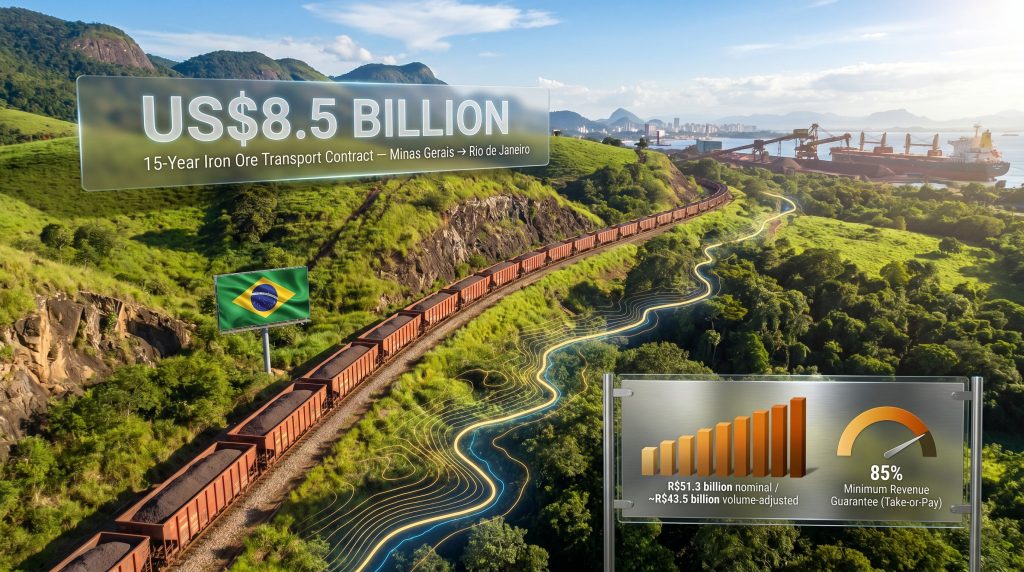
The Vale iron ore transportation contract in Brazil, renewed with MRS Logística for a 15-year term valued at approximately R$51.3 billion (roughly US$8.5 billion at prevailing exchange rates), is one of the largest logistics agreements in Latin American mining history. Its structure, pricing mechanics, and governance framework reveal important truths about how major commodity producers engineer supply chain certainty across multi-decade operational horizons.
When big ASX news breaks, our subscribers know first
The Geography Problem: Why Minas Gerais Cannot Truck Its Way to Market
Brazil's iron ore wealth is geographically inconvenient. The Quadrilátero Ferrífero, or Iron Quadrangle, sits deep in the interior of Minas Gerais state — a mountainous, densely populated region located hundreds of kilometres from the Atlantic coast. The terrain is fundamentally incompatible with road-based bulk freight at export scale. Trucks cannot economically move the tens of millions of tonnes per year required to sustain Brazil's position as a top-tier seaborne supplier.
This creates an absolute dependency on rail. Unlike Australia's iron ore advantages in the Pilbara region, where the geology is relatively flat and private mining companies have built captive rail lines running in near-straight trajectories to coastal ports, Brazil's Southeast mining corridor must traverse complex topography and navigate through one of South America's most densely populated industrial zones.
| Logistics Factor | Brazil (Southeast Corridor) | Australia (Pilbara) |
|---|---|---|
| Primary transport mode | Rail (MRS, EFVM networks) | Rail (private dedicated lines) |
| Terrain complexity | High (mountainous, urban) | Moderate (arid, flat) |
| Port access | Rio de Janeiro, Vitória | Port Hedland, Dampier |
| Key operators | MRS Logística, Vale (EFVM) | BHP, Rio Tinto (captive rail) |
| Approximate distance to port | 400–600 km | 400–500 km |
The practical implication of this geographic reality is that logistics costs structurally weigh more heavily on Brazilian iron ore economics than they do on Australian production. Delivered cost to Chinese steel mills — the dominant pricing reference point in the seaborne market — is consequently a function of how efficiently the Minas Gerais-to-port corridor is managed. Any long-term contract providing cost predictability along this corridor carries direct strategic value.
MRS Logística: More Than a Mining Railway
MRS Logística operates one of Brazil's most commercially complex freight rail networks. Its concession covers the triangular corridor linking Minas Gerais, Rio de Janeiro, and São Paulo — a zone that encompasses not only iron ore flows but also steel products, agricultural commodities, consumer goods, and containerised freight. This multi-commodity character distinguishes MRS from purely captive mining railways and creates a more commercially resilient operating model.
Vale holds an equity stake in MRS Logística, which means the two companies exist in a related-party relationship. This is a structurally significant fact with governance and regulatory implications discussed further below. For now, the operational consequence is that Vale cannot simply treat MRS as an arm's-length service provider — the commercial terms negotiated between them are subject to regulatory scrutiny designed to protect minority shareholders on both sides of the investment structure.
Contract Architecture: Breaking Down the US$8.5 Billion Agreement
The renewed agreement between Vale and MRS Logística covers the transportation of iron ore, iron ore pellets, and related derivative products from Vale's loading terminals in Minas Gerais state to port terminals in Rio de Janeiro state. The contract runs for 15 years from December 1, 2026 through December 31, 2041, taking effect immediately upon the expiry of the preceding agreement on November 30, 2026.
Two financial figures are worth distinguishing carefully:
- R$51.3 billion (~US$8.5 billion): The nominal ceiling value of the contract, representing full-volume utilisation across the entire 15-year term.
- ~R$43.5 billion: An adjusted estimate incorporating volume-flexibility provisions that allow Vale to reduce shipment volumes below the maximum ceiling without triggering the full financial exposure of the take-or-pay minimum.
Pricing under the contract is indexed to an inflation benchmark, preserving real-value alignment over time and protecting both parties from the erosive effects of Brazil's historically volatile inflation environment. Embedded termination penalty provisions also protect MRS's capital recovery position in the event of early contract exit by Vale.
Understanding Take-or-Pay: The 85% Revenue Floor Explained
Take-or-pay clauses are standard in large-scale bulk commodity logistics contracts, but their specific parameters vary considerably across deals. In this agreement, Vale is contractually obligated to ensure MRS receives payment equivalent to at least 85% of the estimated annual revenue derived from the approved annual transport plan, regardless of whether Vale actually ships that volume.
The 85% floor is the critical commercial threshold. It gives MRS the revenue certainty needed to service infrastructure debt, maintain rolling stock, and plan capital expenditure cycles, while preserving Vale with a 15% operational buffer to manage production variability without incurring penalty payments.
This structure is particularly meaningful in the context of Vale's post-Brumadinho operational history. Following the January 2019 dam collapse at Córrego do Feijão, Vale was forced into a significant production curtailment across multiple Minas Gerais operations. Production volumes took several years to recover, and the company has been methodically rebuilding output capacity since. A rigid take-or-pay clause with a higher minimum threshold — say 95% — would have created unsustainable financial exposure during those constrained periods.
The revised contract introduces updated volume-adjustment provisions that provide greater operational flexibility during production downturns compared to the prior agreement. This is, furthermore, a meaningful structural improvement, reflecting a more sophisticated risk-sharing framework between infrastructure operator and commodity producer.
Regulatory Dimensions: CVM Oversight and Related-Party Disclosure
Because Vale holds an equity stake in MRS Logística, every commercial agreement between the two entities must be treated as a related-party transaction under Brazilian corporate governance rules. Disclosure of this contract was made in compliance with requirements administered by the Comissão de Valores Mobiliários (CVM), Brazil's securities regulator — the functional equivalent of the SEC in the United States or ASIC in Australia.
The CVM's related-party framework is designed around a core principle: publicly listed companies must not be used as vehicles for transferring value to affiliated entities through non-commercial pricing or preferential terms. For a contract of this scale, the governance requirements include:
- Arm's-length commercial benchmarking to demonstrate that pricing is consistent with market terms.
- Independent board oversight, typically involving audit committee or related-party committee review.
- Transparent public disclosure to protect minority shareholders from information asymmetry.
- Documentation that contractual terms reflect genuine economic value exchange rather than intra-group wealth transfer.
Vale's dual listing on the B3 exchange in São Paulo and the NYSE in New York means its disclosure obligations extend across two regulatory jurisdictions with different but overlapping transparency requirements. This dual-listed governance structure adds an additional layer of accountability to related-party transactions of this magnitude.
The next major ASX story will hit our subscribers first
Vale's Dual Rail Corridor Strategy: MRS and EFVM
One of the less widely understood aspects of Vale's logistics architecture is that it maintains two structurally distinct rail export corridors operating in parallel from Minas Gerais.
| Rail System | Route | Primary Cargo | Operational Model |
|---|---|---|---|
| MRS Logística network | Minas Gerais → Rio de Janeiro | Iron ore, pellets, steel, mixed freight | Contracted (Vale investee) |
| Estrada de Ferro Vitória a Minas (EFVM) | Minas Gerais → Espírito Santo | Iron ore, general cargo | Fully Vale-owned and operated |
The EFVM, which Vale owns outright, connects the northern Minas Gerais production corridor to the Port of Tubarão near Vitória in Espírito Santo state. Tubarão is one of the world's largest iron ore export terminals by throughput capacity. The MRS corridor, however, serves Vale's southern Minas Gerais operations, including complexes associated with the Itabira and Paraopeba mining systems, routing product to Rio de Janeiro port facilities.
Maintaining contractual certainty on the MRS corridor is therefore not redundant to the EFVM — it is complementary and operationally essential. A disruption or contractual gap on either corridor would constrain Vale's total export capacity in ways that could not be absorbed by the other route alone.
What 15 Years Signals About Vale's Southeast Brazil Commitment
Long-duration contracts in bulk commodity logistics are fundamentally statements of strategic intent. Rail infrastructure, rolling stock, and terminal equipment operate on capital recovery timelines of 10 to 20 years. A carrier cannot justify major infrastructure investment on the basis of short-term or rolling annual agreements. Equally, a shipper will not commit to a 15-year financial obligation unless it has confidence in the underlying production base.
The 2026-to-2041 term consequently carries an implicit message: Vale views its Southeast Brazil iron ore operations as a durable, long-cycle production platform. This is notable given ongoing industry discussion about Vale's portfolio rationalisation, its increasing focus on higher-grade Northern System production from the Carajás region in Pará state, and periodic market speculation about the long-term economics of its older, more complex Southeast System mines.
The 15-year contract renewal effectively signals that Southeast Brazil remains a core production pillar in Vale's medium-to-long term operating plan, not a sunset asset being managed for cash extraction ahead of divestiture. Furthermore, the iron ore demand prospects from Asian markets continue to underpin the commercial rationale for this kind of long-horizon infrastructure commitment.
Iron Ore Quality and the Southeast System's Competitive Position
A factor often overlooked in logistics-focused analysis is the quality dimension of the ore being transported. Vale's Southeast System, which includes operations feeding into the MRS corridor, produces iron ore with grades that have historically required more beneficiation processing than the higher-grade direct-shipping ores from Carajás. Carajás ore typically contains iron content above 65% Fe, while Southeast System production often requires pelletising or sintering processes to achieve grades competitive in Asian steel mill specifications.
This is why pellets and pellet feed are explicitly included in the MRS contract scope. The transportation of processed pellets alongside raw ore reflects the product complexity of Southeast Brazil's output mix. Pellets command a price premium over standard sinter feed on international markets, and their inclusion in the contract's cargo definition adds both revenue complexity and logistical specificity to the arrangement. In addition, China steel and iron ore dynamics remain the primary demand driver shaping how Brazilian producers like Vale optimise their product mix for export.
Infrastructure Investment Implications Along the Minas Gerais Corridor
For MRS Logística, a confirmed 15-year revenue stream anchored by an 85% take-or-pay floor fundamentally changes the investment calculus for corridor upgrades. Capital projects that might otherwise be difficult to justify on shorter contract horizons — including track duplication in congested sections, axle load upgrades to increase payload per wagon, and terminal modernisation at loading and unloading points — become financially viable when secured against a multi-decade revenue commitment of this scale.
Increased throughput capacity along the Minas Gerais-to-Rio de Janeiro corridor would directly support Vale's production growth targets while simultaneously reducing per-unit logistics costs through economies of scale. The broader economic spillover for Brazil's logistics sector is also meaningful, given that MRS's network serves multiple industries beyond mining. For context on how iron ore tariff impacts can reshape cost structures across global supply chains, the Brazilian case offers a particularly instructive parallel.
It is also worth noting that Vale's low-carbon initiatives are increasingly shaping infrastructure decisions, as the company seeks to align its logistics framework with broader decarbonisation commitments over this extended contract horizon.
Key Contract Metrics at a Glance
| Metric | Detail |
|---|---|
| Contract value (nominal) | R$51.3 billion (~US$8.5 billion) |
| Volume-adjusted estimate | ~R$43.5 billion |
| Contract term | 15 years: December 1, 2026 – December 31, 2041 |
| Counterparty | MRS Logística (Vale equity investee) |
| Cargo covered | Iron ore, pellets, and derivative products |
| Route | Minas Gerais loading terminals → Rio de Janeiro port terminals |
| Minimum revenue guarantee | 85% of approved annual transport plan revenue |
| Pricing mechanism | Inflation-indexed |
| Regulatory classification | Related-party transaction (CVM-compliant disclosure) |
| Exit protection | Compensatory termination payment in favour of MRS |
Frequently Asked Questions
What is the total value of Vale's iron ore transport contract with MRS Logística?
The renewed agreement carries a nominal value of approximately R$51.3 billion (around US$8.5 billion), with an adjusted volume-flexibility estimate of roughly R$43.5 billion across the 15-year term running from December 2026 to December 2041.
What does the take-or-pay clause require Vale to pay?
Vale must ensure MRS receives at least 85% of the estimated annual revenue from the approved transport plan each year, regardless of whether that volume is actually shipped. The remaining 15% represents Vale's operational buffer for managing production variability.
Why is this a related-party transaction?
Vale holds an equity stake in MRS Logística, making any commercial agreement between them a related-party transaction under Brazilian law. The deal was disclosed in accordance with CVM regulations to protect minority shareholders and ensure arm's-length commercial terms.
How does the MRS contract differ from Vale's EFVM operations?
The EFVM is fully owned and operated by Vale, routing iron ore from northern Minas Gerais to the Port of Tubarão in Espírito Santo. The MRS network is a separate, third-party concessionaire handling Vale's southern Minas Gerais output toward Rio de Janeiro port terminals. The two corridors are complementary, not interchangeable. Understanding the broader iron ore market types and deposit structures helps clarify why these corridors serve fundamentally different production systems.
When does the new contract begin?
The renewed agreement takes effect December 1, 2026, immediately following the expiry of the prior contract on November 30, 2026, ensuring no operational gap in logistics continuity.
Disclaimer: This article is intended for informational purposes only and does not constitute financial or investment advice. Financial figures referenced involve currency conversions based on prevailing exchange rates at time of reporting and are subject to fluctuation. Forward-looking statements regarding production targets and infrastructure investment involve uncertainty and should not be relied upon as guarantees of future outcomes.
Want to Know Which ASX Mineral Discoveries Could Deliver Exceptional Returns?
Discovery Alert's proprietary Discovery IQ model scans ASX announcements in real time, instantly identifying significant mineral discoveries and turning complex data into actionable investment insights — visit the Discovery Alert discoveries page to explore historic examples of major discovery returns, and begin your 14-day free trial to position yourself ahead of the broader market.