June 15, 2026
The Quiet Metal Powering the Modern World
Few materials sit at the intersection of ancient industry and cutting-edge technology quite like tin. While lithium and cobalt absorb the majority of critical raw materials transition discourse, tin has been quietly threading its way through the architectures of smartphones, solar panels, electric vehicles, and semiconductor chips for decades. Its melting point of just 231.93°C, combined with outstanding electrical conductivity and natural oxidation resistance, makes it the material of choice for the solder joints that hold modern electronics together. There is, quite literally, no smartphone without tin.
Yet the geography of global tin supply tells a precarious story. Roughly 55% of annual mine production originates from a handful of Southeast Asian and South American nations, leaving European manufacturers exposed to a supply chain that spans thousands of kilometres and crosses multiple geopolitical fault lines. When a Myanmar mine closes unexpectedly or a Suez Canal blockage disrupts shipping routes, European electronics factories feel the tremors within weeks.
It is precisely this vulnerability that has placed the South Crofty Cornish tin project back into serious strategic conversation, and why Cornish Metals' efforts to restart one of Europe's most historically significant underground tin mines are being watched well beyond the borders of Cornwall.
When big ASX news breaks, our subscribers know first
Why Tin Matters More Than Most Investors Realise
The Supply Chain Mathematics of Modern Electronics
The European Union currently imports approximately 97% of its tin requirements, with the UK facing similarly concentrated import dependency. This is not simply a cost-of-goods issue. It is a structural vulnerability that European policymakers have been slow to quantify but are now urgently addressing.
Tin consumption across European electronics manufacturing sits at roughly 35,000 tonnes annually, representing close to 12% of global demand. The semiconductor sector alone accounts for nearly half of that figure. Crucially, the European Commission's Joint Research Centre has assigned tin a supply risk rating of 9.4 out of 10, placing it among the most critically exposed materials in the EU's industrial base.
What makes this particularly acute is tin's limited substitutability. In high-reliability solder applications used across aerospace, medical devices, and semiconductor packaging, there are currently no commercially viable alternative materials. Tin-based intermetallic compounds form the molecular bond between silicon dies and package substrates in integrated circuits. Replacing this chemistry would require fundamental redesigns across entire product families.
Furthermore, global tin supply risks such as unexpected mine closures in Africa and Asia have repeatedly demonstrated just how fragile existing supply chains can be, intensifying the strategic case for domestic European production.
The strategic importance of tin has been systematically underestimated in critical mineral discussions that focus almost exclusively on lithium, cobalt, and rare earth elements. Its role in semiconductor packaging and high-reliability electronics makes it structurally irreplaceable in modern supply chains.
Tin's Expanding Role in the Energy Transition
Beyond traditional electronics, tin is accumulating new demand vectors across clean energy technologies:
- Photovoltaic manufacturing: Indium tin oxide (ITO) serves as the transparent conductive front contact layer in thin-film solar cells, with no current commercial substitute offering equivalent optical transparency and conductivity
- EV battery connections: Tin-based solders form the critical electrical interconnects within battery management systems and power electronics
- Next-generation batteries: Research into sodium-ion battery technology has identified tin as a promising anode material with a theoretical capacity of 847 mAh/g, significantly exceeding conventional graphite anodes
- Grid storage applications: Lithium-titanate batteries deployed for grid stability use tin components where long cycle life takes priority over energy density
European tin consumption is projected to grow to approximately 45,000 tonnes annually by 2035, representing a compound annual growth rate of 2.8%. This trajectory makes the absence of domestic primary tin production an increasingly uncomfortable policy position, particularly as the broader critical raw materials transition accelerates across European industry.
What Is the South Crofty Cornish Tin Project?
Cornwall's Geological Legacy and Strategic Geography
Tin extraction in Cornwall traces back approximately 4,300 years, making it one of the longest continuously exploited mineral districts in the world. The region's geology is anchored by the Cornubian Batholith, a series of granitic intrusions that formed approximately 300 million years ago during the Variscan orogeny. As superheated hydrothermal fluids migrated through fractures in this granite, they deposited extraordinarily high concentrations of cassiterite, the primary tin oxide mineral, in veins and lodes that cut through the surrounding metamorphic rock.
This geological setting is not incidental to South Crofty's economics. It explains why Cornwall consistently produces tin ore at grades that exceed those found in most modern operating mines, which increasingly rely on lower-grade, bulk-tonnage deposits to remain viable.
South Crofty itself sits near Pool, in the borough of Camborne-Redruth, and operated intermittently across several centuries before its most recent closure in 1998. That closure was driven by a combination of historically depressed tin prices following the collapse of the International Tin Agreement in 1985, and the high operating costs associated with deep underground mining at the time. Critically, the closure was not geological, meaning the deposit itself remained intact and largely unworked.
South Crofty at a Glance
| Project Metric | Detail |
|---|---|
| Location | Pool, Camborne-Redruth, Cornwall, UK |
| Mine Type | Underground hard-rock |
| Total Resource | ~2.85 million tonnes at 1.72% tin equivalent |
| Total Tin in Concentrate (Life of Mine) | ~49,000 tonnes |
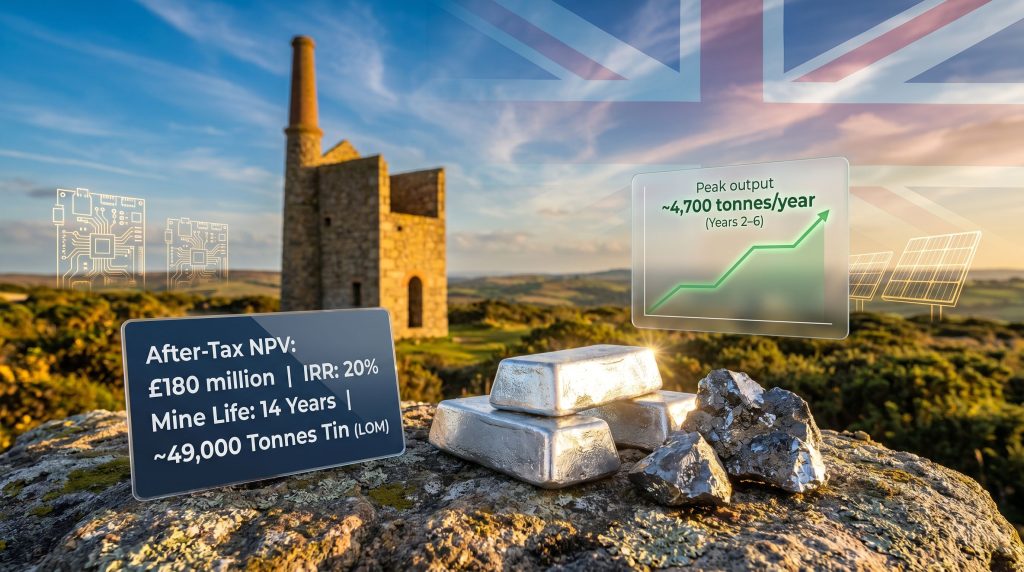
| Peak Annual Production (Years 2-6) | ~4,700 tonnes per year |
| Projected Mine Life | 14 years |
| Pre-Production Capital Cost | ~£198 million |
| After-Tax NPV | £180 million |
| Internal Rate of Return | 20% |
| Life-of-Mine Operating Cost | ~$18,500 per tonne of tin |
| Processing Plant Capacity | 250,000 tonnes per annum |
| Target Tin Recovery Rate | 75% |
| Mining Licence Validity | Until 2071 |
| Direct Employment | 300+ jobs |
| Indirect Employment | Up to 1,000 jobs |
Featured Snippet: South Crofty is projected to produce approximately 4,700 tonnes of tin in concentrate per year during peak production, with a 14-year mine life and total life-of-mine output of around 49,000 tonnes of tin metal.
What Makes South Crofty One of the Highest-Grade Tin Projects Globally?
Grade Advantage: The Core Economic Driver
In hard-rock mining, ore grade is the single most powerful determinant of unit economics. Every tonne of rock that must be extracted, hoisted, crushed, and processed to recover one tonne of metal represents a fixed cost commitment. Higher grades reduce the volume of rock required to produce the same metal output, directly compressing both capital requirements and operating costs per unit.
South Crofty's resource estimate of 1.72% tin equivalent positions it at the high end of the global tin grade spectrum. For comparison, most large-scale producing tin mines in Indonesia and Bolivia operate at grades below 0.5% tin, requiring significantly higher throughput volumes to achieve equivalent metal production. This grade differential is not marginal. It is the primary basis on which Cornish Metals characterises South Crofty as a potential low-cost global producer despite the higher labour and infrastructure costs associated with a UK operating environment.
Underground Mining Design and Surface Impact
The project is designed exclusively as an underground operation, a deliberate choice that carries both practical and social dimensions. Underground mining at depth limits surface disturbance to shaft collars, ventilation infrastructure, and processing facilities, preserving the agricultural and heritage landscape that surrounds the site.
The processing plant is designed to handle 250,000 tonnes of ore per annum, with all generated waste rock planned for underground backfilling as part of a zero surface waste strategy. This approach eliminates the surface tailings storage facilities that represent one of the most significant environmental and social flashpoints in modern mining globally.
The underground mine workings extend to depths of up to 1,000 metres below surface, which introduces particular technical challenges. At these depths, rock temperatures, water pressure, and seismic considerations all intensify, requiring specialist engineering solutions that add to capital costs but also contribute to the project's grade advantage by accessing the highest-quality mineralisation zones.
Permitting Status: The Rarest Competitive Advantage
Perhaps the most underappreciated aspect of the South Crofty Cornish tin project is its permitting position. South Crofty holds a fully granted mining licence valid until 2071, alongside existing approvals covering:
- Underground mining operations
- Mine dewatering and water treatment
- Construction and operation of a new processing plant
- Associated infrastructure development
In a European regulatory environment where new mining projects routinely require a decade or more to navigate environmental assessments, community consultation processes, and multi-agency approvals, this pre-approved status represents a material de-risking factor that simply cannot be replicated by competing development projects. The permitting pathway has already been successfully navigated, which compares favourably even against other European tin development initiatives that remain years behind in their regulatory journeys.
How Do the Project Economics Stack Up?
Decoding the Financial Architecture
The economic case for South Crofty rests on three interlocking variables: tin price assumptions, capital deployment efficiency, and operating cost management. Current study-level metrics indicate:
- After-tax NPV of £180 million, reflecting the discounted present value of projected future cash flows over the 14-year mine life
- 20% internal rate of return, the threshold generally regarded by institutional project finance lenders as the minimum acceptable return for greenfield underground mining
- £198 million pre-production capital, covering mine dewatering, shaft rehabilitation, underground development, and new processing plant construction
- ~$18,500 per tonne life-of-mine operating cost, competitive against global benchmarks given the grade advantage
The £198 million capital figure, while substantial, is not unusual for a permitted deep underground mine requiring complete dewatering of flooded workings, shaft rehabilitation, and purpose-built surface processing infrastructure. A thorough definitive feasibility study will ultimately validate or refine these estimates as the project advances through its development stages.
Scenario Analysis: Variables That Could Reshape the Economics
| Scenario | Variable | Directional Impact |
|---|---|---|
| Tin price above $35,000/t sustained | Commodity upside | Significant NPV expansion; IRR potentially above 25% |
| Construction or dewatering delays | Timeline risk | Capital cost escalation and NPV erosion |
| Financing secured at favourable terms | Cost of capital | Improved equity returns and reduced dilution |
| Ore grades exceed resource estimate | Resource upside | Extended mine life or increased annual production |
| Energy cost inflation in UK market | Operating cost pressure | Margin compression in early production years |
| New Cornish lithium-tin mineralisation identified | Exploration optionality | Potential resource upgrade and mine life extension |
Investor Note: The 20% IRR threshold sits at the minimum acceptable level for most institutional project finance mandates in hard-rock mining. South Crofty's study-level economics sit precisely at this threshold, meaning both execution risk management and commodity price trajectory will be subject to intensive scrutiny by any prospective capital provider.
Key Technical and Operational Challenges
Mine Dewatering: The Critical Path to Production
South Crofty's underground workings have been completely flooded since the 1998 closure, making dewatering the absolute prerequisite for any subsequent underground activity. This is not a straightforward pumping exercise.
The dewatering programme must manage an estimated 1,200 cubic metres of water per hour in the initial phase, water that carries elevated concentrations of arsenic, heavy metals, and acid compounds naturally leached from the host rock over nearly three decades of flooding. Regulatory compliance requires treatment infrastructure capable of reducing these contaminants to acceptable discharge standards before any water enters Cornwall's waterways or coastal environment.
The dewatering programme is permitted, which removes the regulatory uncertainty. However, its execution timeline is the critical path item that determines when underground development drilling can commence, which in turn determines when first production can be achieved. Any deviation from schedule in this phase cascades directly through the entire project timeline and capital cost estimate.
Processing Plant and Metallurgical Complexity
The mineralogical character of South Crofty ore adds layers of complexity to processing plant design. Cassiterite, the primary tin mineral, requires careful liberation through controlled grinding before gravity and flotation circuits can achieve target recovery rates. The target recovery of 75% tin represents a technically demanding specification given the natural grade variability expected across different ore zones.
In addition, improving recovery rates is an area where strategic collaboration can prove decisive. The innovative tin recovery partnership model being explored elsewhere in European tin development demonstrates how processing arrangements can be structured to optimise metallurgical outcomes. Historical Cornish tin ore also contains associated minerals including arsenic-bearing arsenopyrite, copper sulphides, and tungsten minerals, and the processing flowsheet must account for these co-contaminants both to achieve concentrate quality specifications and to manage the arsenic-bearing waste streams that are a regulatory priority throughout the mine's operational life.
Workforce Development in an Atrophied Skills Market
One of the least-discussed but practically significant challenges facing South Crofty is workforce availability. Underground hard-rock mining skills have largely disappeared from Cornwall over the nearly three decades since closure. The specialised competencies required for deep underground tin mining, including raise boring, long-hole stoping, paste backfill operations, and underground equipment maintenance, must be rebuilt from a very low base.
The project's target of 300 direct employees will require a dual strategy: structured training and career pathway development for local Cornish workers, combined with attraction of experienced underground mining professionals from other jurisdictions. The cost and timeline of building this workforce capability represents a non-trivial operational risk that project financiers will factor into their assessments.
The next major ASX story will hit our subscribers first
ESG Positioning and the UNESCO Heritage Dimension
Environmental Design Philosophy
The South Crofty Cornish tin project's environmental framework is built around three core commitments:
- Underground-only mining with no open-cut disturbance to the surrounding landscape
- Zero surface waste through underground paste backfill of all processed tailings
- Mine water treatment meeting environmental discharge standards for Cornwall's sensitive waterway and coastal ecosystems
The paste backfill approach, where processed tailings are mixed with cement binder and pumped back underground to fill excavated voids, serves dual purposes. It eliminates surface tailings storage while also providing ground support for underground workings, improving geotechnical stability and reducing surface subsidence risk.
Operating Within a UNESCO World Heritage Site
South Crofty sits within the Cornwall and West Devon Mining Landscape, a UNESCO World Heritage Site recognised for its exceptional industrial heritage significance. This designation imposes obligations on surface design and visual impact management that go beyond conventional planning requirements.
Every element of surface infrastructure, from headframes and processing buildings to access roads and service buildings, must be designed in consultation with heritage authorities to minimise visual intrusion and respect the character of the surrounding landscape. This constraint adds complexity and cost to surface design but also aligns Cornish Metals' project with a powerful narrative of heritage continuity rather than industrial imposition.
The World Heritage context also provides a genuine differentiator in responsible sourcing discussions. A tin mine operating within a UNESCO site, under UK regulatory standards, with full traceability from ore to concentrate, can credibly position its product as among the most transparently sourced tin available in the global market. This characteristic carries growing commercial value as European manufacturers respond to increasingly stringent supply chain due diligence requirements.
Strategic Scenarios: Three Futures for South Crofty
Scenario 1: Cornerstone of UK Critical Mineral Supply
In this scenario, South Crofty achieves production and establishes itself as the only operating primary tin mine in the UK, supplying concentrate to European smelters and end users seeking traceable, responsibly sourced British tin. The project would demonstrate that high-grade underground tin mining is economically viable under modern UK operating conditions, creating a template for similar heritage mining revivals across Europe's dormant mineral districts in Portugal, Germany, and Scandinavia.
Scenario 2: Catalyst for Cornish Economic Regeneration
Cornwall has experienced sustained economic underperformance relative to UK national averages since the collapse of its mining and industrial base in the late 20th century. A producing South Crofty would represent one of the largest private sector employment operations in the region, with 300 direct jobs and up to 1,000 indirect positions in supply chain, professional services, and community infrastructure. The project's heritage dimension, reconnecting Cornwall with an industrial identity that stretches back millennia, carries cultural and political dimensions that are difficult to quantify but genuinely significant.
Scenario 3: Proof-of-Concept for European Hard-Rock Mining Revival
The third and perhaps most strategically consequential scenario positions South Crofty's success as a signal to policymakers, investors, and mining developers across Europe that domestic hard-rock critical mineral production can compete under modern ESG standards. Several European nations are reassessing their hard-rock mining potential, and a successfully restarted South Crofty would provide concrete evidence that ancient mining districts can be responsibly and economically revived to serve 21st-century supply chain needs.
Frequently Asked Questions: South Crofty Tin Project
When Did South Crofty Last Operate?
South Crofty ceased production in 1998, ending continuous large-scale tin mining in Cornwall after a collapse in global tin prices made deep underground operations economically unviable at the time.
Who Is Developing South Crofty?
The project is owned and being advanced by Cornish Metals, a mining company focused on the responsible redevelopment of South Crofty as a modern underground tin operation. You can find comprehensive project detail via the official South Crofty project page on the Cornish Metals website.
How Long Has Cornwall Produced Tin?
Archaeological evidence suggests tin extraction in the Cornwall region dates back approximately 4,300 years, to around 2,300 BC, making it one of the world's longest-running mineral production regions.
What Will South Crofty Produce?
The project is designed to produce approximately 4,700 tonnes of tin in concentrate per year during peak production, with a total life-of-mine output of around 49,000 tonnes over 14 years.
What Will It Cost to Restart South Crofty?
Pre-production capital expenditure is estimated at approximately £198 million, covering dewatering, shaft rehabilitation, underground development, and new processing plant construction.
What Are South Crofty's Economics?
At study-level assumptions, the project carries an after-tax NPV of £180 million and an IRR of 20%, with life-of-mine operating costs of approximately $18,500 per tonne of tin produced.
What Is the Mining Licence Status?
South Crofty holds a fully granted mining licence valid until 2071, alongside permits for underground mining operations, mine dewatering, and a new processing facility, representing one of the most advanced permitting positions of any development-stage tin project globally.
The Outlook: What Has to Go Right
The path from permitted development project to producing mine at South Crofty requires the successful execution of several interdependent workstreams:
- Completing mine dewatering on schedule and within budget, establishing the critical path to underground access
- Securing project financing at terms consistent with the modelled 20% IRR, in a capital market that scrutinises junior mining development projects with increasing rigour
- Maintaining tin prices at levels that support project economics throughout the construction and early production phases
- Delivering processing plant construction without material cost overruns in an inflationary construction environment
- Building a skilled underground workforce in a region where specialist hard-rock mining competencies have been largely dormant for nearly three decades
- Managing environmental compliance obligations, particularly around mine water treatment and UNESCO heritage site requirements, throughout the construction period
South Crofty's competitive position rests not on scale but on convergence: a grade profile that sits at the high end of the global tin universe, a permitting position that removes years of regulatory uncertainty, a strategic location within a supply-chain-anxious Europe, and a heritage narrative that generates the kind of community and political support that most greenfield mining projects in the developed world simply cannot replicate.
Whether the South Crofty Cornish tin project ultimately delivers on its strategic promise will depend on execution discipline, tin market conditions, and the ability to attract the financing and talent required to bring a flooded historic mine back to life as a modern, responsible operation. What is already clear is that in a world growing increasingly anxious about where its critical minerals come from and how they are produced, few projects anywhere in Europe can claim as compelling a combination of ore quality, regulatory standing, and strategic relevance. For further context on recent operational developments, the London Stock Exchange operations update provides additional detail on Cornish Metals' progress to date.
This article contains forward-looking statements, projections, and economic modelling figures that are subject to material risks and uncertainties. Project economics, timelines, and production estimates are based on study-level assumptions and may differ materially from actual outcomes. Readers should conduct their own due diligence and seek independent financial advice before making investment decisions. References to analyst commentary and expert opinion are included for contextual purposes only.
Want to Stay Ahead of the Next Major Mineral Discovery?
Discovery Alert's proprietary Discovery IQ model scans ASX announcements in real time, instantly identifying high-potential mineral discoveries across tin and more than 30 other commodities — turning complex data into actionable investment insights before the broader market reacts. Explore how historic discoveries have generated substantial returns on Discovery Alert's dedicated discoveries page, and begin your 14-day free trial today to secure a market-leading edge.