August 22, 2026
Regional energy transition dynamics are fundamentally reshaping global commodity flows as major economies accelerate their decarbonization pathways. The strategic timing of these transformations across different national contexts creates cascading effects throughout international energy markets, particularly affecting traditional fossil fuel suppliers who must navigate rapidly evolving demand patterns. Understanding these complex interactions requires analyzing multiple scenario pathways rather than following linear projections.
What Does South Korea's 2040 Coal Exit Strategy Actually Mean for Energy Security?
South Korea quitting coal represents one of Asia's most aggressive energy transition timelines, with profound implications for regional grid stability and global commodity markets. The scale of this transformation extends far beyond simple plant closures, encompassing fundamental restructuring of the nation's electricity generation portfolio.
Deconstructing the 40-Plant Closure Timeline
The Korean government has committed to retiring 40 confirmed coal plants by 2040, with an additional 21 facilities under review for potential closure. This represents approximately 40GW of generation capacity that must be replaced through alternative sources. Currently, coal provides 30% of South Korea's electricity generation, making this transition one of the largest single-country capacity replacements in modern energy history.
Furthermore, the retirement schedule creates significant interim challenges for grid operators. Unlike gradual capacity reductions, the concentrated timeline requires simultaneous development of replacement infrastructure while maintaining system reliability. Regional grid stability during transition phases will depend heavily on carefully coordinated sequencing between plant closures and new capacity commissioning.
Grid infrastructure modernisation requirements include:
- Advanced forecasting systems for renewable generation patterns
- Battery storage infrastructure to manage variable output
- Demand-response mechanisms for balancing capacity retirement
- Potential regional interconnection with China and Japan for stability support
The Nuclear-Renewable Pivot Strategy
South Korea's energy security strategy centres on expanding nuclear baseload capacity while dramatically scaling renewable generation. The nation currently operates approximately 33% nuclear capacity, positioning it to maintain consistent generation during the coal transition period.
In addition, offshore wind expansion represents a critical component, with targets to increase capacity from the current 400MW to 4GW, representing approximately 10-fold growth. This ambitious scaling requires substantial grid integration infrastructure to accommodate variable generation patterns.
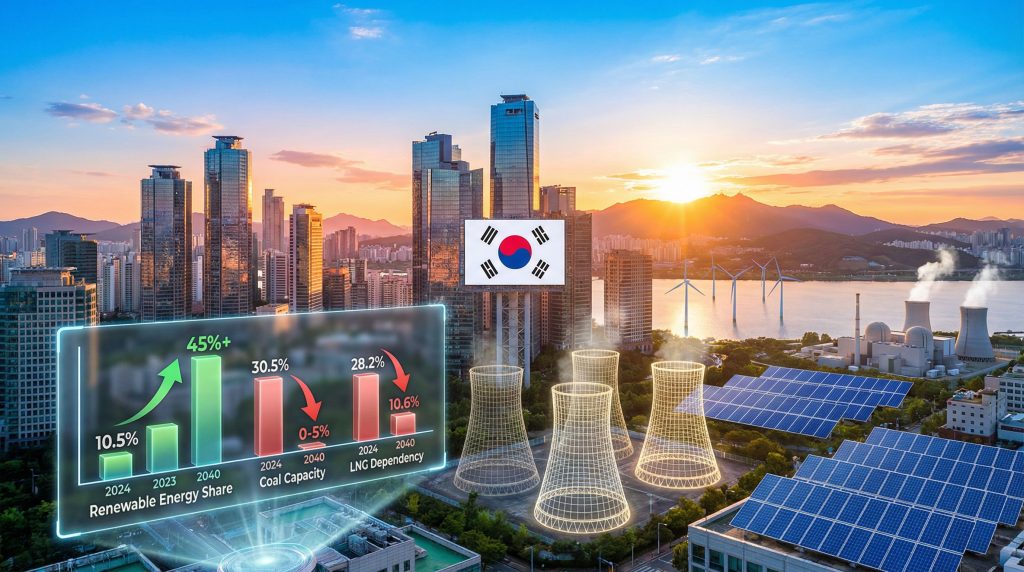
The renewable energy trajectory aims to increase from the current 10.5% to 35%+ by 2035, ultimately reaching 45%+ by 2040. Comparative analysis reveals significant catching-up potential, as Japan generates approximately double South Korea's current renewable energy despite having an economy only twice the size.
Nuclear power's expanded role provides the foundation for reliable baseload replacement during transition periods. This combination of nuclear stability and renewable growth creates a framework for maintaining energy security while achieving decarbonisation targets. Moreover, these developments align with broader energy transition and security considerations across the region.
When big ASX news breaks, our subscribers know first
Why Are Australia's Coal Export Revenues Facing a $750 Million Annual Hit?
Australia's position as the world's second-largest coal exporter makes it particularly vulnerable to South Korea's energy transition. Current thermal coal exports to South Korea generate $1.5 billion annually, representing significant revenue exposure as Korean demand systematically declines.
Thermal Coal Trade Flow Disruption Analysis
James Bowen, Director of ReMap Research consultancy, projects that Australian coal exports could decline by 50% in value over the next five years. Applied to the current $1.5 billion South Korean market, this translates to approximately $750 million in annual revenue losses for Australian exporters.
The disruption extends beyond direct bilateral trade impacts. South Korea ranks as the fourth-largest thermal coal importer globally, behind China, India, and Japan. However, these alternative markets face their own coal supply challenges, limiting absorption capacity for displaced Australian exports.
Market rebalancing scenarios include:
- Indonesian coal competing for remaining Asian demand
- Chinese market access restrictions limiting Australian alternatives
- Indian renewable energy scaling reducing long-term coal imports
- Japanese decarbonisation commitments constraining future demand
Metallurgical Coal Market Resilience Factors
Australia maintains its position as the planet's largest metallurgical coal exporter by far, providing some insulation from thermal coal demand declines. Steel industry requirements for metallurgical coal show greater sustainability than power generation demand, as industrial steel production maintains steady global demand patterns.
South Korea's continued metallurgical coal requirements for steel manufacturing suggest differentiated impact between thermal and metallurgical segments. This distinction becomes critical for Australian producers with diversified coal portfolios, as industrial demand proves more resilient to energy transition pressures than power generation applications.
The economic fundamentals underlying coal's structural decline reflect broader cost competitiveness shifts. Studies indicate 99% of US coal plants are more expensive to operate than replacing them with clean energy alternatives, demonstrating the economic drivers accelerating global coal phase-outs beyond environmental considerations alone. These dynamics significantly impact Australia's export challenges across multiple commodity sectors.
How Will the US LNG Export Boom Navigate South Korea's Gas Reduction Targets?
The United States faces a strategic paradox in its energy relationship with South Korea, as escalating LNG export commitments conflict with Korean decarbonisation timelines. This tension illustrates broader challenges in aligning short-term trade agreements with long-term climate objectives.
The $100 Billion LNG Purchase Agreement Paradox
Negotiations for South Korean energy purchases include commitments to $100 billion in total US energy products, with discussions covering 3-9 million tons of LNG annually. These volumes represent substantial long-term import commitments that must be reconciled with Korean energy transition goals.
The timeline conflict becomes apparent when comparing trade commitments with decarbonisation targets. However, South Korea aims to reduce LNG dependency from the current 28.2% to 10.6% by 2038, representing an 18 percentage point reduction in natural gas's role in electricity generation.
This strategic contradiction reflects broader tensions between:
- Tariff avoidance through increased energy purchases
- Climate commitments requiring reduced fossil fuel consumption
- Long-term contract obligations versus flexible transition pathways
- Economic diplomacy priorities conflicting with environmental goals
Strategic LNG Market Rebalancing Scenarios
US LNG export infrastructure development depends on reliable long-term demand projections, making Korean reduction commitments particularly challenging for American producers. Alternative Asian market destinations provide potential absorption capacity, but regional LNG demand patterns show similar decarbonisation pressures.
For instance, China's LNG imports experienced recent rebounds after prolonged slumps, indicating market volatility that complicates long-term planning. India represents growing LNG demand, but domestic renewable energy scaling may limit future growth trajectories. These dynamics are explored further in our analysis of the US natural gas outlook.
Price competitiveness factors in regional LNG trade include:
- Henry Hub futures plus transportation and liquefaction costs
- Asian spot market pricing creating competitive dynamics
- Long-term contracts providing stability versus spot market exposure
- Methane emissions concerns affecting LNG's climate profile
Infrastructure investment implications for US export terminals require careful demand scenario planning as major Asian importers simultaneously pursue gas reduction strategies. These developments create significant LNG market implications for global suppliers.
What Economic Forces Are Actually Driving Seoul's Coal Abandonment?
Economic competitiveness rather than environmental regulation primarily drives South Korea quitting coal strategy. The fundamental shift in energy cost structures makes renewable alternatives increasingly attractive for maintaining industrial competitiveness in global markets.
Levelised Cost of Energy (LCOE) Transformation
Kim Sung-hwan, South Korea's Minister of Climate, Energy and Environment, emphasised that transitioning from coal to renewables will increase energy security by reducing foreign import dependency and boost competitiveness of South Korean businesses through cheaper energy costs.
The economic foundation for this strategy reflects broader global trends. Research indicates 99% of US coal plants cost more to operate than replacing them with clean energy alternatives, demonstrating structural shifts in energy economics that extend beyond temporary market conditions.
LCOE advantages for renewables include:
- Declining equipment costs for solar panels and wind turbines
- Lower operational costs compared to fuel procurement and maintenance
- Improved financing terms for renewable projects due to policy support
- Fixed cost structures providing price stability over project lifetimes
Industrial Competitiveness Through Cheaper Energy
South Korea's heavy industry sectors, including steel, chemicals, and semiconductors, show particular sensitivity to energy cost structures. Manufacturing competitiveness gains from renewable energy pricing provide measurable advantages in export markets, especially when competing with similarly energy-intensive production from China.
Energy cost optimisation opportunities include:
- 1-2% improvement in energy costs providing competitive advantages
- Reduced exposure to volatile fossil fuel pricing
- Lower long-term energy price projections for renewables
- Air quality improvements reducing healthcare-related external costs
The strategic recognition that coal phase-out represents economic opportunity rather than environmental burden distinguishes South Korea's approach from purely regulatory mandates. This economic foundation provides stronger political sustainability for long-term transition commitments.
Which Countries Will Follow South Korea's Coal Phase-Out Model?
South Korea quitting coal positions the nation as the second Asian member after Singapore in the Powering Past Coal Alliance, creating demonstration effects across Northeast Asia. According to Powering Past Coal Alliance, the alliance includes approximately 60 countries and 120 sub-national governments, businesses, and organisations committed to fossil fuel phase-outs.
Powering Past Coal Alliance Expansion Dynamics
Regional leadership through early coal phase-out commitments provides South Korea with enhanced diplomatic positioning in international climate negotiations. Technology transfer opportunities in clean energy sectors create additional economic incentives beyond domestic energy security benefits.
China's unofficial participation in alliance discussions suggests potential future commitments, though formal membership remains pending. Chinese coal plant closure plans over 5-10 year horizons indicate structural demand decline even without formal alliance participation.
Demonstration effects across Northeast Asia include:
- Enhanced negotiating positions in climate agreements
- Technology development collaboration opportunities
- Regional energy security improvements through reduced import dependency
- Shifting trade relationships with traditional fossil fuel exporters
Global Coal Demand Structural Decline Indicators
Sam Evans, energy analyst and video blogger, warned of systemic market collapse: "South Korea's ambitious goals demonstrate that coal demand will continue falling, with similar commitments from China regarding coal plant shutdowns over 5-10 years, creating a tsunami effect for global coal markets with widespread company bankruptcies".
India's renewable energy scaling provides another major demand reduction signal, as the world's third-largest coal importer pursues domestic clean energy development. Indonesia faces domestic energy transition pressures despite its position as the world's largest coal exporter.
The convergence of economic competitiveness and climate policy across major Asian economies suggests accelerating global coal demand decline rather than gradual transition scenarios. Environmental advocates have noted that South Korea's coal phase-out pledge requires faster action to align with climate leadership expectations.
How Will Energy Transition Financing Shape South Korea's 2040 Timeline?
Infrastructure investment requirements for South Korea's energy transition extend far beyond simple plant replacements, encompassing comprehensive grid modernisation, renewable energy development, and workforce transition programmes.
Infrastructure Investment Requirements
Grid modernisation costs for renewable integration represent the largest single investment category. Accommodating 35-45% renewable generation by 2035-2040 requires advanced grid management systems, energy storage infrastructure, and demand response capabilities.
Offshore wind development capital allocation must support the 10-fold capacity expansion from 400MW to 4GW. This scaling requires:
- Specialised marine construction capabilities
- Grid connection infrastructure for offshore generation
- Port facilities for turbine assembly and maintenance
- Transmission capacity for connecting remote generation sites
Nuclear facility expansion and maintenance funding provides baseload support during the transition period. While nuclear capacity increases moderately, maintaining existing facilities and potentially expanding capacity requires substantial ongoing investment.
Stranded Asset Risk Management
Coal plant early retirement compensation mechanisms must address facility owners' financial losses from premature closure. The 40 confirmed plant retirements represent significant stranded asset values requiring government intervention or market-based solutions.
Worker transition and retraining programmes address employment impacts in coal-dependent regions. Regional economic impact mitigation strategies become essential for maintaining political support throughout the extended transition timeline.
Financing mechanisms include:
- Green bonds for renewable infrastructure development
- Just transition funds for affected communities
- Public-private partnerships for grid modernisation
- International climate finance for technology deployment
The next major ASX story will hit our subscribers first
What Are the Geopolitical Implications of Asia's Coal Retreat?
South Korea quitting coal contributes to fundamental realignment of regional energy security dynamics, as Northeast Asian economies reduce fossil fuel import vulnerability through domestic renewable development.
Regional Energy Security Realignment
Reduced fossil fuel import dependency across Northeast Asia strengthens collective energy independence. South Korea's transition, combined with similar movements in Japan and China's renewable energy expansion, creates regional energy security improvements that extend beyond individual national benefits.
Enhanced energy independence through domestic renewables reduces exposure to global fossil fuel price volatility and supply chain disruptions. This transition provides strategic advantages during geopolitical tensions affecting traditional energy supply routes.
Regional collaboration opportunities include:
- Grid interconnection projects for renewable energy sharing
- Technology development partnerships in clean energy sectors
- Coordinated approach to traditional energy supplier relationships
- Collective negotiating strength in international climate agreements
Climate Leadership Positioning in Global Forums
Early decarbonisation leadership provides South Korea with enhanced diplomatic influence in international climate negotiations. As the second Asian member of the Powering Past Coal Alliance, South Korea demonstrates regional leadership that extends beyond economic considerations to strategic positioning.
Technology transfer opportunities in clean energy sectors create economic incentives aligned with climate leadership. South Korean companies can leverage domestic energy transition experience to capture export opportunities in renewable energy technologies and grid modernisation services.
Diplomatic advantages include:
- Enhanced credibility in climate negotiations
- Leadership positioning in Asian regional cooperation
- Technology export opportunities in clean energy sectors
- Reduced vulnerability to fossil fuel supply chain manipulation
Key Takeaways: Strategic Scenarios for Global Energy Markets
Timeline Summary and Critical Milestones
| Year | Coal Capacity | Renewable Share | LNG Dependency |
|---|---|---|---|
| 2024 | 30.5% | 10.5% | 28.2% |
| 2035 | 15-20% | 35%+ | 15-20% |
| 2040 | 0-5% | 45%+ | 10.6% |
South Korea's transition timeline represents one of the most aggressive coal phase-out schedules among major industrial economies. The 40 confirmed plant retirements by 2040 require coordinated infrastructure development to maintain grid stability throughout the transition period.
Critical milestones include offshore wind capacity expansion from 400MW to 4GW, renewable energy scaling from 10.5% to 45%+, and LNG dependency reduction from 28.2% to 10.6%. These simultaneous transitions create complex implementation challenges requiring careful sequencing and substantial capital investment.
Investment Implications and Market Opportunities
Clean energy infrastructure development priorities focus on grid modernisation, offshore wind development, and energy storage deployment. The scale of required investment creates significant opportunities for technology providers, construction companies, and financial institutions specialising in energy transition financing.
Coal sector divestment acceleration globally reflects economic fundamentals rather than purely environmental mandates. As 99% of coal plants become more expensive than clean alternatives, investors face systematic stranded asset risks across global coal portfolios.
LNG market diversification requirements for exporters become critical as major Asian importers simultaneously pursue gas reduction strategies. US LNG export terminal development must account for evolving demand patterns as traditional markets implement decarbonisation commitments.
Investment strategy considerations include:
- Clean energy infrastructure as long-term growth sector
- Coal asset divestment to avoid stranded asset exposure
- Grid modernisation technologies for renewable integration
- Energy storage deployment supporting variable generation
- Regional renewable energy development opportunities across Asia
South Korea quitting coal demonstrates how economic competitiveness and climate objectives can align to drive fundamental energy system transformation. The success or failure of this ambitious timeline will significantly influence energy transition strategies across major industrial economies worldwide.
Disclaimer: This analysis involves forecasts and projections based on current policy commitments and market trends. Actual outcomes may differ due to changes in government policy, technological developments, economic conditions, or unforeseen market disruptions. Investment decisions should consider multiple scenarios and risk factors.
Want to Stay Ahead of Asia's Energy Transition?
As South Korea leads Asia's dramatic coal phase-out and regional energy markets undergo fundamental transformation, identifying emerging opportunities in critical minerals and clean energy sectors becomes essential for informed investment decisions. Discovery Alert's proprietary Discovery IQ model provides real-time notifications on significant ASX mineral discoveries, empowering subscribers to capitalise on the accelerating demand for lithium, copper, rare earths, and other transition-critical commodities ahead of broader market recognition.