June 8, 2026
The Hidden Architecture of Fuel Switching: Why Energy Price Alone Never Tells the Full Story
Energy markets have a habit of appearing simpler than they are. When commodity prices shift dramatically, observers naturally assume that generators will respond by substituting one fuel for another in a straightforward economic exchange. The reality, particularly in the context of South Korea coal to LNG switching, is considerably more layered. The barriers to fuel substitution in complex power systems are rarely just about price. They emerge from the intersection of physical infrastructure, procurement architecture, regulatory frameworks, and seasonal operating logic, each of which can independently prevent switching even when the economic case appears compelling.
South Korea's energy situation in 2026 illustrates this complexity with unusual clarity. The country finds itself simultaneously managing the immediate consequences of a severe Middle East supply shock, a structurally constrained grid, long-term decarbonisation commitments, and a domestic procurement system that insulates generators from the full transmission of global price signals. Understanding how these forces interact, and which levers are actually available to policymakers and market participants, requires moving beyond headline price comparisons and into the underlying mechanics of how Korean power generation actually works.
When big ASX news breaks, our subscribers know first
How the Coal-LNG Cost Gap Works in South Korea's Power Market
The Generation Cost Equation as of Early 2026
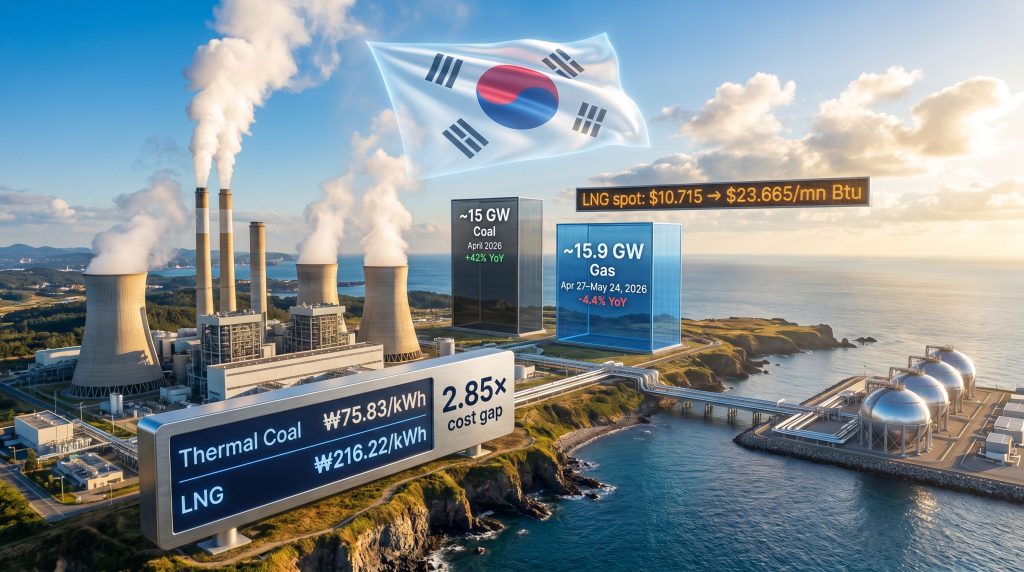
The fundamental economic picture in South Korea's power sector became sharply defined following the escalation of Middle East hostilities in early 2026. As of 6 March 2026, the generation cost of thermal coal in South Korea was estimated at ₩75.83 per kWh, while LNG-fired generation carried a cost of ₩216.22 per kWh, according to Argus Media market analysis. This produced a cost ratio of approximately 2.85 times, meaning gas-fired power was nearly three times more expensive to produce per unit of electricity than coal at prevailing fuel prices.
| Fuel Type | Generation Cost (₩/kWh) | Primary Cost Driver |
|---|---|---|
| Thermal Coal | 75.83 | Spot coal price + handling |
| LNG (Gas-Fired) | 216.22 | Spot LNG price + regasification + tariff |
This differential did not emerge gradually. It was driven by an asymmetric price shock in global commodity markets following the US-Israel-Iran conflict. Northeast Asia spot LNG prices, tracked via the ANEA front-month benchmark, more than doubled from approximately $10.715/mn Btu to $23.665/mn Btu over the period measured. Thermal coal (NAR 5,800 kcal/kg, cfr South Korea), by contrast, rose by approximately $19 per tonne to reach $115.63/t over the same period. The proportional divergence between these two price responses is the core driver of South Korea's accelerated coal burn across the first half of 2026.
Why Global Price Improvements Don't Automatically Help Korean Generators
One of the least understood dynamics in South Korea's fuel switching framework is the disconnect between global LNG price movements and domestic generation costs. This gap exists because Korea Gas Corporation (KOGAS) sits between global markets and domestic power producers as the primary LNG procurement intermediary. KOGAS manages the country's LNG import contracts, storage, and regasification infrastructure, and it sets the domestic tariffs at which gas is sold to generators.
The practical consequence is that even when spot LNG prices fall on global markets, that improvement does not automatically or immediately pass through to the generation cost faced by Korean utilities. KOGAS procurement decisions, the composition of contracted versus spot volumes, and the timing of tariff adjustments all mediate that transmission. This structural lag means the procurement architecture, not just the commodity price, determines when and whether LNG becomes competitive enough to displace coal in the Korean dispatch stack. Furthermore, the broader LNG supply outlook for 2025 and beyond suggests these structural tensions are unlikely to resolve quickly.
The structural barrier to South Korea coal to LNG switching is not purely a price problem. It is a procurement and tariff transmission problem. Until domestic gas tariffs reflect spot LNG economics more dynamically, coal will retain a structural cost advantage across most of the power generation stack.
What Actually Happened: Korea's Dispatch Reality in April Through June 2026
April 2026: The Most Decisive Pivot on Record
The scale of South Korea's shift toward coal in April 2026 was substantial by any historical measure. Coal-fired generation averaged 15 GW across the month, representing a 42% increase from the approximately 10.6 GW recorded during the same period in 2025, according to Argus Media data. On the gas side, generation fell by 6.2% year-on-year, translating to an LNG demand reduction of approximately 110,000 tonnes for April alone.
Compounding the economic pressure, April 2026 was also the first complete calendar month in which South Korea received no LNG deliveries from Qatar following the outbreak of Middle East hostilities. Qatar had historically served as one of Korea's most significant long-term contracted LNG suppliers, and the complete absence of Qatari cargoes created both a physical supply gap and an upward pricing signal that reinforced coal's competitive advantage. Coal switching accelerates in markets across Asia when these conditions align, and South Korea is no exception.
May Through June 2026: Coal Dominance Persists With Nuance
The rolling four-week average covering 27 April through 24 May 2026 showed coal-fired output holding at approximately 15 GW, still up 16.5% year-on-year. Gas-fired generation across the same window averaged 15.9 GW, down 4.4% year-on-year. Despite this coal-dominant environment, at least six LNG spot cargoes were diverted to South Korea during May, signalling that the approach of summer temperatures was beginning to pull gas-fired capacity back into operation at the margins.
| Period | Coal Output | Year-on-Year Change | Gas Output | Year-on-Year Change |
|---|---|---|---|---|
| April 2026 | ~15 GW avg | +42% | Declined | -6.2% |
| 27 Apr to 24 May 2026 | ~15 GW avg | +16.5% | ~15.9 GW avg | -4.4% |
This partial re-entry of LNG into the Korean supply picture through May cargo diversions illustrates a key dynamic: even in a coal-dominant dispatch environment, gas cannot be completely eliminated from the system due to the structural and operational roles it fulfils that coal cannot replicate.
The Structural Constraints Behind South Korea's Limited Switching Capacity
Grid Infrastructure: The Bottleneck That Price Cannot Fix
South Korea's power grid presents a geographic constraint that has no short-term solution regardless of fuel economics. The country's newest and largest generation assets, including coal, nuclear, and renewable facilities, are predominantly located in coastal areas, while the heaviest electricity demand is concentrated in inland urban centres including Seoul and its broader metropolitan region. Insufficient high-voltage transmission capacity between these coastal generation hubs and urban load centres means that available generation capacity frequently cannot be fully dispatched to where demand exists.
This physical constraint maintains a structural floor beneath gas-fired generation output, particularly during off-peak hours when coastal thermal dispatch is administratively constrained to prevent grid overload in the transmission corridors. No amount of fuel price movement changes this underlying infrastructure reality in the near term, and transmission network expansion projects of the scale required take years to complete.
Minimum Stable Output: Why Coal Is Far Less Flexible Than It Appears
A commonly overlooked dimension of the South Korea coal to LNG switching debate is the operational inflexibility of coal-fired power plants relative to gas-fired alternatives. Coal units require higher minimum stable output levels, meaning they cannot reduce generation below a certain threshold without risking equipment instability or damage. During periods when solar photovoltaic generation is elevated, particularly around midday during the spring shoulder season running from March through June, total thermal demand from the grid falls sharply.
Gas-fired combined cycle plants are substantially better suited to rapid load-following and output adjustment, making them the natural balancing resource when solar generation temporarily depresses the residual load. The result is a situation where coal operates at its technical minimum for stability reasons during solar peaks, while gas handles the flexibility and balancing role, even when coal is theoretically the cheaper fuel on a pure cost-per-kWh basis.
- Coal plants cannot ramp down freely when solar reduces midday residual load
- Gas plants absorb variability as the primary flexible balancing resource
- This operational dynamic persists regardless of relative fuel costs
- The spring shoulder season intensifies this effect due to higher solar output
The Countermeasure System: Regulatory Floors Under Coal Dispatch
During the spring shoulder season, South Korean grid operators implement dispatch countermeasures that require coal-fired units to maintain minimum generation levels for system stability reasons. These administrative requirements create a regulated floor beneath coal output that prevents coal from being fully displaced by other resources, even during hours when pure economic dispatch logic might favour reduced coal burn. This regulatory layer further complicates the fuel switching picture by ensuring that coal maintains a continuous operational presence in the dispatch stack through mechanisms that operate independently of market price signals.
Policy in a Holding Pattern: South Korea's Energy Governance Dilemma
The 2040 Coal Phase-Out Under Reconsideration
Before the Middle East disruption reshaped the energy landscape, South Korea had committed to a complete exit from coal-fired power generation by 2040. By 14 April 2026, the government formally signalled that this timeline was under review, acknowledging the tension between long-term decarbonisation commitments and the energy security imperatives that had emerged from the geopolitical shock. The signal was one of pragmatic recalibration rather than outright policy abandonment, with certain coal plant retirement schedules paused and capacity constraints relaxed to preserve operational flexibility.
What makes this policy moment particularly instructive is that the government simultaneously reaffirmed its commitment to expanding renewable energy capacity to 100 GW by 2030. This dual positioning, delaying coal exit while pressing ahead with renewable expansion, implies a transitional period in which coal and renewables both operate at elevated levels, potentially compressing the role of gas-fired generation in the medium term. These dynamics mirror energy transition pressures that are reshaping energy policy across major economies in 2025 and beyond.
Tax Adjustments as a Switching Lever: Useful but Insufficient
South Korea has made adjustments to the relative tax treatment of coal and LNG in recent years, raising coal-specific levies to better reflect environmental externalities and thereby narrowing the effective cost gap between the two fuels. These fiscal interventions improve LNG's competitive position in the dispatch stack at the margin. However, the scale of the current cost differential, approximately 2.85 times on a per-kWh basis, is large enough that tax adjustments alone are insufficient to trigger material switching without corresponding reforms to KOGAS procurement volumes and domestic tariff transmission mechanisms.
The tax lever is therefore better understood as a structural alignment tool for the medium term rather than an immediate switching catalyst in the current price environment.
KOGAS: The Single Most Consequential Variable
Among all the variables shaping South Korea's fuel mix in the near term, KOGAS procurement policy stands out as the most directly actionable. If KOGAS increases spot LNG purchases during periods when global prices are lower and passes those savings through to domestic gas tariffs in a timely manner, the cost competitiveness of gas-fired generation improves materially. Conversely, if procurement remains conservative and tariffs stay elevated relative to prevailing global spot prices, coal retains its structural economic advantage regardless of what happens in global commodity markets.
This makes KOGAS procurement decisions a critical variable for energy traders, power sector analysts, and policymakers tracking the South Korea coal to LNG switching dynamic, because the mechanism through which global price signals should theoretically reach Korean generators is, in practice, mediated by a single institutional actor.
Scenario Analysis: Pathways That Could Shift the Fuel Balance
Four Scenarios and Their Near-Term Feasibility
| Scenario | LNG Demand Impact | Near-Term Probability | Expected Duration |
|---|---|---|---|
| Geopolitical de-escalation and LNG price normalisation | Moderate positive | Low to medium | Structural if sustained |
| Summer heat demand surge pulling gas into stack | Temporary positive | High (above 50%) | Seasonal |
| Nuclear availability decline increasing gas dependency | Moderate positive | Medium | Operational period |
| Coal capacity returning from maintenance reinforcing coal dominance | Negative | High (confirmed) | Structural |
Scenario 1: Geopolitical de-escalation. If Middle East hostilities resolve and LNG shipping through the Strait of Hormuz normalises, global spot prices could retreat toward pre-conflict levels in the range of $10 to $12/mn Btu. At those prices, the coal-LNG cost gap narrows substantially. However, even with price normalisation, KOGAS procurement and tariff transmission lags would delay the benefit reaching Korean generators by weeks or months.
Scenario 2: Summer heat demand surge. South Korea's national meteorological agency indicated a greater than 50% probability of above-average temperatures during June through August 2026. Elevated cooling demand would push total power consumption beyond baseload capacity, forcing gas-fired peaking units into higher utilisation. This does not represent structural switching but rather demand-driven gas re-entry that reverses when temperatures normalise.
Scenario 3: Nuclear availability decline. Scheduled nuclear output is forecast to fall to 19.4 GW during June through August 2026, down from 20.1 GW in the equivalent period of 2025, assuming continued Wolsong reactor maintenance. This 0.7 GW reduction tightens the generation stack and increases the marginal role of gas-fired capacity. Any unplanned nuclear outages beyond the scheduled maintenance programme would amplify this effect materially.
Scenario 4: Coal capacity return from maintenance. Approximately 4.7 GW of coal-fired capacity was scheduled to return from maintenance by end of May 2026. This capacity addition reinforces coal's competitive position in the dispatch stack through the summer period and partially offsets any demand-driven pressure on gas-fired generation.
The next major ASX story will hit our subscribers first
Compounding Supply Risks: The Ichthys LNG Disruption Layer
South Korea's supply-side challenges in 2026 are not limited to Middle East geopolitics. Australia's Ichthys LNG facility, which has a nameplate capacity of 9.3 million tonnes per year, has faced escalating industrial action from the Offshore Alliance union. Strike actions that began on 3 June 2026 were extended from four-hour to eight-hour work stoppages, with cargo loading and unloading bans commencing on 11 June. Traders estimated that approximately four LNG cargoes per month were at risk from these stoppages at the time of reporting, according to Argus Media.
This Australian supply disruption compounds the existing Middle East supply shock. Consequently, South Korea simultaneously faces constrained contract volumes from Qatar and reduced spot availability from a major Pacific Basin supplier. For context, these disruptions are part of the wider Australian energy exports challenges that have intensified across 2025 and into 2026. For a country that depends on imported energy for approximately 97% of its primary energy requirements, this double exposure to independent supply chain disruptions represents a severe stress test of procurement diversification strategies.
The Broader Asian Context: A Pattern Repeating Across the Region
Why South Korea's Constraints Are Not Unique
South Korea's experience with South Korea coal to LNG switching constraints reflects a broader structural pattern across major Asian LNG-importing economies. Japan and Taiwan face comparable procurement architecture limitations, with state-adjacent intermediaries mediating between global spot markets and domestic generators, creating similar transmission lags. Asia's gas shock playbook demonstrates that coal curtailment and LNG competition interact in complex ways that defy simple price-based explanations across the region.
Unlike European gas markets, where spot price signals propagate more directly through to generation economics, Asian LNG markets have historically been characterised by long-term contract dominance, destination clauses, and oil-indexed pricing structures that reduce the responsiveness of domestic generation costs to global spot movements. This structural difference means that policy solutions that work in European energy markets cannot simply be transplanted into the Asian context without addressing the underlying procurement architecture first.
The Long-Term Role of Gas: Flexibility Over Baseload
Despite coal's near-term economic advantage and the operational dominance it has reasserted in 2026, the long-term structural case for LNG in South Korea's energy mix remains intact. As the country progresses toward its 100 GW renewable expansion target, the nature of the role that gas-fired generation plays will shift fundamentally. Rather than competing as a baseload fuel against coal, gas-fired capacity will increasingly serve as the primary flexibility and balancing resource in a grid characterised by high levels of variable renewable generation.
This transition from baseload competitor to system balancer is actually a function that gas performs more efficiently than coal, given the relative flexibility and ramp rate advantages of combined cycle gas turbine technology. In addition, the growing energy transition demand for clean system balancing solutions reinforces the long-term relevance of gas infrastructure investment. The medium to long-term investment case for LNG infrastructure in South Korea therefore does not depend on gas winning the baseload competition against coal. It depends on gas becoming the indispensable partner to a renewable-dominated grid, a role that the current geopolitical disruption has temporarily obscured but has not fundamentally altered.
Frequently Asked Questions on South Korea Coal to LNG Switching
What Is Driving South Korea's Increased Coal Burn in 2026?
The primary driver is the dramatic widening of the generation cost gap between coal and gas following Middle East supply disruptions. LNG-fired generation became approximately 2.85 times more expensive than coal on a per-kWh basis as of March 2026, making continued coal dispatch the economically rational choice for Korean power producers. The complete absence of Qatari LNG deliveries in April 2026 reinforced both the supply constraint and the economic rationale for maximising coal output.
Can South Korea Switch Rapidly From Coal to LNG if Prices Improve?
Rapid switching is constrained by multiple structural factors operating simultaneously. Grid transmission bottlenecks between coastal generation facilities and urban demand centres, minimum stable output requirements for coal plants, the administrative lag in KOGAS tariff transmission, and seasonal dispatch countermeasures all limit the speed and scale of any fuel response. Price improvement alone is a necessary but insufficient condition for meaningful switching. However, an unexpected oil price rally could further complicate the calculus by influencing oil-indexed LNG contract pricing simultaneously.
What Is South Korea's Current Coal Phase-Out Timeline?
The government had committed to exiting coal-fired generation by 2040. In April 2026, the government signalled a potential delay to this timeline in response to energy security concerns, while simultaneously reaffirming the 2030 target of expanding renewable capacity to 100 GW. The exact revised timeline for coal retirement has not been formally specified as of mid-2026.
What Role Does KOGAS Play in South Korea's Fuel Switching Dynamics?
KOGAS functions as the primary LNG procurement intermediary between global markets and domestic power generators. Its decisions on spot purchase volumes, contract management, and domestic tariff-setting directly determine whether improvements in global LNG prices translate into competitive generation economics for Korean utilities. KOGAS procurement policy is therefore one of the most consequential near-term variables in the South Korea coal to LNG switching dynamic.
Key Takeaways: Reading the Strategic Landscape
- The cost gap is severe and structurally embedded: LNG-fired generation at approximately 2.85 times the cost of coal per kWh is a barrier that price adjustments alone cannot rapidly overcome given procurement transmission lags
- Switching is a multi-constraint problem: Grid infrastructure, minimum stable output requirements, procurement architecture, and seasonal dispatch rules each independently limit switching speed and scale
- KOGAS is the most actionable near-term lever: Procurement and tariff decisions by this intermediary determine how quickly global price improvements reach Korean generators
- Policy is navigating genuine tension: Delaying coal retirement while accelerating renewable expansion creates a complex transitional period rather than a clean phase-out trajectory
- Summer 2026 dynamics are driven by demand, not structural switching: Above-average temperature probability will pull gas back into the stack seasonally without representing a durable shift in the fuel mix
- The long-term case for LNG remains intact: As renewables scale toward 100 GW, gas transitions from baseload competitor to system balancer, a role better suited to its operational characteristics than coal
- Compounding supply risks amplify vulnerability: Simultaneous disruptions from Middle East conflict and Australian industrial action create a multi-source supply squeeze for an economy with near-total import dependence
This article contains forward-looking analysis, scenario projections, and market assessments based on data available at the time of writing. Energy market conditions, geopolitical developments, and policy decisions are subject to rapid change. Nothing in this article constitutes financial, investment, or energy procurement advice. Readers should conduct independent research and consult qualified specialists before making decisions based on the information presented here.
Want to Stay Ahead of the Next Major Resource Discovery Driving Energy Markets?
While South Korea's coal-to-LNG switching dynamics reveal how rapidly commodity markets can shift, Discovery Alert's proprietary Discovery IQ model delivers real-time alerts on significant ASX mineral discoveries — instantly translating complex resource data into actionable investment insights for both traders and long-term investors. Explore how historic discoveries have generated substantial returns on Discovery Alert's dedicated discoveries page, and begin your 14-day free trial today to position yourself ahead of the market.