August 22, 2026
When Aid Runs Out, Resources Take Over: The New Logic of African Mineral Diplomacy
Across the global economy, a quiet but consequential restructuring is underway. For decades, the relationship between advanced industrial nations and resource-rich developing countries was filtered through a development assistance lens, with aid flows, technical grants, and concessional financing shaping bilateral engagement. That architecture is now fracturing under the weight of fiscal pressures in donor countries, and what is emerging in its place is something fundamentally different: commercially structured resource diplomacy where both parties bring strategic assets to the table.
Nowhere is this shift more visible than in the deepening South Korea Nigeria critical minerals partnership, a bilateral arrangement that has evolved far beyond its origins as a conventional development cooperation agreement and now sits at the intersection of clean energy supply chains, industrial sovereignty, and African resource geopolitics.
When big ASX news breaks, our subscribers know first
The Numbers Behind Seoul's Mineral Vulnerability
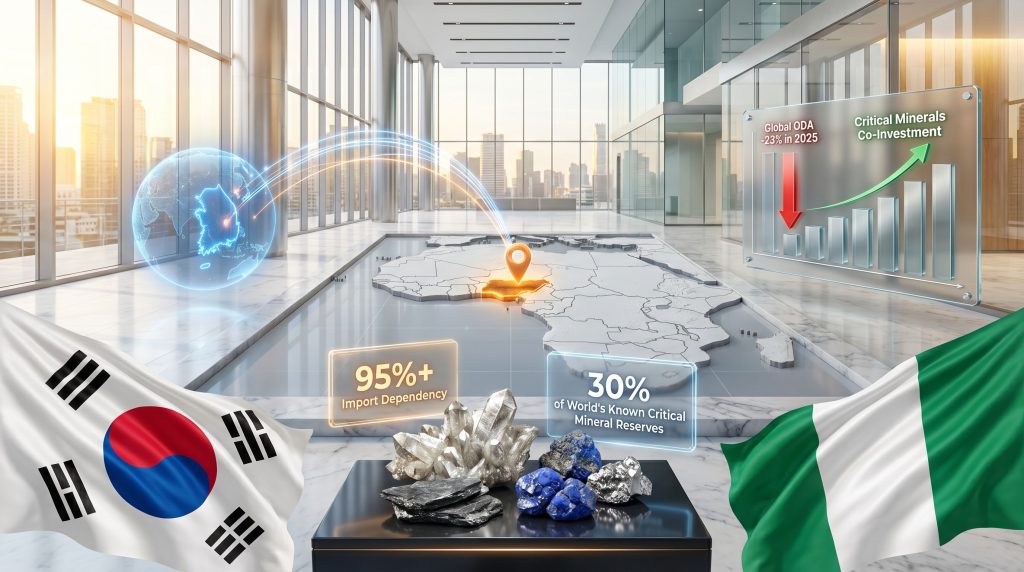
South Korea's strategic anxiety about critical mineral access is not rhetorical. The country imports more than 95% of its critical mineral requirements, placing it among the most resource-import-dependent advanced economies globally. For a nation whose industrial economy is anchored by some of the world's largest electric vehicle battery manufacturers, semiconductor producers, and steel conglomerates, that dependency is not merely an economic inconvenience — it is a structural vulnerability that has moved to the centre of national security planning.
The urgency is compounded by the collapse of global development assistance frameworks that previously provided soft-power entry points into resource-holding nations. According to Korea's Chargé d'Affaires Tak Namgung, speaking at a joint seminar hosted by the Nigerian Institute of International Affairs and the Embassy of the Republic of Korea, global Official Development Assistance dropped to approximately $174 billion in 2025, representing a 23% year-on-year decline — the steepest contraction recorded in recent history. Bilateral aid flows directed at Sub-Saharan Africa are projected to shrink by as much as 28% as major donor economies tighten fiscal positions.
Furthermore, these energy security concerns are reshaping the diplomatic calculus for advanced industrial nations, making resource partnerships a matter of national strategic priority rather than optional engagement.
The traditional donor-recipient framework is no longer viable within the current economic climate. Meaningful cooperation must now be built on shared knowledge, strong institutions, and mutual accountability.
— Korea's Chargé d'Affaires Tak Namgung, Nigerian Institute of International Affairs Seminar (Business Insider Africa, April 2026)
This is not simply a funding shortfall. It represents the structural end of a diplomatic model, forcing both emerging economies and advanced industrial nations to design engagement frameworks around mutual economic interest rather than philanthropic obligation.
Nigeria's Mineral Portfolio: More Diverse Than Most Investors Realise
What makes Nigeria a particularly compelling partner for Seoul is the breadth of its critical mineral endowment, a characteristic that is frequently underappreciated in global resource markets which tend to focus on single-commodity African plays.
While the Democratic Republic of Congo dominates global cobalt narratives and Zimbabwe has attracted significant attention for its lithium pegmatite discoveries, Nigeria's mineral profile spans multiple battery-critical and industrial inputs simultaneously. Rising critical minerals demand across the clean energy sector makes this multi-commodity profile especially attractive to industrial partners seeking diversified supply.
- Lithium hosted in pegmatite formations, with geological characteristics that Korean research institutions have specifically identified as priority targets
- Graphite deposits essential for electric vehicle battery anodes and grid-scale energy storage systems
- Nickel required for high-energy-density battery cathode chemistries
- Cobalt as a key input for NMC (nickel manganese cobalt) battery formulations used extensively by Korean EV-sector manufacturers
- Manganese applicable in both steel production and lithium-manganese-oxide battery architectures
- Copper identified by the Korea Institute of Geosciences and Mineral Resources (KIGAM) as a formal collaboration target within the bilateral framework
This multi-mineral portfolio means the South Korea Nigeria critical minerals partnership is not structured around a single commodity bet. Instead, it represents a diversified supply chain agreement addressing several simultaneous sourcing vulnerabilities within Seoul's industrial base.
Africa collectively holds approximately 30% of the world's known critical mineral reserves, making it the single most strategically important continent for nations seeking supply chain diversification away from existing concentrated sources. Nigeria's position within that continental endowment, combined with its scale as Africa's largest economy, elevates it to tier-one status for Asian industrial partnerships.
The Institutional Architecture of the Partnership
Understanding the South Korea Nigeria critical minerals partnership requires looking beyond the headline resource story and examining the institutional machinery being assembled to deliver it. The framework draws on a revised 2006 Memorandum of Understanding on solid minerals investment, updated through recent high-level negotiations to expand both the range of minerals covered and the technical cooperation mechanisms involved.
| Institution | Country | Function Within Partnership |
|---|---|---|
| Korea Institute of Geosciences and Mineral Resources (KIGAM) | South Korea | Lithium ore processing technology, geoscience research, exploration collaboration |
| Korea Mine Rehabilitation and Mineral Resources Corporation (KOMIR) | South Korea | Technical and financial assistance, private sector investment facilitation |
| Korea International Cooperation Agency (KOICA) | South Korea | Institutional strengthening, e-governance capacity building |
| Nigeria's Ministry of Solid Minerals Development | Nigeria | Policy coordination, MoU revision, regulatory oversight |
| Oando Mining Company | Nigeria | Private sector exploration and mining operations partner |
The revised MoU extends bilateral cooperation across six operational domains:
- Geochemical exploration covering systematic mapping of Nigeria's mineral-bearing geological formations
- Geophysical surveying for subsurface analysis to identify viable ore bodies
- Ore modelling and resource estimation to quantify deposit viability and support investment decisions
- Mineral processing technology transfer, particularly KIGAM's advanced lithium ore upgrading methodology
- Professional training programs aimed at building Nigerian technical capacity across mining sciences
- Joint research and development connecting Korean and Nigerian scientific institutions in collaborative programs
KIGAM's Lithium Technology: A Technical Differentiator Worth Understanding
Among the least-discussed but most strategically significant elements of this arrangement is the technology transfer component centred on KIGAM's proprietary lithium ore processing methodology. This is not a generic knowledge-sharing provision.
KIGAM has developed an advanced lithium ore processing approach capable of achieving two simultaneous outcomes that most conventional processing methods treat as competing priorities: improving ore grade concentration while reducing carbon emissions during processing. For a partnership targeting battery-grade lithium production, this dual capability directly addresses both economic viability thresholds and increasingly stringent environmental compliance requirements embedded in Korean battery manufacturers' supply chain standards.
In practical terms, this means Nigeria would not simply be exporting spodumene concentrate or unprocessed pegmatite ore for refinement elsewhere. The technology transfer framework opens a pathway toward domestic value addition at source, which is the critical distinction between a resource extraction deal and an industrial development partnership. This aligns with Seoul's broader approach to South Korea's battery expansion across global supply chains.
From a mining sector perspective, the difference between exporting raw ore and exporting processed concentrate is the difference between capturing 5% of the value chain and capturing 30% or more. Technology transfer provisions that enable in-country upgrading fundamentally change the economic calculus for resource-holding nations.
This technical dimension also explains why KIGAM's specific identification of Nigeria's lithium-bearing pegmatite formations as a priority collaboration target carries genuine strategic weight. Pegmatite-hosted lithium, while requiring more processing complexity than brine-based sources, tends to deliver consistent ore characteristics amenable to systematic upgrading — a profile well-suited to KIGAM's processing methodology.
The 2024 Korea-Africa Summit: Diplomatic Foundation at Scale
The bilateral framework did not emerge in isolation. It was formalised within a broader multilateral architecture established at the Seventh Korea-Africa Economic Co-operation (KOAFEC) conference held in Busan, which served as the diplomatic platform through which Korea's Africa mineral strategy was elevated from bilateral relationship-building to a structured continental programme.
Key outcomes from the Busan summit relevant to the South Korea Nigeria critical minerals partnership include:
- Signing of a bilateral critical minerals investment promotion agreement between South Korea and Nigeria
- Launch of a Critical Minerals Dialogue encompassing 11 African partner countries
- KIGAM's formal commitment to copper development collaboration within Nigeria
- Parallel mineral agreements with Madagascar and Tanzania, establishing a geographically diversified African supply network for Seoul
The 11-nation dialogue mechanism is particularly significant from a strategic analysis perspective. Seoul is not pursuing a single-country dependency model. Instead, it is constructing a multi-node African mineral security network that distributes supply chain risk across different geological provinces, political environments, and commodity types. This approach mirrors the supply chain diversification logic Seoul is applying globally — but executed specifically within Africa's green mineral partnerships, which are rapidly reshaping the continent's resource diplomacy landscape.
How Does Seoul's African Strategy Compare With Competitor Nations?
| Country | Africa Mineral Strategy | Key African Partners | Primary Minerals Targeted |
|---|---|---|---|
| South Korea | KOAFEC framework, bilateral MoUs, KIGAM/KOMIR technical deployment | Nigeria, Madagascar, Tanzania | Lithium, cobalt, nickel, graphite, copper |
| China | State-backed investment, infrastructure-for-minerals exchanges | DRC, Zambia, Zimbabwe, Mozambique | Cobalt, copper, lithium, rare earths |
| United States | Lobito Corridor, DFC financing, Minerals Security Partnership | DRC, Zambia, South Africa | Cobalt, copper, lithium, manganese |
| European Union | Global Gateway, Critical Raw Materials Act partnerships | Namibia, DRC, Rwanda | Lithium, cobalt, rare earths |
| Japan | JOGMEC resource diplomacy, ODA-linked mining deals | Mozambique, Madagascar | Graphite, nickel, cobalt |
The next major ASX story will hit our subscribers first
Why This Partnership Is Structurally Different From Conventional Extraction Deals
A critical analytical point frequently missed in conventional reporting on African mineral partnerships is the distinction between resource access agreements and genuine industrial development frameworks. The South Korea Nigeria critical minerals partnership contains architectural features that push it toward the latter category, though execution will ultimately determine which category it actually belongs in.
The framework is built on three distinct pillars that together differentiate it from purely transactional resource deals. In addition, its emphasis on institutional accountability sets it apart from the infrastructure-for-minerals models that have dominated African resource engagement historically.
Pillar 1: Institutional Accountability as a Precondition
The partnership explicitly conditions deeper economic integration on institutional strengthening milestones rather than treating governance development as a secondary concern. This is a meaningful departure from models where resource concessions are exchanged for physical assets, with governance questions deferred or ignored entirely. The evolving mining geopolitics of 2025 have made such conditionality increasingly standard among advanced industrial partners.
Pillar 2: Knowledge Transfer With Compounding Value
Professional training programs in geochemistry, geophysics, and mineral processing are structured to build Nigerian technical capacity that persists beyond the initial investment phase. Unlike consultancy arrangements that create ongoing dependency, a genuine training architecture means Nigeria's institutional knowledge base grows with each program cycle.
Pillar 3: Private Sector Co-Investment Architecture
KOMIR's mandate extends to facilitating private sector investment partnerships, connecting Korean mining capital with Nigerian exploration operators including Oando Mining. Consequently, this creates commercial relationships that operate independently of government aid budget cycles — insulating the partnership's commercial core from the ODA contractions that disrupted the previous engagement model.
Namgung also drew on South Korea's own industrialisation history in framing the philosophical basis of the new model, acknowledging that Korea's rapid economic development came with early trade-offs in democratic governance and human rights. His articulation that economic growth and institutional integrity must advance as complementary rather than sequential objectives reflects a harder-won development philosophy than is typical of resource partnership announcements.
Korea's Existing Industrial Footprint in Nigeria
A factor that receives insufficient attention in analysis of this partnership is the degree to which South Korean corporate interests are already embedded in Nigeria's economy, providing a commercial foundation upon which the critical minerals framework can be layered rather than built from scratch.
Several major Korean corporations have maintained operational presence across Nigerian sectors:
- Daewoo Engineering and Construction has been involved in Nigerian infrastructure development projects over an extended period
- Samsung Electronics is active in Nigeria's technology and consumer electronics market, contributing to workforce skills development
- LG Corporation has made industrial capacity contributions across multiple Nigerian economic sectors
Additionally, through KOICA, South Korea has supported Nigeria's e-governance initiatives, reflecting a broader institutional development agenda that predates the critical minerals focus. This history of engagement means Korean entities entering the minerals sector are not operating in an unfamiliar regulatory or relationship environment, which reduces transactional friction and accelerates the trust-building process that underpins complex long-term resource agreements.
A broader Korea-Africa critical minerals development analysis confirms that this embedded corporate presence has meaningfully accelerated bilateral negotiations in other African markets, suggesting Nigeria may benefit from similarly reduced lead times.
The Critical Raw Materials Framework: A Parallel European Lesson
It is worth noting that Seoul's institutional approach shares structural similarities with the European Union's own critical raw materials strategy, which likewise emphasises governance conditionality, technology transfer, and multi-country partnership networks over single-commodity extraction agreements. However, Seoul's competitive advantage lies in the specific processing technologies KIGAM brings to the table — capabilities the EU framework has not yet deployed at equivalent technical depth.
Assessing the Risks: Where the Partnership Could Stall
No analysis of the South Korea Nigeria critical minerals partnership is complete without an honest assessment of the structural challenges that could prevent the MoU framework from translating into operational commercial outcomes.
| Risk Factor | Nature of Challenge | Mitigation Approach |
|---|---|---|
| Regulatory Uncertainty | Inconsistent mining licensing and policy framework in Nigeria | MoU revision includes governance benchmarks as conditionality |
| Infrastructure Deficit | Limited transport, power, and processing infrastructure in mineral-bearing regions | Daewoo and similar Korean infrastructure operators positioned for complementary investment |
| Technical Capacity Gap | Shortage of trained geoscientists and mining engineers in Nigeria | KIGAM and KOMIR professional training programs |
| Geopolitical Competition | China's deeper-rooted financial relationships across Sub-Saharan Africa | Seoul's technology transfer differentiation and multi-country network building |
| ODA Budget Constraints | Declining KOICA budgets limiting scale of institutional programs | Commercial partnership architecture designed to operate independently of aid cycles |
| Timeline Misalignment | Korea's urgent supply chain needs versus Nigeria's longer-term development trajectory | Phased implementation with technical cooperation delivering early value |
The geopolitical competition dimension deserves particular attention. China's presence across Sub-Saharan African mineral sectors is backed by decades of relationship-building, concessional financing structures, and infrastructure delivery that creates leverage difficult for newer entrants to replicate quickly. South Korea's differentiation strategy — centred on technology transfer, institutional development, and governance conditionality — offers a genuinely distinct value proposition, but translating that proposition into commercial priority status against well-entrenched Chinese interests will require sustained diplomatic and commercial pressure.
Three Scenarios for Partnership Outcomes
Given the structural complexity of this arrangement, analysts should consider a range of possible trajectories rather than treating the MoU announcement as a guaranteed pathway to supply chain outcomes.
Scenario 1: Accelerated Integration (Optimistic)
Nigeria moves efficiently on regulatory reform, KIGAM's lithium processing technology is successfully deployed at commercial scale, and KOMIR-facilitated private investment flows into exploration within 24 to 36 months. Korean battery supply chains achieve meaningful lithium and graphite sourcing diversification by the late 2020s.
Scenario 2: Incremental Progress (Base Case)
Technical cooperation advances through training programs and geoscience research, but large-scale commercial mining investment is delayed by infrastructure gaps and regulatory complexity. The partnership delivers significant institutional value and lays the groundwork for commercial development in the early 2030s without delivering near-term supply chain impact.
Scenario 3: Structural Stall (Downside)
Declining ODA budgets constrain KOICA's institutional programs, geopolitical competition from Chinese-backed mining interests limits Korean private sector entry points, and governance challenges prevent the MoU revision from producing operational agreements within a politically sustainable timeframe.
Disclaimer: The scenario analyses presented above represent analytical projections based on publicly available information and are not investment advice. Actual outcomes will depend on a wide range of geopolitical, regulatory, and commercial factors that cannot be predicted with certainty.
What the Korea-Nigeria Dynamic Reveals About Africa's Resource Future
Viewed through a wider lens, the South Korea Nigeria critical minerals partnership is a microcosm of a broader structural transformation in how Africa's mineral endowment is being competed for and negotiated. The era in which African nations accepted resource extraction agreements structured primarily around donor-country preferences and development charity terms is giving way to a more commercially sophisticated posture.
The partnership's emphasis on institutional capacity building, technology transfer, and private sector co-investment architecture — combined with its embedding within a larger 11-nation Critical Minerals Dialogue framework — suggests Seoul has understood this shift and is attempting to position itself as a partner of a different quality than conventional extractive actors.
Whether Nigeria can convert geological endowment into sustained industrial development outcomes will ultimately depend as much on domestic governance trajectory as on the quality of its bilateral partners. However, the architecture of the Korea-Nigeria arrangement at least creates the structural conditions for a more equitable and durable resource partnership than Africa has historically been offered.
The minerals are in the ground. The institutional question is whether the systems built around them are strong enough to ensure the value they generate stays in the country that holds them.
Want to Identify the Next Major Mineral Discovery Before the Market Does?
Discovery Alert's proprietary Discovery IQ model delivers real-time alerts on significant ASX mineral discoveries — instantly transforming complex geological data into actionable investment insights across the battery metals and critical minerals sectors reshaping global supply chains. Explore historic discoveries and their market returns, then begin your 14-day free trial at Discovery Alert to position yourself ahead of the market.