May 22, 2026
When Licences Become Liabilities: Africa's Upstream Oil Reckoning
Across the global energy industry, exploration licences have long functioned as a form of speculative currency. Companies accumulate acreage in frontier basins, pledge capital commitments to host governments, and then spend years seeking larger partners to actually develop the ground beneath them. For decades, many African petroleum ministries tolerated this dynamic, accepting slow progress in exchange for any form of international investor interest. That tolerance is running out.
The decision by South Sudan's Ministry of Petroleum to decline renewal of the Block B3 exploration licence held by Oranto Petroleum is not simply a corporate setback for one company. It is a regulatory data point in a continent-wide pattern, one that reveals how African governments are fundamentally rewriting the terms of upstream engagement. Understanding why South Sudan cancels Oranto Petroleum oil licence access matters far beyond the immediate transaction, and furthermore, it has significant implications for the broader geopolitical risk landscape affecting resource-rich nations.
When big ASX news breaks, our subscribers know first
The Block B3 Story: What Was Promised and What Was Delivered
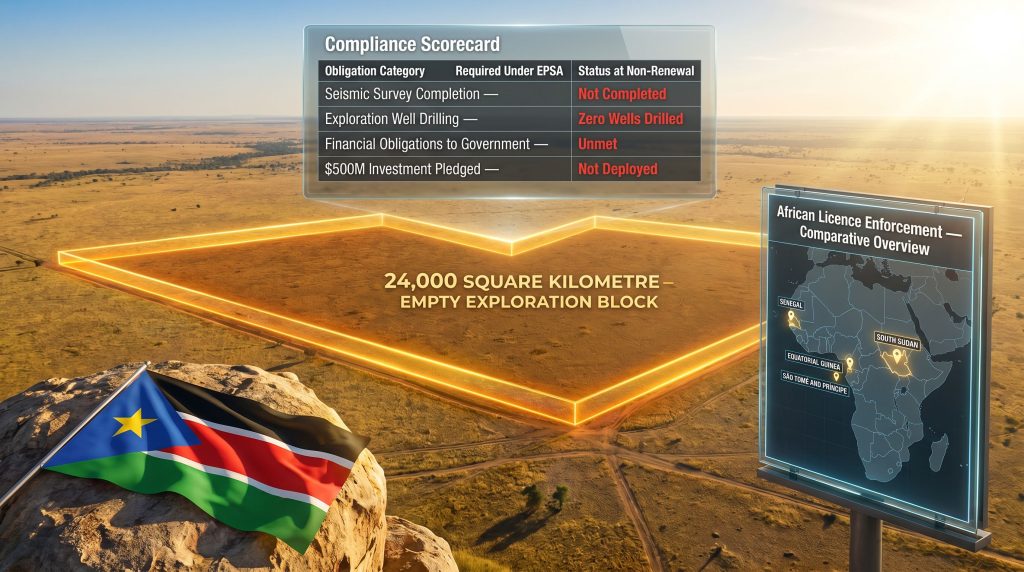
When Oranto Petroleum secured Block B3 in 2017, the commercial proposition appeared significant. The block covered 24,000 square kilometres of South Sudanese territory assessed to hold meaningful hydrocarbon prospectivity, and the company committed to a $500 million investment programme covering exploration and development activity. Oranto held a 90% operator stake, giving it both the authority and the obligation to move the asset forward.
Nearly nine years later, the gap between that commitment and actual execution had become impossible to ignore. According to South Sudan's Ministry of Petroleum, not a single exploration well had been drilled across the entire licence area. Seismic surveys, the foundational step in any credible exploration programme, had not been completed. Financial obligations owed to the government remained outstanding, and the broader work programme required under the Exploration and Production Sharing Agreement had not been executed across multiple dimensions.
South Sudan's Ministry of Petroleum determined that the licence holder had failed to fulfil contractual obligations spanning seismic survey completion, exploration well drilling, financial commitments to the government, and work programme execution over a period covering nearly nine years from the 2017 award date. (Business Insider Africa, May 2026)
The compliance picture at the point of non-renewal looked like this:
| Obligation Category | Required Under EPSA | Status at Non-Renewal |
|---|---|---|
| Seismic Survey Completion | Yes | Not completed |
| Exploration Well Drilling | Yes | Zero wells drilled |
| Financial Obligations to Government | Yes | Unmet |
| Work Programme Execution | Yes | Non-compliant |
| Investment Deployment ($500M pledged) | Yes | Not deployed |
The Ministry has confirmed that Block B3 is now available for new applications, with any future allocation contingent on demonstrated technical capacity, verified financing commitments, and clear compliance with regulatory timelines.
Understanding Exploration and Production Sharing Agreements in Frontier Jurisdictions
To appreciate the weight of what happened in South Sudan, it helps to understand how Exploration and Production Sharing Agreements, commonly referred to as EPSAs, actually function in frontier oil jurisdictions across Africa.
An EPSA is a contract between a host government and an exploration company (or consortium) that defines how the costs and revenues of oil exploration and production will be divided. Crucially, these agreements are not passive property rights. They are conditional development mandates, and they typically include:
- Mandatory work programme milestones with defined timelines for seismic acquisition, well drilling, and field appraisal
- Financial performance bonds or bank guarantees that operators must post as security for their exploration obligations
- Government payment schedules covering signature bonuses, annual licence fees, and other fiscal commitments
- Phased licence structures where each exploration phase must demonstrate measurable progress before extension is granted
- Revocation and non-renewal clauses that explicitly empower governments to withdraw licences from non-performing operators
What the Block B3 case illustrates is that these contractual mechanisms are no longer dormant provisions buried in legal schedules. Governments are activating them.
Oranto's Wider African Portfolio: A Pattern Emerging Across Jurisdictions
The South Sudan decision does not exist in isolation. Oranto Petroleum has faced a series of licence-related challenges across multiple African markets, and when viewed together, these incidents reveal the structural risks embedded in a particular type of pan-African exploration strategy.
In Senegal, the government revoked offshore exploration rights linked to Oranto after the company reportedly failed to provide required bank guarantees and conducted only limited exploration work across a licence period dating back to 2008. The block in question, located offshore near Dakar, had been identified through seismic studies as potentially prospective, but no drilling activity ever occurred despite multiple licence extensions spanning many years.
In Equatorial Guinea, a licence within Oranto's broader portfolio came under pressure following a dispute involving Chevron as the block's operator, demonstrating how junior and mid-tier exploration companies can face collateral licence risk when their positions depend on larger operator relationships that break down.
In São Tomé and Príncipe, Oranto took a different path, reducing its exposure proactively through a farm-down transaction with Petrobras, which assumed operatorship in a restructured joint venture. This case illustrates that portfolio restructuring before regulatory enforcement occurs remains a viable risk management pathway, though one that typically involves surrendering significant economic upside. Indeed, the trends in African project finance suggest that proactive restructuring is increasingly favoured over enforcement-driven exits.
Comparative Overview: Licence Enforcement Across African Petroleum Markets
| Country | Asset | Enforcement Action | Primary Trigger |
|---|---|---|---|
| South Sudan | Block B3 (24,000 km²) | Non-renewal of EPSA | No seismic, no wells, unmet financial obligations |
| Senegal | Offshore Dakar block | Licence revocation | Failed bank guarantees, minimal exploration since 2008 |
| Equatorial Guinea | Portfolio licence | Licence dispute | Operator transition and partnership breakdown |
| São Tomé and Príncipe | Joint venture asset | Farm-down and restructure | Proactive risk mitigation, operatorship transferred to Petrobras |
The "Acquire Early, Partner Later" Model Under Structural Pressure
Industry observers have noted that Oranto has historically pursued what might be described as an accumulation-first exploration strategy: securing early-stage licences across multiple African jurisdictions and then seeking partnerships with larger international oil companies to execute the actual technical work. This approach is not unique to Oranto. It has been a common template for junior and mid-tier exploration companies operating in frontier basins globally.
The model carries a specific risk profile that is now being tested more aggressively by host governments:
- Licence tenure gaps between award and active exploration create extended windows of inactivity that expose operators to enforcement actions
- Dependency on third-party partners means that if anticipated farm-in transactions or joint venture arrangements fail to materialise, the operator may lack the internal capital and technical resources to meet work programme milestones independently
- Regulatory patience erosion across African petroleum ministries is compressing the timescales within which this model can operate before compliance reviews are triggered
- Multiple simultaneous enforcement risks can emerge when a company holds licences in several jurisdictions simultaneously, each at varying stages of compliance exposure
The tightening of African upstream licence enforcement is creating a bifurcated market. Well-capitalised operators with strong technical execution track records are gaining access to reopened and newly tendered blocks on improved terms. Companies that relied on licence accumulation strategies without matching execution capabilities are facing portfolio attrition across multiple jurisdictions at the same time. This dynamic is closely tied to the global resource demand surge reshaping how governments prioritise active development over speculative acreage-holding.
What South Sudan's Decision Signals for African Resource Governance
South Sudan is one of the world's youngest nations, gaining independence in 2011, and its economy remains deeply dependent on petroleum revenues. This context matters when interpreting the Ministry of Petroleum's enforcement action. Governments in fiscally constrained, resource-dependent economies cannot afford to hold strategic hydrocarbon acreage off the market indefinitely while licence holders fail to advance exploration programmes.
The Ministry's decision to reopen Block B3 to new applications, rather than offering Oranto an extended grace period, reflects a deliberate policy position: that active resource development serves national interests more effectively than maintaining relationships with non-performing operators.
This governance posture is becoming more common across Sub-Saharan Africa, where petroleum ministries are redesigning their approach to upstream licensing along several key dimensions:
- Stricter pre-qualification requirements, including demonstrated access to financing and proven technical capacity in comparable operating environments
- Shorter initial licence periods with mandatory performance reviews before any extension is granted
- Escalating financial penalties for work programme non-compliance rather than simple extension approvals
- Transparent retendering processes when licences are revoked or not renewed, signalling to the market that blocks will be reallocated rather than abandoned
- Greater scrutiny of pledged investment figures versus verifiable funding commitments, distinguishing between promotional capital promises and documented financing arrangements
The next major ASX story will hit our subscribers first
What New Applicants Should Understand About Block B3
For exploration companies evaluating whether to pursue Block B3 following its reopening, the opportunity and the risk profile both deserve careful assessment.
Potential attractions of the block include:
- Its geographic scale of 24,000 square kilometres represents substantial exploration footprint within a region assessed to hold hydrocarbon potential
- Any geological or seismic data generated during the prior licence period may provide informational value for new applicants conducting due diligence
- First-mover positioning in a reopened strategic block can carry commercial advantages if hydrocarbon potential is confirmed through early exploration activity
- The Ministry's explicit invitation to qualified international and regional operators signals genuine government willingness to engage credible new investors
Significant risk factors that must be weighed include:
- South Sudan's operating environment involves substantial infrastructure constraints, logistical complexity, and political risk that have historically challenged oil development timelines
- The country's conflict history continues to influence investor confidence and the practical execution of exploration programmes in remote areas
- The precedent established by the Block B3 non-renewal means any new licence holder will face a high-scrutiny regulatory environment with reduced tolerance for timeline slippage
- Securing project finance for frontier exploration in a high-risk jurisdiction requires robust risk mitigation structures that many exploration companies find difficult to arrange
Frequently Asked Questions: South Sudan Oil Licensing and African Upstream Regulation
Why Did South Sudan Cancel the Oranto Petroleum Oil Licence?
South Sudan's Ministry of Petroleum declined to renew the Block B3 licence after determining that Oranto Petroleum had not fulfilled its contractual obligations under the Exploration and Production Sharing Agreement across the nearly nine-year period since the 2017 award. The specific failures identified included non-completion of seismic surveys, no exploration wells drilled, unmet financial obligations to the government, and broader work programme non-compliance.
What Is Block B3 and How Significant Is It?
Block B3 is a 24,000-square-kilometre exploration block in South Sudan. Oranto had committed to a $500 million investment programme at the time of the 2017 licence award and held a 90% operator stake. The block sits in a region considered prospective for hydrocarbons and is now being reopened to applications from new operators who can demonstrate credible technical and financial capabilities.
Can African Governments Legally Revoke Oil Licences for Non-Performance?
Yes. EPSA contracts across African jurisdictions routinely include provisions that empower host governments to revoke or decline to renew licences when operators fail to meet mandatory work programme milestones, financial obligations, or other compliance requirements. These powers are also reinforced by national petroleum legislation in most producing countries.
What Criteria Will South Sudan Apply to New Block B3 Applicants?
The Ministry of Petroleum has indicated that future allocations will prioritise operators demonstrating verified technical capacity to execute exploration programmes in challenging environments, credible and committed financing structures, a track record of regulatory compliance, and alignment with the government's development objectives. Consequently, the resource investment outlook for frontier jurisdictions increasingly favours operators with proven delivery records over those relying on speculative acreage-holding strategies.
The Larger Implication: African Petroleum Governance Is Changing
The South Sudan decision, the Senegal revocation, the Equatorial Guinea dispute, and the São Tomé and Príncipe restructuring collectively tell a coherent story. African petroleum regulators are moving toward a governance standard that treats hydrocarbon licences as conditional development obligations rather than passive entitlements that can be renewed indefinitely as long as commercial intentions are expressed.
For exploration companies operating across the continent, the practical implication is significant. Holding frontier acreage without active, demonstrable exploration programmes is becoming an untenable position. The era of broad licence portfolios sustained by partnership promises rather than execution records is facing structural regulatory headwinds across multiple African jurisdictions simultaneously.
For well-capitalised operators with genuine technical credentials, however, this shift creates real opportunity. Strategic blocks in prospective basins are being returned to the market with cleaner regulatory histories and a host government posture that is actively seeking credible development partners rather than tolerating prolonged inactivity. Furthermore, the role of mining private equity and structured resource capital in backing execution-capable operators is becoming increasingly relevant as governments prioritise verifiable financing over pledged commitments.
The rules of upstream engagement in Africa have changed. South Sudan cancels Oranto Petroleum oil licence access, and in doing so, sends one of the clearest signals yet that governments across the continent are prepared to enforce those rules.
This article draws on reporting by Business Insider Africa (Agbetiloye, A., May 2026) and publicly available information on African petroleum regulatory frameworks. Forward-looking statements and scenario assessments are based on available evidence and should not be interpreted as investment advice. Investors and companies should conduct independent due diligence before making decisions related to African upstream oil and gas assets.
Want to Stay Ahead of Significant Resource Discoveries Before the Broader Market Reacts?
As African governments tighten upstream licensing enforcement and strategic blocks return to market, the ability to identify actionable opportunities ahead of the crowd has never been more critical — Discovery Alert's proprietary Discovery IQ model delivers real-time alerts on significant ASX mineral discoveries, turning complex resource data into clear, actionable insights for investors at every level. Explore how historic mineral discoveries have generated substantial returns and begin your 14-day free trial today to position yourself ahead of the market.