
August 6, 2026
The Hidden Electricity Equation Behind Aluminium's Most Energy-Hungry Assets
When industrial economists calculate the true cost of producing primary aluminium, electricity rarely appears as a line item. It dominates the entire cost structure. Unlike most manufactured commodities where raw materials represent the primary input cost, primary aluminium smelting is fundamentally an electrochemical process where electrical energy accounts for roughly 30 to 40 percent of total production costs. A smelter that loses access to competitively priced power is not merely inconvenienced. It becomes structurally unviable within months.
This is the lens through which the South32 and Eskom Hillside smelter power supply talks must be understood. These negotiations are not a routine procurement exercise between a mining conglomerate and its utility provider. They represent a defining test of whether South Africa can retain one of its most electrically intensive industrial assets through a period of profound grid transformation, and whether the country's largest utility can evolve its commercial model fast enough to make that retention economically possible.
When big ASX news breaks, our subscribers know first
Why Primary Aluminium Smelters Are Unlike Any Other Industrial Asset
The Hall-Heroult process, which underpins virtually all primary aluminium production globally, requires sustained, uninterrupted electrical current passed through molten cryolite to reduce aluminium oxide into liquid metal. The process operates continuously, 24 hours a day, every day of the year. A single potline at a major smelter typically draws several hundred megawatts.
What makes this technically unique, and commercially precarious, is that smelting pots cannot simply be switched off and restarted. If electrical supply is disrupted for more than a few hours, the molten aluminium solidifies inside the reduction cells, permanently destroying equipment worth tens of millions of dollars per potline. This operational reality means that electricity supply agreements are not merely contracts. They are existential infrastructure for the facility.
For the Hillside Aluminium smelter located in Richards Bay, KwaZulu-Natal, this dependency translates into an estimated electricity consumption requirement in the range of 8 to 11 terawatt-hours annually, based on the facility's output of approximately 720,000 tonnes of primary aluminium per year and standard industry energy intensity benchmarks of between 12,000 and 16,000 kilowatt-hours per tonne. To put that in context, this single industrial facility consumes electricity at a scale comparable to the annual power demand of small-to-medium African nations.
Hillside at a Glance: The Economic Footprint of South Africa's Only Primary Aluminium Smelter
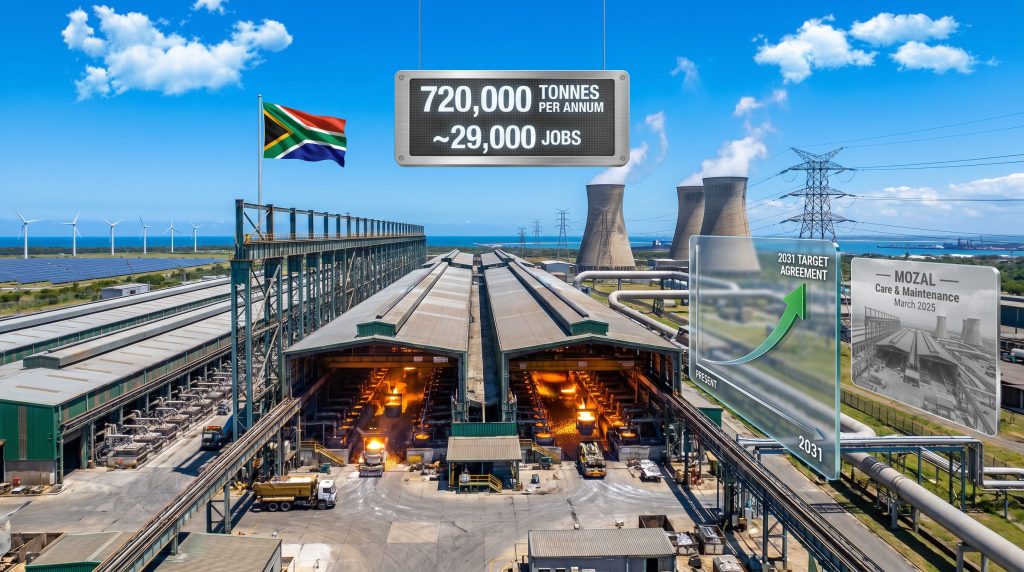
The strategic weight of the South32 and Eskom Hillside smelter power supply talks extends well beyond the facility's production volumes. According to a joint statement released by both parties in April 2026, Hillside supports 3,650 direct and indirect jobs on-site and contributes to an estimated 29,000 jobs across the broader South African economy through downstream processing, logistics, regional supply chains, and port operations at Richards Bay.
Approximately 30 percent of Hillside's annual aluminium output is sold domestically, supplying local fabricators, roll manufacturers, extrusion facilities, and packaging producers. This domestic orientation distinguishes Hillside from many other African smelters that operate primarily as export-focused assets, and it means that any reduction in Hillside's output creates immediate supply disruption for a range of downstream South African industries, not just a revenue gap for South32.
| Metric | Hillside Aluminium (Richards Bay, SA) | Mozal (Mozambique, closed March 2025) |
|---|---|---|
| Annual Output | ~720,000 tonnes | Pre-closure capacity not disclosed |
| On-Site Jobs (Direct + Indirect) | 3,650 | ~4,000 (direct + indirect, economy-wide) |
| Economy-Wide Jobs Supported | ~29,000 | Approx. one-third of Mozambique's manufacturing workforce |
| Domestic Sales Share | ~30% | Primarily export-oriented |
| Power Agreement Status | Under renegotiation (target: 2031) | Contract failure led to closure (March 15, 2025) |
| Years of Continuous Operation | 30 years as of 2026 | Multiple decades prior to closure |
The smelter's 30 years of continuous operation, noted publicly by South32 Chief Operating Officer Noel Pillay in April 2026, signals the depth of institutional investment the facility represents. Three decades of operational continuity in a country that has experienced chronic electricity supply instability is not a minor achievement. It reflects significant prior investment in supply security arrangements and a commercial relationship with Eskom that, while now requiring fundamental renegotiation, has historically functioned.
The Mozal Precedent: A Case Study in Negotiation Failure South32 Cannot Repeat
Before examining what the current Hillside negotiations might produce, it is essential to understand what went wrong in Mozambique. The Mozal smelter closure, effective March 15, 2025, followed years of trilateral negotiations between South32, Eskom (which supplied power to Mozambique through cross-border arrangements), and the Mozambican government. Those negotiations never produced a viable long-term electricity supply agreement.
The consequences were severe and immediate. Closure affected an estimated 4,000 direct and indirect jobs, a figure that reportedly represented roughly one-third of Mozambique's entire manufacturing workforce at the time. For a country with a fragile industrial base, the loss of Mozal was not a sector-specific setback. It was a macroeconomic shock.
Furthermore, as detailed in reporting on the Hillside smelter power talks, the Mozal closure has sharpened the urgency of reaching a workable framework for the remaining Southern African asset.
The Mozal closure is the most instructive available example of what happens when energy contract negotiations between a major industrial operator and a state utility reach an irreversible impasse. Both South32 and Eskom are acutely aware of this precedent as they structure the Hillside discussions.
What differentiates the current Hillside situation from the Mozal failure centres on several structural factors:
- Bilateral rather than trilateral structure: The Hillside negotiations involve South32 and Eskom directly, without the added complexity of a third sovereign government with its own fiscal interests and political constraints
- Formal governance mechanism: The establishment of a joint working group creates shared accountability and a defined decision-making architecture that the Mozal process apparently lacked
- Defined timeline with adequate runway: The 2031 target date provides approximately five years for infrastructure development, regulatory clearance, and contract finalisation, rather than open-ended talks with no terminus
- Eskom's evolving tariff flexibility: South32 CEO Graham Kerr noted publicly in February 2026 that Eskom had demonstrated greater flexibility on tariff structures compared to historical positions, reflecting changing supply-demand dynamics on South Africa's grid
- Post-Mozal urgency: With Hillside now South32's sole remaining Southern African aluminium asset, the reputational and commercial stakes of failure have intensified sharply
The Joint Working Group: Why Structure Matters More Than Intent
The establishment of a formal joint working group between South32 and Eskom to develop a new long-term electricity supply framework for Hillside represents a qualitatively different negotiating posture than what appears to have characterised the Mozal process. Governance architecture in complex infrastructure negotiations matters enormously. When parties operate through ad hoc discussions without clear mandates, escalation paths, or shared technical workstreams, prolonged stalemate is the most common outcome.
A joint working group structure implies several things that bilateral conversations do not:
- Shared technical analysis of energy options, grid capacity, and tariff modelling conducted jointly rather than adversarially
- Defined deliverables and milestones against which progress can be measured
- Escalation mechanisms that allow technical disagreements to be referred to senior decision-makers without collapsing the entire negotiation
- A collaborative framing that positions both parties as co-designers of a solution rather than opposing negotiators
The joint statement released by both organisations in April 2026 explicitly described the solutions being assessed as carrying the potential to benefit Eskom and its broader customer base beyond Hillside alone. This framing is analytically significant. It suggests that the working group's mandate extends beyond securing power for a single smelter and may function as a pilot framework for how South Africa structures energy contracts with large industrial consumers during the post-coal transition period.
Energy Solutions on the Table: What a Renewable-Backed Agreement Could Look Like
Several energy supply pathways are reportedly being assessed through the joint working group process. In addition, renewable energy solutions in mining are increasingly shaping how large industrial operators structure long-term power arrangements across the sector:
- Utility-scale renewable integration incorporating solar photovoltaic and wind generation as a primary or partial electricity source
- Nuclear baseload contribution as Eskom progresses its longer-term grid expansion plans
- Hybrid supply structures combining grid electricity with independent power arrangements to reduce Hillside's exposure to Eskom's legacy coal-heavy generation mix
- Tariff restructuring mechanisms that reflect both the commercial requirements of internationally competitive aluminium production and South Africa's energy transition trajectory
The carbon dimension of this conversation is increasingly consequential. The European Union's Carbon Border Adjustment Mechanism applies a cost penalty to carbon-intensive industrial imports, and primary aluminium produced using coal-dominated electricity carries a materially higher carbon intensity than aluminium smelted using renewable or nuclear power. As CBAM rates progressively increase through the late 2020s, Hillside's ability to access European export markets at competitive prices will depend partly on the carbon profile of its electricity source.
A renewable-backed power agreement would therefore serve dual purposes: securing competitive long-term electricity pricing and improving Hillside's carbon credentials in export markets. This convergence of commercial and environmental incentives strengthens the business case for both parties to reach a workable agreement. For instance, Rio Tinto's repowering of its Gladstone aluminium operations offers a comparable example of how major smelters are navigating the shift toward lower-carbon energy supply.
The next major ASX story will hit our subscribers first
Eskom's Shifting Commercial Posture Toward Industrial Customers
One of the less obvious dimensions of the South32 and Eskom Hillside smelter power supply talks is what they reveal about Eskom's evolving commercial strategy. For much of the 2010s and early 2020s, Eskom operated under conditions of acute supply scarcity, implementing rolling blackouts (locally termed loadshedding) that periodically extended to tens of thousands of hours of interrupted supply nationally. Under those conditions, large industrial customers had limited negotiating leverage.
As South Africa's generation capacity picture gradually improves through renewable energy additions and demand-side changes, Eskom's commercial relationship with large industrial consumers is shifting. Retaining anchor industrial customers with predictable, high-volume electricity demand becomes financially important for a utility that needs stable revenue to service its debt obligations and fund capital investment.
South32 CEO Graham Kerr noted in February 2026 that Eskom had demonstrated increased flexibility on tariff structures, attributing this shift partly to the progressive entry of renewable and nuclear capacity into the grid. This is a materially different commercial environment from the one that contributed to the Mozal impasse, and it creates conditions for a negotiated outcome that would have been structurally difficult to achieve in prior years.
Eskom CEO Dan Marokane described the partnership with South32 as long-standing and emphasised that the joint process aims to develop a solution that simultaneously supports industrial competitiveness and advances South Africa's transition toward a lower-carbon electricity system. This dual mandate framing positions the Hillside negotiations as consistent with, rather than in tension with, Eskom's broader strategic direction.
Three Scenarios for Hillside by 2031: A Risk-Calibrated Assessment
Any honest analysis of the South32 and Eskom Hillside smelter power supply talks must account for the range of possible outcomes. The 2031 target date provides meaningful but not unlimited runway. The following scenario framework reflects the structural factors that will determine which path materialises.
Scenario 1: Successful Long-Term Renewable-Backed Agreement
This outcome involves the joint working group finalising a structured power purchase arrangement incorporating renewable energy generation and grid supply before 2029, allowing sufficient lead time for infrastructure commissioning and regulatory approval before the 2031 target. Hillside continues full-capacity operations at 720,000 tonnes per annum through the 2030s, the 29,000 economy-wide jobs remain anchored to the facility, and South Africa retains its only primary aluminium production hub.
Scenario 2: Partial or Transitional Agreement with Capacity Constraints
This outcome involves the working group producing a transitional arrangement that covers partial power requirements, with full renewable integration delayed beyond 2031. Hillside operates at reduced capacity during a transition window, creating domestic aluminium supply disruption and placing some proportion of economy-wide employment under pressure. This scenario represents a suboptimal but recoverable outcome.
Scenario 3: Negotiation Breakdown and Phased Closure
Failure to reach agreement before or by the 2031 deadline triggers a Mozal-style transition to care and maintenance. South Africa loses its only primary aluminium smelter, with cascading effects across the KwaZulu-Natal industrial economy. Domestic aluminium supply becomes entirely import-dependent, and up to 29,000 economy-wide jobs are placed at risk.
| Scenario | Probability Assessment | Economic Impact | Job Exposure | Aluminium Supply Outcome |
|---|---|---|---|---|
| Successful Renewable-Backed Agreement | Moderate to High (given 2026 momentum and structured process) | Strongly positive | 29,000 jobs protected | Domestic supply maintained |
| Partial / Transitional Deal | Moderate | Mixed with partial disruption | Partial exposure | Capacity reduction risk |
| Negotiation Breakdown / Closure | Low to Moderate (Mozal precedent confirms the risk is real) | Severely negative | Up to 29,000 at risk | Full import dependency |
Disclaimer: The above scenario probability assessments represent analytical judgements based on publicly available information and structural indicators. They are not financial forecasts and should not be treated as investment advice. Outcomes will depend on variables including Eskom's grid development trajectory, renewable energy cost trends, global aluminium prices, and the political economy of industrial energy pricing in South Africa.
What This Negotiation Reveals About South Africa's Industrial Energy Future
The Hillside power talks carry implications that extend well beyond a single smelter. Energy-intensive industries across South Africa, including ferrochrome producers, steel manufacturers, and chemical processors, are watching this negotiation closely as a signal of whether Eskom can structure long-term contracts that balance commercial viability with decarbonisation objectives. However, broader market pressures are also at play; the impact of US aluminium tariffs on global supply chains has further complicated the operating environment for smelters dependent on export revenue.
A successful Hillside framework would establish a replicable model for industrial power contracting in the post-coal transition era, potentially attracting new industrial investment and retaining existing energy-intensive operations that have been evaluating relocation to lower-cost jurisdictions. Consequently, failure would accelerate the deindustrialisation trend that has already affected multiple sectors exposed to South Africa's historical supply instability.
The South32 and Eskom Hillside smelter power supply talks are therefore functioning simultaneously as a commercial negotiation, an industrial policy test, and a carbon transition experiment. The outcome will define not just Hillside's operational future but potentially the template through which South Africa manages its most electrically intensive industrial relationships for the remainder of the decade and beyond.
With Mozal gone and Hillside carrying the full weight of South32's Southern African aluminium ambitions, the stakes for both parties could not be more precisely defined. Furthermore, understanding how top aluminium mining companies are navigating similar energy transitions globally adds important context to the choices facing South32 and Eskom. A joint working group, a 2031 target, and a utility showing new commercial flexibility are meaningful ingredients. Whether they are sufficient will depend on the technical and commercial solutions that emerge from the process over the next two to three years.
Want to Stay Ahead of Major ASX Mineral Discoveries Before the Market Moves?
Discovery Alert's proprietary Discovery IQ model delivers real-time alerts on significant ASX mineral discoveries, instantly translating complex data across more than 30 commodities into clear, actionable insights for both short-term traders and long-term investors. Explore how historic discoveries have generated substantial returns by visiting Discovery Alert's dedicated discoveries page, and begin your 14-day free trial today to position yourself ahead of the broader market.