July 8, 2026
The Minerals Gap Reshaping American Industrial Strategy
For decades, the architecture of US critical mineral supply chains has been built on a foundation of import dependency rather than domestic production. Zinc sourced from Peru, manganese shipped from South Africa and Gabon, silver refined across multiple international jurisdictions. This geographic dispersal of supply may have once seemed like a feature of globalised trade efficiency, but shifting geopolitical conditions have reframed it as a structural vulnerability with real consequences for manufacturing competitiveness and national security.
Against this backdrop, the South32 Hermosa project Arizona environmental approval issued in July 2026 carries weight well beyond a single mining milestone. It represents the most advanced multi-mineral federal permitting outcome in recent US history, and the regulatory pathway it has carved may reshape how the country approaches domestic critical minerals production for years ahead.
When big ASX news breaks, our subscribers know first
Why Hermosa Is Structurally Different From Most US Mining Projects
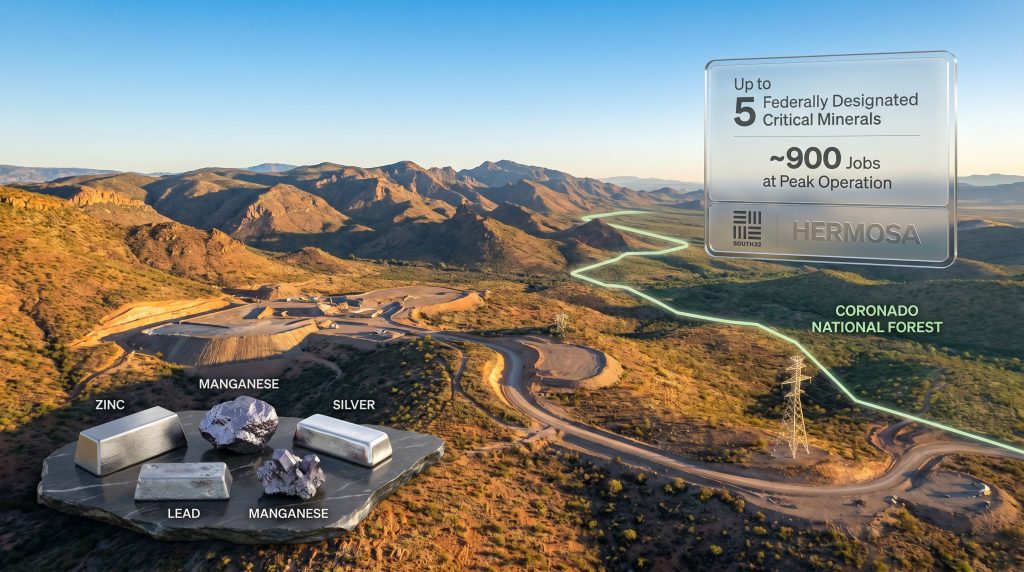
Most domestic mining projects in the United States are built around a single commodity. Hermosa is not. The Taylor sulphide deposit, which forms the core of South32's operation in Arizona's Patagonia Mountains roughly 80 kilometres south-east of Tucson, hosts a mineralised system capable of producing up to five federally designated critical minerals from a single operational footprint.
That convergence is geologically uncommon. Polymetallic mineral systems of this type tend to form in volcanogenic or sediment-hosted environments where zinc, lead, silver, and manganese mineralisation co-precipitate under specific hydrothermal conditions. The Taylor deposit's ore system delivers an unusual combination of metals that aligns precisely with 21st-century industrial demand, from galvanised steel infrastructure to emerging battery cathode chemistries.
The Mineral Portfolio and Why It Matters Strategically
| Mineral | Primary Industrial Use | US Import Dependency Risk |
|---|---|---|
| Zinc | Galvanisation, battery anodes | Moderate to High |
| Manganese | Steel alloys, EV battery cathodes | High |
| Silver | Electronics, solar panels | Moderate |
| Lead | Energy storage, industrial applications | Low to Moderate |
Manganese deserves particular attention in this context. While it has long been used in steel alloy production, its role in lithium-ion battery cathodes is growing rapidly. High-manganese cathode chemistries, including lithium manganese iron phosphate formulations, are gaining commercial traction as battery manufacturers seek to reduce cobalt and nickel content. The US currently has no meaningful domestic manganese mining capacity, making Hermosa's potential output strategically significant across both the steel and energy storage sectors.
Domestic zinc production has also declined substantially over recent decades. Output from historic producing regions has contracted, increasing reliance on imports from China, Peru, and Australia. A single project capable of producing zinc and manganese at scale represents a rare confluence of strategic value within a 750-acre surface footprint, a compact operational area by any industry standard.
Understanding the Federal Approval: What the ROD Actually Authorises
One of the most frequently misunderstood aspects of the South32 Hermosa project Arizona environmental approval is its precise scope. The US Forest Service's Final Record of Decision, which completed the federal National Environmental Policy Act review process, does not constitute blanket project authorisation. It is more targeted than that.
The ROD specifically unlocks development rights for ancillary infrastructure crossing Coronado National Forest land. Three categories of infrastructure were approved:
- A primary access road connecting the mine site to existing transport corridors through the Patagonia Mountains
- A secondary dry-stack tailings facility engineered to eliminate the need for conventional wet tailings impoundments
- A 138 kV power transmission corridor to be constructed by utility provider UniSource Energy Services across National Forest land
Hermosa's core mineral deposit sits on privately held land. Underground mining operations therefore fall outside Forest Service jurisdiction. This distinction is critical: the NEPA process was triggered specifically by the need to route surface infrastructure across adjacent federal territory. By the time the ROD was issued, construction on private land was already approximately 50% complete, meaning significant capital had already been deployed ahead of federal resolution.
South32 had previously secured all required state-level permits from the Arizona Department of Environmental Quality for surface infrastructure on private land, further demonstrating the layered, multi-jurisdictional nature of large-scale US mining approvals. Furthermore, South32's sustainability commitments at Hermosa have been central to the project's regulatory progress throughout this process.
FAST-41: A Permitting Framework That Hermosa Defined
Hermosa was the first mining project ever admitted to the FAST-41 programme, a federal framework originally established under the Fixing America's Surface Transportation Act to improve permitting coordination for nationally significant infrastructure projects. Its inclusion set a precedent that has since been followed by 57 additional mining projects admitted during the current administration.
A commonly held misconception in the industry is that FAST-41 functions as a shortcut that reduces environmental scrutiny. The Hermosa experience demonstrates the opposite: the framework improved interagency coordination and accountability while keeping every element of environmental review fully intact, including public comment periods, Tribal consultation processes, and comprehensive impact assessments.
What FAST-41 actually delivered for Hermosa was structured timeline discipline across multiple federal agencies simultaneously. Without such coordination, parallel agency reviews can create bottlenecks where one agency's delay holds up the entire permitting chain. FAST-41 addressed this by imposing accountability mechanisms that kept the process moving without compressing the quality of review.
For Washington policymakers, Hermosa's journey through this framework is increasingly cited as evidence that rigorous environmental standards and efficient permitting timelines are not mutually exclusive goals. US Senator Ruben Gallego publicly characterised the project as an economic asset not only for Santa Cruz County but for national energy security as a whole. This aligns closely with the broader critical minerals strategy being pursued at the federal level to reduce import dependency.
The 135+ Mitigation Commitments: Environmental Engineering at Scale
South32 committed to more than 135 individual conservation, mitigation, and monitoring measures as conditions of the approval. These were developed collaboratively over multiple years with federal agencies, Indigenous Tribal representatives, and local stakeholder groups. The breadth of these commitments reflects both the complexity of operating near protected federal land and the elevated standard that FAST-41 projects are expected to meet.
Several of these commitments represent genuine engineering innovation rather than standard compliance:
- The dry-stack tailings facility design is central to Hermosa's water management strategy. Unlike conventional wet tailings dams, which store processed rock material in water-saturated impoundments, dry-stack systems mechanically dewater tailings before placement. This dramatically reduces the risk of impoundment failure and eliminates the large water volumes associated with traditional tailings storage.
- Hermosa is designed to operate using approximately 90% less water than comparable regional mining operations, a critical competitive advantage in Arizona's water-stressed environment where aquifer depletion and interstate water rights disputes represent genuine long-term constraints on industrial development.
- Biodiversity protection, air quality monitoring, and land rehabilitation frameworks are embedded across the mitigation package, extending the project's environmental accountability well beyond construction into operational and post-closure phases.
Active Regulatory Complications That Investors Must Understand
The positive headline of the South32 Hermosa project Arizona environmental approval must be read alongside two active regulatory complications that add material uncertainty to the project's near-term execution timeline.
Compliance Issues Summary
| Compliance Issue | Regulatory Body | Status | Risk Level |
|---|---|---|---|
| Particulate matter permit revision | EPA and ADEQ | Directed for revision mid-2025 | Moderate |
| Antimony discharge exceedance | ADEQ | Under investigation late 2025 | Moderate to High |
| NEPA federal review | US Forest Service | Final ROD issued July 2026 | Resolved |
| State surface permits | ADEQ | Approved for private land | Resolved |
The first issue involves the US Environmental Protection Agency directing ADEQ to revise Hermosa's Clean Air Act permit within 90 days of mid-2025, citing inadequate provisions for particulate matter monitoring. Dust management is a particularly sensitive compliance area in arid mining environments where fine particulate generation during blasting, haulage, and crushing operations can affect air quality across considerable distances.
The second issue is more serious from a governance perspective. In late 2025, ADEQ launched a formal investigation after discharge from the site exceeded permitted antimony concentration limits. The complicating factor is not only the exceedance itself but South32's failure to report the event within the mandatory five-day notification window. Consequently, the broader antimony supply risks associated with this incident have drawn wider industry attention, given antimony's growing strategic importance.
These regulatory complications do not negate the significance of the ROD milestone, but they do introduce execution risk that any investor or analyst tracking the project should factor into their assessment of construction and operational timelines.
The next major ASX story will hit our subscribers first
The 45-Day Objection Period: What Happens Before the Decision Is Final
Despite the issuance of the Final Record of Decision, the approval is not yet fully binding. A formal 45-day objection period follows the Draft Record of Decision, during which affected parties may lodge formal objections. This is followed by a further 45-day resolution period before the Forest Service can issue its final binding determination. The final decision is anticipated later in 2026.
Parties with standing to object include:
- Environmental organisations with established presence in the Coronado National Forest region
- Tribal nations engaged through the consultation process who may seek additional protective conditions
- Adjacent landowners or water rights holders in the Patagonia Mountains area
If objections are sustained, the Forest Service may require modifications to infrastructure routing, additional mitigation conditions, or enhanced monitoring requirements. A supplemental environmental review is considered a low-probability outcome given the depth of the completed NEPA process, but it cannot be entirely discounted. Hermosa's progress through federal permitting has, however, been widely recognised as a benchmark for the broader sector.
Economic Scale and Community Impact Projections
South32 projects Hermosa will support up to 900 direct jobs during peak operational periods, with broader economic multiplier effects flowing through Santa Cruz County and surrounding communities over multiple decades. For a county of Santa Cruz's size and economic profile, this represents transformative employment scale.
How Hermosa Compares to Peer Projects
| Project Attribute | Hermosa (South32) | Typical US Critical Mineral Project |
|---|---|---|
| Critical minerals produced | Up to 5 federally designated | 1 to 2 |
| Permitting framework | FAST-41 (first mining project) | Standard NEPA |
| Conservation commitments | 135+ measures | Varies widely |
| Water use reduction target | ~90% vs regional peers | No standard benchmark |
| Employment at peak | ~900 jobs | 200 to 600 typical |
| Surface footprint | 750 acres | Project dependent |
Scenario Analysis: If Hermosa reaches full operational capacity producing zinc, manganese, and silver simultaneously, the project could meaningfully reduce US import dependency for at least two federally designated critical minerals within a single supply chain node. That outcome carries direct implications for domestic manufacturing cost structures and defence industrial base resilience, both areas of growing policy interest in Washington. In addition, the broader critical minerals demand trajectory driven by the energy transition continues to strengthen the long-term investment case for projects of this type.
What Hermosa Signals for the Broader US Critical Mineral Sector
Beyond its direct output potential, the South32 Hermosa project Arizona environmental approval establishes several precedents worth tracking at the industry level.
First, it demonstrates that polymetallic projects with complex multi-agency permitting requirements can navigate the US regulatory system to a federal decision within a commercially viable timeframe when proper coordination frameworks are applied. Second, it establishes a template for how mining projects can engage Indigenous Tribal nations, environmental stakeholders, and federal agencies in a structured, multi-year process that strengthens rather than compromises the final outcome. Third, the dry-stack tailings and water efficiency commitments represent a design standard that future projects operating in arid western US environments may increasingly be expected to match.
For investors, Hermosa's regulatory journey offers a framework for evaluating other advanced US critical mineral projects: permitting structure, stakeholder engagement quality, water management design, and compliance track record are now demonstrably significant variables in project execution risk assessment, not peripheral considerations.
Disclaimer: This article is intended for informational purposes only and does not constitute financial or investment advice. Forecasts, scenario analyses, and projections referenced in this article involve inherent uncertainty. Readers should conduct independent due diligence before making any investment decisions. Regulatory outcomes and project timelines remain subject to change.
Want to Identify the Next Major Critical Mineral Discovery Before the Market Does?
Discovery Alert's proprietary Discovery IQ model delivers real-time alerts on significant ASX mineral discoveries — instantly transforming complex geological data into actionable investment insights for both short-term traders and long-term investors. Explore historic examples of exceptional mineral discovery returns and begin your 14-day free trial today to position yourself ahead of the broader market.