July 20, 2026
When Commodity Cycles Force a Reckoning: The Portfolio Transformation Playbook in Mining
Large-scale mining companies rarely transform themselves voluntarily. History shows that portfolio restructuring at the major miner level almost always follows a combination of prolonged commodity price divergence, shifting energy transition demand curves, and the recognition that capital is being misallocated across commodities with structurally different long-term outlooks. The decision to shed an entire commodity vertical is not a routine capital recycling exercise. It is a strategic bet on which metals will matter most in the decades ahead.
That is precisely the lens through which South32 operating results and the Alcoa aluminium sale should be understood. Rather than reading this as a simple divestment, investors with a longer time horizon should treat it as a fundamental re-rating event — one that compresses South32's exposure into a tighter, more thematically coherent portfolio built around the metals most critical to electrification, grid infrastructure, and industrial modernisation. Furthermore, the role of critical minerals for the energy transition makes this strategic pivot especially timely.
When big ASX news breaks, our subscribers know first
The Architecture of the Alcoa Transaction
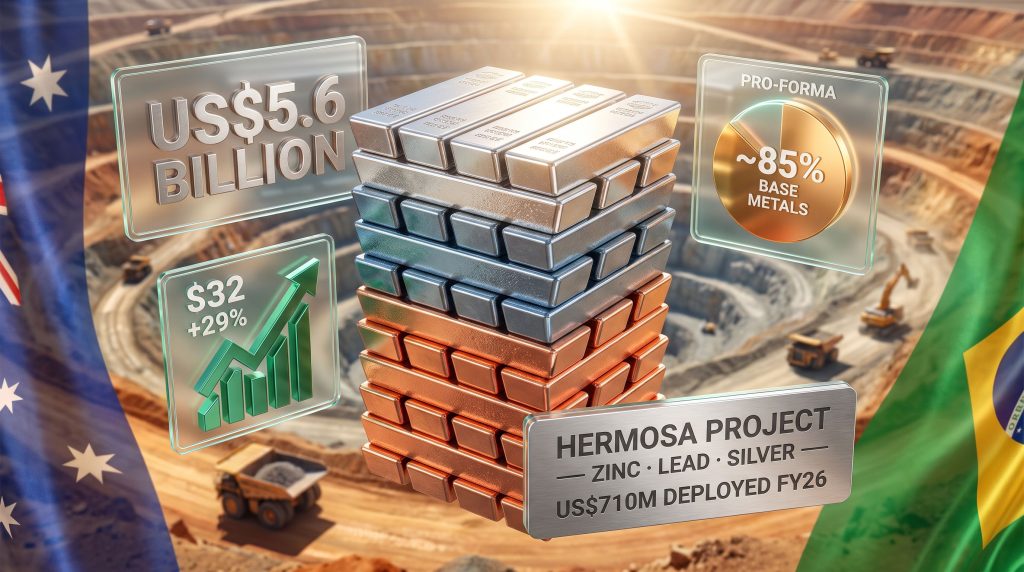
The transaction structure is more nuanced than a headline figure suggests. South32 has agreed to divest the substantial majority of its aluminium value chain to Alcoa Corporation, encompassing bauxite mining, alumina refining, and aluminium smelting operations spread across Australia, Brazil, and South Africa. According to Alcoa's official announcement, the implied enterprise value of the deal reaches up to US$5.6 billion, but the payment mechanics deserve careful examination.
The consideration is structured across three distinct tranches:
- Approximately US$3.1 billion in upfront cash, providing immediate balance sheet certainty.
- Approximately US$1.0 billion in Alcoa shares, specifically 17 million newly issued shares, giving South32 ongoing exposure to aluminium price upside through an equity stake in the acquirer.
- Up to US$750 million in contingent payments, linked to alumina and aluminium benchmark prices over a four-year window post-completion, ensuring South32 participates in any sustained commodity price appreciation.
Additionally, approximately US$1.2 billion in rehabilitation provisions transfer to Alcoa as part of the transaction, relieving South32 of long-dated environmental obligations that would otherwise weigh on future cash flow allocation.
What Stays and What Goes
| Asset Category | Transaction Outcome |
|---|---|
| Australian Bauxite and Alumina | Divested to Alcoa |
| Brazilian Aluminium Operations | Divested to Alcoa |
| South African Aluminium Assets | Divested to Alcoa |
| Mozal Aluminium, Mozambique | Retained by South32 |
The exclusion of Mozal Aluminium from the transaction is worth noting. Mozambique carries a distinct sovereign and operational risk profile given the country's documented history of civil instability. Investors should monitor Mozal as a residual exposure that sits outside the clean base metals narrative South32 is constructing.
The transaction is expected to close in the second half of FY27, subject to South32 shareholder approval and regulatory clearances across multiple jurisdictions. In addition, South32's aluminium value chain sale documentation confirms that Alcoa anticipates extracting approximately US$900 million in net present value synergies from integrating these assets into its existing global operations, reflecting meaningful operational complementarity.
The Timing Question: Why Exit Aluminium Now?
This is perhaps the most strategically interesting dimension of the deal. Alumina prices surged by approximately 45% in the year prior to this transaction announcement, materially elevating the earnings contribution of South32's aluminium segment. Divesting into a period of elevated commodity prices, rather than at the trough of a cycle, is a textbook approach to maximising exit valuation.
"The structure of the deal, incorporating both upfront cash and contingent price-linked payments, reflects a calculated approach. South32 captures immediate high-valuation proceeds while retaining exposure to any further aluminium price appreciation through Alcoa equity and contingent payment mechanisms."
This contrasts with the more common pattern of miners divesting non-core assets during downturns when valuations are compressed. The aluminium exit at a moment of sector strength, combined with the reinvestment of proceeds into copper, zinc, and silver growth assets, demonstrates a deliberate top-of-cycle monetisation strategy. Consequently, understanding commodity prices and mining performance becomes essential context for evaluating this decision, as the relationship between commodity prices and mining performance directly shapes the strategic rationale here.
South32 FY26 Operating Results: A Scorecard Across the Portfolio
The South32 operating results for FY26 revealed consistent outperformance across the core retained operations, lending credibility to management's conviction that the base metals portfolio can sustain production growth momentum independent of aluminium.
| Operation | FY26 Outcome | Guidance Performance |
|---|---|---|
| Sierra Gorda (Copper) | Record annual distributions of US$401M | Exceeded by 2% |
| Australia Manganese | Above guidance | Exceeded by 1% |
| South Africa Manganese | Above guidance | Exceeded by 4% |
| Cannington (Silver-Lead-Zinc) | Strong operational output | On track |
| Group Q4 Sales Volumes | +15% quarter-on-quarter | ~US$200M working capital released |
Sierra Gorda: The Copper Engine Gaining Altitude
Sierra Gorda, South32's copper joint venture in Chile, delivered record annual cash distributions of US$401 million in FY26, exceeding production guidance by 2%. This is not a marginal outperformance. For a large-scale copper operation, consistent guidance beats at this scale signal genuine operational maturity and cost discipline.
Copper's structural demand outlook underpins why this asset sits at the centre of South32's retained growth story. The ongoing copper supply crunch continues to outpace new supply development, with project lead times of 10 to 15 years from discovery to production meaning that existing producing assets like Sierra Gorda carry scarcity value that pure-play exploration companies cannot replicate quickly.
Manganese: Dual-Geography Outperformance
Both Australian and South African manganese operations exceeded FY26 guidance, with South Africa delivering the stronger beat at 4% above target. Manganese's relevance extends beyond traditional steelmaking. High-purity manganese sulphate is an essential input for lithium-ion battery cathode chemistries, particularly LNMO formulations gaining commercial traction in next-generation battery architectures.
This dual demand profile — traditional steel plus emerging battery end markets — provides manganese with a more durable long-term demand foundation than its historic steel-only characterisation suggests. However, a key operational variable to watch at Australia Manganese is water management, as intermittent water-related disruptions have affected operations and FY27 guidance is expected to be updated with South32's upcoming results release.
Hermosa: The Arizona Growth Lever
South32's most capital-intensive near-term growth project is Hermosa, a zinc-lead-silver development located in Arizona, United States. During FY26, the company deployed approximately US$710 million into Hermosa, reflecting serious construction-phase momentum. Thorough mining project feasibility work underpins this confidence, with critical US permitting milestones progressing on schedule.
The project is central to South32's stated ambition of achieving 55% production growth from currently approved projects. Hermosa's commodity mix — zinc, lead, and silver — aligns well with both industrial demand cycles and the energy transition, as silver's industrial demand in photovoltaic solar panel manufacturing continues to grow with global solar installation rates.
Growth Roadmap: Key Catalysts to Monitor
| Growth Asset | Primary Commodity | Current Phase |
|---|---|---|
| Sierra Gorda Expansion | Copper | Capacity expansion underway |
| Hermosa Project | Zinc, Lead, Silver | Construction, permitting advancing |
| Cannington Open-Pit | Silver, Lead, Zinc | Development planning stage |
The Cannington open-pit development represents the next operational evolution for one of South32's most established assets. Transitioning from underground to open-pit mining at Cannington would alter the cost structure and mine life trajectory meaningfully, and progress here deserves monitoring alongside Hermosa.
Portfolio Transformation: Before and After
The most significant investor implication of the Alcoa transaction is the resulting shift in South32's earnings composition. The table below illustrates the scale of this transformation on a pro-forma basis:
| Earnings Source | Pre-Divestment (Approx.) | Post-Divestment (Pro-Forma) |
|---|---|---|
| Base and Precious Metals | ~50-60% | ~85% |
| Aluminium Value Chain | Significant contributor | Negligible (Mozal residual only) |
| Manganese | Retained | Retained |
A portfolio generating approximately 85% of EBITDA from base and precious metals is a fundamentally different investment proposition than a diversified miner with meaningful aluminium exposure. The re-rating potential is genuine, as investors applying a diversified miner valuation multiple to South32 pre-transaction may find that post-completion, the company more appropriately attracts multiples benchmarked against focused copper and energy transition metal producers.
The next major ASX story will hit our subscribers first
Capital Returns: The Shareholder Distribution Picture
South32 returned US$327 million to shareholders during FY26, combining ordinary dividends and on-market share buybacks. The prospective fully franked special dividend of approximately US$500 million, conditional on completion of the Alcoa transaction, represents a material additional return for Australian shareholders.
Franking credits carry real value for Australian resident investors operating within a dividend imputation system, effectively eliminating or reducing the tax payable on that distribution depending on the investor's marginal rate. Furthermore, the combined FY26 shareholder returns and prospective special dividend underscore South32's capital discipline at a moment when many miners face pressure to demonstrate tangible returns rather than accumulating cash for speculative acquisitions.
Share Price Performance: A Re-Rating Already Underway
| Metric | South32 (ASX: S32) | S&P/ASX 200 Index |
|---|---|---|
| 12-Month Share Price Change | +29% | +1% |
| Relative Outperformance | +28 percentage points | Benchmark |
The 29% gain in South32 shares over the prior twelve months against a benchmark that returned approximately 1% is not incidental. It reflects a market that has begun pricing in the strategic value of portfolio simplification, production guidance beats across multiple operations, and the capital return signals embedded in the South32 operating results and the Alcoa aluminium sale structure.
Leadership Continuity: Reading the CEO Transition Signal
Matt Daley assumed the CEO role on 1 July 2026, succeeding long-serving predecessor Graham Kerr. In the mining industry, CEO transitions at pivotal strategic moments often signal either acceleration or reversal of the incumbent strategy. However, the Alcoa transaction and continued Hermosa investment suggest strong strategic continuity, with execution velocity appearing to be the primary variable under new leadership rather than directional change.
Capital allocation discipline and a focused base metals identity are expected to remain the defining pillars of South32's strategic framework through the FY27 period and beyond.
Key Risks Investors Should Not Overlook
No investment thesis is complete without an honest assessment of the risk profile. South32's transformation carries several material uncertainties:
- Mozal residual risk: Mozambique's political and social environment introduces sovereign risk that is difficult to quantify and cannot be fully hedged through operational adjustments.
- Commodity price sensitivity: While the Alcoa deal is structured to capture aluminium upside through contingent payments and equity, South32's retained portfolio remains deeply exposed to copper, zinc, and silver price cycles.
- Hermosa permitting and construction risk: Large greenfield developments in regulated jurisdictions carry inherent schedule and cost uncertainty. Any delays would impact the 55% production growth target materially.
- Water management at Australian Manganese: Operational disruption from hydrological variability represents a near-term earnings risk that management has flagged as an ongoing variable requiring active monitoring.
- Regulatory and shareholder approval for the Alcoa transaction: The deal does not constitute a done deal until shareholder approval and multi-jurisdictional regulatory clearances are obtained.
This article contains general information only and does not constitute financial advice. Past performance is not a reliable indicator of future returns. Investors should seek independent professional advice tailored to their personal financial circumstances before making investment decisions.
Frequently Asked Questions: South32 FY26 Results and Alcoa Deal
What did South32 sell to Alcoa?
South32 agreed to divest the majority of its aluminium value chain, covering bauxite mining, alumina refining, and aluminium smelting across Australia, Brazil, and South Africa, to Alcoa Corporation for an implied enterprise value of up to US$5.6 billion. Mozal Aluminium in Mozambique was retained.
How is the Alcoa deal payment structured?
The total consideration comprises approximately US$3.1 billion in cash, US$1.0 billion in Alcoa shares (17 million newly issued), and up to US$750 million in contingent payments tied to alumina and aluminium price benchmarks over four years. Around US$1.2 billion in rehabilitation provisions also transfer to Alcoa.
When will the South32 and Alcoa transaction complete?
Completion is expected in the second half of FY27, pending South32 shareholder approval and regulatory clearances across relevant jurisdictions.
What percentage of South32's earnings will derive from base metals post-transaction?
On a pro-forma basis, approximately 85% of EBITDA is projected to come from base and precious metals — primarily copper, zinc, silver, and lead — following completion of the divestment.
Did South32 meet FY26 production guidance?
South32 exceeded guidance at Sierra Gorda by 2%, Australia Manganese by 1%, and South Africa Manganese by 4%. Group Q4 sales volumes rose 15% quarter-on-quarter, releasing approximately US$200 million in working capital.
What shareholder returns did South32 deliver in FY26?
South32 returned US$327 million through ordinary dividends and on-market buybacks during FY26, with a further approximately US$500 million fully franked special dividend planned upon Alcoa transaction completion.
Want to Track the Next Major ASX Base Metals Discovery Before the Market Does?
Discovery Alert's proprietary Discovery IQ model scans ASX announcements in real time, instantly identifying significant mineral discoveries across copper, zinc, silver, and the critical metals driving the energy transition — the very commodities reshaping portfolios like South32's. Explore historic discoveries and their exceptional market returns, then begin your 14-day free trial to position yourself ahead of the next transformative find.