August 5, 2026
Southeast Asia's emergence as a major aluminum production hub reflects fundamental shifts in global industrial strategy, as Chinese producers navigate domestic capacity constraints while positioning for evolving trade patterns. The region's southeast asia aluminium production expansion represents more than simple capacity addition – it demonstrates how resource endowments, combined with strategic capital deployment, can rapidly reshape established supply chains. Furthermore, this transformation aligns with broader mining industry evolution trends that emphasise regional diversification and sustainable development.
The region's bauxite reserves provide the foundation for integrated value-chain development, while established industrial park models offer proven frameworks for rapid capacity scaling. This convergence creates conditions that extend beyond traditional commodity extraction into sophisticated manufacturing ecosystems.
Regional Market Position and Strategic Importance
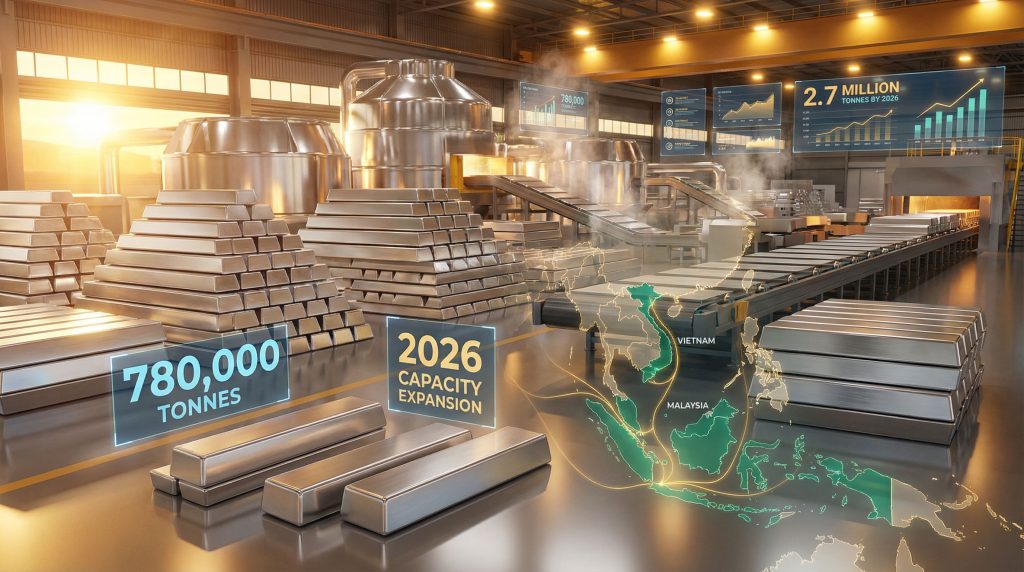
Southeast Asia's aluminum sector represents a fundamental shift in global production geography. The region's 1.92 million tonnes of output in 2025 is projected to surge to 2.7 million tonnes by 2026, representing a 40% annual increase that positions ASEAN among the world's fastest-growing aluminum production zones.
This expansion reflects strategic positioning advantages that extend beyond simple cost competitiveness:
- Abundant bauxite reserves: Indonesia alone holds approximately 2.5 billion tonnes of proved reserves, representing 8% of global resources
- Proven industrial development capability: Successful nickel value-chain integration over the past decade demonstrates execution capacity
- Strategic geographic positioning: Proximity to major Asian consumption markets reduces logistics costs
- Regulatory stability: Established mining codes and investment frameworks support large-scale capital deployment
The competitive landscape reveals Malaysia's established leadership through Press Metal's 1.08 million tonnes annual capacity, while Indonesia emerges as the primary growth driver with 705,000 tonnes of new capacity additions expected in 2026. Vietnam's market entry through the Dak Nong project represents geographic diversification that extends aluminum production into previously untapped regional markets.
When big ASX news breaks, our subscribers know first
Investment Flow Analysis and Capital Deployment
Chinese capital deployment in Southeast Asia reflects strategic supply chain diversification rather than opportunistic expansion. Multiple conglomerates, including Tsingshan, Xinfa, and Lygend, are establishing integrated production facilities that leverage Chinese technical expertise with local resource access and regulatory advantages.
Key Investment Projects and Structures:
| Project | Developers | Capacity (tonnes/year) | Investment Model |
|---|---|---|---|
| Kaltara Phase 1 | Adaro-Lygend | 500,000 | State-private partnership |
| Juwan IWIP | Tsingshan-Xinfa | 250,000 | Pure private venture |
| Taijing IMIP | Tsingshan-Xinfa | 600,000 | Integrated facility model |
| Dak Nong Vietnam | Joint venture | 150,000 | New market entry |
These partnerships demonstrate hybrid financing structures that combine foreign capital and technology with local regulatory navigation and resource concession advantages. The state-backed model through Indonesia's Adaro provides regulatory legitimacy, while pure private structures enable faster decision-making and operational autonomy.
The strategic motivation derives from China's approaching 45 million tonnes annual aluminum production capacity cap, driving proactive supply-chain resilience planning. This represents coordinated sectoral strategy aligned with state-level industrial policy objectives rather than isolated commercial decisions.
Indonesia's Industrial Transformation Strategy
Indonesia's vertical integration approach leverages the country's abundant bauxite reserves to construct integrated supply chains spanning extraction through value-added processing. This strategy mirrors successful nickel sector development, establishing proven capability for coordinating multi-stage industrial expansion. Moreover, the approach aligns with international mining decarbonisation benefits by creating opportunities for cleaner production methods.
2026 Production Capacity Architecture:
| Facility | Developer | 2026 Output | Full Capacity | Status |
|---|---|---|---|---|
| Kaltara Phase 1 | Adaro-Lygend | 280,000 tonnes | 500,000 tonnes | Operational ramp-up |
| Juwan IWIP | Tsingshan-Xinfa | 250,000 tonnes | 250,000 tonnes | Q1 2026 commissioning |
| Taijing IMIP | Tsingshan-Xinfa | 180,000 tonnes | 600,000 tonnes | Q3 2026 commissioning |
The bauxite-to-aluminum value chain encompasses multiple conversion stages:
- Bauxite extraction from domestic geological formations
- Alumina refining through Bayer process conversion
- Primary aluminum smelting via Hall-Héroult electrolytic reduction
- Value-added processing into fabricated products and industrial components
Export performance demonstrates market capture success. Primary aluminum shipments grew 71% year-over-year to 414,600 tonnes in January-October 2025, while value-added product exports increased 40% to approximately 111,000 tonnes. China remains the dominant destination, absorbing 191,500 tonnes or 46% of total export volumes.
Export Market Distribution:
| Destination | Volume (tonnes) | Market Share | Strategic Role |
|---|---|---|---|
| China | 191,500 | 46% | Primary processing hub |
| South Korea | 65,787 | 16% | Manufacturing integration |
| Vietnam | 42,284 | 10% | Regional supply chain |
| Turkey | 35,896 | 9% | European gateway |
Vietnam's Market Entry Dynamics
Vietnam's aluminum sector entry through the Dak Nong project represents significant geographic expansion in Southeast Asia's production landscape. The facility's 150,000 tonnes annual nameplate capacity targets 75,000 tonnes initial output in 2026, with Phase 1 operations commencing in Q2 2026.
This market entry demonstrates several strategic advantages:
- New production geography: Reduces regional supply concentration risk
- Local market access: Positions for domestic automotive and construction sector growth
- Export platform development: Leverages Vietnam's established trade networks
- Regulatory framework: Government incentives support aluminum processing development
The project's location provides access to regional consumption markets while maintaining export capability to established Asian aluminum trading centers. Vietnam's manufacturing sector growth, particularly in electronics and automotive assembly, creates domestic demand potential that supports integrated production planning.
Malaysia's Market Leadership Consolidation
Press Metal maintains Southeast Asia's largest integrated aluminum production capacity at 1.08 million tonnes annually, with expectations for sustained 100% capacity utilisation through 2025 and 2026. The company's operational excellence across Bintulu facilities demonstrates proven capability for high-efficiency production management.
Strategic positioning advantages include:
- Hydro-powered operations: Sarawak facilities leverage renewable energy for low-carbon product differentiation
- European market access: Products qualify as low-carbon under EU carbon border adjustment mechanism (CBAM) requirements
- Operational efficiency: Consistent high-capacity utilisation rates demonstrate management excellence
- Market leadership: Established relationships with regional and international customers
The Bintulu complex operates 960,000 tonnes across two integrated sites, while Mukah facility contributes 120,000 tonnes annually. This geographic distribution provides operational redundancy and logistics optimisation benefits.
CBAM compliance positioning becomes increasingly valuable as European regulations tighten carbon border requirements effective January 1, 2026. Press Metal's hydro-powered operations provide significant competitive advantages for European market access compared to coal-powered alternatives.
Supply Chain Economics and Cost Structure Analysis
Regional competitiveness derives from multiple cost structure advantages that extend beyond simple labour arbitrage. Energy generation models, logistics optimisation, and resource proximity create sustainable competitive positioning for the expanding sector. Additionally, projects like the Julimar West Bauxite Project demonstrate how regional resource development enhances supply chain economics.
Power Generation Models:
- Coal-fired captive plants: Dominant supply source with cost volatility risks
- Renewable alternatives: Long lead times and high capital requirements limit adoption
- Grid stability: Industrial-scale demand management challenges
- Energy security: Captive generation reduces external supply dependencies
Indonesian facilities predominantly rely on coal-fired captive power plants, while Malaysia's Sarawak operations leverage hydroelectric resources. This energy mix differentiation creates distinct market positioning opportunities, particularly for carbon-conscious European customers.
Logistics and Transportation Advantages:
- Port proximity: Coastal facility locations optimise export logistics
- Shipping route efficiency: Strategic positioning on major Asian trade lanes
- Inland connectivity: Raw material and finished product movement infrastructure
- Regional integration: ASEAN trade facilitation mechanisms reduce administrative barriers
Production cost competitiveness reflects multiple factor inputs. Energy typically represents 35-40% of aluminum smelting costs, making power pricing and reliability critical determinants of operational economics. Labour costs provide additional advantages, though skilled workforce development remains essential for complex industrial operations.
The next major ASX story will hit our subscribers first
Export Market Dynamics and Trade Flows
Southeast Asia's aluminum export patterns reflect both regional consumption growth and established global trade relationships. Indonesia's 71% export growth demonstrates rapid market capture capability, while destination market diversification reduces single-country dependency risks. However, these patterns remain subject to commodity prices impact on overall industry performance.
Indonesian Export Performance (January-October 2025):
- Total primary aluminum exports: 414,600 tonnes (+71% year-over-year)
- Value-added products: 111,000 tonnes (+40% year-over-year)
- Export value growth: Demonstrates both volume and price improvements
- Market diversification: Reduced single-destination concentration risk
Trade flow analysis reveals China's continued dominance as a processing hub, absorbing nearly half of Indonesian primary aluminum exports. However, growing South Korean (65,787 tonnes) and Vietnamese (42,284 tonnes) volumes demonstrate regional supply chain integration development.
Monthly Export Trends:
The progression from 114,645 tonnes in Q1 to 140,027 tonnes in Q3 2025 demonstrates consistent market expansion. This growth pattern reflects both production ramp-up at new facilities and market development success across multiple destination countries.
Turkey's emergence as a 35,896 tonne market demonstrates European connectivity, while Malaysia (22,394 tonnes) and Thailand (20,702 tonnes) represent regional manufacturing integration opportunities.
Value-Added Processing Integration
Chinese value-added product (VAP) producers have expanded Indonesian operations significantly over the past eighteen months, seeking supply chain diversification ahead of potential domestic capacity constraints. This trend creates downstream demand for primary aluminum output, potentially reducing export dependence.
Integration Strategy Benefits:
- Supply chain security: Reduces disruption risks from single-source dependencies
- Margin capture: Value-added processing generates higher returns than commodity sales
- Market positioning: Finished products access broader customer bases
- Technology transfer: Advanced processing capabilities support local capability development
The integration model involves Chinese producers establishing regional VAP facilities that purchase local primary aluminum for conversion into fabricated products. This creates captive demand for Indonesian smelter output while building regional manufacturing ecosystems.
Product categories under development include:
- Aluminum extrusions for construction and automotive applications
- Sheet and plate products for packaging and transportation sectors
- Wire and cable applications for infrastructure development
- Specialty alloys for aerospace and high-performance applications
Infrastructure Challenges and Bottleneck Analysis
Power supply constraints represent the most significant limitation to expanded aluminum production capacity. Coal dependency creates environmental compliance risks and cost volatility, while renewable energy transition faces substantial lead time and capital requirement challenges.
Power Infrastructure Bottlenecks:
- Coal plant environmental compliance: Stricter emissions standards increase operating costs
- Grid stability concerns: Industrial-scale aluminum smelting demands consistent power supply
- Renewable energy transition: Long development timelines for hydroelectric and solar projects
- Captive power requirements: Large-scale smelters typically require dedicated generation capacity
Indonesia's Net Zero 2060 roadmap commits to renewable energy integration, but practical implementation faces significant infrastructure development requirements. Aluminum smelting typically demands 13-15 MWh of electricity per tonne of production, making energy security critical for operational reliability.
Transportation and Logistics Infrastructure:
- Port capacity expansion: Growing export volumes require enhanced handling capabilities
- Inland transportation networks: Raw material and finished product movement efficiency
- Storage and warehousing: Inventory management for production planning optimisation
- Regional connectivity: ASEAN trade facilitation implementation
Environmental permitting represents another constraint, particularly for land use and forestry compliance requirements. Large-scale industrial development faces scrutiny from environmental regulators and local communities, requiring comprehensive stakeholder engagement strategies.
Regulatory and Environmental Compliance Framework
Indonesia's regulatory environment balances industrial development objectives with environmental protection requirements. The Net Zero 2060 roadmap establishes framework conditions for sustainable aluminum production, while mining and forestry regulations govern resource extraction activities. Consequently, implementing effective mine reclamation innovation becomes crucial for long-term operational sustainability.
Key Regulatory Considerations:
- Environmental impact assessments for large-scale industrial projects
- Forestry permits for facilities requiring land conversion
- Mining concession compliance with extraction quotas and rehabilitation requirements
- International trade standards for destination market access
Recent policy developments demonstrate increased regulatory oversight. The government suspended certain nickel mining operations for lacking reclamation guarantees and seized lands from operators without proper forestry permits. These actions signal stricter enforcement of existing regulations across the metals sector.
Compliance Requirements:
- Environmental management: Waste treatment and emissions control systems
- Rehabilitation planning: Post-mining land restoration requirements
- Community engagement: Local stakeholder consultation and benefit-sharing
- International standards: Meeting destination market environmental requirements
Carbon border adjustment mechanisms in the European Union create additional compliance requirements for exporters seeking access to European markets. Low-carbon production methods provide competitive advantages, particularly for facilities utilising renewable energy sources.
Market Forces and Production Outlook
What drives continued expansion prospects?
Demand-side projections for 2026-2030 reflect several convergent trends that support continued southeast asia aluminium production expansion. Regional automotive sector recovery, construction industry growth, and rising middle-class consumption create sustained demand foundations. As analysed by Argus Media, the region's aluminum output trajectory demonstrates significant momentum.
Automotive Sector Recovery:
- Electric vehicle manufacturing expansion: Growing regional EV assembly capacity
- Lightweight materials adoption: Aluminum content per vehicle continues increasing
- Regional production growth: Automotive manufacturing relocating to Southeast Asia
- Supply chain localisation: OEMs establishing regional supplier networks
Construction industry demand reflects infrastructure development across ASEAN markets. Government infrastructure spending, urbanisation trends, and commercial real estate development create sustained aluminum consumption growth prospects.
Supply-Side Constraints and Opportunities:
Chinese capacity constraints drive continued regional investment interest. The 45 million tonnes annual production cap creates structural incentives for Chinese producers to establish overseas operations, supporting continued Southeast Asian expansion.
Technology transfer benefits enhance regional competitiveness through advanced smelting and processing capabilities. Chinese producers bring proven operational expertise that accelerates regional capability development and improves production efficiency.
Price and Profitability Dynamics
Global aluminum pricing influences regional profitability through London Metal Exchange (LME) benchmark relationships. Production cost advantages in Southeast Asia provide margin buffers during price volatility periods, while energy cost stability affects long-term competitiveness.
Cost Structure Comparison:
- Southeast Asian production costs: Typically $1,200-1,400 per tonne below European levels
- Energy cost advantages: Coal-fired power provides cost stability despite environmental concerns
- Labour cost benefits: Skilled workforce availability at competitive rates
- Logistics advantages: Proximity to Asian consumption markets reduces transportation costs
Currency and trade policy impacts create additional considerations. Exchange rate volatility affects export competitiveness, while potential tariff changes could alter trade flow patterns. Regional trade agreements provide some protection against protectionist policies.
Profitability Factors:
- Energy cost management: Power supply contracts and hedging strategies
- Operational efficiency: Capacity utilisation and maintenance optimisation
- Market positioning: Product differentiation and customer relationship management
- Risk management: Currency hedging and supply chain diversification
Strategic Implications for Global Markets
Supply chain diversification benefits extend beyond simple geographic risk distribution. Southeast Asian capacity development creates alternative supply sources that reduce market dependency on single-country production, enhancing global supply chain resilience. Moreover, this trend reflects broader patterns in Chinese strategic expansion across Southeast Asian markets.
Investment and Partnership Opportunities:
- Technology collaboration: Knowledge transfer and joint development projects
- Financial innovation: Project financing structures and risk-sharing mechanisms
- Market access strategies: Leveraging regional trade agreements for competitive positioning
- Sustainability integration: Low-carbon production methods and environmental compliance
Regional integration potential through ASEAN trade mechanisms creates operational advantages for facilities serving multiple markets. Reduced administrative barriers and harmonised standards support efficient regional supply chain development.
How will the market evolve through 2030?
Southeast Asia's 2.7 million tonnes baseline capacity in 2026 represents foundation infrastructure for continued expansion through 2030. Additional project development depends on market demand growth, regulatory stability, and continued Chinese investment interest.
Competitive landscape shifts reflect new market entrants and potential consolidation trends. Regional producers may pursue vertical integration strategies, while global aluminum companies evaluate Southeast Asian investment opportunities for supply chain diversification.
Environmental compliance integration becomes increasingly critical as carbon footprint considerations influence customer purchasing decisions and regulatory requirements. Low-carbon production capabilities provide sustainable competitive advantages in evolving global markets.
The transformation of Southeast Asia into a major aluminum production center demonstrates how resource endowments, strategic investment, and regulatory frameworks can rapidly reshape global commodity supply chains. This evolution continues influencing international trade patterns and industrial development strategies across the aluminum sector, positioning the region as a critical component of global southeast asia aluminium production expansion.
Interested in ASX Mining Investment Opportunities?
Discovery Alert provides real-time alerts on significant ASX mineral discoveries powered by its proprietary Discovery IQ model, helping investors identify actionable opportunities in the rapidly evolving metals and mining sector. Explore historic examples of exceptional mining discovery returns by visiting Discovery Alert's discoveries page and begin your 30-day free trial today to position yourself ahead of the market.