July 23, 2026
Mexico's Mining Regulatory Maze: How Southern Copper Navigated a Decade of Uncertainty to Unlock El Pilar
Few investment environments in Latin America test the patience of mining developers quite like Mexico's federal permitting architecture. A project can hold valid concessions covering thousands of hectares, clear environmental review hurdles under one administration, and then find itself in regulatory limbo within a single electoral cycle. This is not a hypothetical scenario. It is precisely the experience that shaped the long road toward securing the Southern Copper El Pilar permits in Mexico, a milestone that carries implications well beyond one company's project pipeline.
Understanding what the El Pilar approval actually means requires moving past the headline capex figure and examining the structural forces that delayed, complicated, and ultimately enabled this outcome.
When big ASX news breaks, our subscribers know first
Mexico's Federal Permitting Architecture: More Complex Than It Appears
The Multi-Agency Regulatory Gauntlet
Large-scale open-pit copper mining in Mexico does not answer to a single regulatory authority. Projects must navigate a layered approval process involving multiple federal agencies, each with distinct mandates, timelines, and political sensitivities. The mining permitting realities in this context are far more demanding than most investors initially anticipate.
- SEMARNAT (Secretariat of Environment and Natural Resources) issues the Environmental Impact Authorization (known by its Spanish acronym MIA), which is the cornerstone permit for any major surface disturbance operation.
- CONAGUA (National Water Commission) controls water use concessions, a particularly consequential approval for copper projects in arid northern Mexico where water scarcity is a structural constraint, not a seasonal one.
- The Secretariat of Economy manages mineral concession titles, which grant the right to explore and extract but do not, by themselves, authorise surface operations or water use.
- State and municipal authorities retain jurisdiction over access roads, land use zoning, and certain environmental monitoring requirements that layer on top of federal approvals.
What makes this architecture especially challenging for developers is that each agency operates on its own internal timeline, and approval from one body provides no guarantee of expedited review at another. A project can be fully authorised for environmental impact purposes while simultaneously blocked at the water concession stage, which is a scenario that has trapped multiple Sonoran projects in costly holding patterns.
Why the Sonora Corridor Adds Another Layer of Complexity
Sonora is Mexico's dominant copper-producing state, home to major operating mines including Buenavista del Cobre (also operated by Grupo México, Southern Copper's parent) and a concentration of development-stage projects that have drawn sustained international investment interest. However, the state's regulatory environment reflects tensions that go beyond standard permitting bureaucracy.
Water governance is the most acute pressure point. Sonora sits within the Sonoran Desert biome, and basin-level water availability declarations issued by CONAGUA can effectively freeze new mining approvals in specific hydrological regions regardless of a project's technical merit or economic scale. For SX-EW copper operations in particular, which rely on aqueous chemistry rather than dry pyrometallurgical processes, water access is not peripheral to the project design. It is central to the entire production model.
Indigenous consultation requirements under Mexican federal law add a further procedural dimension. Free, prior, and informed consultation (CPLI under Mexican regulatory terminology) obligations apply to projects affecting territories with indigenous community presence, and the adequacy of these consultations has been successfully challenged in Mexican courts, resulting in permit suspensions for projects that moved too quickly through this phase.
El Pilar Project: Technical Profile and What SX-EW Really Means
Core Project Parameters
| Parameter | Detail |
|---|---|
| Location | Sonora, Mexico |
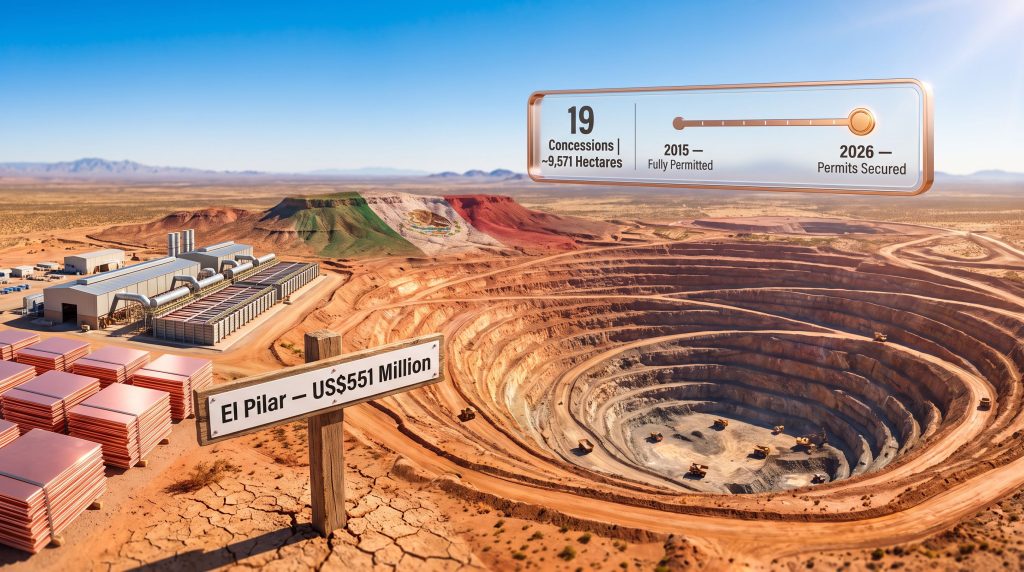
| Total Capital Expenditure | US$551 million |
| Mining Method | Open-pit |
| Processing Method | SX-EW (solvent extraction-electrowinning) |
| Land Tenure | 19 mineral concessions, approximately 9,571 hectares |
| Output | Copper cathodes (refined, LME-grade) |
| Operator | Southern Copper Corporation (majority owned by Grupo México) |
| Permit Status (July 2026) | Permits formally secured |
The SX-EW Distinction and Its Regulatory Implications
Solvent extraction-electrowinning is a hydrometallurgical process that recovers copper from oxide ores using acid leaching followed by selective chemical extraction and electroplating. Unlike conventional flotation-smelting circuits, SX-EW eliminates the need for a smelter on site and produces finished copper cathode directly. Furthermore, understanding the copper leaching process helps illustrate why this is a significant logistical and commercial advantage.
However, SX-EW carries its own regulatory footprint that is frequently underappreciated by non-technical observers:
- Acid management: The process relies on sulphuric acid solutions, which require containment infrastructure, spill response planning, and specific environmental authorisation conditions relating to soil and groundwater protection.
- Water consumption: Heap leach and SX-EW circuits consume substantial volumes of process water in closed-loop systems, but evaporation losses in hot, arid environments mean net water consumption is meaningfully positive, making CONAGUA concession approval a genuine bottleneck.
- Reagent logistics: Acid and organic extractant supply chains require road infrastructure capable of handling hazardous materials transport, which connects directly to the access road component of El Pilar's infrastructure requirements.
"SX-EW copper cathodes are registered as Grade A copper on the London Metal Exchange, meaning El Pilar's output would be directly tradeable at benchmark pricing without further refining. This is a commercially important distinction that supports project economics relative to concentrate-producing operations that face treatment and refining charge deductions."
A Decade of Delay: Tracing El Pilar's Regulatory Timeline
From 2015 Approval to 2026 Re-Authorisation
El Pilar's permitting history illustrates one of the most underappreciated risks in Latin American mining investment: the non-permanence of regulatory approvals across political cycles. According to Southern Copper's corporate history, the project was classified as fully permitted within Southern Copper's portfolio as early as 2015, suggesting the company had cleared the primary environmental and concession hurdles necessary to advance toward construction. Yet construction did not begin, and the project remained in development limbo for the better part of a decade.
The intervening years brought substantial changes to Mexico's policy environment for extractive industries. The administration of President Andrés Manuel López Obrador (2018 to 2024) adopted a posture toward private mining investment that was, at minimum, cautious and, in practice, resulted in a significant slowdown in the processing of new environmental authorisations for large-scale projects. Whilst no formal legislative moratorium on mining permits was enacted, the functional effect of reduced agency processing capacity, heightened environmental scrutiny, and shifting bureaucratic priorities produced what industry observers characterised as an informal approval freeze for new or lapsed permits.
CONAGUA's increasing use of water availability declarations to restrict new concessions in water-stressed basins compounded this dynamic, effectively closing approval windows in regions where new copper projects were most likely to be located.
By early 2026, Southern Copper's earnings communications indicated that El Pilar was advancing through technical and regulatory realignment processes, and by July 2026 the company confirmed that permits had been formally secured, clearing the path toward the next development stage.
| Period | Regulatory Status | Key Driver |
|---|---|---|
| 2015 | Classified as fully permitted | Initial authorisation under prior framework |
| 2018-2024 | Effective stall | Policy environment shift under López Obrador administration |
| 2024-2025 | Re-engagement with federal agencies | Change in administration; new regulatory dialogue |
| Early 2026 | Technical alignment progressing | Sheinbaum government engagement with mining sector |
| July 2026 | Permits formally secured | Re-authorisation confirmed |
What the Re-Authorisation Process Actually Involved
This is where the El Pilar story becomes instructive for investors and project developers across Latin America. The need for re-authorisation in 2026 was not a reflection of project failure. It reflected the structural reality that environmental impact authorisations in Mexico carry operational conditions, review periods, and expiry provisions that require active maintenance. A project that holds permits but does not advance toward construction within defined timeframes may find its approvals lapsed, conditioned on updated assessments, or subject to supplementary review under revised regulatory standards.
Environmental assessment frameworks in Mexico were updated between 2015 and 2026 to incorporate strengthened biodiversity protection standards, revised water impact assessment methodologies, and expanded indigenous consultation protocols. A project authorised under the older framework would require re-evaluation against these updated criteria before construction activity could lawfully commence.
"This is a pattern that repeats across Latin American jurisdictions. Permit receipt and construction readiness are not the same milestone, and the gap between them is often measured in years rather than months."
What the 2026 Approval Signals for Mexico's Investment Climate
Reading the Policy Signal Without Overstating It
The Sheinbaum administration, which took office in October 2024, has indicated a more pragmatic orientation toward private sector industrial investment than its predecessor, particularly in sectors relevant to Mexico's nearshoring opportunity and clean energy supply chains. Copper is directly relevant to both: it is an essential input for manufacturing facility electrical infrastructure and for the grid expansion required to support renewable energy integration.
The formal re-authorisation of Southern Copper El Pilar permits in Mexico is notable in this context, but investors should be careful about inferring too broad a policy shift from a single project outcome. El Pilar benefits from several factors that may not apply equally to all stalled mining projects in Mexico:
- Southern Copper and its parent Grupo México have deep institutional relationships within Mexico's federal government and long track records of large-scale mine operation in the country.
- El Pilar's relatively contained footprint (9,571 hectares across 19 concessions) and established SX-EW technology profile make it more straightforward to assess under environmental review than greenfield mega-projects.
- The project's US$551 million capex, whilst substantial, is modest compared to multi-billion-dollar developments like El Arco, reducing the political and financial risk calculus for approving agencies.
In addition, the Mexico mining disruption risks that have affected other operations in the region serve as a reminder that regulatory approval is only one dimension of operational security in this market.
Copper's Macro Position and Mexico's Strategic Calculus
Global copper demand forecasts consistently project supply deficits emerging by the late 2020s and deepening through the 2030s, driven by electrification of transport, grid-scale battery storage deployment, and renewable energy infrastructure buildout. The copper supply crunch documented by major commodity research houses confirms that the pipeline of new copper projects globally is insufficient to offset declining grades at existing mines and meet demand growth simultaneously.
Mexico produced approximately 750,000 tonnes of copper in 2023, placing it well behind Chile (approximately 5.3 million tonnes) and Peru (approximately 2.8 million tonnes) in the regional hierarchy. El Pilar, once operational, would add meaningful incremental capacity to Mexico's output, though its contribution relative to the global supply deficit would be modest in isolation.
Risks That Remain Between Permit Approval and First Copper Cathode
The Gap Between Authorisation and Production
Permit receipt is a necessary condition for El Pilar's advancement, but experienced Latin American mining investors will recognise it as far from sufficient. Several material risks remain:
- Water concession finalisation: CONAGUA approval for the specific volumes required for SX-EW operations in a water-stressed basin may involve conditions, volumetric caps, or compensatory measures that affect project economics.
- Access road and infrastructure authorisation: Water pipeline routing and road construction through Sonoran terrain may require additional environmental and land use approvals at the state level.
- Community relations continuity: Consultation obligations are ongoing, not one-time events. Community relations management throughout construction and commissioning will affect operational risk.
- Capital queue competition: Southern Copper's broader Mexican development pipeline includes the significantly larger El Arco project, which will compete for management attention and capital allocation. El Pilar's relatively smaller scale may work in its favour here, as it could be advanced without crowding out El Arco's longer development timeline.
- Political environment: Mexico's regulatory environment has demonstrated it can shift materially within a single presidential term. Investors should price this risk into long-duration project models rather than treating the current approval environment as permanently stable.
The next major ASX story will hit our subscribers first
Investment and Economic Dimensions of the El Pilar Decision
What US$551 Million in Capex Activates in Sonora
A copper project of El Pilar's scale generates economic activity well beyond its direct employment footprint. Construction phase activity typically activates local supply chains across civil engineering, earthworks, steel fabrication, electrical installation, and camp logistics. For Sonora, which already hosts significant mining services infrastructure from existing operations, El Pilar would represent an incremental but meaningful demand signal for regional contractors and equipment suppliers.
Southern Copper has a demonstrated track record of executing large copper projects within Mexican regulatory and physical environments. Buenavista del Cobre, the company's flagship Sonoran operation, is one of the world's largest copper mines by production volume, providing institutional knowledge and established contractor relationships that reduce execution risk for El Pilar relative to a new market entrant.
Portfolio Context: Where El Pilar Sits in Southern Copper's Development Pipeline
| Project | Location | Capex (Approx.) | Status (Mid-2026) | Key Feature |
|---|---|---|---|---|
| El Pilar | Sonora, Mexico | US$551 million | Permits secured | SX-EW cathode; manageable scale |
| El Arco | Baja California, Mexico | US$3+ billion | Permitting discussions ongoing | Large porphyry; high complexity |
| Tía María | Arequipa, Peru | ~US$1.4 billion | Advanced; community tensions ongoing | Long-contested; social licence challenged |
El Pilar's position in this portfolio as the most near-term, most permittable, and most capital-efficient option gives it a credible claim on priority within Southern Copper's near-term development sequencing. Consequently, those exploring copper investment strategies should monitor construction commencement timelines closely, as formal announcements have not been publicly confirmed as of mid-2026.
Disclaimer: This article contains forward-looking analysis and commentary based on publicly available information as of July 2026. It does not constitute investment advice. Regulatory timelines, capital allocation decisions, and project outcomes are subject to material uncertainty. Readers should conduct independent due diligence before making investment decisions related to any company or project discussed herein.
Want to Stay Ahead of the Next Major Copper Discovery on the ASX?
Discovery Alert's proprietary Discovery IQ model delivers real-time alerts on significant ASX mineral discoveries, instantly transforming complex mineral data into actionable insights for both short-term traders and long-term investors — explore historic discoveries and their returns to understand the scale of opportunity, then begin your 14-day free trial at Discovery Alert to position yourself ahead of the broader market.