June 17, 2026
The Long Game: Understanding Southern Copper's Patient Capital Approach to Tía María
Large-scale copper mining projects rarely follow straight lines. Between discovery, permitting, financing, and first production, decades can pass, social landscapes can shift, and market conditions can transform entirely. Among the most instructive examples of this reality in Latin America is the Tía María copper project in southern Peru — an asset that has tested the patience and conviction of one of the world's most formidable copper producers across more than a decade of setbacks, restarts, and regulatory turbulence.
What makes the Tía María story particularly compelling from an investment and strategic standpoint is not the delays themselves, but rather how Southern Copper Corporation has responded to them. Rather than retreating to the sidelines, the company has repeatedly committed capital to the project through long-dated debt instruments — a calculated posture that reveals as much about Southern Copper's balance sheet confidence as it does about its long-term view of copper demand drivers.
When big ASX news breaks, our subscribers know first
What the Tía María Project Actually Represents for Copper Markets
Situated in the Arequipa region of southern Peru, Tía María is a copper oxide deposit designed for production via solvent extraction-electrowinning, commonly known as SX-EW. This hydrometallurgical processing method is particularly suited to oxide ore bodies and produces high-purity copper cathodes without requiring a smelter, which meaningfully reduces both the capital intensity and the emissions footprint relative to conventional sulphide processing routes.
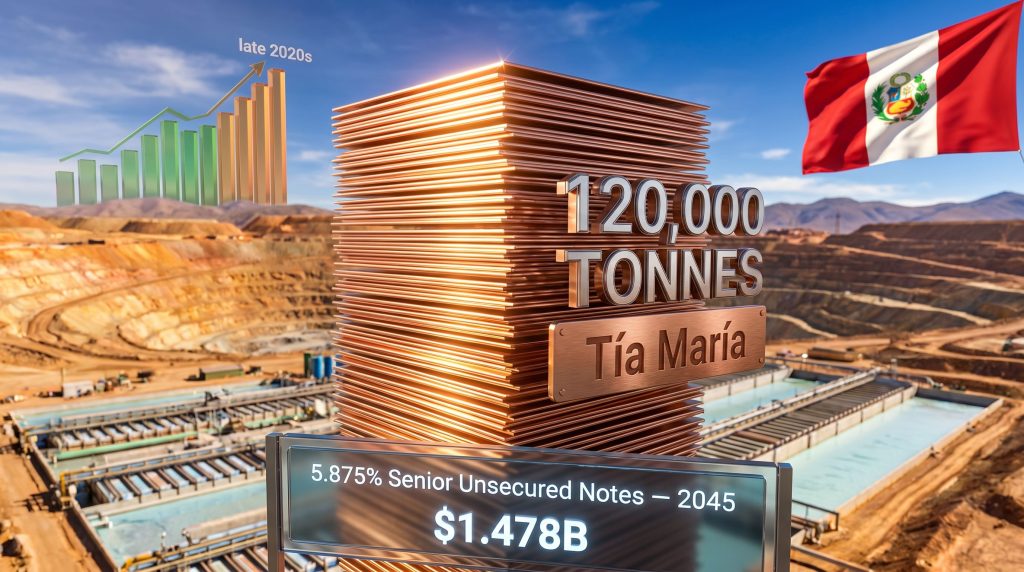
The project is budgeted at $1.802 billion in total capital expenditure and is designed to produce 120,000 tonnes of copper cathodes annually at full capacity. To contextualise that figure: Peru typically produces around 2.7 to 2.8 million tonnes of copper per year in total, placing it in the top tier of global producers alongside Chile. Tía María's projected output would represent approximately 4 to 5% of Peru's current national production — a meaningful addition to both country-level export volumes and global refined copper supply.
From a product quality perspective, SX-EW cathodes produced by Tía María would meet Grade A copper cathode specifications — the highest standard for refined copper traded on the London Metal Exchange. This product form commands consistent demand from wire rod mills, electrical component manufacturers, and transformer producers, giving the output a clearly defined commercial pathway without any intermediate processing dependency.
SX-EW Technology: Why the Processing Method Matters for Investors
The choice to develop Tía María as an SX-EW operation is not purely technical. It carries significant commercial and risk-management implications that are often overlooked in mainstream coverage. Furthermore, understanding the copper leaching benefits helps contextualise why this method is increasingly favoured:
- SX-EW operations typically have lower operating costs per tonne than conventional concentrator-smelter-refinery chains, because acid heap leaching and electrowinning avoid the energy-intensive pyrometallurgical steps
- The absence of smelting infrastructure also means the project does not require offtake agreements with third-party smelters, giving Southern Copper full control over the production-to-market pathway
- Copper cathodes from SX-EW operations are directly deliverable against LME contracts, providing price transparency and liquidity for the output
- The sulphuric acid required for heap leaching can, in some configurations, be sourced from nearby smelter operations, though Tía María would primarily rely on acid procurement logistics given its geographic setting
The 2026 Southern Copper Tía María Project Debt Issuance: Structure and Strategic Logic
In mid-2026, Southern Copper launched a 5.875% Senior Unsecured Note offering with a maturity date of 2045, raising approximately $1.478 billion in proceeds. The primary allocation of funds is directed toward Tía María development, with secondary allocations covering broader capital expenditure across Southern Copper's existing portfolio and general corporate purposes including working capital.
| Financing Parameter | Detail |
|---|---|
| Instrument Type | Senior Unsecured Notes |
| Coupon Rate | 5.875% per annum |
| Maturity Date | 2045 |
| Principal Amount | ~$1.478 billion |
| Interest Schedule | Semi-annual payments |
| Primary Use of Proceeds | Tía María project development |
| Secondary Uses | General capex and working capital |
The selection of a senior unsecured structure is deliberate and strategically important. By not pledging specific project assets as collateral, Southern Copper preserves maximum operational flexibility during the pre-construction phase — a period when regulatory status remains in flux. Secured project financing, by contrast, typically requires fully approved permits and construction-ready status as preconditions, making it unsuitable for an asset where permitting timelines remain uncertain.
The 19-year duration of the instrument is equally intentional. Mining debt with very long maturities is unusual in corporate finance, and its use here signals that Southern Copper is structuring its obligations to align with the entire productive life of the mine rather than concentrating repayment pressure in the early operational years.
Optional Redemption Features and Cross-Border Tax Provisions
Two embedded features within the note structure deserve attention from fixed-income investors:
- Make-whole call provisions allow Southern Copper to redeem the notes early at a premium calculated by discounting remaining cash flows at a treasury benchmark plus a spread, protecting the company's refinancing optionality without creating an outright call risk for bondholders in declining rate environments
- Par call provisions at specified dates closer to maturity allow redemption at face value, giving the issuer a cleaner exit mechanism as the notes approach their final years
- Peruvian withholding tax gross-up clauses ensure that if Peruvian tax authorities impose withholding on coupon payments to foreign noteholders, Southern Copper compensates investors so they receive the full contractual coupon net of any such deductions — a meaningful structural protection in an emerging market cross-border financing context
A Decade of Conviction: The 2015 Precedent That Frames the 2026 Issuance
The 2026 Southern Copper Tía María project debt issuance does not exist in isolation. In 2015, Southern Copper executed a $2.0 billion senior note offering that included $1.5 billion at the identical 5.875% coupon rate, also due in 2045. At that time, the company projected construction would commence almost immediately and reach completion around 2017.
That timeline collapsed under the weight of sustained community opposition, primarily from agricultural communities in the Tambo Valley who raised concerns about potential impacts on local water resources. The project entered years of regulatory and social uncertainty that effectively stranded the 2015 debt issuance against an unbuilt asset.
| Parameter | 2015 Issuance | 2026 Issuance |
|---|---|---|
| Total Offering Size | $2.0 billion | ~$1.478 billion |
| Coupon Rate | 5.875% | 5.875% |
| Maturity Date | 2045 | 2045 |
| Projected Start | 2015-2016 | Post-permit reinstatement |
| Project Status | Social conflict; permits contested | Permit revoked; under review |
The fact that Southern Copper is returning to capital markets with an identical coupon and maturity structure more than a decade later is not coincidental. It reflects a deliberate institutional memory and signals that the company views the original financing framework as sound and the asset as fundamentally viable, regardless of the intervening difficulties.
The willingness to carry the cost of long-dated debt against an asset without confirmed construction permits for extended periods is a form of real options investing. Southern Copper is effectively paying an option premium — structured as annual interest on $1.5 billion-plus — to retain the right to begin construction the moment regulatory conditions allow.
Permitting Turbulence: What the Revocation of the 2025 License Means
The Peruvian government granted a mining construction license for Tía María in October 2025, representing a significant milestone after years of regulatory uncertainty. However, that permit was subsequently revoked in early 2026, triggering a mandatory fresh review and returning the project to a state of regulatory limbo just months after what appeared to be a breakthrough.
This cycle of approval and revocation is not unique to Tía María within the Peruvian mining context. Peru has a long history of resource nationalism tensions and community consultation requirements under the framework of prior consultation laws applicable to indigenous and agricultural communities. Understanding this regulatory architecture is essential for assessing project risk:
- Environmental Impact Assessments (EIAs) in Peru require public consultation periods and are subject to challenge by affected communities and civil society organisations
- Mining construction licenses are a separate regulatory step that can be challenged independently of EIA approvals
- Community benefit-sharing agreements have become increasingly central to permit stability, with projects that lack robust social investment programmes facing heightened revocation risk
- Peru's Constitutional Tribunal and administrative courts have jurisdiction over permit challenges, creating multiple potential legal pathways for project opponents
The revocation of Tía María's 2025 construction license — and the company's decision to proceed with its debt issuance anyway — strongly suggests Southern Copper's legal and regulatory teams believe the revocation is procedurally reversible rather than substantively fatal. Indeed, this mirrors broader challenges seen across the copper supply gap facing producers throughout the region.
Southern Copper's Portfolio Context and What Tía María Adds
Southern Copper operates some of the most significant copper assets in Latin America, including the Cuajone and Toquepala mines in Peru and the Buenavista del Cobre mine in Sonora, Mexico. The company's consolidated copper production typically ranges between 900,000 and 1,000,000 tonnes per annum, placing it among the five largest copper producers globally by output.
Within this context, Tía María's projected 120,000-tonne annual output represents roughly an 8 to 10% incremental increase on current consolidated production — a material but not transformative addition in volume terms. The strategic value is arguably greater than the raw tonnage suggests, for several reasons:
- The project requires no new geographic or jurisdictional entry, operating within Southern Copper's established Peruvian operational and regulatory footprint
- SX-EW cathode production diversifies Southern Copper's output mix, which currently skews heavily toward concentrate from conventional sulphide ore processing
- The project's development creates no smelter dependency, insulating the company from third-party processing bottlenecks during periods of smelter capacity tightness — a dynamic that has periodically disrupted concentrate flows globally
The next major ASX story will hit our subscribers first
Supply-Side Timing and the Copper Deficit Thesis
One of the most consequential questions surrounding the Southern Copper Tía María project debt issuance is whether the project will achieve production in time to capitalise on the copper supply deficit widely projected for the late 2020s. The worsening copper supply crunch has led multiple commodity research houses and mining companies to flag a structural shortfall beginning around 2027 to 2030, driven by:
- Accelerating copper demand from electric vehicle drivetrain and battery systems, where a single battery electric vehicle uses approximately three to four times more copper than a conventional internal combustion vehicle
- Grid infrastructure expansion globally, including high-voltage transmission lines and substation build-out required for renewable energy integration
- A multi-year drought in new large-scale greenfield project approvals through the late 2010s and early 2020s, creating a pipeline gap that current development activity may not fill quickly enough
Disclaimer: Copper supply and demand projections involve significant uncertainty and are subject to revision based on macroeconomic conditions, technological change, and policy developments. The information above reflects broad industry consensus as of mid-2026 and should not be construed as investment advice.
If Tía María's permit is reinstated and construction commences in 2026 or early 2027, a typical three to four year construction timeline for an SX-EW operation of this scale would place first production in the 2029 to 2031 window — which aligns reasonably well with the projected peak deficit period. Further delays, however, risk pushing the project into a phase where the supply gap may already be narrowing through other project completions.
Key Takeaways for Fixed-Income and Copper Market Participants
The Southern Copper Tía María project debt issuance offers a multi-layered case study in long-cycle mining capital strategy. Furthermore, broader trends around copper project partnerships suggest this kind of institutional resolve is becoming increasingly common across the sector. Several themes stand out for different investor audiences:
For fixed-income investors:
- Southern Copper benefits from the credit support of parent company Grupo México — one of Latin America's largest diversified mining and infrastructure conglomerates — providing a robust backstop against project-level risk
- The 19-year duration creates meaningful interest rate and country risk exposure, partially mitigated by the gross-up provisions and optional redemption features
- The precedent of the 2015 issuance demonstrates that Southern Copper has successfully carried similar obligations through extended periods of project inactivity without default or restructuring
For copper market participants:
- Tía María's 120,000-tonne target represents pure refined cathode output, with no concentrate processing dependency, making it a clean addition to global refined copper supply once operational
- The project's SX-EW nature means its output would not displace smelter capacity or alter the global copper concentrate-to-cathode processing balance
- Continued regulatory delays into the late 2020s would meaningfully reduce Tía María's contribution to bridging the projected supply deficit, potentially supporting a more prolonged copper price premium
The overarching narrative of this project is one of institutional resolve meeting structural market opportunity. Whether that resolve is ultimately rewarded depends on variables that no debt prospectus can resolve: community consent, regulatory integrity, and the patience of capital markets participants measuring time in decades rather than quarters.
Want to Capitalise on the Next Major Copper Discovery Before the Market Does?
Discovery Alert's proprietary Discovery IQ model delivers real-time alerts on significant ASX mineral discoveries — instantly converting complex mineral data into actionable investment insights for both short-term traders and long-term investors. Explore historic examples of exceptional discovery returns and begin your 14-day free trial today to position yourself ahead of the market.