July 30, 2026
Titanium dioxide production faces mounting supply challenges as traditional rutile operations reach exhaustion phases across multiple mining jurisdictions. These supply constraints emerge precisely when aerospace, defence, and advanced manufacturing sectors demand superior titanium feedstock for next-generation applications. The convergence of tightening natural rutile availability with expanding industrial requirements creates strategic opportunities for large-scale deposits capable of delivering sustained production over decades, particularly following a major Sovereign Metals rutile resource upgrade.
Technical Specifications Drive Sovereign Metals Rutile Resource Upgrade Success
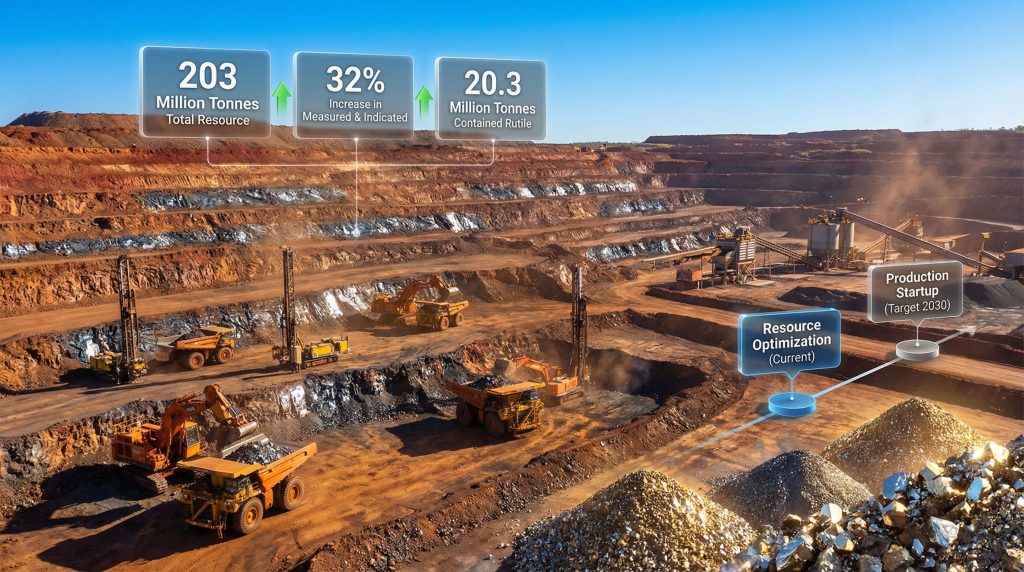
The latest mineral resource evaluation for Sovereign Metals' Kasiya project reveals substantial improvements in geological confidence classifications that significantly enhance project bankability. Total rutile resources expanded to 203 million tonnes, representing a 13% increase from previous assessments. More critically for project financing, measured and indicated resources grew by 32%, shifting substantial tonnage into higher-confidence categories preferred by mining engineers and financial institutions.
The measured resource classification alone encompasses 107 million tonnes at an average grade of 1.05% rutile, providing complete geological coverage for the projected six-year initial mining phase. This geological certainty reduces technical risk during the critical startup period when operational parameters undergo optimisation and safety protocols are established.
Resource Classification Breakdown:
| Category | Tonnage (Mt) | Average Grade | Confidence Level |
|---|---|---|---|
| Measured | 107 | 1.05% | Highest |
| Indicated | 1,545 | Variable | High |
| Inferred | 452 | Variable | Moderate |
Mining resource classifications follow the Joint Ore Reserves Committee (JORC) Code 2012 standards, which define measured resources as those supported by detailed geological mapping, comprehensive sampling programmes, and rigorous statistical analysis. These classifications provide the foundation for engineering design and financial modelling in project development phases.
Furthermore, the 32% increase in measured and indicated resources compared to the 13% overall resource growth demonstrates exploration success concentrated in higher-confidence categories. This pattern indicates that geological understanding has improved substantially across the deposit, rather than merely expanding lower-confidence inferred resources.
When big ASX news breaks, our subscribers know first
Global Rutile Supply Dynamics Create Strategic Positioning Opportunities
The Kasiya project contains approximately 20.3 million tonnes of contained rutile, representing 29 years of current global natural rutile production at existing consumption rates of approximately 700,000 tonnes annually. This scale positions the project as a potentially transformational supply source in global titanium feedstock markets.
Natural rutile production has historically concentrated in limited geographic regions, with legacy operations in Sierra Leone approaching end-of-life phases. Australian ilmenite operations produce rutile as byproducts, whilst Southeast Asian operations maintain variable output levels. This concentration creates genuine supply-risk conditions for major titanium consumers, contributing to the ongoing supply chain crisis.
Global Supply Context:
• Annual global rutile production: ~700,000 tonnes
• Kasiya contained rutile: 20.3 million tonnes
• Supply duration equivalent: 29 years at current demand
• Geographic concentration risk: High in ageing operations
Unlike synthetic rutile produced from ilmenite through chloride or sulphate processes, natural rutile commands premium pricing due to superior metallurgical properties in specific industrial applications. These applications include aerospace-grade specifications, defence applications requiring high-purity materials, and advanced manufacturing processes where material consistency is critical.
However, legacy rutile operations face operational challenges including mine depletion, infrastructure ageing, and periodic production suspensions. The Rutile Mining Limited operation in Sierra Leone has experienced production volatility, demonstrating vulnerability in current supply chains to operational disruptions in single-source regions.
Engineering Development Pathway Establishes Technical Milestones
The Sovereign Metals rutile resource upgrade follows structured technical progression from resource definition through production startup. The upgraded Mineral Resource Estimate provides the geological foundation for detailed engineering studies currently underway.
Development Timeline Framework:
Phase 1: Resource Optimisation (Completed Q1 2026)
• Upgraded Mineral Resource Estimate finalised
• Geological confidence categories improved
• Resource classification enhanced for financing
Phase 2: Project Financing (Late 2026-2027)
• Definitive feasibility study completion
• Environmental approval progression
• Offtake agreement finalisation with tier-one buyers
Phase 3: Construction Implementation (2027-2029)
• Infrastructure development programmes
• Processing plant construction
• Transportation network establishment
Phase 4: Production Startup (Target 2030)
• Commissioning and operational ramp-up
• Commercial production achievement
• Quality assurance system implementation
The definitive feasibility study phase transforms geological resource estimates into engineered mine plans with defined extraction sequences, processing flowsheets, infrastructure requirements, and detailed cost budgets. Financial institutions and equity investors rely on DFS completion to make funding commitments.
In addition, DFS deliverables typically include mine planning and scheduling, metallurgical and processing design, economic analysis with capital and operating expenditure projections, risk assessment and mitigation strategies, and project control frameworks. These studies achieve cost estimation accuracy of ±10-15% compared to ±30-50% for pre-feasibility assessments.
Production Capacity Analysis Reveals Scale Advantages
The scale of Kasiya significantly exceeds production capacity of existing individual rutile operations, enabling the project to function as a primary supply source rather than supplementary producer. This magnitude supports investment in dedicated infrastructure including processing facilities, logistics networks, and quality assurance systems.
Large-scale mining operations typically achieve superior unit economics through amortisation of fixed infrastructure costs across larger production volumes, procurement leverage for equipment and consumables, and sufficient scale to justify advanced processing technology investments. These advantages align with broader industry evolution trends toward consolidation and efficiency improvements.
Comparative Scale Metrics:
• Current global annual production: 700,000 tonnes
• Kasiya resource magnitude: 29x annual global output
• Single-asset supply duration: Multiple decades
• Infrastructure investment justification: Large-scale economics enabled
Major mineral operations demonstrate economic advantages of scale through dedicated port facilities, specialised rail infrastructure, and advanced processing plants. Iron ore operations in Australia achieve annual production ranging from 50-100 million tonnes, leveraging similar economics for heavy infrastructure investment.
Consequently, the deposit's 25-30 year projected mine life provides strategic advantage for long-term offtake agreements and supply chain planning by major consumers. This longevity enables industrial customers to integrate Kasiya production into long-term manufacturing strategies and capacity planning frameworks.
Market Positioning Benefits from Tier-One Buyer Engagement
Credible tier-one buyer interest provides technical and commercial advantages including product specification validation, quality standard confirmation, supply chain integration planning, and technical support during development phases. This early engagement reduces commercial risk and validates technical specifications of planned operations.
For instance, securing major buyer interest before production startup facilitates technical knowledge transfer and operational optimisation. Industrial customers can provide input on product specifications, quality requirements, and delivery scheduling that informs engineering design decisions during the DFS phase.
Strategic Partnership Benefits:
• Technical specification validation: Product meets end-user requirements
• Quality standard confirmation: Processing parameters optimised
• Supply chain integration: Logistics and delivery frameworks established
• Risk mitigation: Commercial uncertainty reduced through advance commitments
Furthermore, the aerospace sector's demand for titanium continues expanding due to strength-to-weight ratio advantages in next-generation aircraft and defence applications. Mitsui's recent offtake agreement demonstrates serious commercial interest from established industrial buyers. Robotics and precision engineering applications create additional demand drivers as these sectors scale industrial adoption.
What Makes Natural Rutile Particularly Valuable?
Natural rutile's superior properties compared to synthetic alternatives include higher titanium dioxide content, lower impurity levels, and optimal particle size distribution. These characteristics make it essential for high-performance applications where material consistency directly impacts product quality and safety specifications.
Financial Structure Considerations for Large-Scale Development
Mining project financing typically requires substantial measured and indicated resources to support loan structures and debt service capabilities. The Sovereign Metals rutile resource upgrade improves project bankability by providing higher geological confidence for financial modelling and cash flow projections.
Project Finance Requirements:
• Geological confidence: Measured resources support early mine life
• Economic parameters: DFS provides detailed cost and revenue projections
• Market risk reduction: Offtake agreements secure product sales
• Technical validation: Engineering studies confirm operational feasibility
Large-scale rutile projects require significant capital investment across mining equipment and infrastructure, processing plant construction, transportation and logistics networks, and environmental management systems. The scale of Kasiya enables capital deployment across multiple technical systems with justified economic returns, particularly when utilising proven capital raising methods.
However, capital expenditure for comparable mining projects typically ranges from hundreds of millions to over a billion dollars depending on processing capacity, infrastructure requirements, and geographic location factors. The DFS phase will establish detailed capital requirements and financing structures for the project.
How Does Resource Classification Affect Project Financing?
Higher geological confidence categories directly correlate with reduced financing costs and improved loan terms. Measured resources provide the most reliable foundation for cash flow projections, whilst inferred resources carry higher technical risk premiums that increase overall project financing costs.
The next major ASX story will hit our subscribers first
Supply Chain Transformation Implications for Global Markets
Kasiya's production scale could fundamentally alter global rutile supply dynamics, providing enhanced supply security for major consumers whilst potentially influencing pricing structures across titanium feedstock markets. The project's African location offers geographic diversification from traditional supply sources.
Long-Term Market Impact:
• Supply diversification: Reduced dependence on ageing operations
• Geographic risk reduction: Alternative supply source development
• Price stability potential: Large-scale production influence on market dynamics
• Innovation opportunities: Technical advancement in processing and logistics
Large-scale operations often drive technical innovations in mineral processing, transportation logistics, and environmental management that benefit broader mining industry applications. These innovations can include advanced separation technologies, automated mining systems, and sustainable processing methodologies showcased at events like the global resources expo.
Moreover, the strategic significance of natural rutile in aerospace, defence, and advanced manufacturing applications ensures continued demand growth even as supply sources consolidate around fewer, larger operations. This market evolution favours projects with Kasiya's scale and resource quality characteristics, particularly following the recent Sovereign Metals rutile resource upgrade.
What Are the Long-Term Implications for Global Titanium Markets?
The addition of Kasiya's substantial rutile resources to global supply portfolios could stabilise pricing volatility, reduce supply concentration risks, and enable expanded industrial applications previously constrained by material availability. This transformation supports broader adoption of titanium-intensive technologies across multiple sectors.
Investment Disclaimer: This analysis contains forward-looking statements and projections based on current market conditions and technical assessments. Mining projects involve significant risks including technical, operational, financial, and regulatory challenges. Resource estimates and development timelines are subject to change based on ongoing studies and market conditions. Investors should conduct independent research and consider professional advice before making investment decisions.
Looking to Capitalise on Major Mineral Discoveries?
Discovery Alert delivers instant notifications on significant ASX mineral discoveries using its proprietary Discovery IQ model, transforming complex geological data into actionable investment insights for both short-term traders and long-term investors. Explore historic examples of exceptional discovery outcomes and begin your 14-day free trial today to position yourself ahead of the market when the next major breakthrough is announced.