
June 14, 2026
The Anatomy of a Bubble Signal: Why Record IPOs Arrive at the Wrong Time
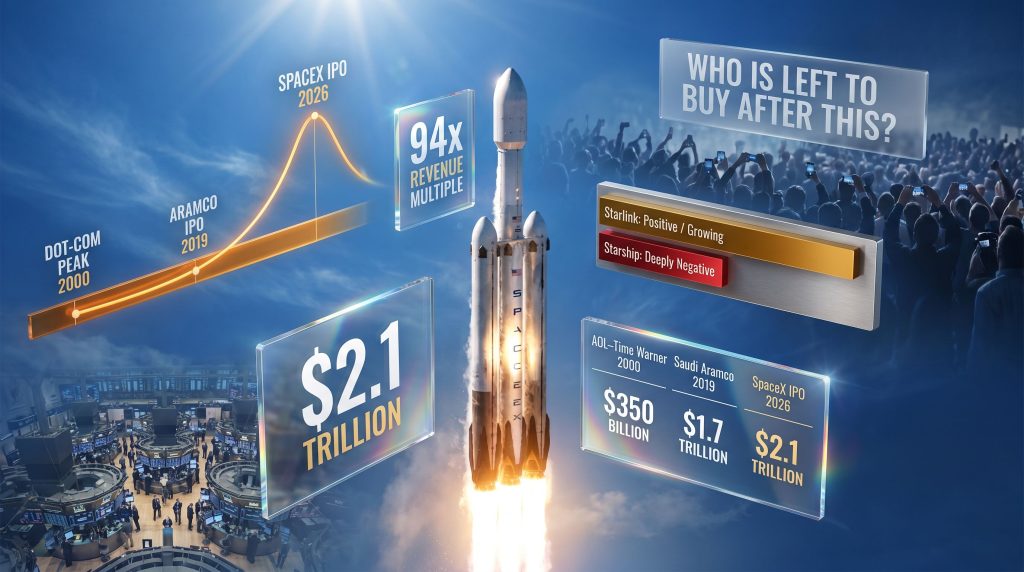
Market history has a way of repeating its most expensive lessons. The pattern is almost always the same: an extraordinary deal, celebrated by financial media and institutional cheerleaders alike, arrives at precisely the moment when the cycle has the most to lose. The SpaceX IPO, floated in June 2026 at a post-listing market capitalisation of approximately $2.1 trillion, fits this template with uncomfortable precision.
Understanding why requires stepping back from the excitement of the listing itself and examining the structural conditions that made it possible in the first place. SpaceX IPO bubble concerns are not merely the territory of contrarians and pessimists. They reflect a disciplined reading of valuation mechanics, market cycle analysis, and the historically documented behaviour of insiders during peak pricing environments.
When big ASX news breaks, our subscribers know first
What a $2.1 Trillion Valuation Actually Implies
The headline number alone is striking. At $2.1 trillion, SpaceX entered public markets as one of the most valuable listed entities on the planet. However, the more instructive figure is the revenue multiple embedded in that valuation: approximately 94 times annual sales.
To appreciate how extreme this is, consider the following context:
- Mature, high-performing technology companies typically trade between 5x and 20x revenue
- Even during the peak of the 2020–2021 speculative growth cycle, only a handful of software companies with exceptional recurring revenue profiles briefly touched multiples above 50x
- A 94x revenue multiple implies that investors are pricing in decades of hypergrowth, across multiple divisions, with essentially no margin of safety
The critical structural problem is that this multi-trillion-dollar valuation rests almost entirely on one profitable business unit. Starlink, SpaceX's satellite-based internet service, is the company's sole segment generating consistent earnings. Every other operational arm, including launch services, the Starship development programme, and defence-related contracts, is widely considered to be a significant consumer of capital rather than a contributor to it.
Segment-Level Profitability at a Glance
| Division | Estimated Profitability | Capital Intensity |
|---|---|---|
| Starlink (Satellite ISP) | Positive and growing | Moderate |
| Launch Services | Breakeven to negative | Very high |
| Starship Programme | Deeply loss-making | Extreme |
| Defence Contracts | Mixed results | High |
The analytical question that every serious investor must confront is straightforward: can Starlink's current and projected earnings trajectory justify a multi-trillion-dollar enterprise valuation on its own? Historical precedent suggests the answer is almost certainly no, at least not at the current entry price. Furthermore, Morningstar's detailed analysis of the upcoming IPO reinforces the view that the valuation demands extraordinary scrutiny from prospective investors.
The Insider Behaviour Signal Most Retail Investors Ignore
One of the most underappreciated analytical tools available to investors evaluating any IPO is the behaviour of the people closest to the business. When founders and early insiders choose to sell equity to the public at a given price, that decision carries information.
The logic is not complicated. Founders possess asymmetric information about their company's future prospects. If the founder of a company believed the equity was meaningfully undervalued at the IPO price, the rational behaviour would be to retain as much ownership as possible and allow public market appreciation to deliver returns. Choosing to sell to the public at a record valuation sends a different signal entirely.
"Strategic Insight: Sophisticated investors treat large-scale insider liquidity events at all-time-high valuations as meaningful data points, not noise. The person with the most information about a company's future is making a deliberate decision about price."
This dynamic is compounded by the float structure of the SpaceX listing, which market observers have noted is deliberately constrained. A small public float creates the appearance of strong demand in early trading, but it also sets the stage for significant selling pressure once insider lockup periods expire, typically between 90 and 180 days post-IPO.
Retail investors who purchase at IPO pricing are frequently the most exposed to this lockup expiry mechanism, as institutional participants often hedge or exit positions well before the expiry window opens. In addition, understanding bull vs bear markets helps contextualise why insider behaviour tends to intensify as cycles mature.
The AOL-Time Warner Parallel: Why Timing Is Everything
In January 2000, AOL, an internet company with roughly six million subscribers, completed its acquisition of Time Warner, one of the world's largest media conglomerates. Wall Street celebrated the transaction as a landmark moment for the digital age. Financial media coverage was overwhelmingly enthusiastic. The deal was described as transformational and visionary.
Within approximately two and a half years, equity markets had entered one of the most severe bear markets of the modern era, with broad indices losing more than half their value from peak to trough.
The structural lesson from that episode is not about the quality of either company involved. It is about timing. Landmark deals of unprecedented scale have a documented historical tendency to arrive at or near cyclical market peaks. Consequently, all three conditions — stretched valuations, enthusiastic institutional participation, and favourable media coverage — were present in June 2026 when SpaceX went public.
Five Historical Markers That Have Preceded Major Market Corrections
- Record-breaking IPO valuations attracting mainstream retail participation
- Compressed market volatility alongside elevated index levels
- Financial media coverage shifting decisively from scepticism to celebration
- Insider liquidity events executed at historically high multiples
- Capital crowding into a single dominant sector or narrative theme
All five of these markers were observable at the time of the SpaceX listing.
Dow Jones Volatility: The Market's Most Reliable Late-Cycle Indicator
One of the most compelling technical observations surrounding the SpaceX IPO involves the behaviour of equity market volatility. At the time of the listing, the Dow Jones Industrial Average was trading approximately 3% below its most recent all-time high, with daily volatility remaining historically compressed.
Market analysts who track long-term volatility cycles have identified a consistent pattern across every major equity market correction since 1960: each of the five most significant drawdowns was preceded by a measurable and sustained rise in daily volatility, specifically an increase in days where the Dow moved more than plus or minus 2% from the prior day's closing price.
The current low-volatility environment is textbook late-stage bull market behaviour. Complacency, by definition, peaks before reversals occur. When extreme volatility days finally return, they will arrive unannounced and accumulate rapidly, potentially pushing the Dow's 200-day moving average of daily volatility above the 1.00% threshold that has historically coincided with the onset of major corrections.
"Warning: Low volatility does not mean low risk. In fact, sustained low volatility in a late-cycle environment is often the precondition for the sharpest and most abrupt corrections, precisely because it encourages maximum complacency and leverage among participants."
Reviewing the broader stock market outlook helps frame these volatility dynamics within their wider cyclical context.
The FOMC Liquidity Factor and Valuation Inflation
The conditions that make a $2.1 trillion IPO possible do not emerge from organic business performance alone. A significant portion of the valuation inflation visible across equity markets in 2026 is attributable to the prolonged expansion of monetary liquidity by the Federal Reserve.
The March 2020 episode is instructive. When equity markets experienced a flash crash that month, the Federal Reserve responded by injecting approximately $2 trillion of liquidity into the financial system within a single month, whilst simultaneously beginning to purchase corporate debt for the first time in its history. This intervention did not merely stabilise markets — it created the monetary conditions for one of the most rapid and sustained asset price inflations on record.
The problem with liquidity-driven valuations is their inherent fragility. Unlike valuations anchored to earnings growth, cash flow generation, or competitive positioning, valuations inflated by monetary expansion depend on the continuation of that expansion. When liquidity conditions tighten, mean reversion in asset prices becomes a structural inevitability rather than a remote possibility. Furthermore, recession risk analysis underscores how quickly liquidity-dependent valuations can unwind once macro conditions shift.
The Broader Valuation Context
| Factor | Current Condition | Historical Risk Signal |
|---|---|---|
| Dow Jones distance from all-time high | Approximately 3% below peak | Near-peak exposure |
| Daily Dow volatility (200-day MA) | Below 1.00% | Low, late-cycle |
| Revenue multiple (SpaceX) | ~94x sales | Extreme speculative pricing |
| FOMC monetary environment | Historically accommodative | Liquidity-dependent valuations |
| Retail IPO allocation | Unusually large | Classic distribution signal |
The next major ASX story will hit our subscribers first
Who Bears the Real Risk: The Retail Allocation Problem
Commentary surrounding the SpaceX IPO has highlighted an unusually large retail allocation relative to comparable mega-cap offerings. Market analysts have characterised this structure as consistent with a pattern where sophisticated institutional sellers distribute shares to less-informed retail buyers near cycle peaks.
This dynamic operates through a mechanism sometimes described as the greater fool theory: the final buyers in a speculative cycle absorb the losses that earlier participants successfully avoided. Institutional investors, armed with superior access to pre-IPO information, lockup expiry timelines, and hedging instruments, are structurally better positioned than retail participants to navigate the post-IPO price discovery process.
The mathematical reality is stark. At 94x revenue, there is essentially no margin of safety built into the entry price. If Starlink's growth trajectory decelerates even modestly, or if broader market conditions deteriorate, the valuation compression potential is severe. SpaceX IPO bubble concerns are therefore most acute for retail participants entering at or near IPO pricing.
"Warning: Historical data consistently shows that retail investors entering high-multiple IPOs near market cycle peaks face the steepest and most prolonged drawdowns. A 94x revenue multiple requires perfect execution, sustained hypergrowth, and a continuously supportive macro environment to generate positive real returns from IPO pricing."
The Bull Case: Where the Optimistic Argument Has Genuine Merit
Intellectual honesty requires engaging with the bull case seriously. SpaceX occupies a genuinely unique market position at the intersection of satellite communications, AI infrastructure, and defence technology — three of the most heavily capitalised thematic categories in current institutional portfolios.
Founder-led growth narratives have demonstrated a sustained and documented ability to attract premium valuation multiples regardless of near-term profitability. However, some analysts, including those at GQG who warned about eye-watering valuations inflating a tech bubble, argue the real near-term risk is not an immediate post-IPO collapse but rather a prolonged period of speculative elevation, followed by a sharper correction once the broader IPO pipeline saturates available market capital.
Scenario Analysis: Three Potential Outcomes
| Scenario | Core Assumption | Implied Long-Term Outcome |
|---|---|---|
| Optimistic | Starlink reaches $15B+ revenue; multiple divisions approach breakeven by 2028–2029 | Valuation partially justified; modest long-term gains for patient holders |
| Bull Case Extension | SpaceX diversifies profitability across three or more divisions within five years | Strong long-term returns, but from a lower entry point than IPO pricing |
| Bear Case | Starlink growth decelerates; other divisions remain structurally loss-making | Significant valuation compression; potential 50–80% drawdown from IPO price |
The honest version of the bull case acknowledges that even if SpaceX ultimately becomes a legitimate multi-trillion-dollar business, the returns available to investors who buy at IPO pricing may be deeply inferior to those available to investors who wait for post-peak price discovery to create a more rational entry point.
SpaceX IPO Bubble Concerns: Key Questions Answered
What is SpaceX's post-IPO market capitalisation?
SpaceX reached approximately $2.1 trillion at listing, placing it among the most valuable publicly traded companies on the planet at the time of its debut.
Is SpaceX currently profitable?
The Starlink satellite internet division is the company's primary profit-generating segment. All other major operational divisions, including launch services and the Starship programme, are widely regarded as capital-intensive and currently loss-making.
What revenue multiple does the SpaceX IPO imply?
Analysts have cited a revenue multiple of approximately 94 times annual sales, a level significantly above the typical range for even the most aggressive high-growth technology valuations.
Why do contrarian analysts view this IPO as a bubble signal?
The combination of record-scale valuation, deliberately constrained float, elevated retail participation, historically compressed market volatility, and documented precedents showing that landmark IPOs tend to cluster near cyclical peaks all contribute to this analytical framework.
Should I buy SpaceX shares at IPO pricing?
This article does not provide financial advice. The analytical framework presented here suggests that investors evaluate the valuation multiple, float structure, lockup expiry timeline, insider behaviour signals, and broader market cycle positioning carefully before making any investment decision. Consulting a structured investment strategy framework before committing capital to high-multiple IPOs is strongly advisable.
Bull vs. Bear: The SpaceX IPO Debate Summarised
| Dimension | Bull Case | Bear Case |
|---|---|---|
| Valuation | Justified by long-term addressable market across space, AI, and defence | 94x revenue requires extraordinary sustained growth; no margin of safety |
| Profitability | Starlink provides a profitable core to build from | All non-Starlink divisions are structural cash drains at present |
| Market Timing | Strong institutional demand for AI-adjacent narratives supports near-term pricing | Record IPO at market peak mirrors every major historical bubble pattern |
| Retail Exposure | Broad public participation reflects genuine long-term interest | Small float and large retail allocation creates asymmetric downside risk |
| Insider Behaviour | Proceeds may be reinvested into future growth initiatives | Selling at record-high valuations is a textbook insider exit signal |
| Macro Environment | Monetary conditions remain accommodative and supportive | Liquidity-driven valuations are inherently fragile and historically mean-reverting |
A Framework for Evaluating High-Multiple IPOs in Late-Cycle Markets
Regardless of one's view on SpaceX specifically, the analytical discipline required to evaluate this listing applies to any high-multiple IPO arriving in a late-cycle market environment. Three questions provide the foundation for a rigorous assessment:
- What earnings trajectory is genuinely required to justify the entry price? At 94x revenue, model the downside scenario if growth disappoints by 20 or 30 percent. The resulting valuation compression is typically severe.
- Who is selling, and what does their decision reveal about expected future returns? Evaluate the lockup structure, the proportion of shares being sold by existing holders versus raised as new capital, and the overall float mechanics.
- What do the broader market volatility signals suggest about entry timing? Late-cycle environments characterised by compressed volatility, record issuance activity, and elevated index levels have historically been the worst entry points for high-multiple growth assets.
Many of the most celebrated technology companies of the past two decades, including Amazon, Apple, and Netflix, experienced post-peak drawdowns of 50 to 80 percent before resuming their long-term upward trajectories. Investors who exercised patience and waited for post-peak corrections frequently achieved returns that were vastly superior to those who bought at peak enthusiasm.
"Strategic Insight: The SpaceX IPO may well represent an extraordinary long-term business opportunity. The question is not whether the company is remarkable. It is whether the current entry price reflects that quality, or whether it reflects the final stages of a speculative cycle that has run further than fundamentals can support."
Key Takeaways
- SpaceX's $2.1 trillion IPO valuation at approximately 94x revenue places it in historically rare and extreme pricing territory
- Starlink is the company's only consistently profitable division; all other segments are capital-intensive and currently loss-making
- The AOL-Time Warner parallel from January 2000 illustrates how landmark deals of unprecedented scale have historically arrived at or near cyclical market peaks
- The small float structure combined with elevated retail allocation creates asymmetric downside risk, particularly once insider lockup periods expire
- Dow Jones daily volatility remains historically compressed, consistent with late-stage bull market behaviour and the complacency that has historically preceded major corrections
- Federal Reserve liquidity expansion has played a central role in creating the valuation conditions that make a $2.1 trillion IPO possible, but liquidity-driven valuations are structurally fragile
- The bull case has genuine merit for patient, long-term investors, but the risk-adjusted case for buying at IPO pricing remains deeply unfavourable by historical standards
Further Exploration: Readers seeking additional context on market cycle analysis, IPO valuation frameworks, and long-term monetary dynamics may find independent analysis and market commentary at Gold-Eagle.com, which regularly publishes perspectives on equity market conditions, monetary policy, and alternative investment themes.
Want To Spot The Next Major Mineral Discovery Before The Market Does?
While speculative mega-cap IPOs dominate headlines at record valuations, Discovery Alert's proprietary Discovery IQ model is quietly scanning every ASX announcement in real time — instantly identifying significant mineral discoveries with the kind of asymmetric upside that historically precedes extraordinary returns. Explore Discovery Alert's dedicated discoveries page to see how historic finds have generated substantial market returns, and begin your 14-day free trial today to position yourself ahead of the broader market.