June 30, 2026
Two Markets, One Metal: Understanding the Architecture Behind Precious Metals Pricing
Most investors approach precious metals with a single question: what is gold worth right now? But the more layered question, and the one that separates informed participants from reactive ones, is which market is generating that price, and why does it matter which one you use to access it? The global pricing ecosystem for gold, silver, platinum, and palladium operates across two fundamentally distinct market structures, and understanding spot vs futures markets is not just academic. It shapes real outcomes for real portfolios.
When big ASX news breaks, our subscribers know first
The Two-Market System: Architecture Before Strategy
Spot vs futures markets represent more than a timing difference. They are structurally different ecosystems with different ownership models, capital requirements, risk exposure profiles, and participant bases. Treating them as interchangeable is one of the most common errors made by investors entering the precious metals space for the first time.
The spot market is an immediate-execution environment. Transactions occur at prevailing market prices, ownership transfers within one to two business days, and there is no contract expiration to manage. The futures market operates through standardised, legally binding forward contracts: agreements to transact a specified quantity of an asset at a price determined today, with settlement occurring on a defined future date. No immediate ownership changes hands.
Critically, these two markets are interdependent rather than isolated. Futures prices are anchored to spot prices as their underlying reference, while sentiment and positioning in the futures market regularly influence short-term spot price direction. Understanding one without the other leaves gaps in any analytical framework. Furthermore, understanding the LBMA vs COMEX gold markets helps illustrate how these structural differences play out across major global exchanges.
How Spot Market Pricing Actually Works
The spot price for a precious metal represents its real-time market value as determined by active supply and demand dynamics, global benchmark processes, and the depth of available liquidity. For gold, silver, platinum, and palladium, these benchmarks are established through widely recognised international mechanisms and are used consistently across major financial markets worldwide.
One important and frequently misunderstood point: the spot price is not the price a retail buyer actually pays for physical metal. It is the baseline, not the final figure. Physical products such as coins, bars, and rounds carry premiums above spot that reflect the full cost chain involved in transforming raw metal into a finished, distributable product.
The true acquisition cost for physical bullion follows this structure:
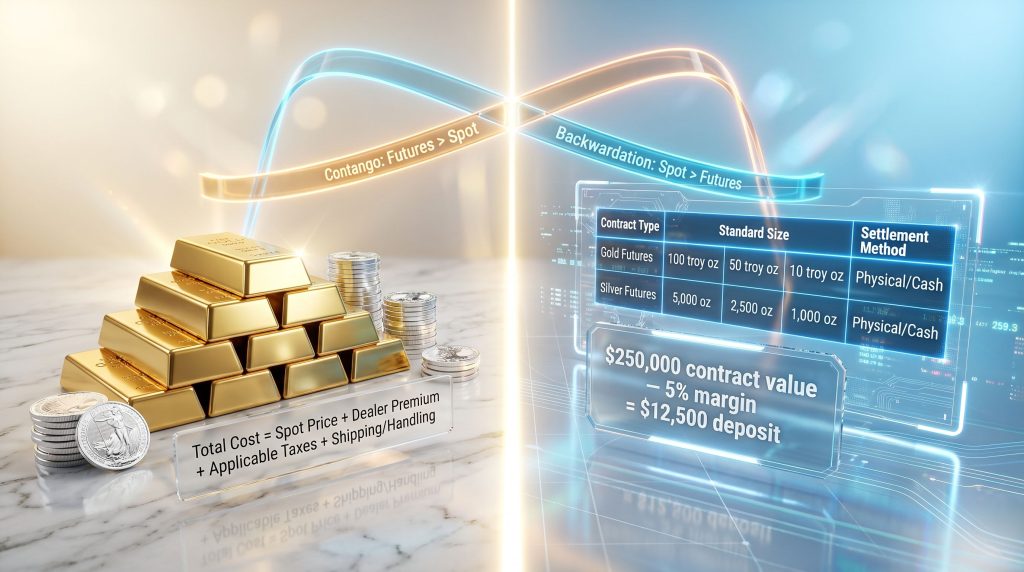
Total Bullion Cost = Spot Price + Dealer Premium + Sales Tax (where applicable) + Shipping and Handling
Those premiums exist because of real costs: refinery processing, minting and die production, quality assurance, packaging, logistics, dealer distribution margins, and in some cases, heightened demand during periods of market stress. During periods of acute buying pressure, such as the supply disruptions witnessed in 2020, premiums on popular bullion products expanded dramatically above their normal ranges, meaning the gap between spot and actual transaction price widened significantly for retail buyers.
Spot prices can also exhibit minor regional variation due to currency exchange rates, local tax treatment, transportation costs, and jurisdiction-specific market conditions. However, the high liquidity and global integration of precious metals markets generally keeps these differentials narrow and short-lived. In addition, when considering how tariffs and precious metals interact, regional price differentials can become more pronounced during periods of trade policy uncertainty.
Futures Contract Architecture: What You Are Actually Buying
Contract Specifications and Sizing
A futures contract is a standardised agreement traded through a centralised exchange and cleared through a counterparty-risk-mitigating clearinghouse structure, such as that operated by CME Group. This centralised clearing is a meaningful structural advantage over many over-the-counter spot arrangements, as it significantly reduces default risk for market participants.
Precious metals futures contracts come in multiple sizes designed to accommodate different capital bases and strategic objectives:
| Contract Type | Standard Size | Mini Size | Micro Size | Settlement Method |
|---|---|---|---|---|
| Gold Futures | 100 troy oz | 50 troy oz | 10 troy oz | Cash or Physical Delivery |
| Silver Futures | 5,000 oz | 2,500 oz | 1,000 oz | Cash or Physical Delivery |
| Platinum Futures | 50 troy oz | N/A | N/A | Physical Delivery |
Platinum futures carry different contract specifications from silver futures, and investors should verify current exchange parameters before trading any specific contract.
Margin, Leverage, and the Amplification Effect
Futures markets require only a fraction of the total contract value to open a position. This initial margin deposit, typically a percentage defined by the exchange, gives traders leveraged exposure to the underlying asset's full price movement.
Consider this hypothetical to illustrate the mechanics:
Hypothetical Scenario: A trader opens a standard gold futures contract representing 100 troy oz at a price of $2,500 per ounce. The total contract value is $250,000. If the exchange requires a 5% initial margin, the trader deposits $12,500 to control that full exposure. A 2% adverse price movement, representing a $5,000 loss on the contract, equates to a 40% drawdown on the margin deposit alone. The same 2% move in the trader's favour produces a 40% gain on deposited capital.
This leverage amplification is what makes futures attractive to speculators and valuable to hedgers, but genuinely dangerous for underprepared participants. Maintenance margin requirements add another layer: if a position moves against a trader and the account balance falls below the maintenance threshold, a margin call is triggered, demanding additional capital at short notice.
Rolling a position, the process of closing an expiring contract and reopening exposure in a later delivery month, also introduces ongoing transaction costs. In contango markets, where each successive contract is priced higher than the one before it, this roll cost accumulates over time and can meaningfully erode returns for long-term futures holders.
Spot vs Futures Markets: Side-by-Side Comparison
| Operational Dimension | Spot Market | Futures Market |
|---|---|---|
| Settlement Timeline | Immediate (T+1 to T+2) | Fixed contract expiration date |
| Ownership Transfer | Direct and immediate | Contractual obligation only |
| Capital Requirement | Full payment upfront | Margin deposit (fraction of contract value) |
| Leverage Available | Typically none | Yes, exchange-defined ratios |
| Expiration Risk | None | Active management required |
| Price Basis | Real-time benchmark | Spot + carry costs + market expectations |
| Market Structure | Often OTC or decentralised | Exchange-traded with central clearing |
| Primary User Profile | Long-term investors, physical buyers | Hedgers, speculators, institutional traders |
| Regulatory Oversight | Varies by jurisdiction | Heavily regulated (e.g., CFTC in the U.S.) |
Contango and Backwardation: Reading the Pricing Curve
Why Futures Prices Diverge from Spot Prices
The relationship between the spot price and the futures price is not random. It carries embedded information about market expectations, carry costs, and near-term supply and demand dynamics. Understanding this relationship is one of the more sophisticated analytical tools available to precious metals investors.
Contango: The Normal Carry-Cost Premium
When futures prices trade above the current spot price, the market is in contango. The economic logic is straightforward: the futures price must incorporate the cost of holding the physical commodity from today until the delivery date. These carry costs include storage fees, insurance premiums, and financing charges.
For gold and silver, both of which carry meaningful storage and insurance costs relative to their value density, contango is the typical market condition under normal circumstances.
Example: If crude oil is trading at $80 per barrel on the spot market but a four-month futures contract is priced at $83, the $3 differential approximates the expected carry costs over that period. This is textbook contango.
Backwardation: The Supply Stress Signal
Backwardation occurs when the spot price commands a premium over futures prices. This inversion signals that buyers place a higher value on immediate access to the physical commodity than on future delivery. The drivers typically include acute near-term supply constraints, unusually strong present demand, or both.
Example: Crude oil priced at $85 per barrel spot but at $82 per barrel for four-month delivery indicates that the market is paying up for immediacy. This backwardation structure suggests either tight near-term supply, urgent demand, or a preference for current physical availability over deferred delivery.
For precious metals specifically, backwardation is relatively rare and, when it occurs, is often interpreted as a signal of genuine physical demand pressure or localised supply disruption rather than a routine market feature.
| Condition | Spot vs Futures | Common Driver | Market Interpretation |
|---|---|---|---|
| Contango | Futures above Spot | Storage and carry costs | Normal market; cost-of-carry embedded in price |
| Backwardation | Spot above Futures | Supply tightness or urgent demand | Physical scarcity signal or demand surge |
The next major ASX story will hit our subscribers first
Risk Dimensions: What Each Market Exposes You To
Spot Market Risk Factors
- Full price volatility exposure: Without hedging instruments, spot holders absorb the complete impact of real-time price movements in either direction
- Concentration risk: Allocating heavily to a single metal position without broader portfolio balance amplifies drawdown potential during adverse price cycles
- Premium erosion on resale: Physical bullion acquired at elevated premiums during high-demand periods may be sold at lower premiums during quieter markets, compressing realised returns
- Liquidity variation by product type: Major metals like gold carry deep global liquidity, but niche physical formats and lower-mintage products can carry wider bid-ask spreads that affect transaction efficiency
Futures Market Risk Factors
- Leverage amplification: Margin-based position sizing means modest price moves produce outsized financial consequences relative to capital deployed
- Expiration management complexity: Failing to roll or close a position before expiry can trigger forced cash settlement or physical delivery obligations with logistical implications most retail traders are not equipped to handle
- Margin call exposure: Adverse moves can trigger capital demands at the worst possible moments, particularly during high-volatility market episodes
- Roll cost drag in contango markets: Extended futures exposure through rolling in a contango environment accumulates transaction costs that quietly erode performance
- Operational complexity: Active contract monitoring, understanding of delivery mechanics, and familiarity with exchange rules are prerequisites, not optional extras
Risk Warning: Futures markets allow traders to control large contract values with relatively small margin deposits. This leverage structure means that even modest price movements can produce significant financial consequences, both positive and negative, depending on position size, margin levels, and prevailing market conditions.
Matching Market Structure to Investor Profile
The debate around spot vs futures markets is not a competition with a universal winner. Each structure serves distinct strategic purposes, and the appropriate choice depends on an honest assessment of several investor-specific variables. For instance, those exploring physical gold vs ETFs will find that these same structural considerations apply across a broad range of precious metals investment vehicles.
Key Decision Variables
- Investment time horizon: Long-term wealth preservation favours the spot market and physical ownership; short-term tactical exposure often utilises futures
- Risk tolerance: Can the investor absorb leverage-amplified drawdowns without being forced to close positions at unfavourable prices?
- Capital availability: Full upfront payment for spot versus margin-based access for futures represents fundamentally different capital efficiency profiles
- Operational capacity: Does the investor have the time, knowledge, and systems to monitor contract expiry, margin levels, and rolling requirements?
- Objective clarity: Direct ownership and tangibility versus pure price exposure and tactical flexibility are genuinely different goals requiring different instruments
| Investor Profile | Recommended Market | Rationale |
|---|---|---|
| Long-term physical asset holder | Spot Market | Direct ownership, no expiry management required |
| Short-term speculator | Futures Market | Leverage, flexibility, no storage costs |
| Producer or industrial hedger | Futures Market | Lock in future delivery prices, manage input cost risk |
| Beginner or retail investor | Spot Market | Simpler mechanics, no margin requirements |
| Institutional portfolio manager | Both | Spot for allocation; futures for hedging and tactical positioning |
Strategic Note: For investors whose primary objective is capital preservation and the holding of a tangible asset, acquiring physical bullion through the spot market eliminates the operational complexity of contract rolling, margin calls, and expiration management. For those seeking tactical price exposure, hedging capacity, or leveraged short-term positioning, futures offer structural tools the spot market simply cannot replicate. However, they demand substantially greater market knowledge and active management commitment.
Consequently, investors broadening their understanding of paper versus physical instruments may also benefit from reviewing our exchange-traded commodities guide, which explores how ETCs sit alongside both spot and futures structures within a diversified portfolio. Furthermore, those analysing relative value between metals should consider gold-silver ratio analysis as a complementary framework for timing allocation decisions. For a broader perspective on how these markets compare mechanically, resources like TradingView's spot vs futures breakdown offer additional context on choosing between the two structures.
Frequently Asked Questions: Spot vs Futures Markets
What is the fundamental difference between spot and futures markets?
Spot markets execute transactions immediately at current prices, with ownership completing within one to two business days. Futures markets use standardised contracts that establish a price today for settlement on a specified future date, with no immediate transfer of ownership occurring at the time of contract entry.
Can a futures contract result in physical delivery?
Yes, most precious metals futures contracts provide for physical delivery upon expiration. However, the vast majority of futures positions are closed or rolled before reaching the delivery date. Physical delivery through futures involves significant logistical and administrative requirements that differ materially from purchasing bullion directly through the spot market.
What does rolling a futures contract mean in practice?
Rolling involves closing a position in an expiring contract and simultaneously establishing a new position in a contract with a later delivery date. This allows continuous market exposure without triggering delivery or cash settlement at the original expiry, though it incurs transaction costs and, in contango markets, a pricing premium on each successive contract.
Why do precious metals futures prices differ from spot prices?
Futures prices incorporate the spot price plus estimated carry costs, including storage, insurance, and financing, alongside market expectations about future supply and demand. The relationship between these two prices defines whether the market is in contango or backwardation at any given time.
Is futures trading appropriate for retail investors?
Futures carry significant complexity and risk, particularly due to leverage mechanics and contract management requirements. Most financial professionals recommend that investors thoroughly understand margin structures, contract specifications, and position management before engaging with futures instruments. Independent financial advice is strongly recommended before entering either market.
Key Takeaways
- The spot market provides immediate ownership at current benchmark prices; the futures market provides contractual price exposure for a defined future delivery date
- Physical precious metals always carry a premium above the spot price, reflecting the full cost chain from raw metal to finished, distributed product
- Futures introduce leverage, expiration risk, and active management requirements that are entirely absent from straightforward spot transactions
- Contango and backwardation are structural pricing signals that reveal embedded market expectations about carry costs, supply availability, and near-term demand
- Investor profile, including time horizon, risk tolerance, capital base, and operational capacity, should determine which market structure is appropriate for a given strategy
- Neither market is universally superior; each serves distinct and legitimate strategic functions within a well-considered precious metals investment framework
Disclaimer: This content is produced for educational and informational purposes only and does not constitute financial, investment, or trading advice. All figures and hypothetical scenarios are illustrative only. Individuals considering participation in spot or futures markets should seek guidance from a qualified and licensed financial professional before making any investment decisions. Past market behaviour does not guarantee future outcomes.
Want to Identify the Next Major ASX Mineral Discovery Before the Broader Market?
Discovery Alert's proprietary Discovery IQ model delivers real-time alerts on significant ASX mineral discoveries, transforming complex mineral data into clear, actionable insights for investors at every experience level — explore historic discoveries and their returns to understand the opportunity, then begin your 14-day free trial at Discovery Alert to position yourself ahead of the market.