June 21, 2026
## SQM and Codelco Salar Futuro lithium project: why this Chile lithium platform matters
Lithium markets rarely move in a straight line, and that volatility is one reason the SQM and Codelco Salar Futuro lithium project is drawing such close attention. Prices can surge on electric vehicle optimism, then retreat when inventories build, conversion bottlenecks emerge, or battery chemistry expectations shift.
That is exactly why large, long-life brine assets matter. In a cyclical commodity, the projects that shape the next decade are often not the fastest to make headlines, but the ones that remain relevant through weak prices, tougher environmental scrutiny, and changing extraction technology.
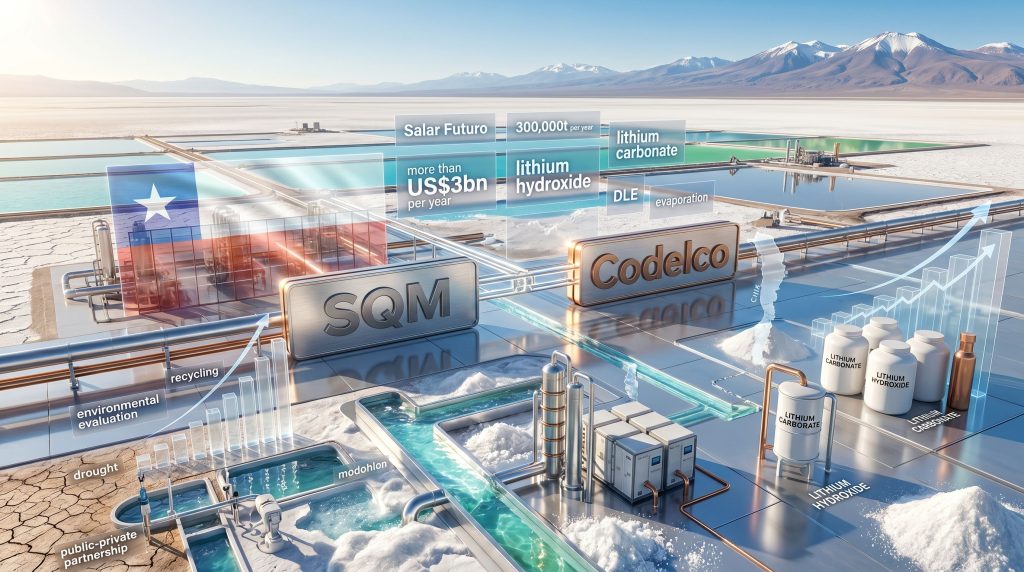
Against that backdrop, the project stands out less as a simple mine expansion and more as a test of Chile’s next lithium model. Available reporting links Salar Futuro to a development framework in the Salar de Atacama, with a value flagged at more than US$3 billion and broader Chile production ambitions reaching up to 300,000 tonnes per year.
That combination places it at the intersection of scale, state participation, brine chemistry, water management, and processing innovation. For context, Chile’s policy direction is increasingly tied to a broader Chile lithium strategy that seeks to balance growth with stronger public oversight.
The core investment question is not only whether Chile can produce more lithium. It is whether it can do so under tighter governance, higher environmental expectations, and a potentially different extraction pathway than the historic pond-heavy model.
## SQM and Codelco Salar Futuro project snapshot
For search intent, a direct definition helps.
Salar Futuro is the planned long-duration lithium development framework involving SQM and Codelco in Chile’s Salar de Atacama, associated with more than US$3 billion in project value and linked to Chile’s ambition to lift lithium output towards 300,000 tonnes per year.
The most important known metrics are summarised below.
| Metric | Current known figure | Why it matters | What still needs confirmation |
|---|---|---|---|
| Project value | More than US$3bn | Signals large-scale, multi-stage development | Exact phasing and capex split |
| Geography | Salar de Atacama, Chile | One of the world’s best-known lithium brine basins | Specific asset boundaries and staging |
| Resource type | Lithium-bearing brine | Brine economics differ from hard-rock lithium | Final extraction and processing route |
| National production ambition | Up to 300,000t per year | Indicates country-level supply relevance | Project-level contribution versus Chile-wide output |
| Product pathway | Lithium carbonate and lithium hydroxide themes | Important for battery supply chain positioning | Final product mix |
| Technology theme | DLE and evaporation both relevant | Central to water, recovery, and footprint debates | Commercial flowsheet and scaling evidence |
| Key non-technical risk | Environmental evaluation and drought pressure | Basin hydrology may shape timing and design | Approval milestones and baseline data |
A critical distinction matters here. The 300,000t per year figure appears tied to Chile’s wider lithium ambitions, not necessarily a single standalone Salar Futuro asset producing that full amount by itself. Therefore, investors should avoid collapsing country targets and project output into one number.
## Why Salar Futuro matters for Chile’s lithium strategy
Chile has long held an elite position in lithium brines, especially because the Salar de Atacama combines high lithium concentration, established operating history, and strong solar evaporation conditions. Furthermore, industry literature has often cited Atacama brines as among the world’s richest.
In practical terms, that geological advantage can support lower-cost production than many hard-rock projects, although it does not remove environmental or political complexity. In addition, the strategic context is shaped by the importance of Chile’s lithium reserves to future global battery supply.
What changes the story is governance. The project reflects Chile’s broader attempt to pair state participation with private operating experience. Codelco’s involvement signals stronger public stewardship over a strategic mineral, while SQM contributes operational know-how developed in brine processing and lithium chemicals.
This matters for three reasons:
- Sector template: the structure could influence how Chile approaches future strategic mineral partnerships
- Investor perception: state participation can improve policy durability for some investors, but it can also increase scrutiny over control, dividends, and approvals
- Social legitimacy: a more formal public-private structure may be viewed as an effort to align economic development with national resource oversight
Chile is therefore not just trying to defend market share. It is also trying to redesign the rules under which major lithium basins are developed.
## Chile brine expansion versus hard-rock lithium growth
Brine projects and hard-rock projects serve the same battery chain, but their economics and risks often differ sharply.
| Factor | Chilean brine model | Hard-rock lithium model |
|---|---|---|
| Typical scale | Large basin-scale potential | Often modular mine and concentrator growth |
| Cost profile | Can be lower on operating cost if chemistry is favourable | Usually higher mining and processing cost |
| Ramp-up risk | Slower if hydrology, ponds, or DLE scale-up become constraints | Faster mine build possible, but concentrator and conversion risks remain |
| Water sensitivity | Very high environmental scrutiny in arid salars | High too, but usually framed differently |
| Technology dependence | Rising if DLE or hybrid systems are adopted | More conventional upstream mining, but still reliant on conversion chain |
| Permitting complexity | Strong ecological and community focus | Strong land, tailings, and infrastructure focus |
For Chile, Salar Futuro is strategically significant because brines can remain globally competitive on the cost curve, but only if water, reinjection, and permitting issues are managed credibly.
## How the production ambition could affect global lithium supply
At first glance, 300,000 tonnes per year is a headline figure. In market terms, it is better understood as a supply-chain signal. Depending on whether the reference is lithium carbonate, lithium hydroxide, or lithium carbonate equivalent, the same tonnage can imply different downstream value and conversion needs.
A useful way to think about the number is through scenarios:
-
Base case
EV demand grows steadily, lithium prices stabilise, and Chile adds production in stages. In this outcome, Salar Futuro supports Chile’s relevance without flooding the market. -
Bull case
EV adoption re-accelerates, higher-nickel cathode demand improves hydroxide consumption, and the project scales efficiently. Consequently, Chile’s role in future battery raw material flows would strengthen. -
Bear case
Lithium prices stay weak for longer, permitting takes more time, or DLE performance disappoints. Under that scenario, capital rollout could slow and staged development becomes more likely.
For industry observers, the real importance is not a single supply number but whether Chile can convert resource advantage into dependable, scalable chemical output during a volatile market cycle.
A large lithium project matters most when it can survive low-price periods, not only when it looks attractive at the top of the cycle.
## What operating model could make Salar Futuro different
Traditional lithium brine operations in Chile have relied heavily on evaporation ponds. However, the newer alternative is direct lithium extraction, which aims to selectively recover lithium from brine using engineered materials or chemical processes rather than depending mainly on long pond residence times.
A practical step-by-step framework looks like this:
- Brine is pumped from the salar system
- Lithium concentration is increased or selectively separated through evaporation, DLE, or a hybrid method
- Intermediate streams are purified to remove unwanted elements such as magnesium, calcium, or boron
- Final lithium chemicals are produced, commonly lithium carbonate and potentially lithium hydroxide through additional conversion
- Waste handling, reinjection plans, and water accounting become central to environmental acceptance
Not all DLE approaches are equal. Some rely on adsorption media, while others use solvent extraction, ion exchange, or membrane systems. Therefore, the right investor question is not whether DLE sounds modern, but whether it has shown:
- commercial-scale throughput consistency
- acceptable reagent consumption
- manageable energy demand
- strong lithium recovery
- credible performance with real brine impurities
- realistic reinjection assumptions
That distinction is crucial because pilot success does not automatically translate into basin-scale reliability.
## The biggest environmental and water-management questions
In northern Chile, water cannot be treated as a footnote. Drought pressure, basin sensitivity, and ecological monitoring are central to project value. For any salar development, the market increasingly focuses on whether lithium brine production affects surrounding hydrology, wetlands, habitats, and community water confidence.
Key environmental themes include:
- groundwater drawdown risk
- brine balance and aquifer interaction
- freshwater versus brine extraction differences
- biodiversity monitoring
- community and Indigenous consultation
- cumulative basin impacts
- closure and long-term monitoring obligations
| Environmental risk | Why it matters | Evidence to look for | Possible mitigation pathway |
|---|---|---|---|
| Groundwater drawdown | Can affect ecosystems and local water confidence | Baseline hydrology and monitoring design | Pumping controls and adaptive management |
| Brine imbalance | May alter salar behaviour over time | Reservoir modelling and recharge assumptions | Conservative extraction plans and verification |
| Habitat disruption | Sensitive species and wetlands may be affected | Biodiversity baseline studies | Exclusion areas and long-term monitoring |
| Permitting delays | Timing risk affects capex and output | Environmental filing progress | Better baseline work and staged development |
| Community conflict | Social opposition can slow projects materially | Consultation record and grievance systems | Transparent engagement and benefit-sharing design |
| Climate-linked drought stress | Raises scrutiny across the basin | Regional climate and water trend data | Lower-intensity water design and operational flexibility |
For readers, one underappreciated point is that ore quality alone does not determine success in brines. Hydrogeology can be just as important as grade.
For additional project detail, the official Salar Futuro project overview outlines the partnership’s stated development approach. Meanwhile, reports on the planned environmental study submission show how tightly market attention is centred on approvals.
## Partnership structure and governance questions
The governance logic behind the SQM and Codelco Salar Futuro lithium project may prove as important as the geology. Markets typically want clarity on:
- who controls operations
- who funds expansion stages
- how major strategic decisions are approved
- how dividends and reinvestment are balanced
- what oversight mechanisms apply to environmental performance
These are not administrative details. Instead, they shape confidence in capital discipline, policy continuity, and execution speed. A project can have excellent resource fundamentals yet still trade at a discount if governance looks ambiguous.
## Regulatory and permitting hurdles to watch
No matter how strategic the basin may be, approvals still depend on process. Large lithium developments in Chile typically face a layered pathway involving environmental assessment, hydrological evidence, consultation requirements, processing approvals, and infrastructure authorisations.
The regulatory stack should be understood in sequence:
- Project concept and studies
- Environmental filing
- Technical review and requests for further information
- Consultation and stakeholder engagement
- Approval or conditional approval
- Construction and commissioning
- Commercial ramp-up
Potential delay factors include incomplete hydrological baseline work, technology validation gaps if DLE is central, community opposition, design revisions after review, and slower downstream infrastructure decisions.
## How investors can think about the US$3bn-plus valuation
A multi-billion-dollar lithium project headline should be treated as a framework, not a verdict. The better question is whether the capital is efficient relative to staged output, chemistry quality, environmental controls, and technological complexity.
A simple investor framework is below.
| Evaluation lens | Why it matters |
|---|---|
| Capex per tonne | Tests whether spending is proportionate to achievable output |
| Operating cost position | Determines resilience during lithium price weakness |
| Flowsheet risk | DLE or hybrid routes may add execution complexity |
| Product flexibility | Carbonate versus hydroxide exposure affects downstream optionality |
| Basin sustainability | Environmental constraints can cap value regardless of grade |
| Governance quality | Strong structure reduces uncertainty discount |
If lithium prices remain weak for two years, likely consequences could include slower capex deployment, delayed higher-risk process modules, tighter return thresholds, and a greater emphasis on proven lower-cost operating routes. Moreover, developments in the wider lithium carbonate market will strongly influence project economics.
This article is for informational purposes only and is not financial advice. Project economics, timing, and output are subject to change based on studies, regulation, commodity prices, and operating performance.
## Final assessment
The SQM and Codelco Salar Futuro lithium project is best understood as a strategic proving ground for Chile’s next lithium era. Its importance comes from the combination of scale, state-private partnership design, technology transition pressure, and water scrutiny in one of the world’s most consequential brine basins.
The long-term verdict will likely depend on three linked tests:
- Can the partnership govern efficiently and transparently?
- Can the environmental case hold up under serious hydrological scrutiny?
- Can the operating model deliver commercial output at scale through a volatile lithium cycle?
If the answer to those questions is yes, Salar Futuro could strengthen Chile’s position in the battery materials chain for years. If not, the project may still matter, but more as a lesson in the limits of scale than a model for future expansion.
## FAQ
### What is the SQM and Codelco Salar Futuro lithium project?
It is a planned lithium development framework in Chile linked to the Salar de Atacama, combining SQM’s operating experience with Codelco’s participation in a project context associated with more than US$3 billion in value.
### How large is the Salar Futuro project?
Available reporting indicates a value of more than US$3bn. Broader Chile lithium ambitions associated with the initiative reference up to 300,000 tonnes per year, though that should not be assumed to be a single-asset output figure.
### Is the project using direct lithium extraction?
DLE is a major theme around the project, but the final commercial process route should be treated as subject to confirmation. It may involve DLE, evaporation, or a hybrid combination.
### Why is Codelco involved in lithium?
Its role reflects Chile’s broader preference for greater state participation in strategic minerals while still relying on experienced operators for execution.
### What are the biggest risks?
The main risks are environmental approval, hydrological evidence quality, technology scale-up, community acceptance, governance execution, and lithium price volatility.
Want Earlier Insight Into Major Lithium Discoveries?
Discovery Alert’s proprietary Discovery IQ model delivers real-time alerts on significant ASX mineral discoveries, helping investors spot actionable opportunities across fast-moving battery metals before the broader market. See how major discoveries have historically delivered exceptional returns on the Discovery Alert discoveries page and start a 14-day free trial at the Discovery Alert home page.