
June 17, 2026
When Trade Policy Becomes Industrial Strategy: Decoding the Global Steel Barrier Surge
Across economic history, protectionist trade cycles tend to arrive not as isolated national decisions but as cascading responses to shared structural pressures. The current wave of EU, US, and Mexico steel trade barriers tightening simultaneously is a textbook example of this dynamic. Each jurisdiction has framed its actions in distinct political language, but the underlying diagnosis is nearly identical: global steel markets are flooded with excess production capacity, predominantly from Asia, and domestic industries cannot survive without policy intervention.
Understanding why EU, US, and Mexico steel trade barriers have converged at this particular moment requires moving past the headlines and into the structural mechanics driving each decision.
When big ASX news breaks, our subscribers know first
The Overcapacity Engine Behind Simultaneous Protectionism
Global steel overcapacity is not a new problem, but its effects have intensified to a point where previously passive trading partners have been forced into active defence. The core issue is that steelmaking capacity, particularly in China, has expanded far beyond domestic consumption requirements, pushing surplus volumes into export markets at prices that undercut producers operating under higher labour, environmental, and regulatory cost structures.
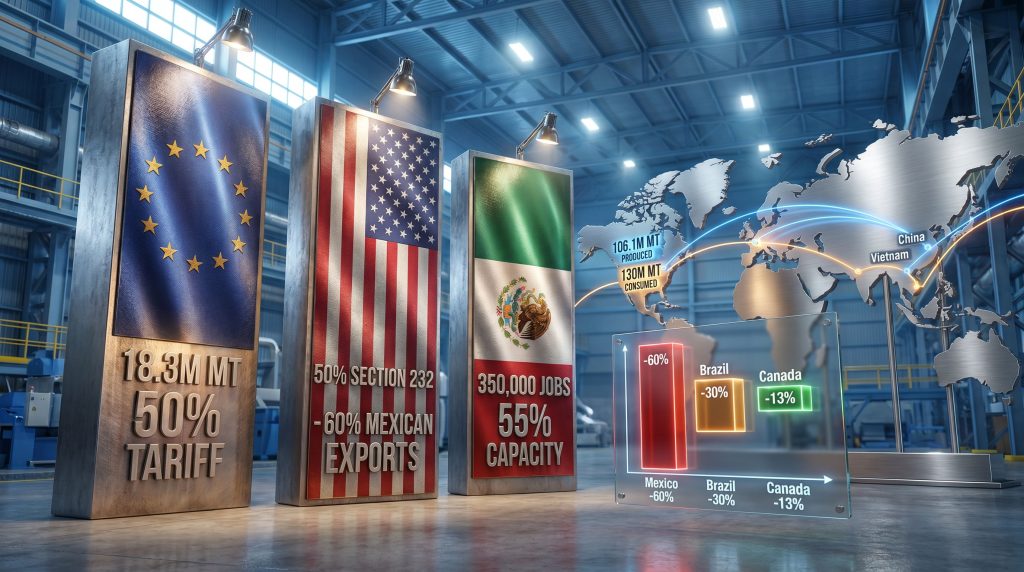
North America's structural vulnerability to this dynamic is measurable. In 2024, the continent produced 106.1 million metric tons of crude steel, operating at roughly 75% of installed capacity, while consuming approximately 130 million metric tons, according to CANACERO data. That gap of nearly 24 million metric tons represents chronic import dependency, much of it filled by lower-cost foreign producers.
Europe's exposure is framed differently but is equally acute. Approximately 100,000 steel sector jobs have been lost across the European Union since 2008, a figure that transforms what might otherwise be a purely economic debate into a politically volatile employment crisis touching industrial heartlands across Germany, France, Italy, and beyond.
The mechanism connecting Asian overcapacity to North American and European trade policy is trade diversion. When one jurisdiction imposes barriers, steel originally destined for that market is rerouted through intermediary countries, undergoes minimal processing to change its technical classification or apparent origin, and re-enters protected markets through transformation loopholes. Mexico's steel imports grew by 12.4% over two years before protective measures were introduced, a surge that investigators linked directly to diverted flows from China and Vietnam following earlier US restrictions. For a broader view of how these dynamics are unfolding, the global crude steel outlook for 2025 provides essential context.
The near-simultaneous tightening of EU, US, and Mexico steel trade barriers reflects a shared structural problem that no single jurisdiction can resolve unilaterally: Asian overcapacity producing export volumes that domestic producers in all three regions cannot competitively absorb without policy intervention.
What the European Parliament Actually Approved
The European Parliament's vote on a new steel safeguard framework was decisive: 606 in favour, 16 against, and 39 abstentions. The vote replaces a safeguard architecture that has been in place since 2018 and was scheduled to expire on June 30, 2026. Furthermore, the EU steel action plan sets out the broader industrial strategy underpinning these legislative changes.
The headline changes are significant in both scale and design:
- The annual tariff-free import ceiling is fixed at 18.3 million metric tons, representing a 47% reduction from the previously permitted duty-free volume
- Above-quota imports will now face a 50% tariff, doubled from the previous 25% rate
- Origin determination rules shift from the country where steel was last processed to the country where it was first smelted and moulded, closing the transformation loophole
- Ukraine's steel industry receives an explicit carve-out, recognising war-related disruption as a legitimate mitigating factor
- The European Commission is mandated to conduct scope reviews to assess whether additional product categories should be added
The Traceability Architecture: Why Origin Rules Matter
The change in origin determination methodology is arguably the most technically significant element of the new EU framework, though it receives less attention than the headline tariff numbers. Under previous rules, steel produced in China or Vietnam could enter EU markets after processing in a third country such as Turkey or Egypt, with that country of processing recorded as the origin.
The new standard requires that origin be traced to the country where first smelting and moulding occurred, regardless of subsequent processing. This is a fundamental shift in the traceability infrastructure of EU steel trade, one that will require importers to maintain detailed production-chain documentation extending back to primary steelmaking.
| Provision | Previous Framework | New Framework |
|---|---|---|
| Tariff-free import ceiling | Higher baseline | 18.3 million metric tons |
| Above-quota tariff rate | 25% | 50% |
| Origin determination | Processing country | Country of first smelting and moulding |
| Ukraine carve-out | Absent | Explicitly included |
| Commission review obligation | Limited | Mandatory scope review |
Note: The regulation requires formal Council approval before entering into force. Readers should verify the Council vote status at time of reading.
The US Section 232 Architecture and Its Asymmetric Impact on Mexico
The United States restructured its Section 232 metals tariffs in 2026 under a tiered framework that applies differentiated rates depending on the level of steel content in imported goods. The US steel tariffs impact has been felt unevenly across trading partners, with Mexico bearing a disproportionate share of the burden:
- 50% on steel, aluminium, and copper products
- 25% on derivative products containing these metals
- 15% on metal-intensive industrial equipment, effective through 2027
A blanket 50% tariff on steel and aluminium imports from Mexico has been in effect since June 3, 2025. The impact on Mexican steel trade has been disproportionate compared to other major exporters to the US market.
| Country | Decline in Steel Exports to US (Post-Section 232) |
|---|---|
| Mexico | -60% |
| Brazil | -30% |
| Canada | -13% |
Source: American Iron and Steel Institute
The value of Mexican steel shipments to the United States fell 12% between January and October 2025 versus the equivalent period in 2024, according to Banco de Mexico data. Mexico's domestic steel sector is now operating at approximately 55% capacity utilisation, a figure that signals structural distress rather than a temporary market adjustment.
The Conditional Tariff Reduction Pathway
In April 2026, the United States opened a tariff-adjustment mechanism that allows eligible Mexican and Canadian steel and aluminium producers to reduce Section 232 duties by up to 50%. The condition attached is commercially significant: producers must commit to expanding primary steel or aluminium production capacity within the United States, specifically in support of automotive and heavy vehicle supply chains.
This mechanism effectively converts a punitive trade barrier into a production-location incentive, rewarding capital redeployment toward US soil rather than simply penalising foreign production. For Mexican producers, this creates a difficult strategic calculation: absorb the full 50% tariff burden, or invest in US capacity expansion that may conflict with their domestic industrial mandates.
The Peterson Institute for International Economics has noted that while elevated tariffs on steel will almost certainly expand profit margins for major US steel producers, the downstream consequences for American manufacturers and households include meaningful job losses and higher input costs across industries that consume steel as a raw material.
Mexico's Multi-Layered Defensive Response
Faced with collapsing export volumes and domestic capacity utilisation at critically low levels, Mexico has deployed a layered set of protective measures targeting both import competition from Asia and the asymmetric impact of US Section 232 tariffs. The tariff supply chain impact has been particularly acute for manufacturers reliant on integrated North American production networks.
Permanent Tariff Extension on Non-FTA Steel
Mexico permanently extended tariffs ranging from 10% to 35% on steel imports from countries without free trade agreements with Mexico, covering 220 steel product categories. The primary targets are China, Vietnam, and South Korea. The original tariff package, introduced in April 2024 across 1,466 products spanning 17 sectors, was originally scheduled to expire in April 2025 but has now been made indefinite.
Provisional Countervailing Duties on Hot-Rolled Steel
Following an investigation initiated after a complaint filed in November 2024 by Ternium, Mexico's Ministry of Economy imposed provisional countervailing duties on hot-rolled steel from China and Vietnam:
| Country of Origin | Countervailing Duty Range |
|---|---|
| China | US$0.20/kg to US$0.23/kg |
| Vietnam | US$0.19/kg to US$0.196/kg |
Countervailing duties of this structure are specifically designed to offset subsidies that foreign governments provide to their steel industries, making the measure legally distinct from a standard protective tariff and grounded in WTO anti-subsidy frameworks.
The Employment Stakes
The scale of the employment risk underpinning Mexico's defensive posture is substantial. Government officials estimated that without protective intervention, up to 350,000 jobs could be lost by end-2026. The automotive manufacturing sector, which accounts for approximately one-third of Mexico's total manufacturing employment, was identified as the most exposed segment given its intensive use of flat-rolled steel products.
Mexico's President Claudia Sheinbaum has framed the country's trade position as a defence of both industrial sovereignty and worker livelihoods. Her administration has publicly stated its intent to secure a broad trade agreement with the United States that resolves current tensions and supports long-term economic stability, including through the elimination or meaningful reduction of Section 232 tariffs on products that meet USMCA rules of origin. According to research from the Baker Institute, Mexico's broader economy faces significant headwinds under sustained US tariff pressure.
Víctor Martínez, President of CANACERO and CEO of ArcelorMittal Mexico, has challenged the economic justification for applying Section 232 on Mexican steel specifically. His argument centres on an observable market anomaly: during the period when US tariffs were suppressing Mexican steel export volumes, steel prices in Mexico declined across 13 benchmark product categories while US domestic prices rose. This price divergence suggests the tariffs are generating market segmentation and artificial price inflation in the US rather than correcting a genuine supply imbalance.
A Comparative Framework: How the Three Regimes Stack Up
| Dimension | European Union | United States | Mexico |
|---|---|---|---|
| Primary mechanism | Safeguard quota + above-quota tariff | Section 232 national security tariff | Permanent tariffs + countervailing duties |
| Tariff-free threshold | 18.3 million metric tons/year | No quota; flat tariff applies | Varies by FTA status |
| Above-threshold tariff rate | 50% | 50% (steel and aluminium) | 10% to 35% (non-FTA) |
| Origin determination rule | Country of first smelting | Product classification-based | FTA membership |
| Key target countries | China, Vietnam, and others | Global including Mexico and EU | China, Vietnam, South Korea |
| Carve-outs | Ukraine | Conditional US capacity investment | FTA partner countries |
| Primary policy rationale | Overcapacity protection | National security | Employment and industry protection |
The next major ASX story will hit our subscribers first
Downstream Consequences for Manufacturers and Supply Chains
The convergence of EU, US, and Mexico steel trade barriers into a multi-jurisdictional compliance environment creates compounding costs for businesses operating across these markets. Steel producers and industrial buyers must now simultaneously navigate:
- Distinct origin determination rules in each jurisdiction
- Overlapping quota structures with different thresholds and measurement methodologies
- Active countervailing duty investigations that can alter landed costs mid-contract
- Tariff-adjustment pathways with capital commitment conditions that affect investment planning
For automotive manufacturers in Mexico specifically, the pressure is bi-directional. Higher input costs from steel tariffs compress production margins, while US duties on finished vehicles containing Mexican-sourced steel simultaneously reduce export competitiveness. This dual squeeze is compressing profitability across integrated North American automotive supply chains in ways that simple tariff cost models do not fully capture. In addition, the China steel market challenges continue to create ripple effects that amplify these pressures across all three jurisdictions.
When steel prices in Mexico declined across 13 benchmark products while US domestic prices rose simultaneously, this divergence became a measurable indicator that tariff architecture was creating artificial market segmentation. For procurement teams and trade analysts, this kind of price divergence is a critical signal that policy-driven distortions, rather than supply and demand fundamentals, are driving cost structures.
The USMCA Review as the Critical Near-Term Inflection Point
The ongoing USMCA review has become the primary diplomatic arena through which Mexico is pressing for structural change to the Section 232 tariff framework. Mexico's negotiating position rests on a legally coherent argument: products that comply with USMCA rules of origin should not be subject to national security tariffs under Section 232, because the free trade framework itself is designed to certify the North American identity of compliant goods. The White House fact sheet on the US-EU trade deal illustrates how bilateral negotiations can reshape tariff arrangements when political will is present.
Three scenarios define the possible resolution pathways:
- Partial relief through investment commitments: The US expands the April 2026 tariff-adjustment pathway, offering Mexican producers meaningful but conditional duty reductions in exchange for US-based capacity investment. Compliance complexity persists but the tariff burden diminishes.
- USMCA-based carve-out for rules-of-origin compliant steel: The review produces an agreement that exempts qualifying North American steel from Section 232, substantially relieving integrated supply chains while leaving broader global tariffs intact.
- Escalation and retaliatory fragmentation: USMCA negotiations fail to produce a steel agreement, Mexico implements counter-measures, and trade fragmentation accelerates across both North American and transatlantic supply chains.
The outcome of the USMCA review will ultimately determine whether the current convergence of EU, US, and Mexico steel trade barriers represents a temporary structural adjustment or the opening phase of a permanent reconfiguration of global steel trade architecture.
This article contains forward-looking analysis and scenario projections based on current trade policy data. Trade policy environments are subject to rapid change, and readers should not interpret scenario projections as predictions of future outcomes. All statistics are sourced from publicly available institutional data including CANACERO, Banco de Mexico, the American Iron and Steel Institute, and the Peterson Institute for International Economics.
Want to Stay Ahead of the Commodity Shifts Driving ASX Markets?
The structural pressures reshaping global steel trade are already influencing resource equities and mineral exploration sentiment across the ASX. Discovery Alert's proprietary Discovery IQ model delivers real-time alerts on significant ASX mineral discoveries, transforming complex commodity and market data into actionable investment insights — and you can explore the historic returns generated by major mineral discoveries to understand just how transformative early positioning can be. Begin your 14-day free trial today and ensure you are never behind the market on the discoveries that matter most.