June 9, 2026
Understanding the Technology Behind Stirred Mill Grinding Systems
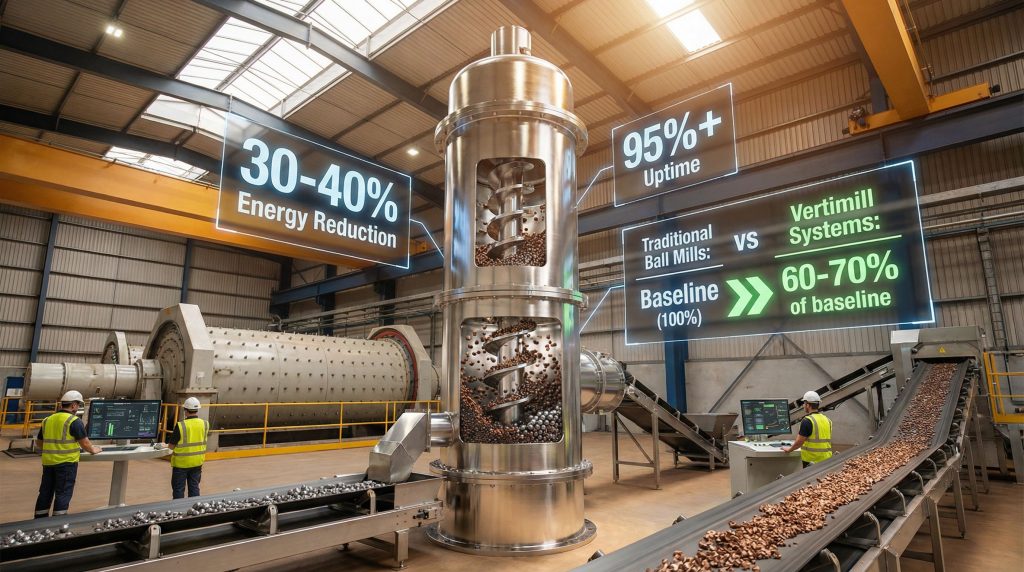
Modern mineral processing operations face mounting pressure to reduce energy consumption while maintaining production efficiency. Traditional ball mills, despite their widespread adoption across mining operations, consume substantial energy through their horizontal tumbling action. This energy-intensive approach has driven the development of energy-efficient Vertimill grinding mills that fundamentally reimagine particle size reduction methods.
Vertical stirred mills represent a paradigm shift in grinding technology, utilising gravity-assisted media movement rather than energy-intensive tumbling mechanisms. These systems position grinding media vertically within a cylindrical chamber, where a central rotating screw mechanism creates controlled particle interaction zones. The vertical orientation allows gravitational forces to assist in media circulation, reducing the energy required for effective grinding action.
The core architecture centres on a vertical screw assembly that rotates within a stationary cylindrical chamber. Feed material enters at the bottom of the unit and progresses upward through increasingly intense grinding zones. As particles become finer, they migrate toward the discharge point at the top of the mill, creating natural classification within the grinding circuit.
When big ASX news breaks, our subscribers know first
Comparative Energy Performance Analysis
Energy efficiency represents the primary advantage of vertical stirred mills over conventional horizontal grinding systems. Traditional ball mills require significant energy input to lift grinding media against gravity during each rotation cycle, with much of this energy dissipated as heat rather than contributing to particle breakage.
Energy Consumption Comparison:
| Mill Configuration | Relative Energy Use | Grinding Efficiency | Heat Generation |
|---|---|---|---|
| Horizontal Ball Mills | 100% (baseline) | Moderate | High |
| Vertical Stirred Mills | 60-70% of baseline | Enhanced | Reduced |
| Advanced Vertical Systems | 50-65% of baseline | Optimised | Minimised |
The energy savings stem from several technical factors. Vertical orientation reduces the energy required to lift grinding media, as gravitational forces assist media circulation. The controlled screw rotation creates consistent particle-media contact without the energy losses associated with cascading media in horizontal systems.
Additionally, vertical systems operate at lower rotational speeds than ball mills, reducing mechanical stress on drive components and minimising energy conversion to heat. This thermal efficiency translates directly into reduced cooling requirements and improved overall plant energy management. Furthermore, these innovations are part of broader data-driven mining operations that optimise performance through advanced analytics.
Operational Advantages and Performance Characteristics
The vertical configuration delivers space utilisation benefits that extend beyond energy savings. These systems typically require 40-50% less floor space than equivalent capacity ball mills, allowing more efficient plant layouts and reduced construction costs for new facilities.
Key Operational Benefits:
• Reduced maintenance requirements due to lower mechanical stress
• Improved liner longevity through controlled media movement
• Enhanced particle size distribution control
• Simplified installation and commissioning processes
• Reduced vibration and noise levels compared to horizontal mills
Maintenance scheduling becomes more predictable with vertical stirred mills. The controlled grinding environment reduces impact wear on internal components, extending liner replacement intervals. Bearing systems experience less dynamic loading, contributing to improved reliability and reduced unplanned maintenance events.
The vertical design also enables better process control through consistent residence time distribution. Particles follow predictable flow patterns through the grinding chamber, allowing operators to optimise performance for specific ore characteristics and product requirements.
Industry Applications and Ore-Specific Considerations
Iron ore processing represents a primary application area for energy-efficient Vertimill grinding mills. Direct Reduction (DR) grade iron ore requires precise particle size control to achieve optimal pelletising characteristics. The consistent particle size distribution achieved through vertical stirred mills supports high-quality pellet production essential for steel manufacturing.
Recent installations in iron ore operations demonstrate the technology's capability to handle varying ore hardness whilst maintaining product specifications. The controlled grinding environment allows processors to adjust parameters for different ore blends without compromising efficiency or product quality. For instance, Metso's advanced grinding technology has proven particularly effective in challenging ore processing applications.
Application-Specific Advantages:
• Copper concentrate regrinding for improved recovery rates
• Gold ore fine grinding for enhanced liberation
• Industrial minerals processing for controlled particle morphology
• Base metal concentrate upgrading applications
Each application requires specific consideration of ore characteristics, target particle sizes, and downstream process requirements. The flexibility of vertical stirred mills allows operators to optimise grinding parameters for diverse mineral types and processing objectives.
Technology Evolution and Market Adoption
The development of larger capacity vertical stirred mills has expanded their applicability to high-throughput mining operations. Modern units can handle significantly greater material volumes than earlier generations, making them viable alternatives to multiple smaller grinding units.
Installation data indicates growing adoption across diverse geographic regions, driven by energy cost considerations and environmental regulations. Mining operations in energy-intensive regions particularly benefit from the reduced power consumption characteristics of vertical grinding systems. This trend aligns with the broader mining industry evolution toward more efficient technologies.
Market Penetration Factors:
• Rising energy costs driving efficiency improvements
• Environmental regulations favouring lower emission technologies
• Capital cost advantages for new plant construction
• Proven reliability in challenging operating conditions
The technology has evolved to incorporate advanced process control systems and remote monitoring capabilities. These features enable operators to optimise performance in real-time and implement predictive maintenance strategies that further improve operational efficiency. Moreover, the integration of AI in mining processes enhances these systems' autonomous operation capabilities.
Environmental Impact and Sustainability Considerations
Energy-efficient grinding technologies contribute significantly to mining industry sustainability objectives. Reduced energy consumption directly translates to lower carbon emissions, particularly in regions where electrical grids rely heavily on fossil fuel generation.
Industrial assessments of large-scale vertical stirred mill deployments indicate substantial environmental benefits, with some installations reducing annual carbon footprint by tens of thousands of tons compared to conventional grinding systems.
The environmental advantages extend beyond energy consumption. Reduced grinding media consumption decreases raw material requirements and waste generation. Lower heat generation reduces cooling water requirements, conserving water resources in water-scarce mining regions.
Sustainability Metrics:
• Carbon emission reductions through lower energy consumption
• Reduced grinding media consumption and associated mining impacts
• Water conservation through reduced cooling requirements
• Noise reduction benefits for mining communities
These environmental benefits align with increasing investor and regulatory focus on mining industry sustainability performance. Operations implementing energy-efficient technologies can demonstrate measurable improvements in environmental key performance indicators. Consequently, these systems support the sustainable mining transformation that the industry increasingly demands.
The next major ASX story will hit our subscribers first
Economic Evaluation Framework for Implementation
Mining operations considering vertical stirred mill implementation require comprehensive economic analysis encompassing capital costs, operating expenses, and productivity improvements. The evaluation framework must account for both direct cost savings and indirect benefits such as improved plant reliability and reduced maintenance requirements.
Total Cost of Ownership Components:
• Initial capital expenditure for equipment and installation
• Energy cost savings over equipment lifetime
• Maintenance cost reductions through improved reliability
• Production capacity optimisation potential
• Residual value considerations for end-of-life planning
The economic analysis should consider site-specific factors including energy costs, ore characteristics, and existing plant configuration. Retrofit applications may require additional infrastructure modifications that impact overall project economics.
Installation complexity varies depending on existing plant configuration and integration requirements. New greenfield projects typically achieve better economic returns due to optimised plant layout and reduced retrofitting costs. Additionally, operations must navigate energy transition challenges when implementing new technologies.
Future Technology Development Trends
Digitalisation initiatives are transforming grinding mill operations through advanced sensors, data analytics, and automated control systems. These technologies enable real-time optimisation of grinding parameters based on feed characteristics and downstream process requirements.
Artificial intelligence applications show promise for predictive maintenance and performance optimisation. Machine learning algorithms can identify optimal operating parameters for varying ore conditions, maximising efficiency whilst minimising equipment wear.
Emerging Technology Areas:
• Advanced materials for improved component durability
• Integrated process control and optimisation systems
• Hybrid grinding circuits combining multiple technologies
• Remote monitoring and diagnostic capabilities
Research continues into advanced liner materials and grinding media compositions that further improve efficiency and reduce maintenance requirements. These developments promise continued improvement in vertical stirred mill performance and reliability.
Implementation Considerations and Best Practices
Successful vertical stirred mill implementation requires careful consideration of site-specific factors and integration requirements. Process engineering analysis should evaluate feed characteristics, target product specifications, and downstream processing constraints.
Critical Implementation Factors:
• Ore characterisation and grindability testing
• Circuit design and integration planning
• Operator training and skill development programmes
• Spare parts inventory and maintenance planning
• Performance monitoring and optimisation protocols
Training programmes should address the operational differences between vertical and horizontal grinding systems. Operators familiar with ball mill operations require specific instruction on vertical stirred mill control strategies and maintenance procedures.
The technology offers proven advantages for mining operations seeking to reduce energy consumption whilst maintaining or improving grinding circuit performance. Furthermore, recent market developments demonstrate increasing industry confidence in these systems.
Energy-efficient Vertimill grinding mills represent a mature technology solution for modern mining operations facing increasing pressure to improve sustainability performance whilst maintaining economic competitiveness. The combination of reduced energy consumption, improved operational reliability, and enhanced process control makes these systems an attractive alternative to conventional grinding technologies.
Ready to Capitalise on Mining Technology Advancements?
Discovery Alert's proprietary Discovery IQ model delivers instant notifications on significant mining technology discoveries and innovations, empowering subscribers to identify actionable investment opportunities in companies pioneering energy-efficient processing solutions. Begin your 14-day free trial today to gain a competitive edge in discovering the next breakthrough mining technologies before the broader market.