
August 12, 2026
Understanding the Strait of Hormuz's Critical Role in Global Oil Supply
The strategic balance of global energy security rests precariously on a handful of maritime chokepoints where geopolitical tensions intersect with economic necessity. These narrow waterways serve as critical arteries for international commerce, yet their vulnerability to disruption creates cascading effects throughout energy markets that extend far beyond immediate supply concerns. Understanding how these chokepoints function within the broader energy security framework reveals the complex interplay between geography, military positioning, and market psychology that drives modern commodity pricing.
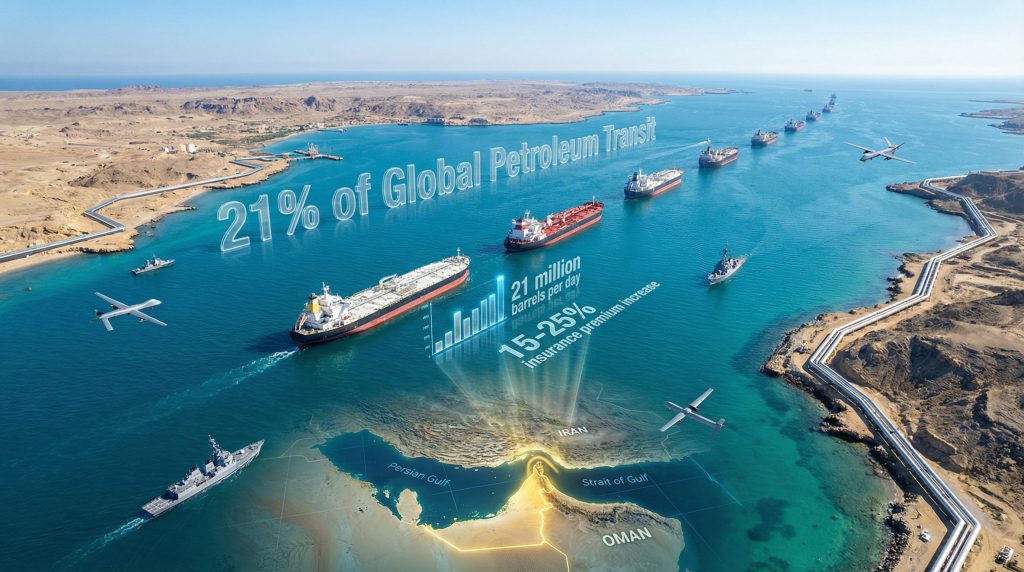
The Strait of Hormuz exemplifies this delicate balance, functioning as one of the world's most strategically vital maritime passages. Approximately 21% of global petroleum liquids transit through this narrow waterway, with daily throughput reaching approximately 21 million barrels of crude oil and petroleum products. This concentration of energy flow through a single geographic location creates inherent vulnerability that extends beyond physical supply disruption to encompass financial market volatility and geopolitical risk assessment.
The geographic constraints of the Strait compound its strategic importance. At its narrowest point, the waterway spans merely 21 miles (34 kilometers), with shipping lanes restricted to two-mile-wide corridors in each direction. This physical limitation means that any disruption, whether intentional or accidental, immediately affects a substantial portion of global energy trade.
Regional Producer Dependencies and Economic Multipliers
Gulf Cooperation Council nations maintain heavy dependence on Strait access for their crude oil exports, creating a concentration of economic vulnerability that extends beyond individual national interests. Saudi Arabia, the United Arab Emirates, Qatar, Oman, Bahrain, and Kuwait collectively rely on this maritime route for revenue generation, making regional stability directly tied to global energy security.
Alternative transportation routes remain limited in capacity and economically constrained. Pipeline infrastructure, while providing some redundancy, cannot fully compensate for maritime disruptions. The East-West Pipeline operates at 5.0 million barrels per day capacity, while the Trans-Arabian Pipeline maintains 4.8 million barrels per day with ongoing capacity expansion projects. The Iraq-Turkey pipeline, operating intermittently at 0.6 million barrels per day, provides additional but unreliable alternative capacity.
Maritime insurance premiums reflect these geographic vulnerabilities through dynamic risk pricing. During periods of heightened tension, insurance rates typically increase by 15-25%, as documented by Lloyd's of London maritime insurance indices. These premium adjustments often precede actual supply disruptions, indicating that financial markets price geopolitical risk independently of physical supply availability.
When big ASX news breaks, our subscribers know first
What Triggers Risk Premium Adjustments in Oil Pricing Models?
Energy market analysts employ sophisticated risk assessment frameworks that incorporate multiple variables beyond immediate supply disruption concerns. These models demonstrate how geopolitical tensions translate into commodity pricing through complex psychological and financial mechanisms that often amplify the actual strategic threat.
Current market conditions illustrate these dynamics in real-time application. As of February 2026, energy analysts estimate that a $3 to $5 risk premium is embedded in oil pricing, reflecting ongoing geopolitical tensions in the Persian Gulf region. Furthermore, these oil price rally details demonstrate how market anticipation affects pricing independently of actual production limitations.
West Texas Intermediate settled at $63.21 per barrel for March delivery, while Brent crude reached $67.33 for April settlement during recent trading sessions. These price levels incorporate geopolitical risk assessments alongside traditional supply-demand fundamentals, demonstrating how market psychology influences commodity valuation.
Market Psychology and Diplomatic Signaling
Trader sentiment responds immediately to diplomatic communications and military positioning changes. Recent market behavior demonstrates this sensitivity when oil futures pared gains following diplomatic statements about pursuing negotiations. However, they advanced as much as 3.3% in post-settlement trading after renewed maritime incidents, highlighting the tariffs market impact on energy pricing.
The relationship between diplomatic positioning and energy pricing reflects sophisticated market participant analysis of negotiation probabilities. Energy market experts interpret recent diplomatic moves not as genuine de-escalation attempts but as calculated positioning designed to achieve strategic leverage in broader geopolitical negotiations.
Primary risk assessment factors include:
• Military asset positioning density in critical shipping lanes
• Diplomatic communication frequency and tone during international negotiations
• Historical precedent analysis comparing previous incident outcomes and market recovery timeframes
• Currency movement correlations affecting commodity pricing mechanisms
How Do Naval Confrontations Influence Energy Security Calculations?
Modern naval incidents demonstrate how technological advancement intersects with traditional geopolitical tensions to create new categories of security challenges. Recent events in the Arabian Sea and Strait of Hormuz illustrate these evolving dynamics through specific confrontations involving unmanned systems and traditional maritime forces.
A recent drone incident in Strait of Hormuz involving Iranian unmanned aircraft approaching American naval assets resulted in immediate market responses. The incident, where an Iranian drone approached an American aircraft carrier in the Arabian Sea before being intercepted, restored geopolitical risk premiums that had previously diminished during diplomatic positioning periods.
Simultaneously, Iranian naval forces hailed an oil tanker participating in US military fuel procurement programs within the Strait of Hormuz. This created renewed concerns about systematic targeting of energy transportation infrastructure. These coordinated actions suggest strategic messaging rather than isolated incidents, affecting market psychology beyond the immediate operational impact.
Technological Evolution in Maritime Security
Unmanned systems proliferation fundamentally alters traditional naval engagement protocols, creating attribution challenges and escalation management complexities. The integration of drone technology into maritime security frameworks introduces variables that extend beyond conventional military analysis.
Modern unmanned maritime systems demonstrate capabilities including:
• Extended surveillance range and duration exceeding manned alternatives
• Cost-effectiveness ratios providing persistent monitoring at reduced operational expense
• Plausible deniability factors complicating incident attribution and response protocols
• Electronic warfare integration enabling signal jamming and navigation disruption
Tanker rates have increased substantially during recent tension periods, reflecting insurance industry assessment of active versus theoretical risks. Consequently, this premium adjustment occurs when maritime incidents transition from potential threats to documented confrontations. This indicates that market mechanisms respond to escalation phases rather than static threat levels.
Why Do Tanker Harassment Incidents Create Disproportionate Market Reactions?
Individual vessel targeting demonstrates strategic intentions while creating immediate supply chain concerns that extend far beyond the single affected tanker. These incidents often function as testing mechanisms for international response capabilities, with market participants interpreting isolated events as indicators of broader conflict escalation probability.
A single large tanker typically carries 2-4 million barrels depending on vessel classification. Against daily Strait of Hormuz throughput of approximately 21 million barrels, individual vessel disruption represents 9-19% of single-day flow capacity. However, market reactions consistently exceed this mathematical relationship. This indicates that psychological factors amplify economic impact assessments, particularly when considering oil price crash analysis scenarios.
Supply Chain Vulnerability and Strategic Signaling
Recent tanker incidents demonstrate coordinated timing that suggests strategic messaging rather than opportunistic targeting. The harassment of vessels participating in military fuel procurement programs occurred within hours of aerial confrontations. This indicates deliberate escalation management rather than isolated operational decisions.
Insurance industry responses reflect this systematic risk assessment through immediate premium adjustments. Lloyd's of London maritime insurance indices track Gulf region risk premiums in real-time. Rate increases occur when incidents demonstrate active targeting patterns rather than hypothetical threats.
Historical precedent analysis provides context for current market reactions:
• Tanker War (1980-1988): Approximately 544 merchant vessels were attacked during Iran-Iraq conflict, with 119 vessels sustaining damage
• 2019 Strait incidents: Four tankers attacked in May, followed by Kokuka Courageous incident in June
• September 2019: Saudi Aramco facilities struck by drones, creating sustained price volatility
• Recovery patterns: 24-72 hour price spikes followed by 1-2 week assessment periods before premium normalisation
What Role Does Diplomatic Positioning Play in Energy Market Stability?
Contemporary energy markets increasingly reflect diplomatic developments alongside traditional supply-demand fundamentals. Market participants monitor negotiation progress as closely as production statistics. This integration of geopolitical analysis into commodity pricing creates immediate market responses to diplomatic communications and strategic positioning changes.
Recent diplomatic positioning illustrates these market dynamics through real-time price movements. Statements regarding diplomatic engagement preferences resulted in immediate futures price adjustments. This demonstrates direct correlation between political messaging and commodity valuation, especially when combined with OPEC meeting insights affecting supply decisions.
Energy market analysts interpret current diplomatic initiatives as calculated positioning designed to achieve negotiating leverage rather than genuine de-escalation efforts. This assessment reflects sophisticated understanding of how diplomatic rhetoric functions within broader strategic frameworks. It affects market pricing through expectation management rather than immediate policy changes.
Nuclear Negotiation Framework Integration
Current energy market premiums reflect assessment that diplomatic engagement serves strategic calculation purposes rather than conflict prevention objectives. Market participants interpret recent moves as attempts to establish sufficient leverage for comprehensive agreement negotiations. These negotiations cover nuclear programs and regional influence parameters.
The interconnection between nuclear negotiations and energy security creates complex market dynamics where:
• Sanctions regime complexity affects multiple jurisdiction enforcement variations
• Alliance coordination requirements influence NATO and regional partner alignment
• Economic leverage calculations impact trade relationship assessments
• Timeline pressure dynamics create tension between market expectations and diplomatic realities
How Do Alternative Supply Routes Affect Market Resilience?
Global energy infrastructure redundancy capabilities determine market stability during regional disruptions. Alternative transportation routes provide varying degrees of supply security. Understanding these alternatives helps explain risk premium calculations and market resilience assessments during geopolitical tensions.
Cape of Good Hope routing represents the primary maritime alternative to Strait of Hormuz passage. It adds approximately 6,000-7,000 nautical miles and 15-20 additional transit days compared to direct routing. This extended timeline creates inventory management challenges and increases transportation costs. These factors influence commodity pricing even without active supply disruptions.
Pipeline Infrastructure Analysis
Regional pipeline capacity provides limited but strategically important alternative transportation options. Furthermore, concerns about US oil production decline amplify the importance of secure transportation routes:
| Route | Capacity (mbpd) | Operational Status | Strategic Importance |
|---|---|---|---|
| East-West Pipeline | 5.0 | Fully Operational | Critical |
| Trans-Arabian | 4.8 | Capacity Expansion | High |
| Iraq-Turkey | 0.6 | Intermittent | Moderate |
Suez Canal capacity handles approximately 12% of global trade volume, creating additional chokepoint vulnerability that compounds Strait of Hormuz risk assessment. Panama Canal limitations restrict passage for the largest tanker vessels. This forces larger ships to utilise alternative routing that increases transportation complexity and costs.
The next major ASX story will hit our subscribers first
What Investment Implications Emerge from Maritime Security Tensions?
Energy sector investment strategies increasingly incorporate geopolitical risk assessments, affecting capital allocation decisions across industry value chains. These evolving risk frameworks influence upstream exploration, midstream infrastructure, and downstream refining investment priorities through comprehensive threat analysis integration.
Recent supply chain disruptions demonstrate how multiple geographic risks combine to create complex investment decision frameworks. In addition to Persian Gulf tensions, interruptions from Kazakhstan alongside other regional challenges create compound effects. Market participants must evaluate regional risk premiums while assessing long-term infrastructure development strategies.
Sector-Specific Risk Integration
Current market conditions illustrate investment strategy evolution across energy sector segments:
• Upstream exploration: Regional risk premium adjustments affecting project economics and development timelines
• Midstream infrastructure: Security enhancement capital requirements for pipeline and terminal facilities
• Downstream refining: Crude oil sourcing diversification strategies reducing single-region dependency
• Strategic reserves: Government and corporate stockpile optimisation balancing inventory costs against supply security
Insurance product innovation reflects evolving risk management requirements through parametric coverage development for geopolitical events. These financial instruments provide protection against specific trigger events rather than traditional damage-based coverage. This enables more precise risk transfer mechanisms.
How Do Technology Advances Change Maritime Security Dynamics?
Unmanned systems proliferation fundamentally alters traditional naval engagement protocols, creating new categories of security challenges for energy transportation networks. Recent technological integration demonstrates how autonomous capabilities intersect with conventional maritime security frameworks.
Autonomous system capabilities provide extended monitoring range and operational duration while reducing direct human risk exposure. These technological advantages create operational benefits for surveillance and reconnaissance missions. Simultaneously, they complicate traditional rules of engagement and escalation management protocols.
Attribution and Response Challenges
Modern drone technology creates plausible deniability factors that complicate incident investigation and response determination. Unlike traditional military assets, unmanned systems can operate with reduced direct command attribution. This creates ambiguity in escalation assessment and diplomatic response formulation.
Countermeasure development focuses on multiple technological approaches:
• Electronic warfare systems providing signal jamming and navigation disruption capabilities
• Kinetic interception adapting traditional weapons systems for unmanned target engagement
• Cyber defence protocols protecting autonomous systems from network-based attacks
• Communication enhancement maintaining secure command and control during contested operations
What Lessons Can Energy Markets Learn from Historical Precedents?
Previous maritime incidents provide valuable frameworks for understanding current market dynamics and potential future scenarios. Historical analysis reveals consistent patterns in market response timing, premium calculation, and recovery timeframes. These patterns inform contemporary risk assessment methodologies.
The Iran-Iraq Tanker War (1980-1988) established precedent for systematic maritime targeting during regional conflicts. Market responses during this period demonstrated how individual incident impact scales through psychological amplification. This creates price premiums that exceed immediate supply disruption calculations.
Market Recovery Timeline Patterns
Historical incident analysis reveals consistent market response phases:
• Immediate response period: 24-72 hour price spike duration reflecting initial uncertainty
• Assessment phase: 1-2 week evaluation period determining actual supply impact versus perceived risk
• Normalisation timeline: 2-6 weeks for premium reduction as market confidence stabilises
• Structural adjustment: Long-term risk premium integration for ongoing geopolitical concerns
Recent precedent patterns (2019-2021) demonstrated escalation cycles where multiple incident types created cumulative market impact. The May 2019 tanker attacks near the Strait, followed by June Kokuka Courageous targeting and September Saudi Aramco drone strikes, established contemporary frameworks for multi-vector threat assessment. Maritime tensions continue to influence market behaviour patterns.
How Should Energy Companies Prepare for Future Maritime Disruptions?
Corporate risk management strategies must evolve to address increasingly complex geopolitical-technological intersection points affecting global energy transportation. Contemporary threat environments require comprehensive preparedness measures that integrate traditional supply chain management with advanced security assessment capabilities.
Route diversification planning represents fundamental preparation strategy, requiring multiple transportation pathway development that provides operational flexibility during regional disruptions. Companies must balance increased transportation costs against supply security benefits while maintaining competitive market positioning.
Operational Preparedness Integration
Effective preparation strategies incorporate multiple operational domains:
• Inventory optimisation: Strategic stockpile positioning balancing storage costs against supply security requirements
• Communication protocol enhancement: Real-time incident response capabilities enabling rapid operational adjustment
• Technology investment priorities: Advanced monitoring systems providing early warning of potential disruptions
• Partnership development: Government liaison programmes enhancing coordination with security agencies
Strategic partnership development extends beyond traditional commercial relationships to encompass security cooperation and intelligence sharing initiatives. Industry collaboration creates shared resource pooling that improves collective response capabilities while distributing individual company risk exposure.
Contemporary drone incidents in Strait of Hormuz demonstrate how rapidly evolving security environments require adaptive preparation strategies. Energy companies must integrate geopolitical analysis with operational planning while maintaining cost-effective business operations in increasingly complex threat environments.
Disclaimer: This analysis contains forward-looking assessments based on current geopolitical conditions and market trends. Energy markets remain subject to rapid change due to diplomatic developments, technological advancement, and unforeseen security incidents. Investment decisions should incorporate comprehensive risk assessment beyond the scenarios discussed in this analysis.
Seeking Opportunities in Energy Sector Investments?
Discovery Alert's proprietary Discovery IQ model delivers real-time alerts on significant ASX mineral discoveries, including critical energy and rare earth elements that underpin global energy security infrastructure. Visit Discovery Alert's discoveries page to explore historic examples of exceptional market returns from major mineral discoveries, then begin your 14-day free trial to position yourself ahead of evolving commodity markets.